
12V空调电池寿命:100Ah电池能用多久?
如果您正在设计一套离网制冷系统,首先要考虑的问题是一个:12V 空调在电池供电下究竟能运行多久?答案取决于几个可测量的变量,而计算的准确性决定了系统能否可靠运行,还是会在最糟糕的时刻突然断电。
本文将以微型直流空调产品线的实际规格为例,逐步讲解计算方法。我们将介绍核心公式、影响运行时间长短的变量,以及延长电池续航时间的实用策略。
核心公式:运行时计算
任何直流供电设备的电池续航时间都遵循一个简单的公式:
运行时间(小时)= 可用电池容量(安时)/ 平均电流消耗(安培)
这个等式中的每一项都包含重要的细微差别,会影响你的实际结果。让我们来逐一分析。
可用电池容量
一块100Ah的电池并不能提供100Ah的可用能量。放电深度(DoD)决定了在不损坏电池或缩短其循环寿命的前提下,实际可以使用的容量:
- 磷酸铁锂(LiFePO4): 80-90%的放电深度是安全的。一块100Ah的磷酸铁锂电池可提供80-90Ah的可用容量。
- AGM(吸附式玻璃纤维隔板):建议放电深度(DoD)为50%,以延长电池寿命。一块100Ah的AGM电池大约能提供50Ah的可用容量。
- 满液铅酸蓄电池:最大放电深度 (DoD) 为 50%,在更高的放电速率下,由于佩克特效应,放电深度还会进一步降低。
在本分析中,我们将以 80Ah 作为基准——代表 100Ah LiFePO4 电池,放电深度为 80%,这是现代离网装置中最常见的配置。
平均电流消耗
大多数计算错误都出在这里。空调铭牌上的额定电流代表的是压缩机满负荷运转时的最大电流,而不是正常运行时的平均功耗。
例如,微型直流空调DV1910E-AC的额定工作电流为12V/16A。这是压缩机在最大热负荷下全速运转时的峰值电流。实际上,一旦达到目标温度,压缩机就会循环或调节运行以维持设定温度,从而显著降低平均电流消耗。
在中等热负荷的典型运行条件下,平均电流消耗会降至最大额定值的 40-60%:
- 满负荷(最坏情况): 16A — 压缩机在高环境温度下持续运行
- 部分负荷(典型值): 8-10A — 压缩机正常循环,中等热量进入
- 轻载(最佳情况): 5-6A — 绝缘良好的外壳,环境温差低
实例演示:DV1910E-AC 搭配 100Ah 磷酸铁锂电池
Let us run the numbers for the most common scenario — a Micro DC Aircon unit cooling an equipment enclosure with moderate insulation in a warm environment.
Given:
- Battery: 100Ah LiFePO4
- Usable capacity at 80% DoD: 80Ah
- Unit: DV1910E-AC (12V, 450W cooling capacity, 16A max current)
- Average draw at partial load: ~8-10A
Calculation:
- Conservative estimate: 80Ah ÷ 10A = 8 hours
- Moderate estimate: 80Ah ÷ 8A = 10 hours
A realistic runtime estimate for this configuration is 8 to 10 hours of continuous cooling from a single 100Ah LiFePO4 battery. This assumes the enclosure has reasonable insulation and the ambient-to-setpoint differential is not extreme.
Important note: The 450W specification refers to cooling capacity (heat removal), not electrical input power. Electrical consumption is determined by the current draw at operating voltage (12V × 16A = 192W maximum electrical input). This distinction matters when sizing your battery bank and solar array.
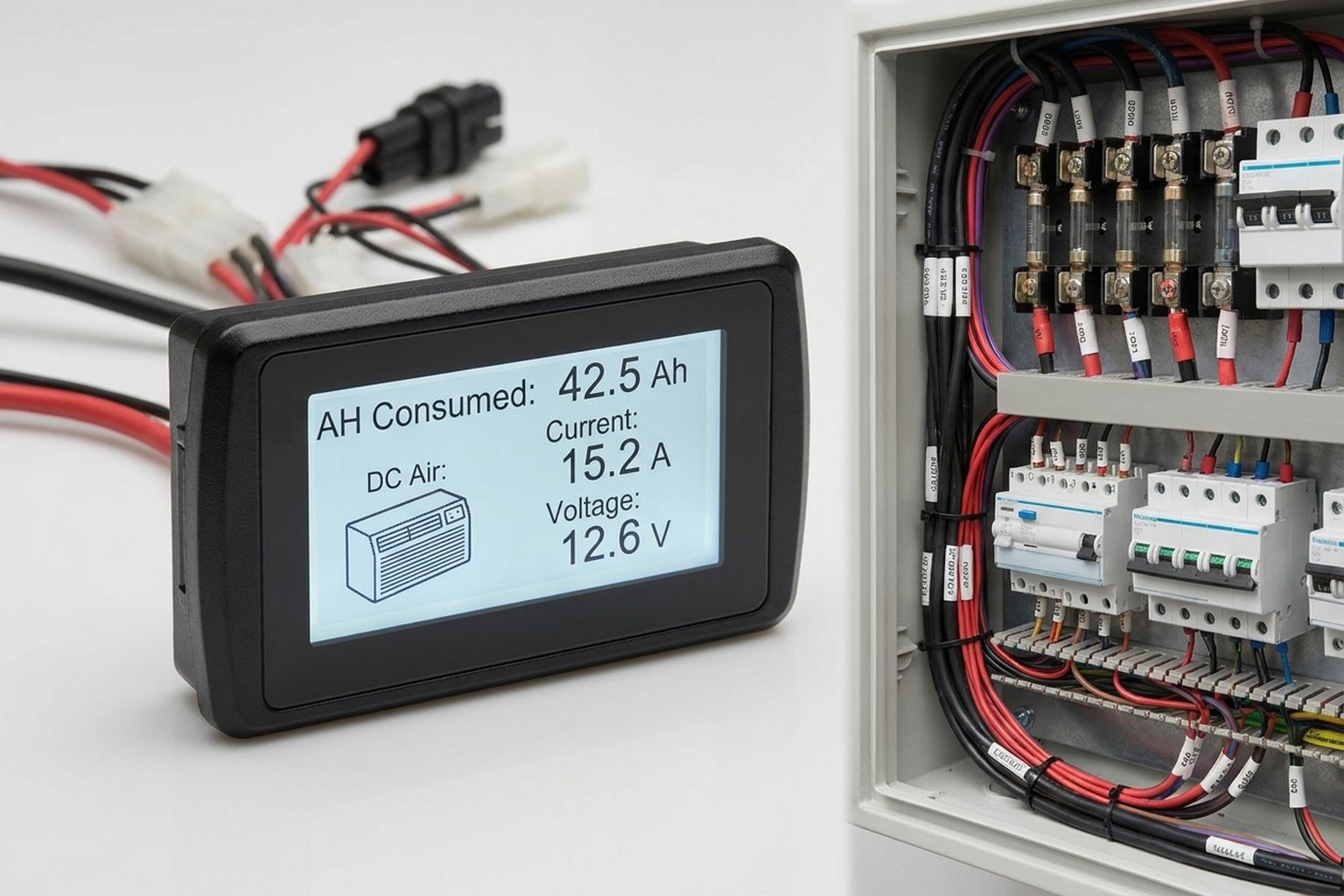
Runtime Comparison Table
The following table shows estimated runtime across different load conditions and battery types. All figures assume a 100Ah nominal battery capacity.
| Load Condition | Current Draw | LiFePO4 (80Ah usable) | AGM (50Ah usable) |
|---|---|---|---|
| Full load (max cooling demand) | 16A | 5 hours | 3 hours |
| Partial load (typical operation) | 10A | 8 hours | 5 hours |
| Light load (well-insulated, low delta-T) | 6A | 13 hours | 8 hours |
These are estimates. Actual runtime varies based on the factors discussed below. For AGM batteries, the Peukert effect further reduces effective capacity at higher discharge rates, making the real-world numbers slightly lower than the simple division suggests.
Variables That Affect Runtime
Understanding what moves the needle on battery life helps you design a system that hits your target runtime reliably.
Ambient Temperature
The greater the difference between outside ambient temperature and your target setpoint, the harder the compressor works. A unit maintaining 25°C inside an enclosure at 35°C ambient will draw significantly less current than the same unit holding 25°C against 50°C ambient. Every degree of additional temperature differential increases average current draw.
Enclosure Insulation
Insulation is the single most effective lever for extending battery life. A well-insulated enclosure with an R-value of 10 or higher dramatically reduces heat ingress, allowing the compressor to cycle less frequently. The difference between an uninsulated metal cabinet and a properly insulated enclosure can double or triple your runtime.
Internal Heat Load
Equipment inside the cooled space generates its own heat. Servers, power supplies, radio transmitters, and monitoring instruments all contribute thermal load that the air conditioner must overcome. Accurately calculating internal heat generation is essential for realistic runtime estimates.
Setpoint Temperature
A higher setpoint (say 30°C instead of 22°C) reduces the temperature differential and therefore the cooling demand. If your equipment tolerates higher temperatures, raising the setpoint is a simple way to extend battery life without any hardware changes.
Battery Chemistry and the Peukert Effect
LiFePO4 batteries deliver their rated capacity consistently across a wide range of discharge rates and maintain a flat voltage curve until nearly depleted. This makes runtime calculations straightforward and predictable.
Lead-acid batteries (AGM, gel, flooded) suffer from the Peukert effect: at higher discharge rates, effective capacity decreases non-linearly. A 100Ah AGM battery discharged at 16A may deliver significantly less than the 50Ah you calculated at 50% DoD. This effect is less pronounced at lower discharge rates, which is another argument for reducing average current draw through better insulation.
Voltage Sag and Cutoff
As batteries discharge, voltage drops. Most 12V DC air conditioners have a low-voltage cutoff to protect the battery (typically 10.5-11V for lead-acid, 10V for LiFePO4). The compressor may also lose efficiency as input voltage drops below nominal, particularly with lead-acid batteries that exhibit significant voltage sag under load.
Practical Strategies to Extend Runtime
Based on the variables above, here are engineering-level strategies to maximize how long your 12V air conditioner runs on battery power.
1. Insulate the Enclosure
This is the highest-impact, lowest-cost improvement. Use closed-cell foam insulation (XPS or polyiso) with a minimum R-value of 6 on all surfaces. Pay special attention to the roof if the enclosure is exposed to direct sunlight. Reflective radiant barriers on sun-facing surfaces provide additional benefit.
2. Reduce Solar Heat Gain
If the enclosure is outdoors, shade it. A simple sun shade or reflective paint on the exterior can reduce heat ingress by 30-40%. Orient the enclosure to minimize afternoon sun exposure on the largest surface area.
3. Choose LiFePO4 Over Lead-Acid
For the same weight and volume, LiFePO4 batteries deliver 60-80% more usable energy than AGM. The flat discharge curve means consistent voltage to the compressor throughout the discharge cycle, maintaining cooling efficiency. The higher cycle life (2000-5000 cycles vs 300-500 for AGM) also makes LiFePO4 more economical over the system lifetime despite higher upfront cost.
4. Add Solar Supplementation
Even a modest solar panel (100-200W) can significantly extend runtime by offsetting a portion of the current draw during daylight hours. A 200W panel in good sun conditions can produce 10-14A at 12V, potentially covering the entire average draw of the air conditioner during peak solar hours and recharging the battery for overnight operation.
5. Optimize the Setpoint
将温度设置在应用允许的最高范围内。大多数电子设备在 35-40°C 的温度下都能安全运行。如果您要冷却额定温度为 40°C 的仪器,将温控器设置为 35°C 而不是 25°C 可以节省 40% 或更多的能耗。
6. 最大限度减少电缆损耗
在 12V 和 16A 的条件下,即使是线路中很小的电压降也会造成显著的功率损耗。请使用合适规格的电缆(3 米以内的线路至少使用 6 AWG,更长的线路至少使用 4 AWG),并确保所有连接都干净牢固。在 16A 电流下,0.5V 的线路压降会浪费 8W 的功率——这些能量本可以延长您的设备运行时间。
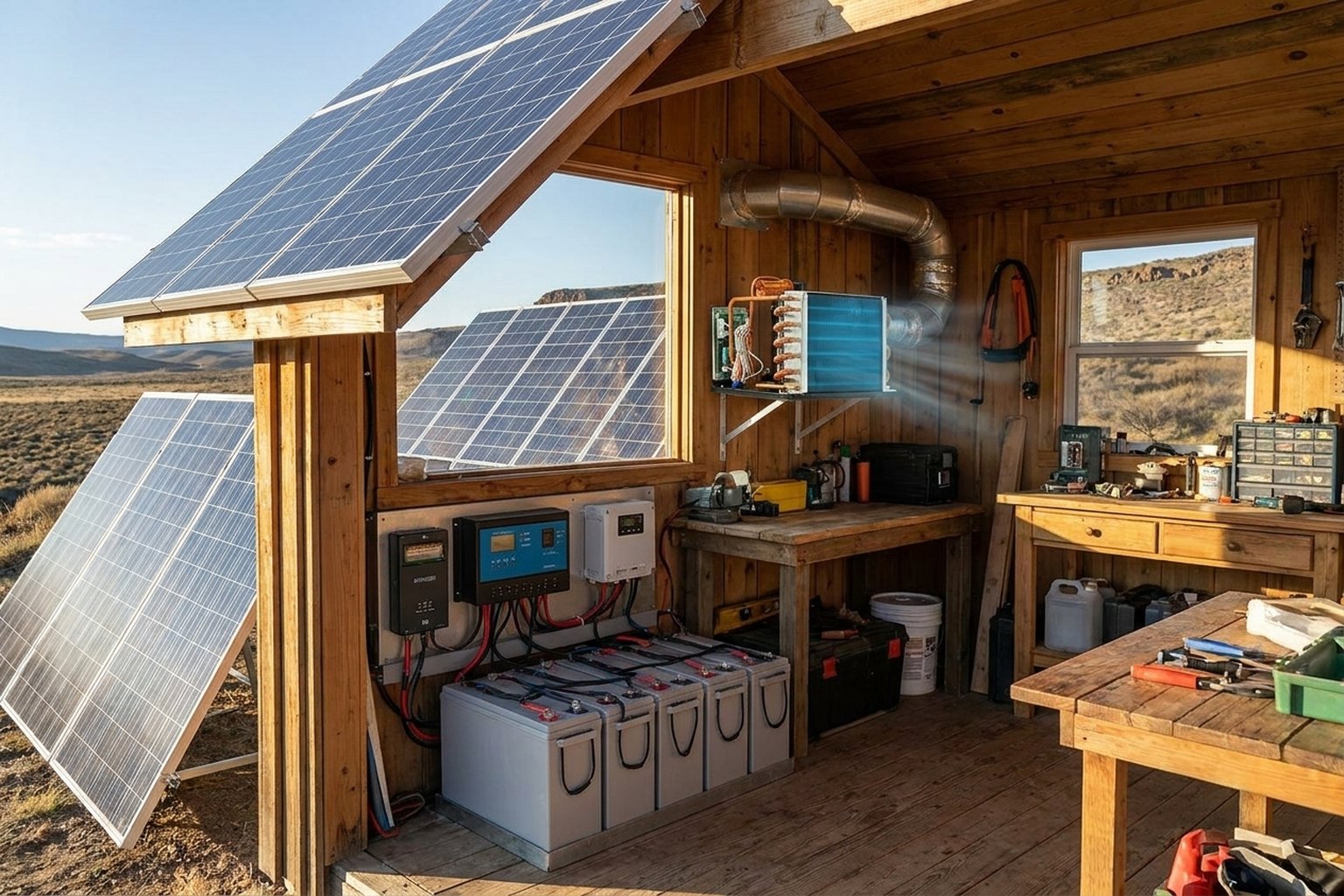
常见应用的系统容量规划
不同的应用程序有不同的运行时需求。以下是典型用例的计算方法。
远程监控站
适用于沙漠环境的防风雨外壳,用于容纳蜂窝调制解调器、传感器和数据记录器。内部电子元件产生的热负荷:30-50W。环境温度:最高 45°C。设定温度:35°C。
在良好的隔热和适宜的环境条件下,预计平均电流为 8-10 安培。一块 200 安时的磷酸铁锂电池组可提供 16-20 小时的自主制冷。配合 300 瓦的太阳能电池板,该系统可在夏季持续运行。
移动设备掩体
一种用于临时野外作业的拖车式仪器遮蔽棚。隔热性能中等,环境条件多变,部署窗口期为 8-12 小时。
100Ah 磷酸铁锂电池与 DV1910E-AC 搭配使用可提供 8-10 小时的制冷,足以满足一整天的工作需求。对于长时间部署,可使用第二块 100Ah 电池或小型发电机进行夜间充电,从而实现 24 小时运行。
便携式乐器箱
坚固耐用的外壳,用于容纳对温度稳定性要求极高的精密测量设备,确保其在运输和现场使用过程中保持稳定。该外壳内部容积小,隔热性能好,热负荷低。
紧凑的外形尺寸和低发热量使其在平均 5-6A 的电流下即可实现轻负载运行。100Ah 的电池可提供超过 13 小时的温度控制——足以满足一整天的野外作业需求。
电池组容量规划:从运行时间倒推
如果您有特定的运行时间要求,请反向计算公式以确定所需的电池容量:
所需容量 (Ah) = 目标运行时间 (小时) × 平均电流消耗 (A) / 放电深度
例如:使用 80% 放电深度的磷酸铁锂电池,平均电流约为 9A,需要 24 小时的冷却:
所需容量 = 24 × 9 / 0.8 = 270Ah
这意味着一个 300Ah 的磷酸铁锂电池组(通常由 3 个 100Ah 电池并联而成)就能满足这一要求,并且还有一些余量。
主要规格:微型直流空调 DV1910E-AC
| 范围 | 价值 |
|---|---|
| 工作电压 | 12V 直流 |
| 制冷能力 | 450瓦 |
| 最大工作电流 | 16A |
| 典型平均电流(部分负载) | 8-10A |
| 100Ah磷酸铁锂电池的预计运行时间 | 8-10小时 |
| 制冷剂 | R134a |
| 应用 | 设备外壳、防护罩、便携式箱子 |
有关详细规格和配置选项,请参阅完整的微型直流空调产品页面。。
电池续航时间计算中的常见错误
在确定系统容量时,请避免以下错误:
- 以铭牌电流作为平均电流。额定电流 16A 为最大值,并非典型值。正常情况下,实际平均电流约为该值的 40% 至 60%。
- 忽略放电深度。铅酸电池100%的容量使用会在几周内损坏。务必根据电池化学特性考虑合适的放电深度。
- 混淆了制冷能力和耗电量。450W的制冷能力指的是热输出。耗电量是指电压 × 电流(12V × 16A = 最大 192W)。
- 忽略佩克特效应。如果使用铅酸电池,在 16A 放电倍率下,其有效容量远小于电池上标示的 C20 容量。
- 先别管电缆和连接损耗。在12V系统中,线路中每损失十分之一伏的电压,都会减少压缩机可用的能量。
- 假设条件恒定。环境温度全天变化。夜间运行良好的系统在午后高温时段可能运行吃力。系统尺寸应考虑最不利的情况。
后续步骤:进行工程评估
本文中的估算结果为系统规划提供了一个可靠的起点,但每个安装项目都有其独特的变量。机柜几何形状、地理位置、季节性温度变化、内部热负荷和运行周期要求都会影响最终的系统设计。
如果您正在为设备保护、远程基础设施或移动应用指定电池供电的冷却系统,我们的工程团队可以根据您的具体参数提供详细的热分析和电池容量选择建议。我们与系统集成商、原始设备制造商 (OEM) 和项目工程师紧密合作,确保冷却解决方案与应用需求精准匹配。
请提供您的机柜尺寸、热负荷数据、环境温度范围和目标运行时间,以便我们进行详细评估。