
Shopping for a 12v air conditioner feels simple until you realize three completely different technologies share the same label. One uses a real compressor and refrigerant. Another relies on a thermoelectric chip. The third blows air through a wet pad and calls it cooling. All three appear in the same search results, at wildly different price points, making promises that range from honest to physically impossible.
This guide exists to sort that out. By the end you will understand exactly how each technology works, where it excels, where it fails, and which one deserves your money based on how you actually plan to use it. No brand-bashing, no hype—just the engineering reality behind each cooling method so you can buy with confidence in 2026.

Three Types of 12V Air Conditioner Technology You Need to Understand
Every 12v air conditioner on the market falls into one of three categories. The differences between them are not minor variations—they are fundamentally different approaches to heat management, each governed by different physics.
Vapor-compression (compressor-based) systems work exactly like your household refrigerator or window AC unit, just miniaturized. A compressor circulates refrigerant through a sealed loop: the refrigerant absorbs heat from indoor air at the evaporator, carries it to the condenser, and dumps it outside. This is genuine air conditioning—it removes heat and moisture from the air, producing a measurable temperature drop regardless of ambient humidity.
Thermoelectric (Peltier) coolers use a solid-state semiconductor chip that transfers heat from one side to the other when electricity flows through it. There are no moving parts in the cooling element itself, no refrigerant, and no compressor. The physics work, but the efficiency is extremely low compared to vapor compression. Most Peltier-based 12V units produce between 30 and 80 watts of cooling capacity—roughly one-tenth of what a small compressor system delivers.
Evaporative coolers (also called swamp coolers) pull air through a water-soaked pad or filter. As water evaporates, it absorbs heat from the air, lowering the temperature of the outgoing airstream. This works well in hot, dry climates where the air has capacity to absorb moisture. In humid environments, evaporation slows dramatically, and the cooler becomes little more than a fan blowing damp air.
Understanding these three categories is the single most important step in choosing the right 12v air conditioner. Everything else—price, size, brand, features—is secondary to whether the underlying technology can actually deliver cooling in your specific conditions.
Compressor-Based 12V Air Conditioning: The Gold Standard
Vapor-compression cooling is the only technology among the three that provides true air conditioning. It does not depend on ambient humidity levels, it can achieve and maintain a specific target temperature, and it actively dehumidifies the air as a byproduct of the cooling process.
Modern 12V compressor units use BLDC (brushless DC) inverter compressors that run natively on direct current. This is a critical distinction. Older designs required an inverter to convert 12V DC to AC power, wasting 10–15 percent of battery energy as conversion heat. A native DC compressor eliminates that loss entirely, which translates directly into longer battery runtime and quieter operation.
The inverter aspect matters equally. Unlike fixed-speed compressors that cycle between full power and off, inverter compressors modulate their speed continuously. When the space approaches the target temperature, the compressor slows down, current draw drops, and noise decreases. This variable-speed operation typically extends real-world runtime by 30–40 percent compared to fixed-speed equivalents on the same battery.
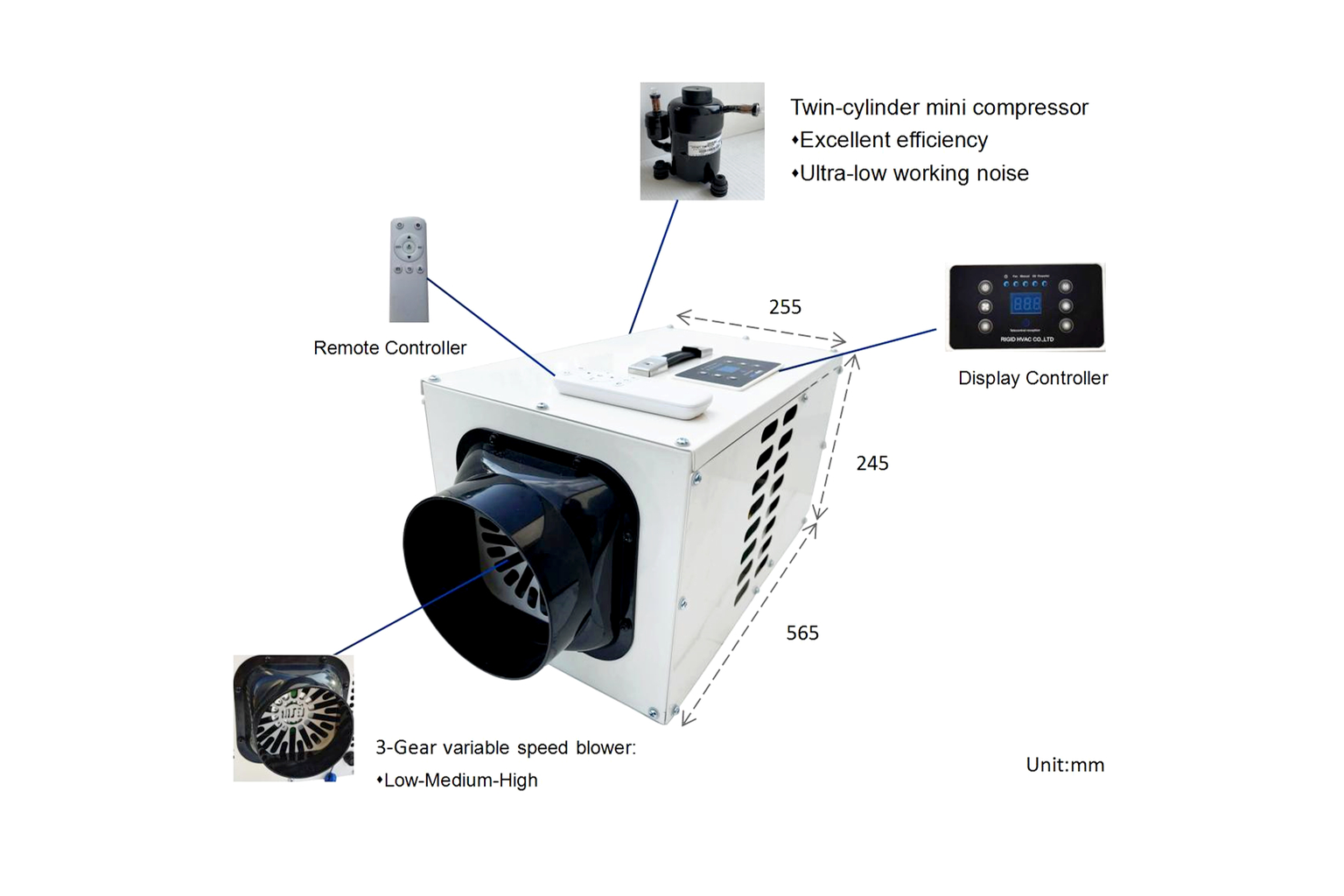
A typical high-quality 12V compressor unit—such as RIGID’s DV1910E-AC in the Micro DC Aircon line—delivers 450 watts of cooling capacity (approximately 1,535 BTU/h) while weighing just 5 kg (11 lbs). At full load the working current is around 16 amps, but during steady-state operation after initial cool-down, average draw typically drops to 10–12 amps thanks to inverter speed modulation.
What does 450W of cooling actually accomplish? In a well-insulated van or a shaded camping tent, expect a temperature reduction of 5–8°C (9–14°F) below ambient. In a smaller enclosed space like a vehicle cabin with windows covered, the differential can reach 10–12°C. These are real, measurable results that hold up regardless of whether the humidity is 20 percent or 90 percent.
The tradeoffs are honest: compressor systems cost more upfront, draw more current than the other two types, and require proper ventilation for the condenser to reject heat. But for anyone who needs actual temperature control—not just air movement—this is the only technology that reliably delivers.
Peltier Coolers: Why the Specs Look Good but the Reality Disappoints
Peltier-based 12V coolers are everywhere online, often marketed as “portable air conditioners” at attractively low prices. The technology is real—thermoelectric cooling does transfer heat from one surface to another. The problem is efficiency.
A Peltier module’s coefficient of performance (COP) typically ranges from 0.3 to 0.6, meaning for every watt of electricity consumed, it moves 0.3 to 0.6 watts of heat. Compare that to a vapor-compression system with a COP of 1.5 to 3.0—a compressor moves three to ten times more heat per watt of input power. This is not a design flaw that better engineering can fix; it is a fundamental limitation of the thermoelectric effect at these temperature differentials.
In practical terms, a Peltier cooler drawing 60 watts from your 12V battery produces roughly 20–35 watts of cooling capacity. That is enough to cool a small personal space by 2–3°C if you sit directly in the airstream, but it cannot meaningfully reduce the temperature of even a small tent or vehicle cabin. The hot side of the Peltier chip also generates waste heat that must be dissipated, and in an enclosed space, that rejected heat often offsets the modest cooling produced.
Peltier devices do have legitimate uses: cooling electronics enclosures, small medical sample containers, or beverage coolers where the temperature differential is small and the cooling load is minimal. As a personal comfort device on a scorching day, they offer marginal relief. As an air conditioner for a livable space, they consistently underdeliver relative to their marketing claims.
The buying trap is this: a Peltier unit at one-third the price of a compressor system seems like a bargain until you realize it produces one-tenth the cooling. Cost per watt of actual cooling capacity heavily favors the compressor.
Evaporative Coolers: Climate-Dependent and Often Misunderstood
Evaporative cooling is the oldest air cooling technology on Earth—humans have used wet cloth and wind for thousands of years. Modern 12V evaporative coolers automate this with a pump, a water reservoir, and a fan, but the physics remain identical.
The effectiveness of evaporative cooling is entirely determined by the wet-bulb depression—the gap between the air’s current temperature and the temperature it would reach at 100 percent humidity. In Phoenix, Arizona, where summer humidity often sits below 15 percent, an evaporative cooler can drop air temperature by 10–15°C. That is genuinely impressive and costs almost nothing in energy—typically 1–3 amps at 12V, since only a small pump and fan need to run.
The problem arises when humidity climbs above 40–50 percent. In Florida, the Gulf Coast, most of Southeast Asia, or anywhere near a coastline in summer, the wet-bulb depression shrinks to 2–4°C. The cooler still blows air, still evaporates water, but the temperature drop becomes almost imperceptible. Worse, it adds moisture to already humid air, making the space feel swampier rather than cooler.
Evaporative coolers also require a continuous water supply. A typical unit consumes 1–3 liters per hour depending on airflow and ambient conditions. For a weekend camping trip in the desert, that means carrying 20–40 liters of water solely for cooling—a significant logistical consideration.
If you live in or travel exclusively through dry climates, a 12V evaporative cooler offers exceptional energy efficiency and simplicity. For everyone else, it is a fan with extra steps.
How to Choose: Matching Technology to Your Actual Use Case
The right choice depends on three factors: your climate, your space, and your power budget.
Choose a compressor-based 12v air conditioner if: You need reliable cooling regardless of humidity. You are cooling an enclosed space like a van, RV cabin, tent, or equipment enclosure. You want thermostat-controlled temperature maintenance. You have a battery bank of 100Ah or more (lithium preferred). You operate in any climate, including coastal and tropical regions.
Choose an evaporative cooler if: You exclusively operate in dry climates with humidity consistently below 30 percent. You need maximum battery efficiency and low cost. You have access to water resupply. You are cooling open or semi-open areas where added humidity is acceptable.
Skip Peltier-based units for space cooling entirely. They serve niche applications in electronics and small-container cooling, but as a 12V air conditioner for human comfort in any space larger than a shoebox, the physics simply do not support the marketing.
For the majority of buyers—those who camp in varying climates, live in vans, need off-grid cooling for vehicles or small rooms, or require climate control for transported pets and equipment—a compressor-based system is the clear winner despite its higher initial cost. The total cost of ownership, measured in dollars per BTU of actual cooling delivered per battery cycle, favors compressor units by a wide margin.
Key Specs to Check Before You Buy
Once you have settled on the right technology type, these specifications separate quality units from disappointing purchases:
Cooling capacity in watts or BTU. This is the single most important number. For a 12V compressor unit, look for at least 400–500W (1,365–1,706 BTU/h) of cooling capacity. Anything significantly below this range will struggle to cool even a small enclosed space in warm conditions. Be wary of listings that state power consumption but not cooling capacity—they are hiding the number that matters.
Native DC operation. Verify the compressor runs directly on 12V DC without requiring a built-in or external inverter. Native DC operation preserves 10–15 percent of your battery energy and reduces system complexity. BLDC inverter compressors are the current best-in-class technology for this application.
Weight and dimensions. A 12V system you cannot easily transport defeats the purpose of portability. Quality compressor units now achieve the 5 kg (11 lb) range—light enough for one person to carry and compact enough to fit alongside standard camping or vehicle equipment.
Refrigerant pre-charge. Units that ship fully charged with refrigerant and compressor oil eliminate field servicing and potential refrigerant handling issues. This is standard on professional-grade units and a strong quality indicator.
Speed control options. Variable-speed operation via potentiometer, PWM, or analog voltage input allows you to tune the system for efficiency. A unit locked at a single speed wastes energy when cooling demand is low. Look for multiple control interfaces—especially if you plan to integrate with a thermostat or microcontroller for automated temperature management.
Airflow rating (CFM). The evaporator fan’s airflow determines how effectively cooled air reaches your space. For small enclosed areas, 25–30 CFM is adequate. Higher CFM ratings can indicate a unit designed for larger spaces but may also mean higher noise levels.
Common Mistakes That Waste Money
After reviewing hundreds of buyer complaints and forum discussions, the same mistakes appear repeatedly. Avoiding these will save you money and frustration:
Buying a Peltier device expecting room cooling. This is the most common and most expensive mistake per dollar of disappointment. The unit arrives, runs for an hour, the room is exactly the same temperature, and the buyer assumes all 12V air conditioners are scams. They are not—the buyer simply purchased the wrong technology.
Undersizing the battery. A compressor unit drawing 16 amps needs a battery that can sustain that current without excessive voltage sag. A 50Ah lead-acid battery at 50 percent safe discharge gives you barely 90 minutes of cooling. Match a 100Ah lithium (LiFePO4) battery minimum to any compressor-based 12v air conditioner for practical runtime.
Ignoring condenser ventilation. The condenser must reject heat to the outside environment. Placing the entire unit inside an enclosed space with no heat exhaust path means the condenser heats the same air the evaporator is trying to cool—net effect approaches zero. Always ensure the hot side vents outside your cooled space.
Using thin wire on long runs. At 16 amps on 12V, every fraction of a volt lost to wire resistance costs you runtime. Use 10 AWG or heavier wire for runs over two meters. Cheap, thin extension cords can waste 5–8 percent of your battery capacity as heat in the wiring alone.
Expecting household AC performance. A 12V unit cooling at 450W is not comparable to a 5,000 BTU window unit. It excels in small, defined spaces—a sleeping area, a vehicle cabin, an equipment enclosure. Set realistic expectations for the space you are cooling and the system will meet them consistently.
The Bottom Line for 2026
The 12v air conditioner market in 2026 is more capable and more confusing than ever. Battery technology has advanced to the point where lithium cells can sustain compressor-driven cooling for an entire night. BLDC inverter compressors have shrunk to a size and weight that would have seemed impossible a decade ago. But the market is also flooded with Peltier devices and evaporative coolers using the same “12V air conditioner” label, making it easy to spend money on something that cannot physically do what you need.
The decision framework is straightforward. If you need real, humidity-independent cooling in any climate—and most people do—choose a compressor-based system with a BLDC inverter compressor, native 12V DC operation, and at least 400W of cooling capacity. Pair it with a properly sized lithium battery, ensure good condenser ventilation, and the system will deliver years of reliable off-grid cooling for your van, tent, RV, or any other small space that needs it.
Skip the shortcuts. The physics have not changed, but the technology to work within those physics has never been better. Choose the right type first, then choose the right unit within that type, and your 12v air conditioner purchase will be one you never regret.