
Can a 12V Air Conditioner With the Engine Off Actually Run?
A 12V air conditioner with the engine off can run only when it is an independent electric cooling system and its battery, wiring, controls, and heat-rejection path remain available after charging stops. Switching off a vehicle’s engine-driven factory A/C normally stops its compressor. A separate DC air-conditioning module is a different installation: it can draw from a suitable auxiliary battery while the vehicle is parked. The useful question is therefore not just whether the unit says “12V,” but what supplies the entire cooling installation when the engine stops and what shuts it down first.
This guide is for compact vehicle and equipment-cabin installations using a DC cooling module. It focuses on the handoff from engine-running charging to parked battery operation. It does not estimate overnight runtime or promise to cool an entire truck cab. For the wider distinction between DC system types, see RIGID’s DC air conditioner guide.
Separate the Factory A/C From the Independent DC Unit
On many combustion-engine vehicles, the factory air-conditioning compressor depends on the engine. Its dashboard fan may still blow with the engine off, but moving air is not proof that the refrigeration circuit is cooling. An independent DC system has its own electrically driven compressor and a defined DC supply. Some vehicles have electrically driven factory A/C, so check the specific vehicle architecture rather than assuming every factory system is belt-driven. The key distinction is the actual compressor power path.
A parked cooler is a separate category for a reason. For example, Webasto describes its truck parking cooler as battery-operated while the vehicle is stationary. That example explains the architecture; its performance, control logic, and protection settings do not transfer to a RIGID module.
Before discussing battery size, identify the installed system on paper. Is the cooling unit a complete portable appliance, a factory electric A/C system, or an OEM module that needs the integrator to provide switches, ducts, protection, and heat rejection? A module specification cannot be treated as the specification for a finished vehicle installation.
Draw the Two Power Paths Before Choosing a Battery
The engine-running path usually includes a charging source and a means of feeding or charging the auxiliary battery. The parked path begins at stored energy: auxiliary battery, protective device, distribution, wiring, connector, and finally the air-conditioning assembly. A vehicle may use an isolator, a DC-DC charger, or another approved charging arrangement. Trace the installed circuit rather than assuming the alternator feeds the unit directly. Solar or shore charging may be present, but either one is a separate input whose actual contribution varies with the installation and conditions.
For a 12V air conditioner with the engine off, mark which components remain connected when the ignition turns off. Some vehicle circuits disconnect automatically; others remain live. A unit wired to an ignition-switched outlet can stop immediately even when the auxiliary battery is full. Conversely, a unit wired to a starting battery may continue operating while parked but leave too little reserve to start the vehicle. The desired parked behavior needs to be designed, documented, and tested, not inferred from a 12V label.
| Observation at engine shutdown | Likely area to check | First useful verification |
|---|---|---|
| Everything stops at once | Ignition-switched feed, relay, control enable, or missing auxiliary path | Check whether the unit input and control signal remain present after key-off. |
| Fan continues, cooling stops | Compressor supply, control state, protection, or heat-rejection problem | Check compressor enable and voltage at the module while a cooling call is active. |
| Cooling works briefly, then shuts down | Load voltage sag, energy reserve, current limiting, or protection event | Compare battery and unit-input readings at startup and just before shutdown. |
| Works while driving, fails only when parked | Charging handoff or parked supply path | Compare the same measurement points with engine running and stopped. |
This table narrows the search; it does not identify a fault by itself. A fan, a compressor, and a controller may have different feeds and operating states. Record what each part actually does during the transition.
Protect the Starting Battery and Define the Parked Supply
A starter battery and a deep-cycle auxiliary battery have different jobs. The installation should state which one supports cooling with the engine off and how the vehicle’s starting reserve is protected. If the two are linked during charging, confirm that the charging device or isolator behaves as intended when the engine stops. A connection diagram should also show the location of overcurrent protection, switching, and any low-voltage disconnect in the complete system.
Do not copy a cutoff number from a different cooler when configuring a 12V air conditioner with the engine off. The correct setting depends on the battery chemistry, battery-management system, cable losses, controller behavior, and the manufacturer’s instructions for the actual components. A cutoff seen at one point in the circuit may occur earlier at the cooler because of voltage drop. Battery state of charge estimates are also not interchangeable with a loaded terminal-voltage measurement. Protective shutdown should preserve the starting reserve and prevent operation outside the approved supply range; the integrator must establish how its own system accomplishes that.
If the installation uses a lithium auxiliary battery, the battery-management system may disconnect its output under conditions the cooler cannot diagnose. If it uses lead-acid, voltage recovery after the load is removed can make the battery look healthier than it was under load. In either case, a post-shutdown resting voltage alone cannot reveal the voltage that the air conditioner saw immediately before it stopped.
Measure the Handoff at the Battery and at the Air Conditioner
For a 12V air conditioner with the engine off, “it has 12 volts” is not a complete test. A nominal 12V system can have different actual voltages during charging, under compressor load, and after the load disconnects. Use the equipment maker’s allowable input range, not a generic nominal number, to interpret each reading. If access to live vehicle wiring is unsafe or outside your scope, have a qualified installer perform the measurements.
Record the same readings with the engine charging, immediately after key-off, during compressor startup, during steady cooling, and just before any unwanted stop: voltage at the auxiliary battery terminals, voltage at the cooling module input, and the state of the control or enable circuit. Record current for the complete installed assembly where the test setup permits. These measurements separate available stored energy from loss in the path between battery and unit.
If battery voltage remains within the battery supplier’s permitted loaded range but the module input falls sharply, look between those points: connectors, switches, fuse holders, cable length, return path, and contacts. If both voltages collapse together, review the battery’s condition, state of charge, battery-management output, and total concurrent loads. If voltage remains acceptable at the unit but the compressor does not start, shift attention to controls, fault indications, and the cooling module itself. Measure at the load while it is trying to cool; an unloaded reading can hide a poor connection.
A clamp meter can help reveal current changes, but its reading needs context. Measure the appropriate conductor, note whether the fan and compressor are both operating, and distinguish a transient start event from steady operation. Do not add up nameplate figures from different components and assume the result captures every startup or protection event. If the system has a manufacturer diagnostic output, record that alongside the electrical readings.
Size the Complete Installation, Not the Published Cooling Capacity
RIGID lists its DV1910E-AC (Pro) Micro DC Aircon as a 12V DC spot-cooling module with 450W cooling capacity. That 450W is cooling capacity, not a claim of 450W electrical draw. The same product page lists working current for the model, but a module figure should not be silently promoted into the power budget for a finished vehicle system. Controls, fans, charging losses, and other installed loads must be accounted for at the relevant boundary. The unit is described for small or confined spaces; a whole-cab cooling result is not implied.
For a 12V air conditioner with the engine off, start a power budget by naming every powered part and identifying what the published figure includes. Then verify actual input while the assembled system operates through its required modes. The continuous supply rating must support the expected load, while the battery, wiring, distribution equipment, and protective devices must tolerate the behavior observed during startup and changes in compressor speed. A capacity estimate in amp-hours is incomplete without battery voltage, usable energy under the battery manufacturer’s limits, and all concurrent loads.
Battery runtime is a separate calculation, and it changes with heat load, ambient temperature, setpoint, compressor operation, battery condition, and recharge availability. For a detailed runtime investigation, use RIGID’s overnight DC air-conditioner troubleshooting guide. Here, the first decision is whether the parked supply path works correctly at all.
Check Controls and Heat Rejection Before Blaming the Battery
A powered fan does not guarantee that the compressor has been commanded to run. RIGID describes the Micro DC Aircon as a subsystem and says the customer supplies the on/off switch for its installation. In an OEM build, the control wiring and the cooling call need to match the delivered unit documentation. Avoid bypassing an enable circuit or protective device merely to keep the compressor running after key-off.
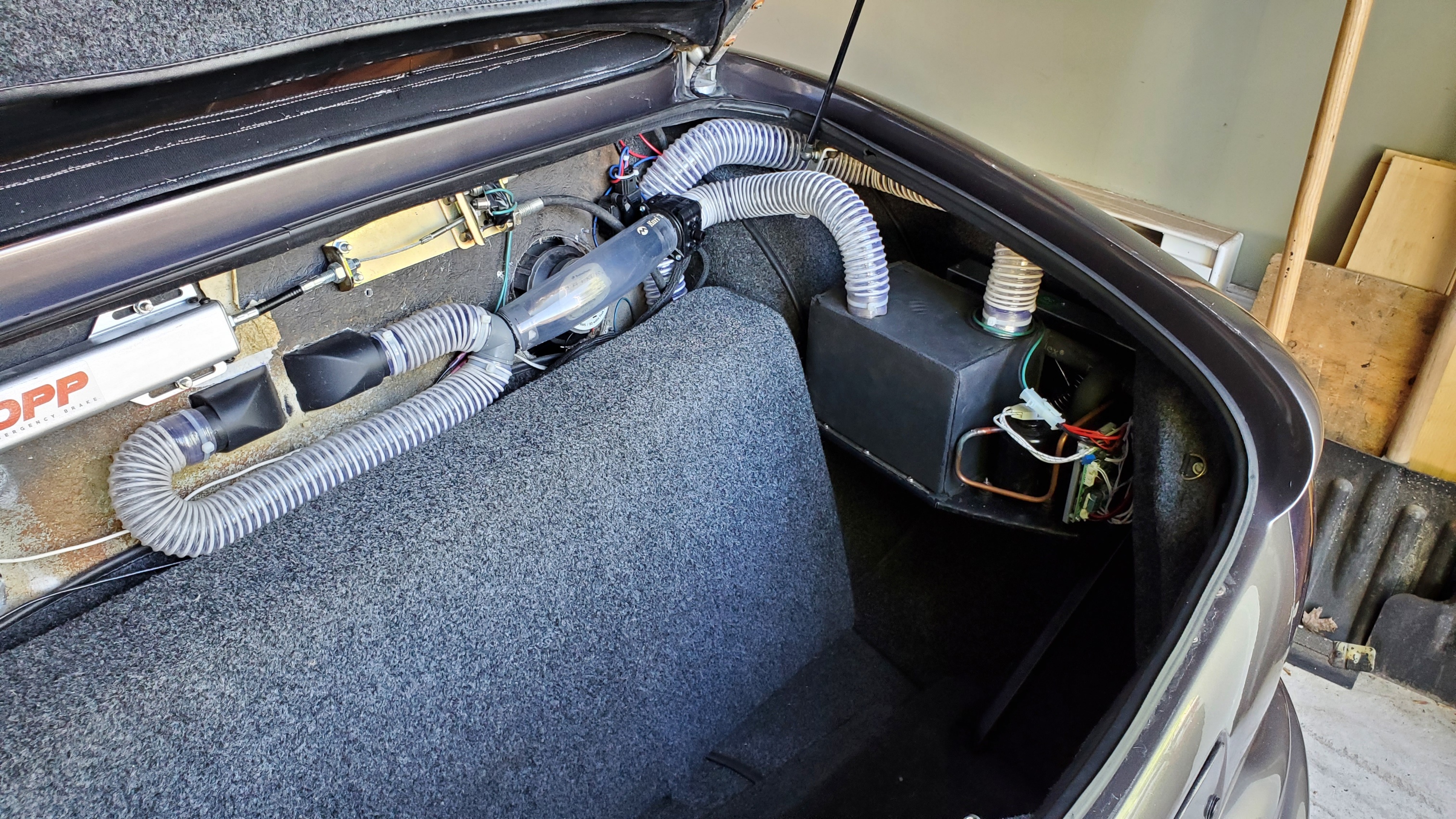 The refrigeration circuit must also reject heat outside the space being cooled. RIGID’s product FAQ calls for a heat-emission opening and allows flexible tubes to connect the unit. If hot exhaust is trapped, or intake and exhaust air recirculate, the installation can underperform even with a healthy battery. Duct restrictions, blocked condenser airflow, and poor condensate management are mechanical issues; voltage readings alone cannot rule them out. Check the actual air path and mounting before increasing battery capacity.
A failure of a 12V air conditioner with the engine off may still be thermal rather than electrical. The engine-running condition can change vehicle airflow and ambient heat around the condenser. Compare the installation under similar cooling loads and record both supply voltage and air-path condition. Do not attribute every engine-off shutdown to low battery voltage without observing the fault as it happens.
Use a Controlled Engine-Off Commissioning Test
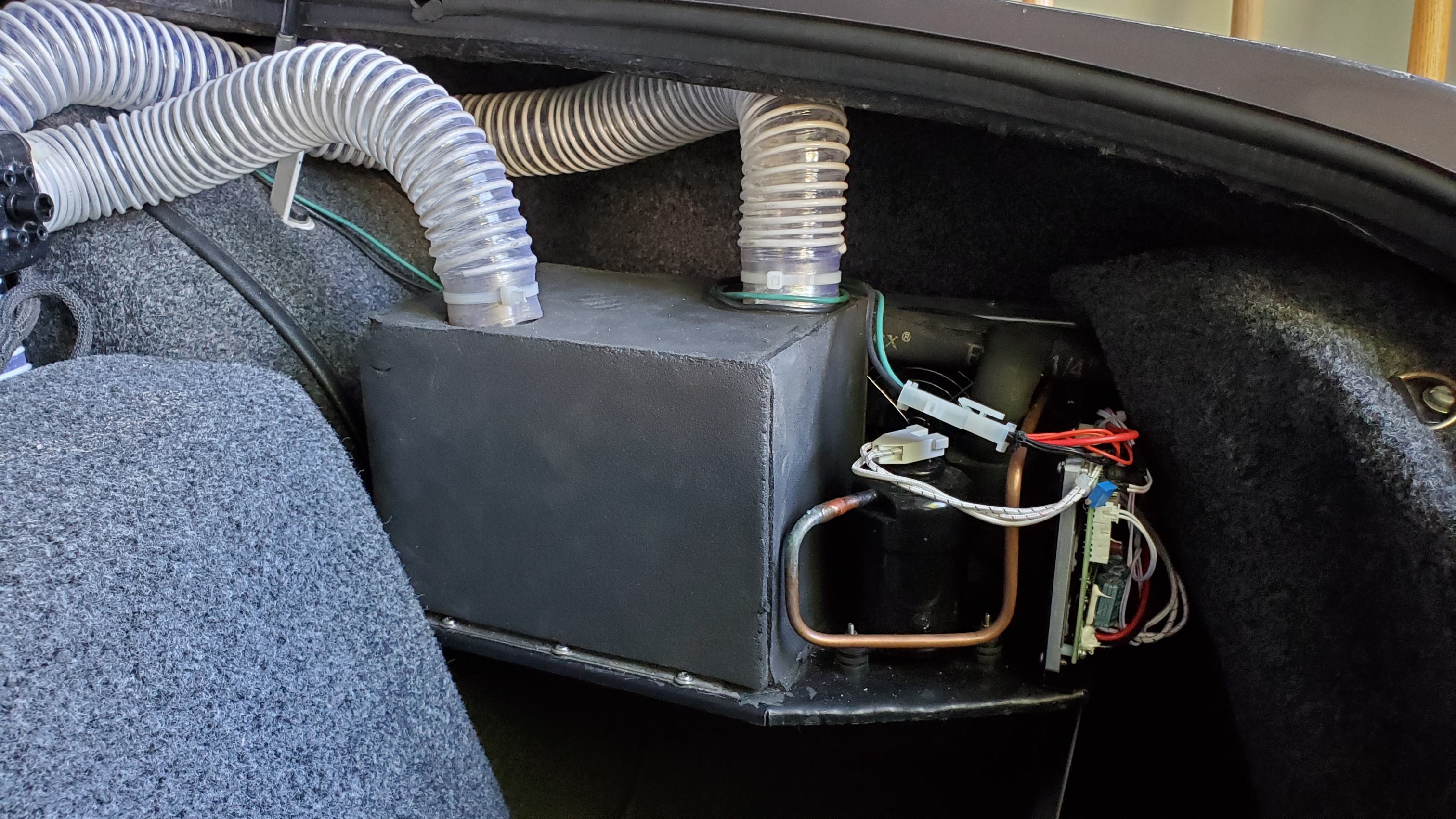 Before approving a parked installation, confirm the battery, protective devices, control wiring, and heat-rejection path against the actual manuals for all supplied components. Begin with the battery charged as specified by its maker and the vehicle in a safe, ventilated test location. Run the cooling system while charging, then turn the engine off without changing the cooling request. Note whether fans, compressor, controls, and any charger or relay change state. Record the three voltage points and total input current in each state.
Next, operate long enough to observe a representative load and, where safe and permitted by the component manufacturers, the designed low-energy stop behavior. Do not deliberately deep-discharge a battery or defeat protection to make a demonstration last longer. Repeat after the system cools if the fault depends on temperature. Log ambient conditions, other active vehicle loads, and any warning codes, because an apparently intermittent event often tracks one of those changes.
For handover, give the operator a simple description of what may run while parked, which battery it uses, what the expected shutdown indication looks like, and how the battery recharges. Keep the measured as-built values with the wiring documentation. Those records let a later technician compare a new fault with a known-good transition instead of guessing from a “12V” sticker.
Decide Whether the Module Fits the Job
A 12V air conditioner with the engine off is a reasonable project when the cooling load is small enough for the chosen module and the independent battery system is designed for the parked duty. For a compact enclosure, small cabin zone, or equipment compartment, a Micro DC Aircon may be a candidate. Its published capacity does not establish comfort in a particular vehicle, and a product photograph does not show the battery, switching, ducts, or controls that the installation still needs.
Prepare the cooling target, enclosure dimensions, heat load, ambient conditions, available battery and charging architecture, required parked operation, and proposed air path before asking for a fit check. If the requirement is a full vehicle cabin, present that requirement explicitly so a different system category can be evaluated. Ask RIGID to review the intended application and module selection using those details.
Frequently Asked Questions
Can my car’s factory 12V air conditioner cool with the engine off?
That depends on the vehicle’s A/C architecture. A conventional engine-driven compressor stops when its engine stops, even if a dashboard fan still runs. An electrically driven factory system may behave differently; use the vehicle manufacturer’s instructions. This article addresses a separate DC cooling installation.
Will a bigger auxiliary battery fix an air conditioner that stops at key-off?
Only if the installed path actually feeds the cooler from that battery and the problem is insufficient usable energy. An ignition-switched feed, missing enable signal, open isolator path, bad connection, or protective shutdown will not be fixed by capacity alone. Compare the battery and unit-input readings during the failure.
Is the Micro DC Aircon’s 450W rating its electrical power draw?
No. RIGID identifies 450W as cooling capacity for the 12V DV1910E-AC (Pro). Electrical demand for the complete installation must be established from the applicable component information and measurements at the assembled system boundary.
What low-voltage cutoff should I set for engine-off cooling?
There is no universal setting for every battery and cooler. Follow the battery, battery-management, and cooling-component manufacturers’ limits; account for voltage drop and preserve starting reserve. Verify the behavior at the battery and at the cooling unit under load.
Why does the fan run while the compressor does not?
The fan and compressor can have different control or supply conditions. Check the cooling call, enable circuit, module-input voltage during attempted start, fault indication, and condenser air path. A running fan alone does not establish that the refrigeration circuit is operating.