
TL;DR: A 12V air conditioner lets you cool small enclosed spaces — sleeping pods, pet crates, boat cabins, electronics enclosures — directly from a vehicle or solar battery without an inverter. This guide helps you decide whether a 12V DC unit fits your application, how to size it correctly, and which specs matter most for vehicles, boats, and off-grid setups.
Who This Guide Is For: Van lifers, boat owners, off-grid solar users, and vehicle modifiers who need compact cooling that runs directly from a 12V battery bank.
Key Decision Checklist Before You Buy a 12V Air Conditioner
- ☐ What is the volume of the space you need to cool? (Under or over 2 cubic meters?)
- ☐ What is your available battery capacity in amp-hours?
- ☐ How many hours of continuous cooling do you need per cycle?
- ☐ Is the space insulated? (Uninsulated spaces lose cooling rapidly)
- ☐ Do you need cooling below 20°C (68°F) or just comfort reduction?
- ☐ Is weight a constraint? (Roof-mounted vs. floor-mounted)
- ☐ What is your maximum current draw budget at 12V?
- ☐ Do you need variable speed control or fixed output?
What Is a 12V Air Conditioner and How Does It Work?
A 12V air conditioner is a vapor-compression refrigeration system that operates directly from a 12-volt DC power source. Unlike conventional AC units that require 120V or 240V mains power (and therefore an inverter when running off batteries), a true 12V unit uses a brushless DC (BLDC) compressor that connects straight to your battery bank.
The refrigeration cycle is identical to household air conditioning: a compressor pressurizes refrigerant (typically R134a), the condenser releases heat outside, an expansion valve drops pressure, and the evaporator absorbs heat from your interior space. The difference is scale and power source — these units are engineered for spaces measured in cubic feet rather than square meters.
This direct-DC approach eliminates inverter losses (typically 10-15% efficiency penalty), reduces system complexity, and removes a common failure point. For battery-powered applications, that efficiency gain translates directly into longer run times.
Where 12V Air Conditioners Work Well — and Where They Don’t
Suitable Applications
- Sleeping pods and single-person rest areas — Truck driver sleeper inserts, van life sleeping quarters with insulation
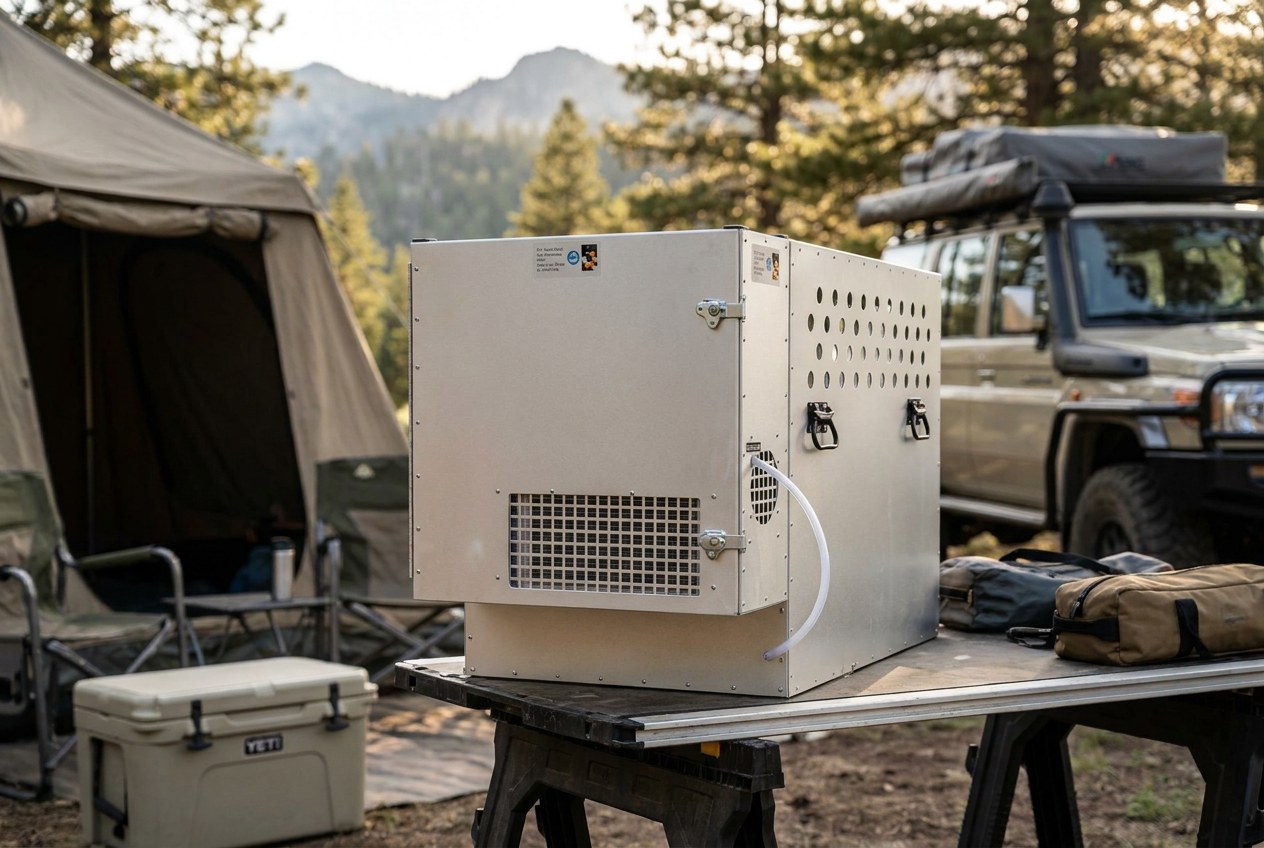
- Pet cooling enclosures — Dog crates, pet transport boxes in vehicles
- Small boat cabins — Sailboat quarter berths, center console helm stations
- Electronics and instrument enclosures — Telecom cabinets, outdoor sensor housings
- Medical equipment cooling — Portable diagnostic devices, sample transport
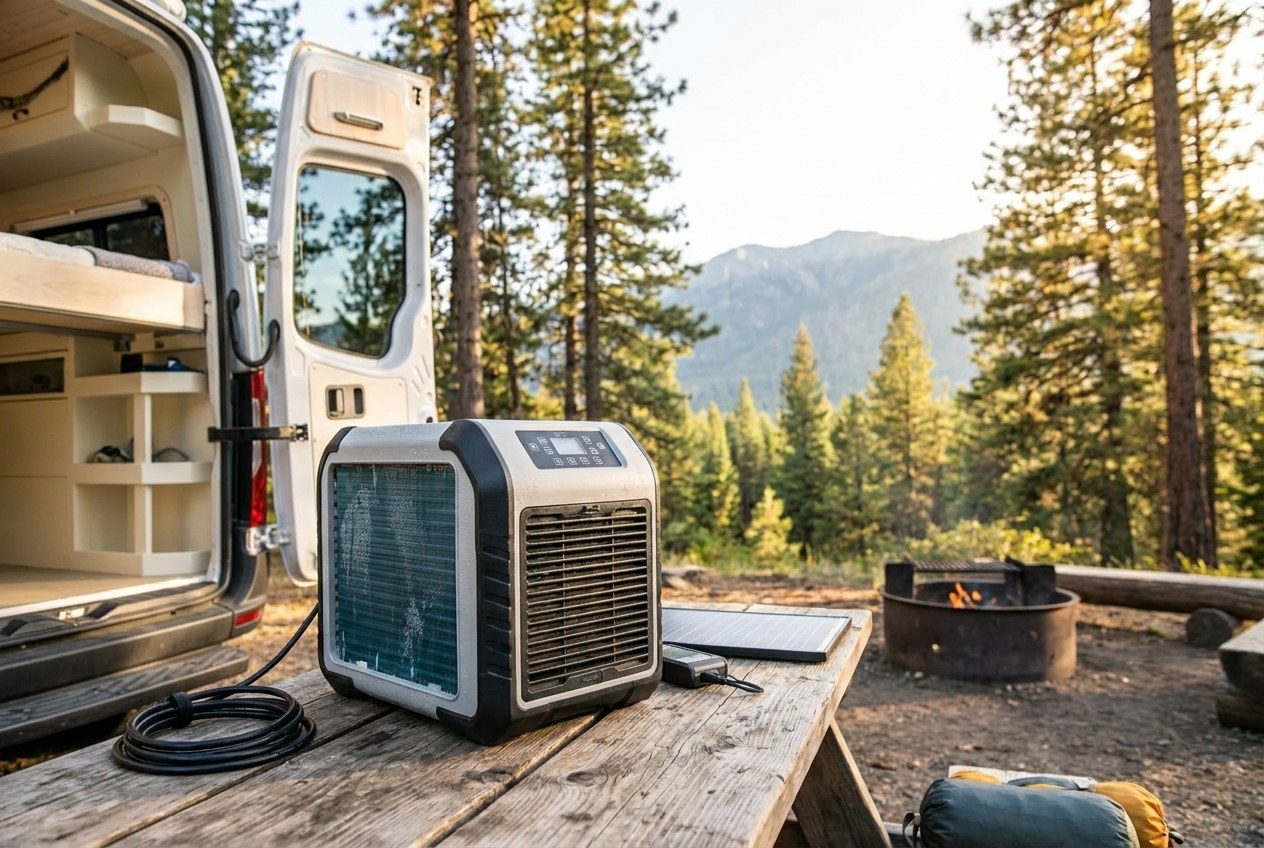
- Off-grid solar cabins — Small insulated spaces with adequate solar generation
Not Suitable For
- Full truck cabs or RV interiors — These spaces exceed 2 cubic meters and need 2,000W+ cooling capacity
- Uninsulated metal enclosures in direct sun — Heat gain will exceed cooling capacity
- Spaces requiring rapid pulldown from extreme temperatures — 450W cooling is gradual, not instant
- Primary cooling for occupied spaces over 60 cubic feet — Supplemental use only at this scale
Sizing a 12V Air Conditioner: The Math That Matters
Proper sizing prevents the two most common complaints: the unit runs constantly without reaching target temperature, or the battery dies before morning.
Step 1: Calculate Heat Load
For a small enclosed space, estimate heat gain from three sources:
- Conduction through walls: Approximately 10-30W per square meter of surface area (depending on insulation R-value)
- Occupant heat: One person at rest generates roughly 70-80W
- Solar gain: Direct sun on an unshaded metal surface adds 200-500W per square meter
A well-insulated sleeping pod (1.5m × 0.8m × 0.6m) with one occupant typically presents a heat load of 150-250W. A 450W cooling capacity unit handles this with margin.
Step 2: Calculate Battery Runtime
At 12V with 16A draw, a 12V air conditioner consumes approximately 192W at full load. With variable speed control, average consumption drops to roughly 100-130W during steady-state operation after initial pulldown.
Runtime formula (approximate): Hours = (Battery Ah × 12V × 0.8 DoD) ÷ Average Watts
Example: A 100Ah lithium battery at 80% depth of discharge provides roughly 960Wh usable. At 120W average draw, that yields approximately 8 hours of cooling — enough for a full night of sleep.
Step 3: Match to Application
Rule of thumb (approximate): You need roughly 150-200W of cooling capacity per cubic meter of well-insulated space. For poorly insulated spaces, double that figure.
Send us your space dimensions, insulation type, and target temperature, and our engineering team can calculate the exact heat load and recommend the right configuration for your build.
Key Specifications to Compare
When evaluating 12V air conditioner options, these specifications determine real-world performance:
| Specification | What It Means | What to Look For |
|---|---|---|
| Cooling Capacity (W or BTU) | Total heat removal rate | Match to calculated heat load with 20% margin |
| COP (Coefficient of Performance) | Cooling output ÷ electrical input | 2.0 or higher; 2.5 is strong for micro units |
| Working Current (A) | Maximum draw at rated voltage | Must not exceed wire gauge and fuse rating |
| Refrigerant Type | R134a (standard) or R290 (propane, higher efficiency) | R134a for simplicity; R290 for slightly better COP |
| Compressor Type | BLDC variable speed vs. fixed speed | Variable speed for battery life and noise |
| Weight | Total system weight including condenser | Under 6kg for portable/roof applications |
| Noise Level | Measured at 1 meter | Under 45dB for sleeping applications |
12V Air Conditioner Selection Matrix
| Application | Space Volume | Cooling Need | Recommended Model | Why This Fits |
|---|---|---|---|---|
| Van sleeping pod | 0.5-1.5 m³ | 150-300W | DV1910E-AC (12V, 450W) | Sufficient capacity with margin; 5kg weight suits roof or wall mount |
| Pet transport crate | 0.2-0.5 m³ | 80-150W | DV1910E-AC (12V, 450W) | Oversized for fast pulldown; variable speed reduces to maintenance level |
| Small boat cabin | 1.0-2.0 m³ | 200-400W | DV1910E-AC (12V, 450W) | Marine-grade DC operation; no inverter needed on 12V boat systems |
| Electronics enclosure | 0.1-0.3 m³ | 50-200W | DV1910E-AC (12V, 450W) | Precise temperature control via variable speed; compact footprint |
| Off-grid solar cabin (small) | 1.5-2.0 m³ | 300-450W | DV1910E-AC (12V, 450W) | Matches typical 12V solar bank; direct DC eliminates inverter loss |
| Truck sleeper insert | 1.0-1.5 m³ | 200-350W | DV1910E-AC (12V, 450W) | Runs from truck battery during rest; 16A draw within alternator budget |
| Large RV interior | 5+ m³ | 1500W+ | Not suitable — need higher capacity system | 450W cannot overcome heat load in large unpartitioned spaces |
Installation Considerations for Different Platforms
Vehicles (Vans, Trucks)
- Mount condenser where airflow is available — roof vents, exterior wall, or ducted to outside
- Use 10 AWG minimum wire for 16A at 12V over runs longer than 3 feet
- Install a 20A fuse within 12 inches of the battery positive terminal
- Vibration-isolate the compressor unit with rubber mounts
- Ensure condensate drainage path is clear and directed outside
Boats
- Marine environments require corrosion-resistant mounting hardware (316 stainless)
- Condenser needs raw water cooling or adequate ventilation in engine compartment
- Wire connections must be tinned copper with heat-shrink terminals
- Consider a dedicated battery for AC to avoid depleting house bank
Off-Grid Solar
- Size solar array to replace consumed energy: 192W draw needs approximately 400W of panels (accounting for 4-5 peak sun hours)
- A charge controller with load output can manage the AC unit directly
- Timer controls help limit operation to peak heat hours only
Cost Considerations
The DV1910E-AC 12V micro air conditioner unit is priced in the range of $580-$600 for the base unit. Total installed cost depends on your application:
| Component | Typical Cost Range | Notes |
|---|---|---|
| DV1910E-AC unit | $580-$600 | Complete with compressor, condenser, evaporator |
| Wiring and fusing | $30-$80 | Depends on run length and wire gauge |
| Mounting hardware | $20-$60 | Application-specific brackets and isolators |
| Thermostat/controller | $15-$50 | Optional; unit has built-in variable speed |
| Additional battery capacity | $200-$600 | If existing bank is undersized for runtime needs |
Compared to running a generator to power a conventional AC unit, the payback period is typically 6-12 months in fuel savings alone — not counting reduced maintenance and noise elimination.
Send us your application details and budget constraints, and our engineering team can spec a complete system with all required components and wiring.
12V vs. 24V vs. 48V: Which Voltage Is Right?
| Factor | 12V System | 24V System | 48V System |
|---|---|---|---|
| Common in | Cars, small boats, basic solar | Trucks, larger boats, mid solar | Large solar, telecom, EV |
| Wire size for 450W | 10 AWG (16A) | 14 AWG (8A) | 18 AWG (4A) |
| Voltage drop concern | High — keep runs short | Moderate | Low |
| Battery options | Widest availability | Good availability | Growing availability |
| Matching RIGID model | DV1910E-AC ($580-$600) | DV1920E-AC ($590-$650) | DV1930E-AC ($600-$620) |
If your existing system is 12V, stay at 12V. The efficiency difference between voltages at this power level is minimal compared to the cost and complexity of voltage conversion.
Maintenance and Longevity
BLDC compressor-based 12V air conditioners have fewer wear components than belt-driven or generator-powered alternatives:
- Monthly: Clean or replace air filters on evaporator intake
- Quarterly: Inspect condenser fins for debris; clean with compressed air
- Annually: Check refrigerant charge (sealed system, loss indicates leak); inspect electrical connections for corrosion
- Every 2-3 years: Replace condensate drain tubing if degraded
Expected compressor life for BLDC units in intermittent-duty applications: 10,000-20,000 hours (approximately 5-10 years of typical use). The sealed refrigerant circuit means no annual recharging is needed under normal conditions — if you notice reduced cooling performance, it typically indicates a slow leak at a fitting or connection point rather than normal consumption.
For marine installations, pay extra attention to electrical connections. Salt air accelerates corrosion on exposed terminals, so inspect and re-apply dielectric grease to all connections every 3-6 months. Use tinned copper ring terminals and heat-shrink with adhesive lining for all permanent connections in marine environments.
Frequently Asked Questions
How long will a 12V air conditioner run on a 100Ah battery?
At average steady-state consumption of approximately 120W (after initial pulldown), a 100Ah lithium battery at 80% depth of discharge provides roughly 8 hours of cooling. Lead-acid batteries should only discharge to 50%, reducing runtime to approximately 5 hours.
Can a 12V air conditioner cool an entire van?
A standard cargo van interior (8-12 cubic meters) exceeds the practical capacity of a 450W unit. However, if you partition a sleeping area to under 2 cubic meters with insulated curtains or panels, a 12V unit can maintain comfortable sleeping temperatures.
What size solar panel do I need to run a 12V air conditioner?
To offset the energy consumed during daytime operation (approximately 192W peak, 120W average), you need roughly 300-400W of solar panels. This accounts for panel efficiency losses and provides charging margin for nighttime use.
Is a 12V air conditioner quieter than a generator?
Significantly. A BLDC compressor unit operates at 35-45 dB at one meter — comparable to a quiet conversation. A portable generator typically produces 60-75 dB. For sleeping applications, this difference is substantial.
Do I need an inverter to run a 12V air conditioner?
No. A true DC air conditioner connects directly to your 12V battery bank. This is one of its primary advantages — no inverter means no conversion losses, no additional equipment cost, and no inverter noise or failure risk.
What refrigerant does a 12V micro air conditioner use?
The DV1910E-AC uses R134a refrigerant, which is widely available and serviceable. RIGID also offers R290 (propane) variants for applications where slightly higher efficiency is preferred, though R290 requires additional safety considerations in enclosed spaces.
Can I install a 12V air conditioner myself?
Yes, for most vehicle and boat applications. The unit requires mounting, 12V DC wiring with appropriate fusing, and routing of condensate drainage. No refrigerant work is needed — the system ships pre-charged and sealed. Basic electrical and mechanical skills are sufficient.
How does a 12V air conditioner compare to a swamp cooler?
Evaporative (swamp) coolers add humidity and only work in dry climates. A 12V vapor-compression air conditioner actually removes humidity while cooling, works in any climate, and achieves lower temperatures. The tradeoff is higher power consumption — a swamp cooler draws 2-5A versus 16A for a compressor unit.
What wire gauge do I need for a 12V air conditioner?
For the DV1910E-AC drawing 16A at 12V, use 10 AWG wire for runs up to 10 feet (3 meters). For longer runs, step up to 8 AWG to keep voltage drop under 3%. Always fuse at 20A within 12 inches of the battery.
Can a 12V air conditioner keep pets safe in a parked vehicle?
Yes, for small enclosed pet crates (under 0.5 cubic meters). The unit can maintain temperatures at or below 20°C (68°F) in a well-insulated pet enclosure. However, always use a temperature monitor with alerts as a safety backup, and never rely solely on any single cooling system for unattended animals.
Making Your Decision
A 12V air conditioner is the right choice when you need genuine refrigeration cooling in a small, defined space powered by a DC battery system. It excels in applications where weight, efficiency, and simplicity matter more than raw cooling power.
The key question is whether your space and heat load fall within the unit’s capability envelope: approximately 2 cubic meters of insulated space with a heat load under 450W. If yes, a 12V DC unit like the DV1910E-AC Micro DC Aircon delivers reliable, efficient cooling without the complexity of generators or inverters.
If your application falls outside these boundaries — larger spaces, higher heat loads, or extreme ambient temperatures — consider stepping up to a 24V or 48V system with higher capacity, or using multiple units in a zoned configuration.
Send us your specific application requirements — space dimensions, ambient conditions, available battery capacity, and runtime needs — and our engineering team can confirm whether a 12V solution fits or recommend the right alternative.