
Here’s a number that keeps showing up in off-grid forums: 58%. That’s the percentage of RV owners who say their air conditioning situation is their single biggest source of frustration. Not the plumbing. Not the leveling jacks. The cooling.
It makes sense when you think about it. Most RV and van cooling systems were designed for a world where you’re always plugged into shore power or running a generator. The moment you want to boondock, park at a trailhead, or just sleep through a summer night without a rumbling generator, the whole setup falls apart.
A 12v air conditioner changes that equation. Instead of converting your battery’s DC power to AC (and losing 15–20% in the process), a DC-native unit runs directly from your battery bank. No inverter. No conversion losses. No generator required.
This guide covers everything you need to make an informed decision: how DC cooling actually works, how to size a unit for your space, what the battery math looks like, and where the technology fits (and doesn’t fit) in real-world applications.
What Makes a 12V Air Conditioner Different from Conventional AC
Let’s start with the engineering basics, because understanding the difference matters more than any marketing spec sheet.
A conventional RV rooftop air conditioner runs on 120V AC power. It draws somewhere between 1,200 and 1,800 watts, requires either shore power or an inverter/generator setup, and typically delivers 11,000–15,000 BTU. These units work well when you’re at a campground with a 30-amp hookup. They’re essentially miniature versions of your home AC.
A 12v air conditioner operates on a fundamentally different principle. The DC compressor inside the unit connects directly to your 12-volt battery bank—the same system that powers your lights, water pump, and USB outlets. There’s no power conversion step. The electrons flow from battery to compressor without any intermediary.
Why does this matter? Every time you convert DC battery power to AC through an inverter, you lose energy. A good inverter operates at 85–90% efficiency. A mediocre one drops to 80%. That means for every 1,000 watts your AC unit draws, your batteries are actually discharging 1,100–1,250 watts. Over a full night of cooling, those losses add up to hours of runtime you’ll never get back.
A DC-native system eliminates that conversion loss entirely. The micro DC aircon technology inside these units uses a variable-speed DC compressor that adjusts its output to match the cooling load. When the space is close to your target temperature, the compressor slows down and sips power. When you first turn it on in a hot van, it ramps up to full capacity.
This variable-speed operation is the second major advantage. Traditional AC units are binary—full blast or off. They cycle on, blast cold air, cycle off, let the temperature drift up, then blast again. Each startup surge draws 3–5x the running current. A DC compressor ramps smoothly, avoiding those surges entirely.
Sizing a 12V Air Conditioner: BTU, Space, and Real-World Expectations
This is where most buyers go wrong, and where honest engineering matters more than optimistic marketing.
Understanding BTU in Small Spaces
BTU (British Thermal Unit) measures cooling capacity—specifically, how much heat a unit can remove from a space per hour. For context:
- A typical bedroom window unit: 5,000–8,000 BTU
- A rooftop RV AC: 11,000–15,000 BTU
- A 12V portable DC air conditioner: 2,000–3,000 BTU
The immediate reaction most people have is: “2,387 BTU? That can’t possibly cool my van.” But that reaction is based on residential thinking, and residential thinking doesn’t apply to a 200-square-foot rolling box with R-5 insulation.
Here’s the practical math. A standard cargo van conversion has roughly 150–200 square feet of floor space with a ceiling height of about 5 feet after insulation. That’s 750–1,000 cubic feet of air. Compare that to a 12×12 bedroom (1,152 cubic feet with 8-foot ceilings). The van contains 35–45% less air volume than the bedroom.
The general rule for well-insulated small spaces: you need approximately 20–30 BTU per square foot. A 150-square-foot van needs 3,000–4,500 BTU. A compact camper trailer? Perhaps 2,500–4,000 BTU. A truck sleeper cab? Under 2,000 BTU.
Where 2,387 BTU Works—and Where It Doesn’t
At 700W cooling capacity (2,387 BTU), a unit like the RIGID LC2810E-AC handles these applications well:
- Truck sleeper cabs: Typically 40–60 square feet. A 2,387 BTU unit will maintain a comfortable temperature even in high ambient heat. This is arguably the ideal use case.
- Camper vans (properly insulated): Sprinter, Transit, or ProMaster conversions with at least 1″ of closed-cell foam insulation. The unit will lower the interior temperature 15–25°F below ambient, which is the difference between miserable and comfortable.
- Tent camping: A well-sealed tent with the unit exhausting through a window panel. This is a growing use case for summer festival camping and hunting trips.
- Pet crates and kennels: Climate control for working dogs, show animals, or veterinary transport. The compact size and portability make this a practical solution.
Where it struggles:
- Large RVs and trailers: Anything over 250 square feet. The BTU capacity simply isn’t there.
- Poorly insulated spaces: If your van has no insulation or only reflective bubble wrap, you’re fighting a losing battle. The unit will run continuously and still struggle to drop the temperature.
- Extreme heat with poor ventilation: A black van parked in direct Arizona sun with no shade or ventilation. Even a 15,000 BTU rooftop unit would struggle here.
Battery Math: How Long Will It Actually Run?
This is the question that determines whether a 12v air conditioner is practical for your setup or just an expensive experiment.
Power Draw Reality
A typical 12V DC air conditioner draws between 40–60 amps at 12V during operation. Let’s use 50 amps as a working average. That’s 600 watts of DC power (12V × 50A = 600W).
Compare that to running the same cooling capacity through an inverter:
- AC unit power draw: 600W
- Inverter efficiency loss (15%): +90W
- Total battery drain: 690W
The DC-native approach saves you 90 watts per hour. Over an 8-hour night, that’s 720 watt-hours—enough to run LED lights, a fan, and charge devices without touching your solar input.
Battery Bank Sizing
Lithium batteries are the only practical choice for running a 12V air conditioner. Lead-acid batteries can’t handle the sustained 50-amp draw without voltage sag, and their usable capacity (50% depth of discharge) makes the math unworkable.
For a single night of cooling (8 hours), here’s what you need:
- Minimum: 200Ah lithium (12V). This gives you 2,400 watt-hours total, with 2,000Wh usable (leaving 20% reserve). At 600W draw, that’s 3.3 hours of runtime.
- Comfortable: 300Ah lithium. 3,600Wh total, 3,000Wh usable. That’s 5 hours of continuous cooling.
- Ideal: 400Ah lithium. 4,800Wh total, 4,000Wh usable. A full 8-hour night with margin for other loads.
But here’s the thing: a variable-speed DC compressor doesn’t run at full power continuously. Once the space reaches your target temperature, the compressor throttles back to 30–40% capacity. In practice, a 300Ah battery bank will get you through most summer nights in a well-insulated van.

Solar Recharge Considerations
Can you run a 12V air conditioner indefinitely with solar? Yes, but the math is tight.
A 600W average load over 24 hours requires 14,400 watt-hours of energy. But you’re not running the AC 24 hours—you’re running it perhaps 10–12 hours (late afternoon through morning). That’s 6,000–7,200 watt-hours.
To recharge that with solar, you need:
- 800W of solar panels (assuming 5 peak sun hours and 80% system efficiency): 800W × 5h × 0.8 = 3,200Wh per day
- 1,200W of solar for comfortable margin: 1,200W × 5h × 0.8 = 4,800Wh per day
This is achievable on a large van roof (Sprinter 170″ wheelbase can fit 1,200–1,400W). It’s tight on a shorter van. It’s impossible on a truck cab.
The practical takeaway: most users run the AC at night on battery, recharge during the day with solar, and accept that cloudy days mean finding shore power or running a generator for a few hours.
Installation and Portability: Split vs. Portable Units
12V air conditioners come in two form factors, and the choice matters more than most buyers realize.
Split Systems
A split system has an indoor evaporator unit and an outdoor condenser unit connected by refrigerant lines. This is the same architecture as a home mini-split or a rooftop RV AC.
Advantages:
- Quieter operation (compressor is outside)
- More efficient heat rejection (condenser has better airflow)
- Cleaner interior aesthetics
Disadvantages:
- Permanent installation required
- Refrigerant lines must be professionally charged (in most jurisdictions)
- Not portable between vehicles
Portable Units
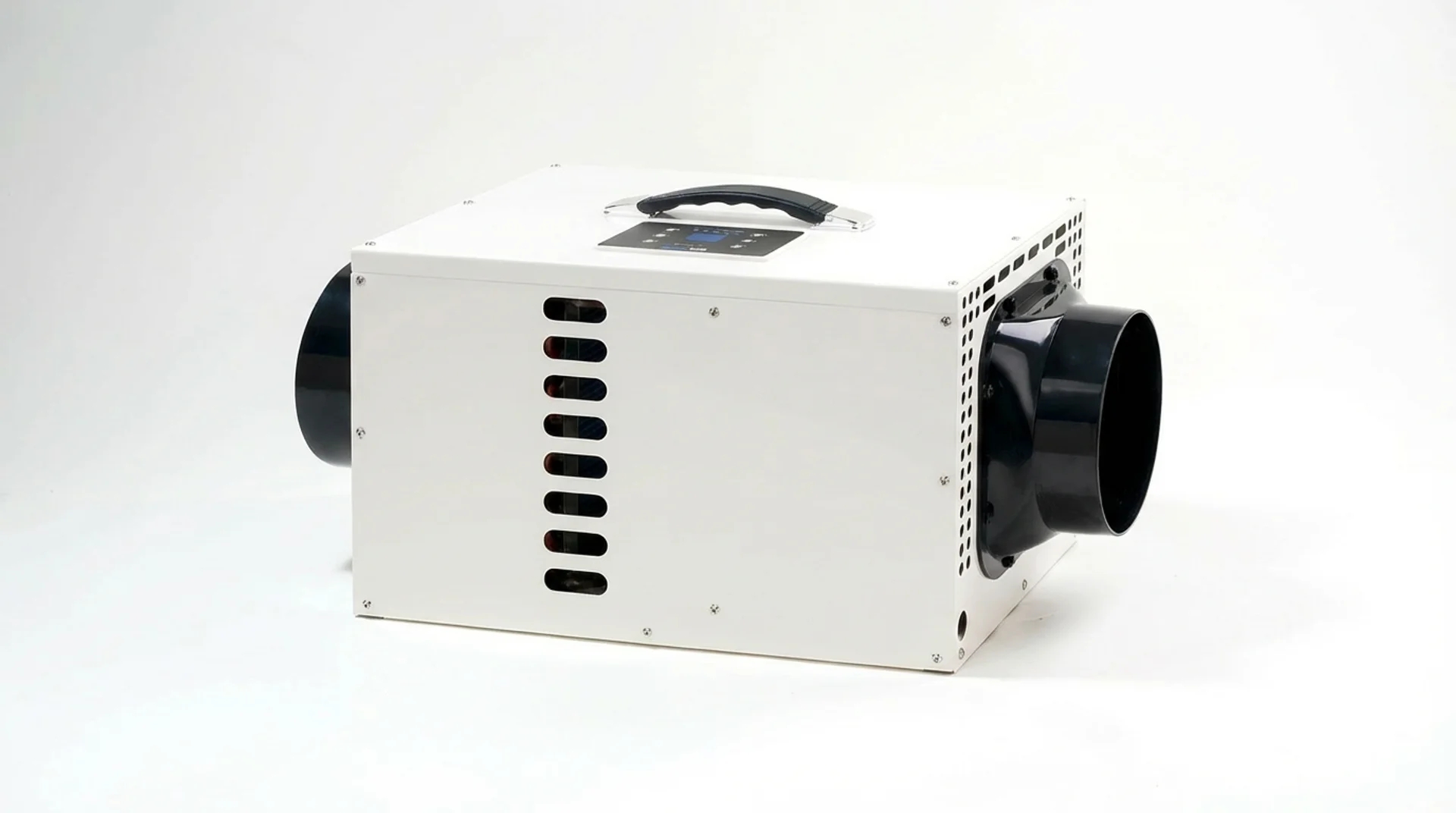
A portable unit is a single box containing both the evaporator and condenser, with exhaust hoses venting hot air outside. Think of it as a miniature version of a portable home AC.
Advantages:
- No installation—plug and play
- Move it between vehicles, tents, or storage
- Pre-charged refrigerant system (no HVAC tech required)
Disadvantages:
- Louder (compressor is in the living space)
- Less efficient (exhaust hoses leak some cool air)
- Takes up floor space
For most van and RV users, the portable format makes more sense. The flexibility to move the unit between vehicles, use it in a tent, or store it during winter outweighs the efficiency penalty. The RIGID LC2810E-AC portable unit, for example, weighs 48 pounds—heavy enough to stay put while driving, light enough to move when needed.
Real-World Performance: What to Expect
Let’s set realistic expectations, because this is where marketing meets physics.
Temperature Drop
A 2,387 BTU unit will lower the interior temperature of a well-insulated 150-square-foot space by 15–25°F below ambient. If it’s 95°F outside, expect 70–80°F inside. If it’s 105°F outside, expect 80–90°F inside.
This is not “arctic blast” cooling. This is “comfortable sleep” cooling. The difference between waking up drenched in sweat and waking up refreshed.
Humidity Control
All air conditioners dehumidify as a byproduct of cooling. As warm, humid air passes over the cold evaporator coil, moisture condenses out. A 12V unit will pull 1–2 pints of water per hour in humid conditions.
This matters more than most people realize. A 75°F space at 80% humidity feels miserable. A 75°F space at 50% humidity feels comfortable. The dehumidification is often more valuable than the temperature drop.
Noise Level
Portable units typically operate at 45–55 dB, roughly equivalent to a household refrigerator or a quiet conversation. Split systems with the compressor outside drop to 35–40 dB inside.
For context, a rooftop RV AC runs at 65–75 dB. A generator is 70–80 dB. A 12V DC air conditioner is noticeably quieter than either.
Cost Analysis: Is It Worth $1,400?
The RIGID LC2810E-AC portable unit retails for approximately $1,400. That’s not cheap. Let’s break down whether the investment makes sense.
Alternative Cooling Options
- Rooftop RV AC + Generator: $800 (AC) + $600 (generator) + $50/month (fuel) = $1,400 upfront + ongoing costs. Plus noise, maintenance, and the inability to boondock quietly.
- Rooftop RV AC + Inverter + Batteries: $800 (AC) + $1,200 (3,000W inverter) + $1,500 (400Ah lithium) = $3,500. More capacity, but also more complexity and conversion losses.
- Evaporative cooler: $200–400. Only works in dry climates (under 40% humidity). Adds moisture to the air, which is the opposite of what you want in humid regions.
- 12V fans: $50–150. Moves air but doesn’t cool it. Helpful but not a solution when it’s genuinely hot.
The $1,400 price point for a DC-native cooling system starts to make sense when you factor in the eliminated inverter cost, the reduced battery bank requirement, and the ability to operate silently without a generator.
Payback Period
If you’re currently running a generator 3 hours per night for AC (conservative estimate), that’s:
- 90 hours per month
- $45/month in fuel (at $0.50/hour)
- $540/year
The 12V air conditioner pays for itself in 2.6 years on fuel savings alone. Add in the eliminated generator maintenance, the ability to camp in no-generator zones, and the improved sleep quality, and the ROI becomes compelling.
Who Should Buy a 12V Air Conditioner—and Who Shouldn’t
You’re a Good Candidate If:
- Your space is under 250 square feet and reasonably well-insulated
- You have (or plan to install) at least 200Ah of lithium batteries
- You value quiet operation and stealth camping
- You spend significant time off-grid or in no-generator zones
- You’re willing to manage power consumption and understand battery limitations
- Comfort matters more than cost—you’re optimizing for quality of life, not just budget
You Probably Need Something Else If:
- Your space exceeds 300 square feet with poor insulation
- You’re always plugged into shore power (a standard AC unit will be simpler and cheaper)
- You need to maintain precise temperatures below 65°F (this is climate control, not refrigeration)
- Your battery bank is under 100Ah lithium (runtime will be too limited for practical cooling)
The Bottom Line
A 12v air conditioner isn’t a replacement for a 15,000 BTU rooftop unit on a 40-foot Class A motorhome. It was never meant to be. What it is: the most practical, portable cooling solution for small spaces running on DC power. The technology—variable-speed DC compressors, efficient refrigerant cycles, smart power management—has reached the point where genuine off-grid cooling is achievable with a reasonable battery and solar setup.
The RIGID portable DC air conditioner at $1,400 represents a specific engineering position in the market: real compressor-based cooling (not evaporative, not thermoelectric), native 12V DC operation (not inverter-dependent), portable form factor (not permanently installed), and a price point significantly below the $2,000+ alternatives.
The math works. The technology is proven. The remaining question is whether your space, your power system, and your expectations align with what a 2,387 BTU portable cooling system can deliver. If they do, a 12V DC air conditioner might be the most impactful upgrade you make to your mobile setup this year.