
Why Most 12V Air Conditioner Options Fail in Real Off-Grid Use
Search for a 12V air conditioner and you find two dead ends. One side sells evaporative coolers and Peltier fans that move humid air around without actually removing heat from the space. The other side offers full-size rooftop RV units that weigh 25 to 35 kg, draw 1,500 watts or more, and need a generator or shore power connection to operate. Neither solves the core engineering problem: delivering real vapor-compression cooling that runs directly from a 12V battery system without an inverter, without a generator, and without draining the battery bank in under an hour.
This gap exists because most portable AC manufacturers start with household technology designed for 110V or 220V AC power and bolt on an inverter to accept DC input. The DC-to-AC conversion typically wastes 15 to 20 percent of the input power as heat before the compressor even starts turning. A DC-native approach eliminates this conversion loss entirely by using a DC compressor designed from the ground up for battery operation. The efficiency difference compounds over every hour of runtime, and in battery-powered applications, efficiency is not a nice-to-have. It is the single factor that determines whether the system is practical or a novelty.
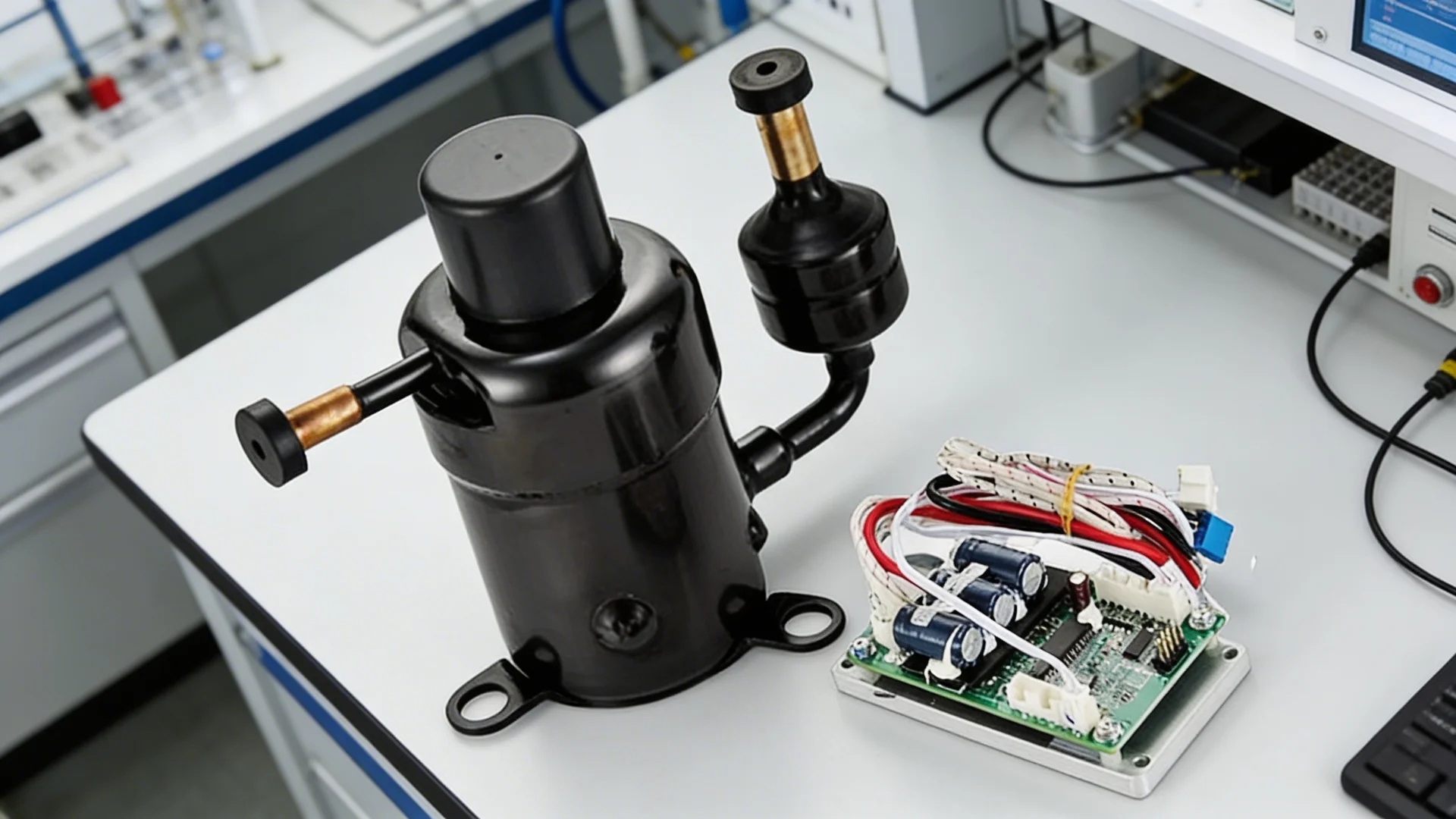
What Separates a Real DC Air Conditioner from a Rebranded Fan
Three engineering decisions separate a functional 12V air conditioner from a marketing label on a fan. Understanding these distinctions prevents the common mistake of purchasing a device that looks like an air conditioner but operates like a desk fan with extra steps.
- Native DC compressor: A brushless DC (BLDC) compressor running directly from 12V or 24V battery voltage draws 30 to 40 percent less current than an equivalent AC compressor behind an inverter at the same cooling output. DC-native systems eliminate the 15 to 20 percent conversion loss that inverter-based setups accept as unavoidable overhead. For a system running on a 100Ah lithium battery, this efficiency gain often translates to an additional 1.5 to 2 hours of cooling runtime per charge cycle.
- Variable speed operation: Fixed-speed compressors cycle on and off in binary fashion, creating temperature swings of 3 to 5°C inside the cooled space and generating high inrush currents (often 3 to 5 times running current) that stress battery cells and connectors. A variable-speed DC compressor ramps continuously between 1,800 and 4,500 RPM to match the instantaneous thermal load, maintaining stable temperature within approximately 1°C while drawing steady, predictable current. This also reduces acoustic noise significantly at partial load, which matters in camping and sleeping applications where the unit runs through the night.
- Factory-sealed refrigerant circuit: A sealed, pre-charged R134a system means no field brazing, no EPA Section 608 certification requirements for the end user, and no refrigerant leaks from amateur flare connections. Pre-charged refrigerant eliminates field brazing and reduces installation to connecting a power cable and positioning the unit. This is a meaningful advantage for consumers and fleet operators who need cooling without HVAC technician involvement.
Efficiency Comparison: Why Battery Runtime Depends on Cooling Technology
The fundamental metric for any battery-powered cooling system is the Coefficient of Performance (COP): how many watts of heat the system moves per watt of electrical input. This ratio directly determines how long your battery lasts.
Vapor compression delivers COP values several times higher than thermoelectric alternatives. A typical BLDC micro DC aircon compressor achieves a COP of 2.0 to 3.5 under moderate conditions, meaning it moves 2 to 3.5 watts of heat for every watt it consumes. A Peltier-based cooler typically operates below COP 0.6, meaning it consumes more energy than it moves in heat. The practical implication: a compressor-based 12V AC provides the same cooling as a Peltier module while consuming roughly one-fifth of the battery capacity.
This is not a marginal difference. It is the reason compressor-based portable AC units can provide overnight cooling from a single battery bank while Peltier devices cannot sustain meaningful cooling beyond 30 to 60 minutes on the same battery.
Runtime Reality: Battery Sizing for Continuous Cooling
The runtime question determines whether a 12V air conditioner is genuinely useful or just a novelty that looks good in a product listing. The answer depends on battery chemistry, capacity, ambient conditions, and how hard the compressor needs to work. Here is the realistic math for a typical portable DC unit averaging 200 to 300 watts of electrical consumption in moderate conditions (30 to 35°C ambient, target interior temperature of 25°C):
| Battery Type | Capacity | Usable Energy | Estimated Runtime |
|---|---|---|---|
| Lead-Acid (AGM) | 100Ah @ 12V | 600Wh (50% DoD) | 2–3 hours |
| LiFePO4 | 100Ah @ 12V | 1,200Wh (100% DoD) | 4–6 hours |
| LiFePO4 | 200Ah @ 12V | 2,400Wh (100% DoD) | 8–12 hours |
| LiFePO4 + 200W Solar | 200Ah @ 12V | 2,400Wh + ~800Wh solar | 10–16 hours |
The critical variable is battery chemistry, not nameplate capacity. LiFePO4 cells maintain stable voltage under sustained current draw and tolerate deep discharge cycles without degradation, delivering their rated capacity consistently across thousands of cycles. Lead-acid batteries experience voltage sag under the 20 to 35 amp continuous draw of a compressor, effectively losing 20 to 30 percent of their nameplate capacity and shortening cycle life if discharged below 50 percent. For any serious off-grid cooling installation, lithium iron phosphate is typically the only practical battery chemistry.
Application Scenarios: Where a 12V Air Conditioner Solves Real Problems
Camping and Overlanding
A tent or rooftop tent in direct summer sun can exceed 45°C inside, making afternoon rest or nighttime sleep impossible in hot climates. A compact 12V air conditioner powered by the vehicle auxiliary battery or a portable lithium battery bank can reduce interior temperature by 10 to 15°C, turning an unusable space into a comfortable sleeping environment. The key constraint in campground applications is often noise: a unit with a variable-speed compressor running at partial load typically operates under 40 dBA at one meter distance, comparable to a quiet conversation and unlikely to disturb neighboring campers.
Van Life and Camper Conversions
Van conversions need cooling that fits in tight spaces without permanent roof modifications that void the vehicle warranty. A portable unit, compact enough to fit within a standard van storage compartment, vents through a window or sliding door hatch and avoids the structural compromises of cutting a roof opening for a rooftop unit. With a 200Ah LiFePO4 bank recharged by rooftop solar panels during the day, overnight cooling in summer becomes feasible without shore power hookups or running a generator that would disturb neighbors in parking areas.
Work Vehicles and Anti-Idle Compliance
Drivers who rest in their vehicles during mandated break periods need cab cooling without engine idling. Anti-idle regulations in over 30 US states now impose fines ranging from $100 to $25,000 for extended idling, making battery-powered AC a compliance requirement rather than a comfort feature. A 12V air conditioner that connects directly to the vehicle electrical system eliminates the cost and complexity of an auxiliary power unit (APU), which typically costs 3 to 5 times more upfront and requires its own fuel supply, maintenance schedule, and installation labor.
Pet Safety in Vehicles
Veterinary guidelines recommend keeping vehicle cabin temperature below 26°C for dogs. Cabin temperature in a parked vehicle can exceed 50°C within 30 minutes in direct sun, even with windows cracked. A 12V air conditioner running from the vehicle battery while the owner is briefly away provides active cooling that window tinting and reflective shades cannot replicate. The temperature display on the unit controller provides monitoring, and the built-in low-voltage cutoff prevents the starter battery from being depleted below the threshold needed to restart the engine.

Sizing Guide: Matching Cooling Capacity to Your Space
Cooling capacity is measured in BTU per hour or watts (1 watt ≈ 3.41 BTU/h). Selecting the right size depends on the air volume to be cooled, the quality of insulation (or lack thereof), solar heat gain through windows, and the temperature differential between inside and outside. Both oversizing and undersizing create problems: an oversized unit wastes battery capacity by short-cycling, while an undersized unit runs at maximum speed continuously, consuming more power per BTU delivered and shortening both battery runtime and compressor life.
- Vehicle cab or small tent (2–5 m³): 1,500 to 2,500 BTU is typically sufficient. This range covers most car cabins, pickup truck sleeping configurations, and 2-person tents with reasonable insulation.
- Camper van or small trailer (5–15 m³): 2,500 to 5,000 BTU handles the larger air volume while accounting for the relatively poor insulation and large window areas typical in van conversions and small trailers.
- Large RV or enclosed workspace (15–30 m³): 5,000 to 8,000 BTU or more. At this volume, a split system with a separate condenser unit mounted externally often becomes more practical than a portable all-in-one, as external condenser mounting provides better heat rejection and quieter indoor operation.
The engineering sweet spot is selecting a unit that can maintain your target temperature while the compressor runs at 50 to 70 percent of its maximum speed under typical daytime conditions. This operating range maximizes both energy efficiency and component longevity, and leaves headroom for occasional peak demand during the hottest part of the day.
Installation: Three Details That Determine Performance
A portable 12V DC air conditioner requires minimal installation compared to a permanent split system, but getting three details right determines whether it works well or creates problems:
- Power connection: Connect directly to battery terminals using the included fused wiring harness. Do not tap into cigarette lighter sockets, which are typically fused at 10 to 15 amps (120 to 180 watts maximum) and will overheat, blow the fuse, or melt the socket under a compressor load of 20 to 35 amps. Use the ring terminals and inline fuse provided, and keep cable runs as short as practical to minimize voltage drop.
- Condenser airflow path: The unit must exhaust heated air from its condenser side to outside the cooled space. A cracked window, a purpose-built vent hatch, or a dedicated exhaust port all work. The critical rule: condenser exhaust air must not recirculate back into the intake. Even partial recirculation creates a positive feedback loop where the condenser runs hotter, the compressor works harder, and cooling capacity drops progressively until the system cannot maintain temperature.
- Condensate drainage: The evaporator dehumidifies the incoming air, producing liquid water that must be drained. In humid climates, expect 0.5 to 1 liter per hour of condensate. Route the drain port to a collection container or to the exterior of the vehicle. Ignoring condensate management leads to pooling, corrosion, and eventually mold growth in the cooled space.
Frequently Asked Questions
Will a 12V air conditioner drain my car starter battery?
Without protection, yes. Most quality portable DC units include a low-voltage cutoff that disconnects the compressor when battery voltage drops below 11.5 to 12.0V, preserving enough charge to start the engine. For extended use beyond 1 to 2 hours, a dedicated deep-cycle auxiliary battery with a voltage-sensitive relay or battery isolator is the more reliable approach and avoids any risk to the starting system.
How does a compressor-based 12V AC compare to an evaporative cooler?
An evaporative (swamp) cooler adds moisture to the air, which provides a cooling sensation in very dry climates below 30 percent relative humidity. However, in humid environments it makes conditions objectively worse by raising both humidity and effective temperature. A compressor-based system removes moisture while cooling, providing measurable temperature reduction regardless of ambient humidity. In any climate above 40 percent relative humidity, which covers most of the continental US east of the Rockies, evaporative cooling is largely ineffective for enclosed spaces.
Can solar panels fully power a 12V air conditioner?
Not in real time, typically. A 200W solar panel produces roughly 800 to 1,000Wh per day under good sun exposure, while a portable AC unit running at moderate load draws 200 to 300W continuously. Solar meaningfully extends daily runtime by offsetting battery drain during daylight hours, but the battery bank remains the primary power reservoir. The practical design approach is to size the battery for your cooling needs first, then add solar capacity as a recharge supplement that extends total daily runtime by 2 to 4 hours.
What is the difference between a portable and a split system 12V AC?
A portable unit integrates the compressor, condenser, and evaporator into a single housing. It is easy to move between vehicles, tents, or applications but requires a path to vent condenser heat outside the cooled space. A split system separates the condenser (mounted permanently outside) from the evaporator (mounted inside), providing better cooling efficiency, quieter indoor operation, and no need for a venting arrangement. The tradeoff is a more involved installation process with refrigerant lines connecting the two units.
What maintenance does a 12V portable AC require?
Minimal. The sealed refrigerant circuit requires no servicing under normal conditions. Periodic maintenance consists of cleaning the condenser fins (compressed air or soft brush to remove dust and debris), checking the air filter on the evaporator intake, and inspecting the power cable connections for corrosion or looseness. In dusty environments, condenser cleaning frequency should increase to prevent airflow restriction that degrades cooling performance.
For off-grid and mobile cooling applications where runtime and efficiency determine whether the system is practical, a metal chassis designed for continuous duty cycles provides the durability that plastic consumer units typically lack in sustained outdoor use. The RigidChill portable DC air conditioner series operates natively on 12V and 24V with a twin-cylinder BLDC compressor and factory-sealed R134a refrigerant, offering OEM customization with sample quantities from 1 unit for fleet and integration applications. Explore the portable DC air conditioner specifications.