
How Long Does a 12V Battery Powered Air Conditioner Actually Run?
This is the first question everyone asks — and the answer nobody gives you straight. Most listings say “low power consumption” and leave it at that. We are going to do the math with real numbers so you can plan your battery setup before you buy.
A 12V battery powered air conditioner uses a compressor to actually cool air — not just blow it around like a fan, and not just evaporate water like a swamp cooler. Real cooling requires real power. The question is how much, and how long your batteries can sustain it.
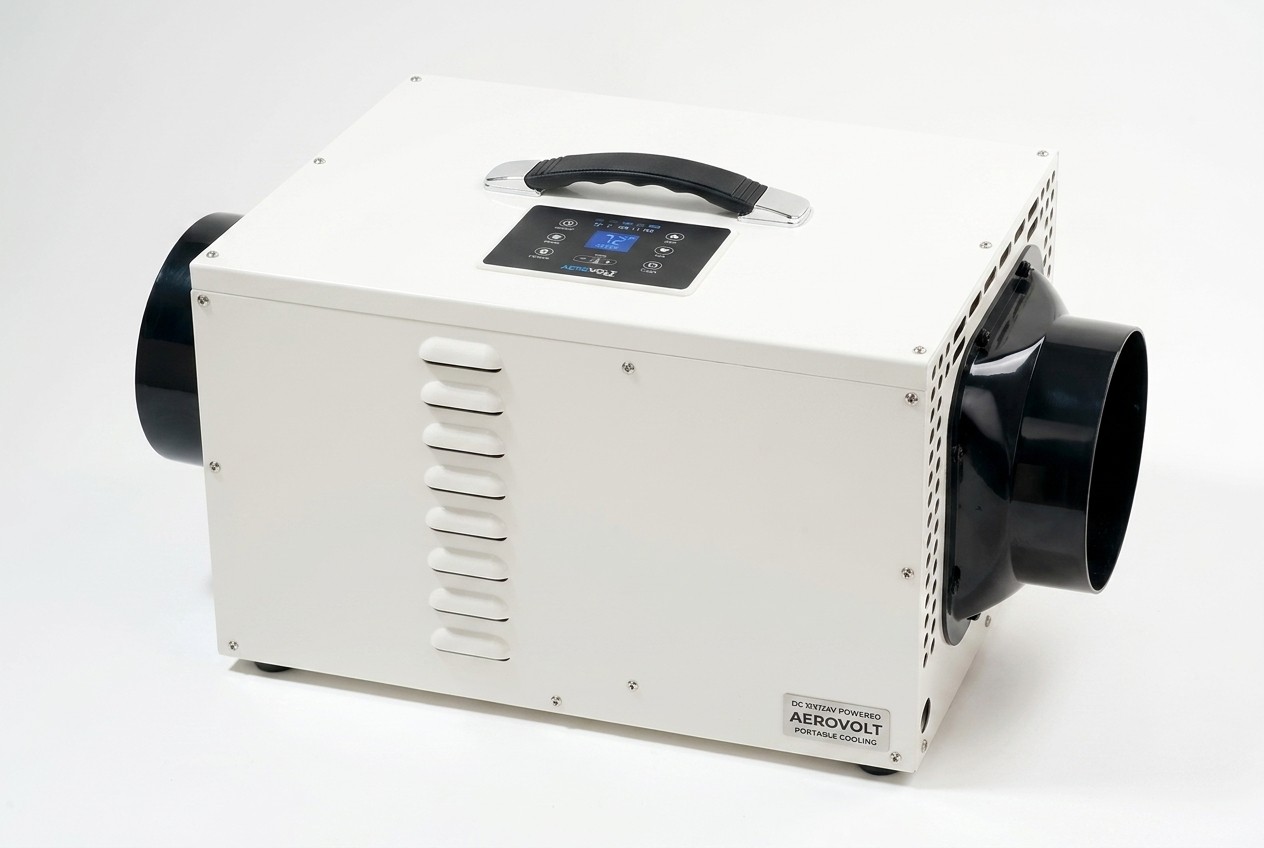
The RIGID Micro DC Aircon DV1910E-AC runs on 12V DC with a working current of approximately 16A at full load. That means roughly 192W of power draw at maximum. But here is the key detail most people miss: these units use BLDC variable-speed compressors. They do not run at full blast all the time. Once the target temperature is reached, the compressor slows down, drawing significantly less power. Real-world average draw is typically 40-70% of the maximum, depending on conditions.
Runtime Math: Battery Capacity vs Power Draw
Let us work through the actual scenarios people care about.
Scenario 1: 100Ah 12V Battery — Overnight Camping
A 100Ah 12V battery stores 1,200Wh of energy. But you should not drain a lead-acid battery below 50% (600Wh usable) or a lithium battery below 20% (960Wh usable).
At full load (192W):
- Lead-acid: 600Wh ÷ 192W = roughly 3.1 hours
- Lithium (LiFePO4): 960Wh ÷ 192W = roughly 5 hours
At typical variable-speed draw (~50% average, 96W):
- Lead-acid: 600Wh ÷ 96W = roughly 6.2 hours
- Lithium: 960Wh ÷ 96W = roughly 10 hours
So a 100Ah lithium battery can realistically run the DV1910E-AC for an overnight camping session (7-10 hours) if the ambient temperature is moderate and the space is reasonably insulated. On a hot night with poor insulation, expect closer to 5-6 hours as the compressor works harder.
Scenario 2: 200Ah 12V Battery — Full Day in a Van
A 200Ah setup doubles everything:
At typical draw (~96W average):
- Lead-acid (1,200Wh usable): roughly 12.5 hours
- Lithium (1,920Wh usable): roughly 20 hours
With a 200Ah lithium battery, you can run a 12V battery powered air conditioner through an entire hot afternoon and night. Add a 200W solar panel and you extend runtime further — the panel offsets a significant chunk of the power draw during daylight hours.
Scenario 3: Pet Safety in a Parked Vehicle
This is a critical safety application. A parked car in sun can reach lethal temperatures in 15 minutes. A 12V battery powered air conditioner maintaining a pet crate at safe temperature is not convenience — it is life-saving equipment.
For pet crate cooling, the 450W (1,535 BTU) DV1910E-AC is appropriately sized. The small, insulated space means the compressor reaches target temperature quickly and then reduces speed, lowering average power draw. With a dedicated 100Ah lithium battery (not the vehicle’s starting battery), expect 8-12 hours of runtime in moderate conditions. That is enough for a full workday with margin.
Critical note: Always use a dedicated deep-cycle battery, not your vehicle’s starting battery. A drained starting battery means you cannot restart the car — a dangerous situation if you are relying on it for your pet’s safety.
Scenario 4: 24V and 48V Systems
The same cooling capacity (450W / 1,535 BTU) is available at higher voltages:
- DV1920E-AC (24V): Working current approximately 8A. Half the current of the 12V model for the same cooling output. Lower current means thinner wiring, less voltage drop over long runs, and better efficiency in larger battery systems.
- DV1930E-AC (48V): Working current approximately 4A. Ideal for 48V battery banks common in solar installations, telecom, and marine systems.
If you are building a new system from scratch, 24V is often the sweet spot — wide battery availability, reasonable wire gauges, and good efficiency. 12V makes sense when you are tapping into an existing vehicle electrical system.
Factors That Kill Your Runtime
The math above assumes reasonable conditions. Here is what makes reality worse than the calculation:
Poor Insulation
This is the biggest factor. An uninsulated metal van body in direct sun gains heat faster than a 450W unit can remove it. The compressor runs at full speed continuously, draining batteries at maximum rate. Even basic insulation — Reflectix on windows, foam board on walls — can cut heat gain in half and double your runtime.
High Ambient Temperature
At 35°C (95°F) ambient, the compressor works moderately. At 45°C (113°F), it works much harder. Every degree of ambient temperature above your target temperature increases the compressor’s workload. Desert camping in July is a harder test than mountain camping in September.
Large or Open Spaces
The DV1910E-AC produces 1,535 BTU. That is sized for small enclosed spaces — a tent sleeping area, a van sleeping zone, a pet crate, an equipment cabinet. Trying to cool an entire large van with doors opening regularly will keep the compressor at maximum and drain batteries fast.
Old or Degraded Batteries
A “100Ah” battery that is three years old and has been deep-cycled 500 times does not actually hold 100Ah anymore. Real capacity degrades over time. Plan with some margin, and replace batteries that have lost significant capacity.
How to Maximize Runtime
Smart setup choices can dramatically extend how long your 12V battery powered air conditioner runs:
- Insulate your space. This is the single most impactful thing you can do. Reduces heat gain, reduces compressor workload, extends runtime. Window covers, reflective barriers, and foam insulation all help.
- Use lithium batteries. LiFePO4 batteries give you 80% usable capacity vs 50% for lead-acid. For the same weight, you get roughly 60% more usable energy. They also maintain voltage better under load, which helps the compressor run more efficiently.
- Add solar. A 200W panel generates roughly 800-1,000Wh per day in good sun. That offsets 8-10 hours of variable-speed compressor operation. Solar plus battery is the combination that makes all-day cooling practical.
- Cool at night, ventilate during the day. If you are camping, the AC is most valuable at night when you are sleeping and cannot open windows. During the day, natural ventilation or shade may be enough.
- Pre-cool. Start the AC 30 minutes before you need it while connected to shore power or while driving (alternator charging). Getting the space cold when power is abundant means the compressor only needs to maintain temperature on battery — a much lighter load.
- Size the space, not the room. Cool only the area you need. A curtain dividing a van’s sleeping area from the cab reduces the volume the AC needs to handle by 30-40%.
Choosing the Right Model for Battery Operation
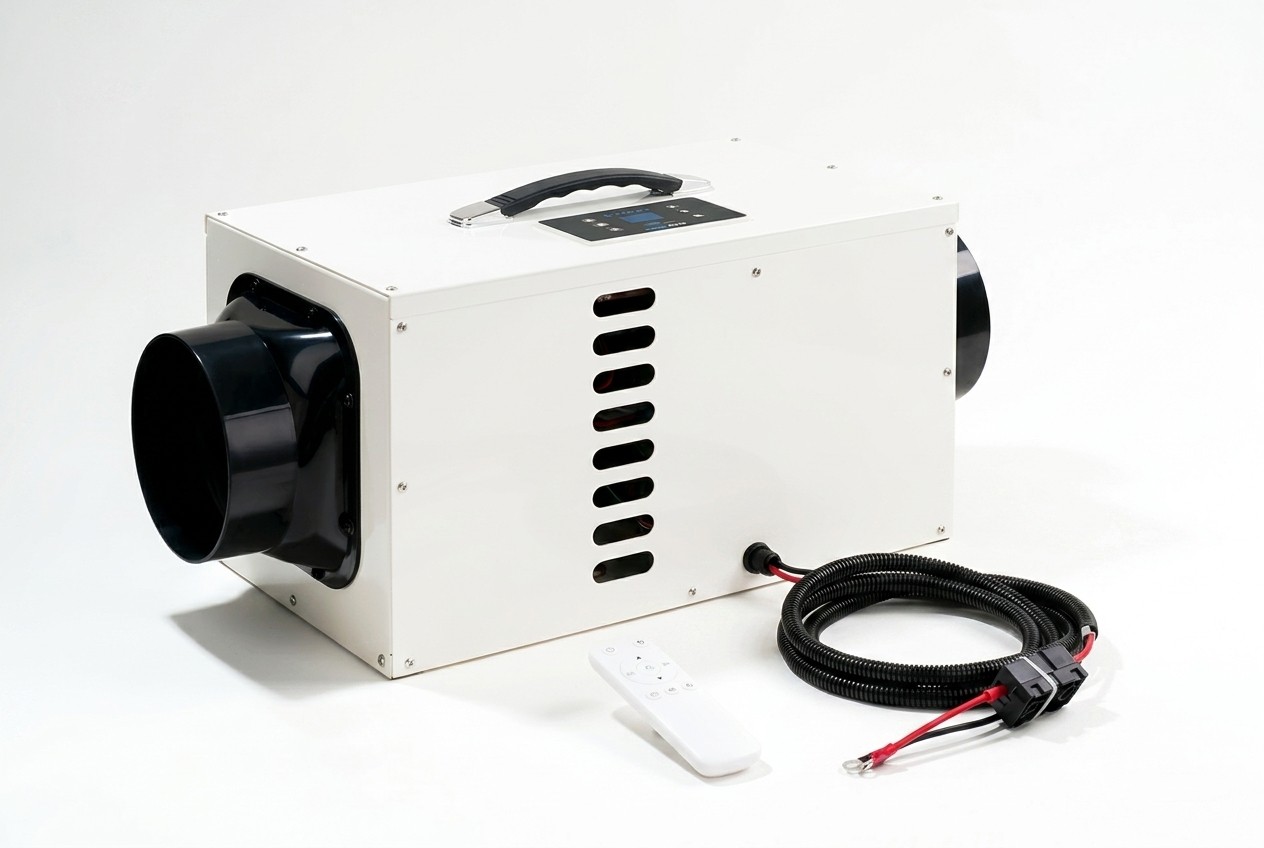
The RIGID Micro DC Aircon lineup offers seven models from 450W to 900W. For battery-powered applications, think carefully about the tradeoff between cooling capacity and runtime:
| Model | Voltage | Cooling | Max Draw | Best For |
|---|---|---|---|---|
| DV1910E-AC | 12V | 450W / 1,535 BTU | ~192W | Vehicle systems, camping, pet crates |
| DV1920E-AC | 24V | 450W / 1,535 BTU | ~192W | Marine, dual-battery setups |
| DV2820E-AC | 24V | 700W / 2,387 BTU | ~300W est. | Larger vans, equipment enclosures |
| DV3820E-AC | 24V | 900W / 3,069 BTU | ~385W est. | Large enclosures, high heat loads |
Note: The 450W models are the most practical for battery operation because they balance meaningful cooling with manageable power draw. The 700W and 900W models cool more but drain batteries roughly 1.5x and 2x faster respectively. Choose based on your space size and available battery capacity.
What a 12V Battery Powered Air Conditioner Cannot Do
Honest boundaries help you make the right decision:
- It will not cool a large room. Even the 900W model tops out at 3,069 BTU. A bedroom window AC starts at 5,000 BTU. These are micro units for micro spaces.
- It will not run indefinitely without charging. Batteries are finite. Plan your power budget — solar, alternator charging, or shore power — for extended use.
- It will not overcome terrible insulation. If your space gains heat faster than the unit removes it, the compressor runs full speed and still loses the battle. Insulation is not optional for battery operation.
- It is not a replacement for your car’s AC. Your vehicle’s belt-driven AC system produces 3,000-5,000W of cooling. A 450W micro unit is for when the engine is off.
Battery Recommendations
For the best experience with a 12V battery powered air conditioner:
- Minimum: 100Ah LiFePO4 for 6-10 hours of overnight use
- Recommended: 200Ah LiFePO4 for all-day cooling with solar supplement
- Optimal: 200Ah+ LiFePO4 with 200-400W solar panel array for near-continuous operation
Avoid lead-acid for primary AC duty. The 50% depth-of-discharge limit, heavier weight, and faster degradation under deep cycling make them a poor match for this application. LiFePO4 costs more upfront but delivers more usable energy, lasts longer, and weighs less.
Solar + Battery: The Practical Combination for All-Day Cooling
If you want a 12V battery powered air conditioner to run beyond a single night, you need to think about charging. The most practical off-grid charging method is solar panels.
Here is how the math works in practice. A 200W solar panel in good conditions (clear sky, proper angle, 4-5 peak sun hours) generates roughly 800-1,000Wh per day. The DV1910E-AC at 50% average draw consumes about 96W, or 960Wh over 10 hours. So a single 200W panel roughly offsets one night of cooling — but only if you have enough battery capacity to store daytime solar production for nighttime use.
The practical system looks like this: the solar panel charges the battery during the day while the AC is off (or running lightly). At night, the battery runs the AC. A 200Ah LiFePO4 battery with a 200W panel can sustain this cycle indefinitely in good weather, with the battery acting as a buffer for cloudy days.
For reliability, size your battery for at least two nights of autonomy without solar. This covers cloudy days and the inevitable situation where you park in the shade (great for staying cool, terrible for solar production). A 200Ah battery with 200W solar gives you the best balance of weight, cost, and autonomy for most van and camping applications.
Charge Controller Selection
Use an MPPT (Maximum Power Point Tracking) charge controller, not PWM. MPPT controllers extract 15-30% more energy from the same panel, which translates directly to longer AC runtime. For a 200W panel feeding a 12V battery, a 20A MPPT controller is appropriate. If you plan to add panels later, size the controller for your future array — they are harder to upgrade than panels.
Alternator Charging While Driving
For vehicle installations, a DC-DC charger (also called a battery-to-battery charger) lets your alternator charge the auxiliary battery while driving. A 30A DC-DC charger puts roughly 360W into a 12V battery, which can fully charge a 200Ah LiFePO4 battery in about 5-6 hours of driving. Combined with solar, this means your AC battery stays topped up as long as you drive regularly — making multi-day trips with overnight cooling entirely practical.
Frequently Asked Questions
Can I run a 12V AC off my car battery while parked?
Technically yes, but we strongly recommend against using your starting battery. A deep discharge can leave you stranded. Use a dedicated deep-cycle battery with a battery isolator so the AC draws from the auxiliary battery only.
Will a portable power station work?
Yes, if it has a 12V DC output with sufficient current capacity (at least 20A for the DV1910E-AC). Many portable power stations have 12V outputs rated at only 10A, which is insufficient. Check the DC output specs carefully.
How does the variable speed compressor help with battery life?
A fixed-speed compressor cycles on at full power and off repeatedly. A variable-speed BLDC compressor ramps down to a lower speed once the target temperature is reached, drawing less power continuously. This reduces average power consumption by 30-50% compared to a fixed-speed unit in most real-world conditions, directly extending battery runtime.
Can I use this while driving?
Yes. The alternator charges the battery while the AC runs. In most vehicles, a properly wired system can run the DV1910E-AC indefinitely while the engine is running. The AC provides supplemental cooling for specific zones — pet crate in the cargo area, sleeping area in a van — while the vehicle’s main AC handles the cabin.
Bottom Line
A 12V battery powered air conditioner delivers real cooling — not just airflow — from battery power. With a 100Ah lithium battery, expect 6-10 hours of overnight cooling in a small, insulated space. With 200Ah and solar, all-day operation is practical. The key variables are insulation quality, ambient temperature, and battery chemistry. Do the math for your specific setup, insulate your space properly, and these units deliver what no fan or evaporative cooler can: genuine temperature control off the grid.