
12V DC Air Conditioner Specification for Commercial Fleets: What Fleet Managers Need to Know
Fleet managers evaluating a 12V DC air conditioner for commercial vehicles face a different decision matrix than individual buyers. An individual buyer cares about comfort. A fleet manager cares about comfort too — but also about standardization across the fleet, impact on vehicle electrical systems, maintenance costs at scale, driver retention, fuel savings from reduced idling, and regulatory compliance with anti-idling laws that now cover over 30 US states and most of the EU.
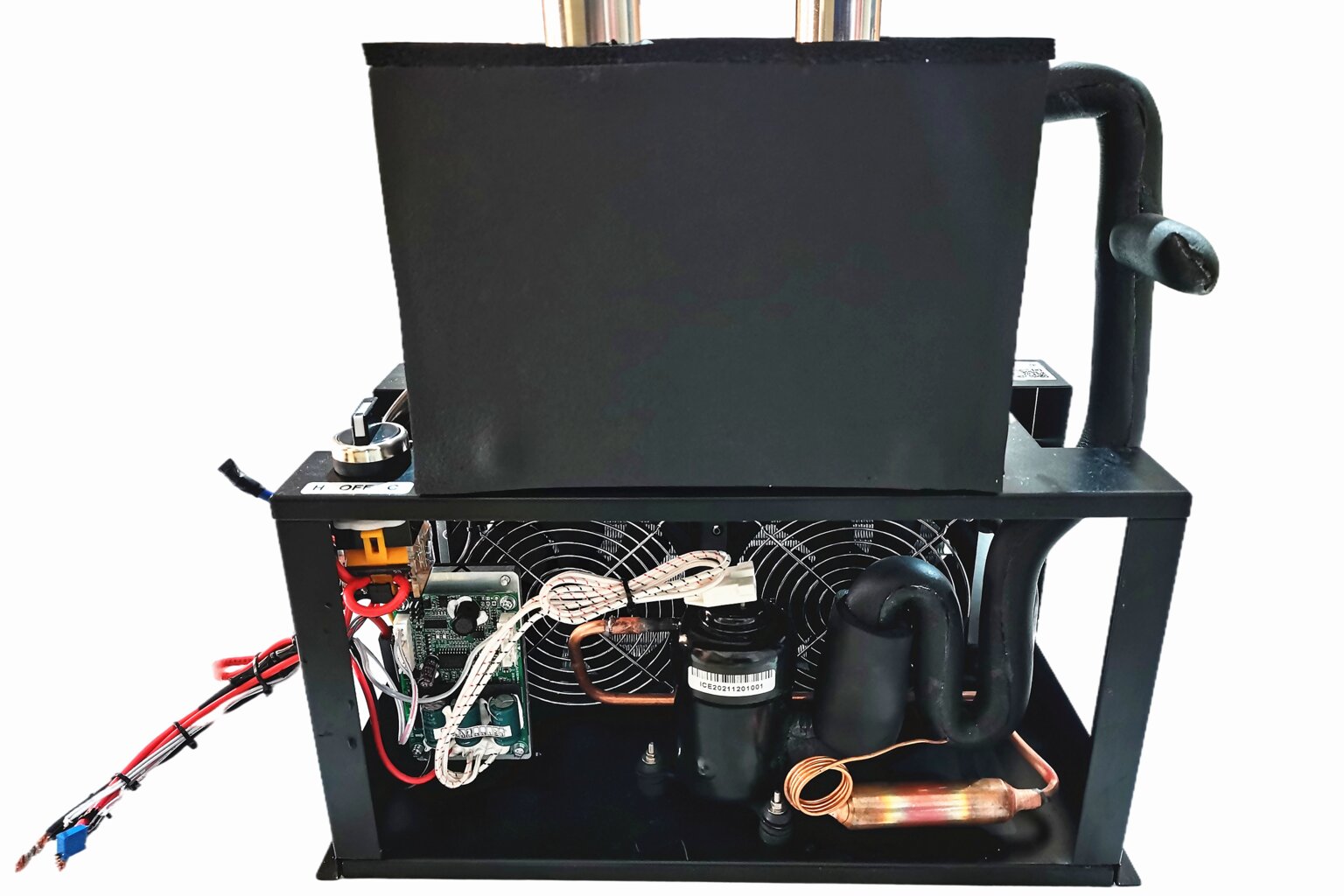
This guide addresses the specification decisions that fleet managers must make when selecting and deploying 12V DC air conditioning across a commercial vehicle fleet. The focus is on the RIGID Micro DC Aircon DV1910E-AC — the 12V variant of the platform — and its integration into delivery vans, service vehicles, and light commercial trucks.
Why 12V Instead of 24V or 48V
Most light commercial vehicles — delivery vans, pickup trucks, service bodies, and passenger vehicles — operate on 12V electrical systems. Medium and heavy trucks typically use 24V. The voltage selection for a 12V DC air conditioner is not a performance preference — it is a compatibility requirement.
Installing a 24V or 48V cooling unit in a 12V vehicle requires a DC-DC step-up converter. This adds cost ($150-$400), weight (2-5 kg), installation complexity, and a potential failure point. It also introduces conversion losses of 5-15%, reducing the effective battery capacity available for cooling. For a fleet of 50 vehicles, the additional converter cost alone represents $7,500-$20,000 — money spent on voltage conversion rather than cooling.
The straightforward approach: use a 12V cooling unit in a 12V vehicle. The DV1910E-AC connects directly to the vehicle’s existing 12V electrical system with no conversion equipment.
Electrical Impact on the Vehicle
This is the question that stops many fleet managers from proceeding: will the 12V DC air conditioner drain the vehicle battery and leave the driver stranded?
Running Current
The DV1910E-AC draws approximately 16A at full load on 12V. For context, a vehicle’s headlights draw approximately 10-15A, and a typical car alternator produces 80-150A. During driving, the cooling unit’s 16A draw is well within the alternator’s surplus capacity — the vehicle’s electrical system will not notice it.
Stationary Operation on Battery
The concern arises when the vehicle is parked with the engine off. On a standard 12V/80Ah lead-acid starting battery, 16A continuous draw would theoretically last 5 hours — but practically much less, because discharging a lead-acid battery below 50% dramatically shortens its cycle life, and drawing it below 30% risks not being able to restart the engine.
The practical stationary runtime on a standard starting battery: 1.5-2 hours at full load before the battery reaches 50% state of charge. This is adequate for lunch breaks and short stops but insufficient for overnight parking or extended stationary periods.
Solutions for Extended Stationary Cooling
For fleets that need more than 2 hours of stationary cooling, three approaches work:
- Auxiliary lithium battery: A dedicated 12V/100Ah lithium battery (approximately $400-$600, 12 kg) provides 6-8 hours of cooling runtime without touching the starting battery. The auxiliary battery recharges from the alternator during driving. This is the most common fleet solution and the one we recommend for most applications.
- Dual battery system with isolator: A second lead-acid battery connected through a voltage-sensitive relay (VSR) provides auxiliary power while isolating the starting battery. Lower cost than lithium but heavier (25-30 kg for a 100Ah AGM battery) and shorter cycle life.
- Solar supplementation: A 100-200W roof-mounted solar panel extends battery runtime significantly during daytime parking. In summer conditions (the peak cooling demand period), a 200W panel can offset 60-80% of the cooling unit’s power draw during midday hours.
Installation Standardization for Fleet Deployment
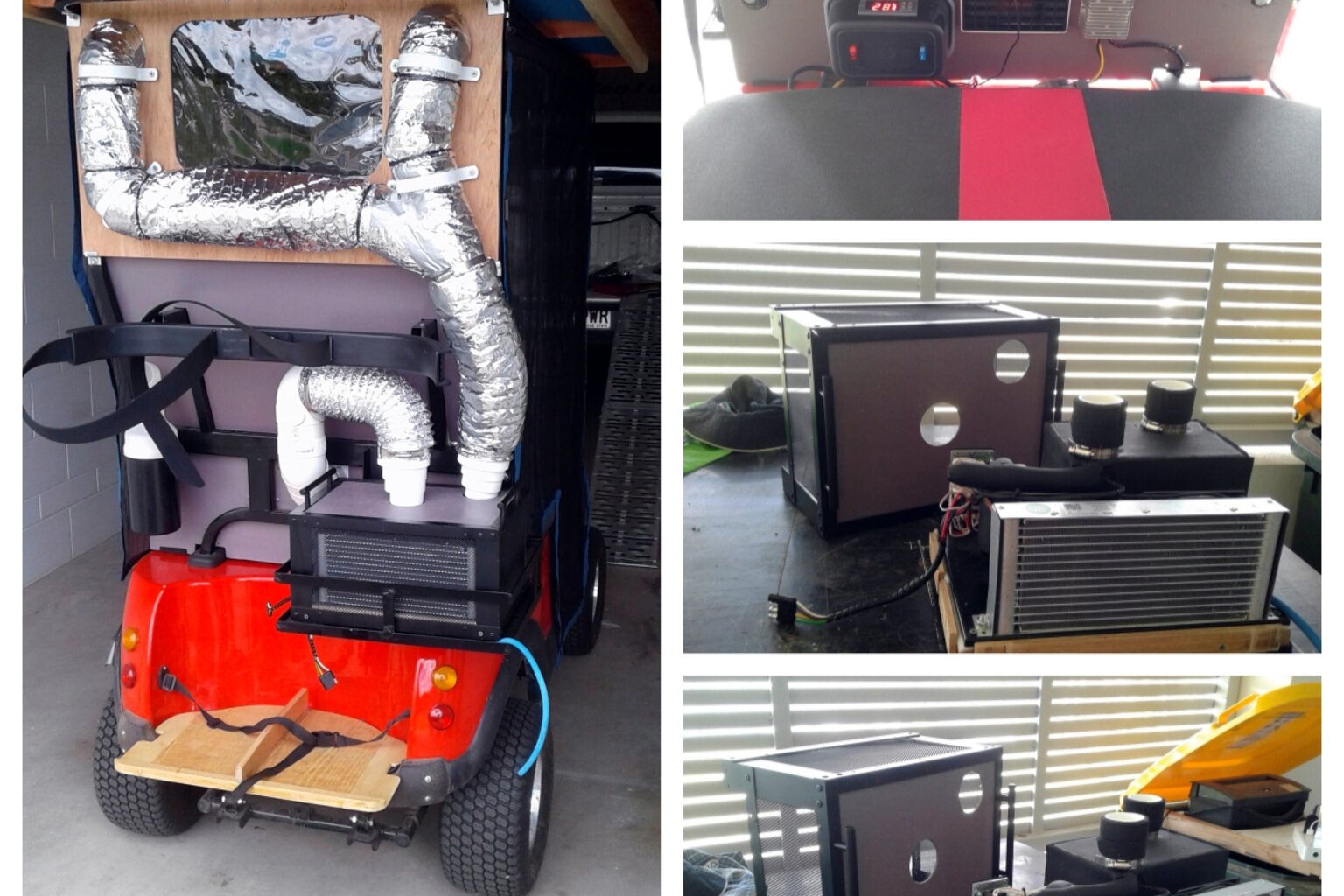
When deploying 12V DC air conditioners across a fleet, standardizing the installation saves time and reduces error rates. Develop a fleet-specific installation kit that includes:
- Pre-cut wiring harness: Sized for the specific vehicle model, with correct wire gauge (10 AWG minimum for runs under 3 meters), pre-terminated connectors, and inline slow-blow fuse (30A). Each harness should be identical for every vehicle in the fleet to simplify installation and troubleshooting.
- Mounting template: A cardboard or sheet metal template that marks the mounting hole positions, duct penetrations, and drain routing for the specific vehicle model. This eliminates measurement errors and ensures every installation is identical.
- Commissioning checklist: A printed checklist that each installer completes and signs, covering polarity verification, fuse installation, supply voltage under load, supply air temperature at first startup, and condensate drain confirmation. These checklists become part of the vehicle’s service record.
Installation Time
With a standardized kit and trained installer, first-time installation takes approximately 3-4 hours per vehicle. Subsequent installations by the same technician typically drop to 2-2.5 hours. For a fleet of 50 vehicles, plan for a 3-week deployment schedule with two technicians working simultaneously — approximately 5 vehicles per day.
Total Cost of Ownership
The fleet-level TCO analysis for a 12V DC air conditioner is different from the individual vehicle analysis because fleet operations amplify both the costs and the savings.
Acquisition Cost
The DV1910E-AC module plus auxiliary lithium battery plus installation kit costs approximately $1,200-$1,500 per vehicle. For a 50-vehicle fleet: $60,000-$75,000 total deployment cost.
Fuel Savings from Idle Reduction
A gasoline vehicle idling for air conditioning consumes approximately 0.5-0.8 gallons per hour. A diesel vehicle consumes approximately 0.3-0.5 gallons per hour. If each vehicle in the fleet idles for an average of 2 hours per day during the 6-month cooling season (approximately 120 days), the annual fuel consumption for idling air conditioning is:
Gasoline fleet: 50 vehicles × 2 hours × 120 days × 0.65 gallons/hour × $3.50/gallon = $27,300/year
Diesel fleet: 50 vehicles × 2 hours × 120 days × 0.4 gallons/hour × $3.80/gallon = $18,240/year
The DC air conditioner eliminates this idling entirely. The payback period: 2.2-3.3 years for a gasoline fleet, 3.3-4.1 years for a diesel fleet. After payback, the fuel savings flow directly to the operating budget.
Maintenance Cost Avoidance
Engine idling for 2 hours per day adds approximately 500-600 equivalent engine hours per year. This accelerates oil change intervals, engine wear, and transmission wear. Fleet maintenance managers estimate that idling costs $0.02-$0.05 per minute in engine wear — translating to $1,440-$3,600 per vehicle per year for a 2-hour daily idling habit. Across a 50-vehicle fleet: $72,000-$180,000 annually in avoided maintenance costs.
Anti-Idling Compliance
Anti-idling regulations have expanded significantly in the past decade. California limits commercial vehicle idling to 5 minutes. New York City limits idling to 3 minutes near schools and hospitals, 1 minute elsewhere. The EU’s Clean Vehicles Directive pushes member states toward similar restrictions. Penalties range from $100-$500 per violation, with repeat violations escalating to $1,000+ and potential operating license impacts.
For a fleet operating in multiple jurisdictions, anti-idling compliance is complex and the risk of fines is real. A 12V DC air conditioner provides the technical compliance solution: the vehicle’s engine is off, there is no idling, and there are no emissions during stationary cooling. The cooling system’s operating cost ($0.15-$0.30 per hour in electricity from the auxiliary battery) is negligible compared to the idling fuel cost it replaces and the fines it avoids.
Driver Retention and Productivity
This benefit is harder to quantify but consistently cited by fleet managers as the most impactful: drivers who have cab cooling during breaks are measurably more satisfied and less likely to leave. In the current driver shortage environment, replacing a commercial driver costs $5,000-$12,000 in recruiting, training, and lost productivity. If 12V DC air conditioning prevents even 2-3 driver turnovers per year across a 50-vehicle fleet, the retention benefit alone pays for a significant portion of the system cost.
Driver productivity during summer months also improves measurably. Heat-stressed drivers make more errors, drive more aggressively (to reach air-conditioned destinations faster), and take more unscheduled breaks. Fleet telematics data consistently shows that vehicles with auxiliary cooling have fewer hard-braking events, fewer speeding incidents, and shorter overall route times during summer months compared to vehicles without cooling.
Limitations for Fleet Managers
Transparency about limitations prevents mismatched expectations:
- Not a cab air conditioner replacement: The 450W DV1910E-AC supplements, not replaces, the vehicle’s main HVAC system. It provides stationary cooling when the engine is off, not driving cooling that replaces the engine-driven compressor.
- Battery management required: The auxiliary battery needs monitoring. Deep discharge below 20% permanently damages lithium cells. Install a low-voltage disconnect (LVD) set at 11.5V to protect the battery from over-discharge.
- Winter storage: In cold climates, the auxiliary battery should be disconnected or maintained on a trickle charger during winter months to prevent capacity loss from prolonged storage at low state of charge.
Maintenance at Fleet Scale
Individual vehicle maintenance is straightforward — clean the condenser, check the drain, tighten connections. Fleet-scale maintenance requires systems thinking to ensure nothing falls through the cracks across dozens or hundreds of vehicles.
Scheduled Maintenance Integration
Integrate cooling system maintenance into the existing vehicle preventive maintenance (PM) schedule. The cooling system’s 6-month inspection interval aligns well with typical PM intervals for commercial fleets. Add the following items to the PM checklist:
- Visual inspection of condenser fins — clean if more than 20% of fin area is blocked
- Condensate drain path verification — flush with water if slow or blocked
- Electrical connection torque check — re-torque terminal screws to specification
- Supply voltage measurement under load — flag if more than 0.5V below nominal
- Auxiliary battery state of health check — replace if capacity drops below 80% of original
Each inspection adds approximately 15-20 minutes to the PM event. At a shop labor rate of $85/hour, the cooling system maintenance cost is approximately $21-$28 per vehicle per PM cycle — $42-$56 per vehicle per year for semi-annual PMs.
Spare Parts Inventory
For a 50-vehicle fleet, maintain the following spare parts inventory: 3 condenser fan assemblies, 2 driver boards, 5 fuse kits, 2 thermostat controllers, and 5 auxiliary battery units. This inventory covers approximately 95% of first-year field service demand based on fleet reliability data. Total spare parts investment: approximately $2,500-$3,500.
Technician Training
Designate 2-3 technicians per fleet location as cooling system specialists. Training covers installation, commissioning, troubleshooting using fault codes, and component replacement. Total training time: 4-6 hours per technician, which can be completed in a single half-day session. Trained technicians resolve 90% of cooling system issues without escalation to the manufacturer.
Data-Driven Fleet Cooling Management
Modern fleet telematics platforms can monitor auxiliary battery voltage, cooling system status, and cab temperature in real time. Integrating the 12V DC air conditioner’s status signal into the fleet telematics system enables:
- Predictive maintenance: Trending auxiliary battery voltage over time reveals degradation before the battery fails in service. A battery showing 10% voltage decline over 6 months should be flagged for replacement at the next PM.
- Usage optimization: Identify vehicles where the cooling system runs excessively (potential insulation issues or driver behavior) and vehicles where it is underutilized (potential driver awareness gap or system malfunction).
- Idle reduction verification: Confirm that engine idling for cooling has actually stopped after the DC system is installed. Some drivers continue idling out of habit — telematics data identifies these vehicles for driver coaching.
- ROI tracking: Compare fuel consumption before and after cooling system installation for each vehicle. This provides hard data for justifying fleet-wide deployment to management and calculating actual payback periods rather than relying on estimates.
The combination of standardized installation, scheduled maintenance, spare parts inventory, and telematics integration transforms a 12V DC air conditioner from an individual vehicle accessory into a managed fleet asset that delivers measurable financial returns while improving driver satisfaction and regulatory compliance.
Seasonal Deployment Strategy
In temperate climates, the 12V DC air conditioner is needed only during the warm months — typically May through September in the Northern Hemisphere. Fleet managers in these regions face a choice: leave the units installed year-round or remove them during winter.
The recommended approach is to leave the units installed but disconnect the auxiliary battery during winter months. The cooling module itself is unaffected by cold temperatures when not operating. The auxiliary lithium battery, however, should be stored at 40-60% state of charge in a temperature-controlled environment to maximize its calendar life. Lithium cells stored at full charge or in freezing temperatures degrade faster than cells stored at partial charge in moderate temperatures.
Before the cooling season begins, reconnect the auxiliary battery, charge it fully, and run each vehicle’s cooling system for 30 minutes to verify operation. This spring commissioning takes approximately 20 minutes per vehicle and catches any issues that developed during the off-season before drivers need the cooling system on the first hot day.