
Why a 12V DC Air Conditioner Off Grid Is Critical for Equipment Shelter Reliability
Remote equipment shelters house sensitive electronics that cannot tolerate thermal extremes. Unlike occupied spaces where people can open a window or step outside, unmanned telecom cabinets, solar-powered monitoring stations, and field instrumentation enclosures have no adaptive mechanism. When internal temperatures climb past rated thresholds, equipment fails silently—and the cost of a site visit to replace a fried radio module or degraded battery bank far exceeds the cost of active cooling.
Consider what happens inside a sealed equipment shelter under direct sun. Ambient temperatures of 35°C outside can push internal cabinet temperatures past 60°C when you factor in heat generated by power supplies, radio transceivers, and battery charging systems. At these temperatures:
- Lithium batteries accelerate capacity degradation. Every 10°C above 25°C roughly doubles the rate of calendar aging, reducing a 10-year battery to 3-4 years of useful life.
- Semiconductor components in telecom radios and PLCs experience increased leakage current and eventual thermal runaway.
- Sensor calibration drifts in environmental monitoring equipment, producing unreliable data that may go undetected for weeks.
- Capacitors in power supplies dry out faster, leading to premature failure of DC-DC converters and charge controllers.
Passive cooling—ventilation louvers, thermal mass, reflective coatings—helps but cannot maintain the 25-35°C operating window that most industrial electronics require when ambient conditions push past 40°C. Active cooling is not a comfort feature for these installations. It is a reliability requirement that directly impacts mean time between failures (MTBF) and total cost of ownership.
Why Direct DC Cooling Outperforms AC Inverter Systems at Remote Sites
The conventional approach to cooling remote shelters involves a standard AC air conditioner powered through an inverter. This architecture introduces multiple failure points and efficiency losses that are unacceptable for unmanned critical infrastructure.
https://pub-e1dc3561f27d41a4b14b346813c0a4fc.r2.dev/blog-images/d26-rc-c1.jpgA direct DC air conditioning system eliminates the inverter entirely. The compressor, fan motors, and control electronics all run natively on DC power—the same power your solar array and battery bank already produce. The engineering advantages are significant:
Conversion Loss Elimination
A typical modified sine wave inverter loses 10-15% of input energy as heat. Pure sine wave inverters are better at 5-8%, but still waste power. With a 192W cooling load, an inverter system actually draws 210-220W from the battery bank. Over a 10-hour cooling day, that is 200-280Wh of wasted energy—energy that required additional solar panels to generate and additional battery capacity to store. A direct DC system draws exactly 192W from the bus, with no conversion overhead.
Reduced Component Count
Every component in a remote system is a potential failure point. Inverters contain electrolytic capacitors, switching MOSFETs, and control ICs that degrade in high-temperature environments—the very conditions you are trying to manage. Removing the inverter removes a common failure mode. For sites with 6-12 month service intervals, fewer components means higher system availability.
Soft-Start and Variable Speed Operation
BLDC (brushless DC) compressor technology enables variable-speed operation without the inrush current spikes that plague conventional AC compressors. A standard AC compressor draws 3-5× its running current at startup, requiring inverters to be oversized by that same factor. The RIGID Micro DC Aircon uses a BLDC compressor that ramps smoothly, eliminating the need for oversized power electronics and reducing stress on battery connections.
Native Integration with Solar and Battery Systems
Solar charge controllers output DC. Batteries store and deliver DC. Your telecom equipment, monitoring sensors, and data loggers all consume DC. Adding an AC air conditioner forces a DC→AC→DC conversion chain that adds cost, complexity, and failure modes. A 12V DC air conditioner connects directly to the same bus that powers everything else in the shelter.
Solar Panel Sizing for Equipment Shelter Cooling
Sizing a solar array for equipment cooling requires understanding the relationship between cooling demand and solar availability. Fortunately, these correlate well—peak cooling demand occurs during peak solar hours.
Baseline Power Requirements
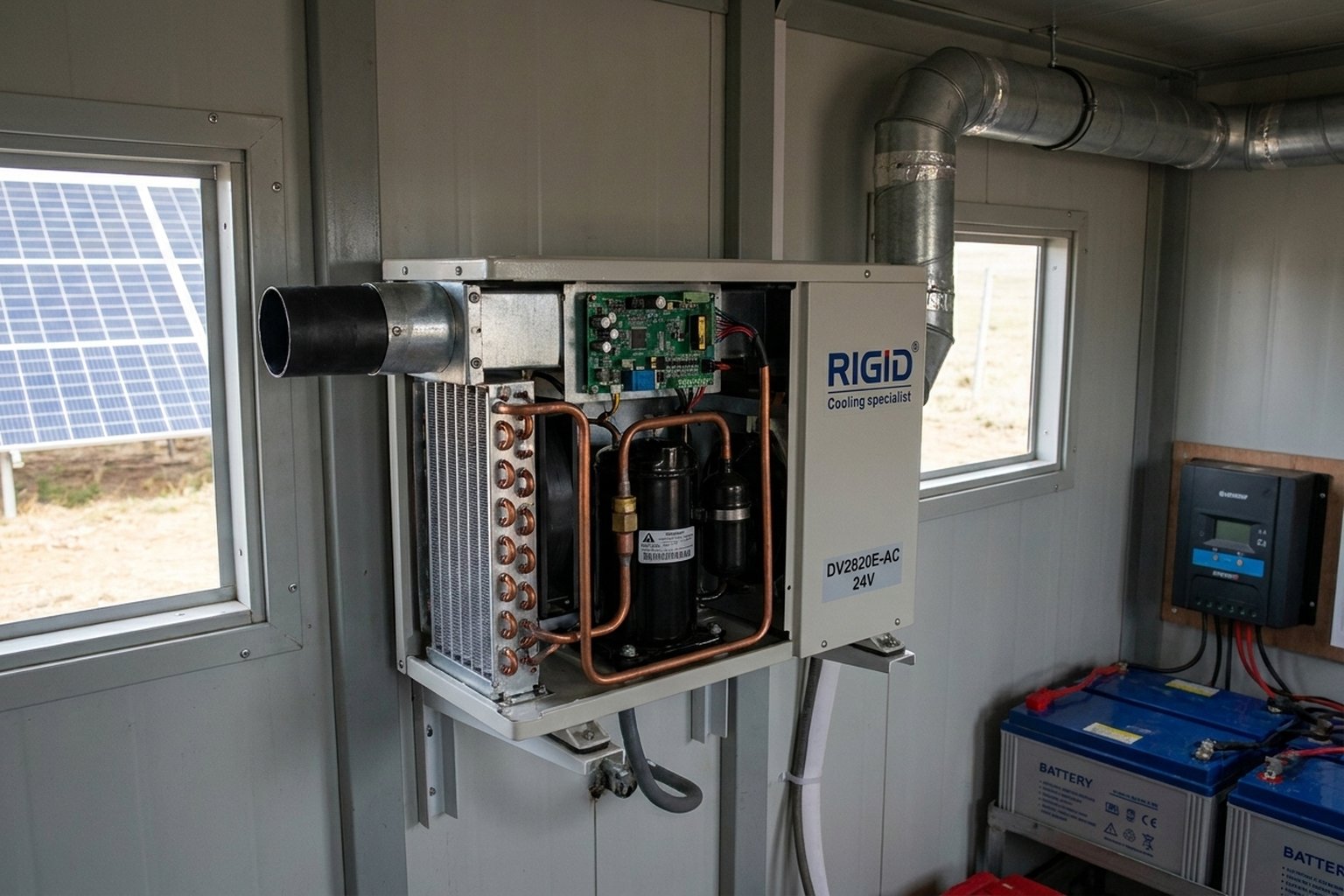
The RIGID DV1910E-AC operates at 12V with a working current of 16A, giving an input power of 192W. This 192W of electrical input produces 450W of cooling capacity—a coefficient of performance (COP) of approximately 2.3. For equipment shelter applications, the compressor does not run continuously. A well-insulated shelter with moderate internal heat loads will cycle the compressor at 40-70% duty cycle depending on ambient conditions.
For solar sizing, assume worst-case: 70% duty cycle during peak heat hours.
Daily Energy Calculation
Step 1: Determine cooling hours. For most locations between 25° and 40° latitude, active cooling is needed 8-10 hours per day during summer months (roughly 08:00 to 18:00).
Step 2: Calculate daily energy consumption.
Daily energy = Input power × Duty cycle × Cooling hours
Daily energy = 192W × 0.70 × 10h = 1,344 Wh/day
Step 3: Account for system losses. Include charge controller efficiency (95%), wiring losses (3%), and battery round-trip efficiency (90% for lithium, 80% for lead-acid).
For a lithium battery system:
Adjusted daily energy = 1,344 ÷ (0.95 × 0.97 × 0.90) = 1,620 Wh/day
Panel Array Sizing
Solar panel output depends on location. Use peak sun hours (PSH) for your site—available from NASA POWER or PVGIS databases.
Required array size = Adjusted daily energy ÷ Peak sun hours
| Location Type | Typical PSH | Required Array (W) | Panels (200W each) |
|---|---|---|---|
| Desert/arid (Southwest US, Middle East) | 6.5h | 249W | 2 panels |
| Temperate (Southeast US, Southern Europe) | 5.0h | 324W | 2 panels |
| Northern/cloudy (Pacific NW, Northern Europe) | 3.5h | 463W | 3 panels |
Engineering margin: For critical infrastructure, add 25% to account for panel degradation, soiling, and anomalous weather. A telecom site in a temperate climate should specify 400-450W of solar capacity dedicated to cooling.
Note: This sizing covers only the cooling load. Your total array must also supply power for the shelter’s primary equipment (radios, sensors, data loggers, lighting) plus their own battery charging requirements.
Battery Bank Autonomy Calculation for Unmanned Sites
Battery autonomy determines how long your cooling system operates without solar input—during extended cloud cover, smoke events, or seasonal low-production periods. For unmanned equipment shelters, autonomy requirements are typically set by the site’s service interval and the criticality of the protected equipment.
Autonomy Targets by Application
- Telecom repeater sites: 2-3 days autonomy (critical infrastructure, high replacement cost)
- Environmental monitoring stations: 1-2 days (data gaps are acceptable but costly to fill)
- Field instrumentation cabinets: 1 day minimum (equipment is hardened but batteries are not)
Battery Capacity Calculation
For 2 days of cooling autonomy with the DV1910E-AC:
Required capacity = Daily energy × Autonomy days ÷ Depth of discharge
Using lithium iron phosphate (LiFePO4) batteries with 80% usable DoD:
Required capacity = 1,344Wh × 2 ÷ 0.80 = 3,360 Wh
At 12V nominal: 3,360Wh ÷ 12V = 280 Ah of battery capacity dedicated to cooling.
For lead-acid systems (AGM/GEL) with 50% recommended DoD:
Required capacity = 1,344Wh × 2 ÷ 0.50 = 5,376 Wh (448 Ah at 12V)
This illustrates why lithium batteries are preferred for remote sites despite higher upfront cost—they require 40% less capacity for the same autonomy, weigh less, and tolerate the elevated temperatures better than lead-acid when kept below 45°C.
https://pub-e1dc3561f27d41a4b14b346813c0a4fc.r2.dev/blog-images/d26-rc-c2.jpg
Intelligent Load Shedding
For sites where full autonomy is cost-prohibitive, implement temperature-based load shedding. Program the cooling system to maintain a relaxed setpoint (35°C instead of 25°C) when battery state-of-charge drops below 40%. Most electronics tolerate 35°C indefinitely—it simply accelerates aging slightly. This approach can reduce autonomy battery requirements by 30-40% while still preventing thermal damage.
Model Selection by Shelter Size and Heat Load
Selecting the correct cooling capacity requires calculating the total heat load inside the shelter. This includes both transmitted heat (through walls and roof) and internal heat generation from equipment.
Heat Load Estimation
Transmitted heat depends on shelter construction, insulation R-value, surface area, and the temperature differential between inside and outside. For a typical insulated equipment shelter (R-13 walls, R-19 roof) measuring 1.2m × 0.8m × 1.5m:
Transmitted heat at ΔT=20°C ≈ 150-250W depending on solar exposure and color.
Internal heat generation is the sum of power consumed by all equipment inside the shelter. A telecom repeater drawing 80W from its DC bus converts nearly all of that to heat. A battery bank charging at 200W generates roughly 10-20W of heat. Total internal generation for a typical small telecom shelter: 100-200W.
Total heat load = Transmitted + Internal = 250-450W
RIGID Micro DC Aircon Model Selection
| Model | Voltage | Cooling Capacity | Input Power | Best Application |
|---|---|---|---|---|
| DV1910E-AC | 12V | 450W | 192W | Small cabinets, single-radio telecom sites, sensor enclosures |
| DV1920E-AC | 24V | 450W | 192W | 24V bus telecom shelters, solar monitoring stations |
| DV1930E-AC | 48V | 450W | 192W | 48V telecom standard bus, fiber distribution hubs |
| DV3220E-AC | 24V | 550W | ~230W | Medium shelters with moderate equipment density |
| DV2820E-AC | 24V | 700W | ~290W | Larger shelters, multiple radio systems, edge computing |
| DV3820E-AC | 24V | 900W | ~375W | High-density equipment rooms, mobile command units |
| DV3830E-AC | 48V | 900W | ~375W | 48V high-capacity sites, data aggregation shelters |
All models weigh approximately 5 kg (11 lbs), produce 27.8 CFM of airflow, and operate with R134a or R290 refrigerant. The cooling temperature range spans 5°C to 30°C, allowing precise setpoint control for different equipment requirements.
Selection rule: Choose a unit whose cooling capacity exceeds your calculated total heat load by at least 20%. This margin accounts for degradation over time, unexpectedly high ambient temperatures, and additional equipment added during future site upgrades.
For 12V systems specifically, the DV1910E-AC at 450W cooling capacity handles shelters with total heat loads up to approximately 375W—covering the majority of small-to-medium remote installations. Sites with higher heat loads should consider stepping up to a 24V bus architecture with the DV2820E-AC or DV3820E-AC.
Installation Considerations for Unmanned Remote Sites
Installing cooling in an unmanned shelter differs fundamentally from occupied-space HVAC. There is no occupant to notice a problem, reset a breaker, or clean a filter. Every design decision must account for months of unattended operation.
Mounting and Airflow
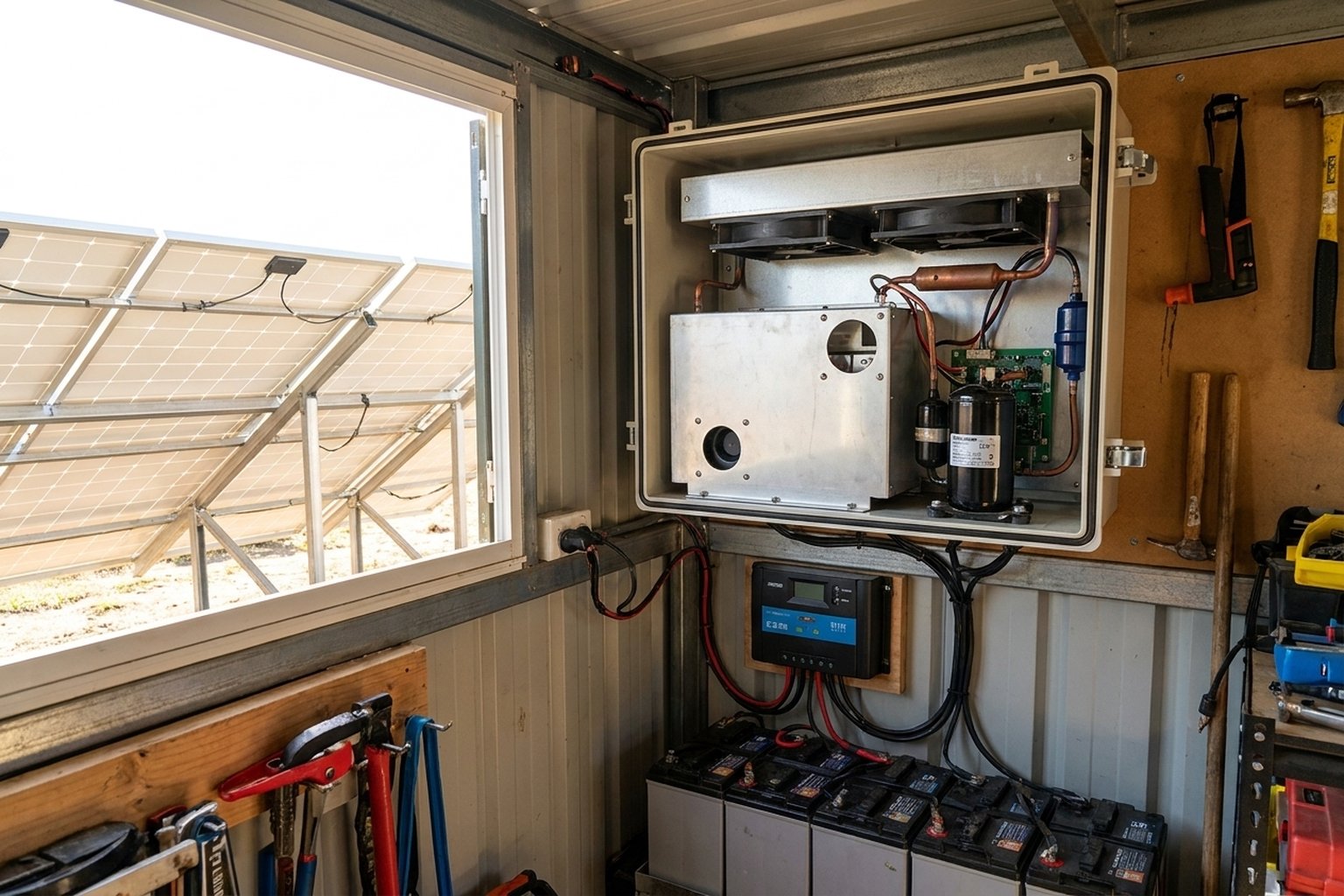
The RIGID Micro DC Aircon compact form factor (approximately 300mm × 200mm × 200mm) allows mounting directly to the shelter wall or ceiling. Position the evaporator outlet to direct cooled air across the highest-heat components first—typically power supplies and radio modules. Avoid dead zones where hot air can stratify.
The condenser (outdoor) section requires adequate clearance for heat rejection. Mount it on the shaded side of the shelter where possible, with at least 150mm clearance from any surface. In dusty environments (desert sites, agricultural areas), orient the condenser fins vertically to allow natural cleaning by wind and rain.
Electrical Integration
Connect the unit directly to the 12V DC bus through an appropriately rated fuse or circuit breaker. At 16A working current, use 10 AWG (6mm²) minimum wire gauge for runs up to 3 meters. For longer runs, size up to limit voltage drop below 3%.
Install a DC contactor or solid-state relay controlled by your site management system. This allows remote power cycling if the unit becomes unresponsive, and enables scheduled operation based on time-of-day or temperature thresholds.
Condensate Management
In humid environments, the evaporator produces condensate that must be routed outside the shelter. Use a gravity drain with a P-trap to prevent insects and debris from entering. In freezing climates, route the drain line through an insulated section or use a heated drain pan to prevent ice blockage during shoulder seasons when cooling may still be needed during daytime.
Environmental Protection
For shelters in harsh environments, protect the condenser section with a mesh guard (minimum 12mm spacing to avoid restricting airflow) against debris, nesting animals, and vandalism. In coastal or high-humidity sites, specify units with conformal-coated control boards and corrosion-resistant condenser coils.
Remote Monitoring and Fault Detection
An unmanned cooling system must communicate its status. Without monitoring, a failed air conditioner goes undetected until equipment damage triggers an alarm—by which point the damage is done.
Temperature Monitoring
Install at minimum two temperature sensors inside the shelter: one at the air intake (representing return air/ambient) and one at the hottest point (typically near power supplies or battery banks). Set alarm thresholds at:
- Warning: Internal temperature exceeds 35°C (cooling may be underperforming)
- Critical: Internal temperature exceeds 45°C (equipment damage imminent, dispatch service)
- Differential alarm: If intake-to-hotspot delta exceeds 15°C, airflow may be obstructed
Power Monitoring
Monitor the DC current draw of the cooling unit. A healthy DV1910E-AC draws approximately 16A at full load and cycles between 8-16A during normal modulation. Anomalies to watch for:
- Zero current with high temperature: Unit has failed or lost power
- Constant full-load current: Unit cannot reach setpoint—possible refrigerant leak, blocked condenser, or heat load exceeds capacity
- Erratic current spikes: Possible compressor bearing wear or electrical fault
Integration with Site Controllers
Most remote site management systems (Schneider Electric SiteManager, Vertiv Liebert, or custom PLC-based controllers) accept analog 4-20mA or digital Modbus inputs. Use a DC current transducer on the cooling unit’s supply line and connect temperature sensors to available analog inputs. Program the controller to send alerts via cellular modem or satellite link when thresholds are breached.
For sites with limited telemetry bandwidth, implement edge logic that only reports state changes and daily summaries rather than continuous streaming. A simple daily health report—peak temperature, average duty cycle, total energy consumed—provides sufficient oversight for most installations.
Total System Cost and ROI Considerations
The economic case for active DC cooling in remote equipment shelters is straightforward: compare the cost of the cooling system against the cost of equipment failure and site visits.
Cooling System Cost Components
- DC air conditioner unit (DV1910E-AC): one-time capital expense
- Dedicated solar capacity (400W): 2× 200W panels
- Dedicated battery autonomy (280Ah LiFePO4): sized for 2-day autonomy
- Installation labor: typically 4-8 hours for a qualified technician
- Monitoring integration: temperature sensors, current transducer, controller programming
Cost of NOT Cooling
- Premature battery replacement: LiFePO4 banks cost significantly more than a cooling system and degrade 2-3× faster without thermal management
- Equipment failure and replacement: A single radio module replacement including site visit labor often exceeds the entire cooling system cost
- Data loss and service interruption: For revenue-generating telecom sites, downtime has direct financial impact
- Accelerated maintenance cycle: Sites without cooling require more frequent preventive maintenance visits
For most installations, the cooling system pays for itself within 12-18 months through extended equipment life and reduced emergency site visits alone.
Engineering Assessment: Right-Sizing Your Installation
Every remote site has unique characteristics—altitude, ambient temperature range, equipment heat load, available solar resource, and service access frequency. A standardized cooling solution may be undersized for high-ambient desert installations or oversized for temperate coastal sites.
The sizing calculations in this guide provide a solid engineering foundation, but site-specific factors can shift requirements significantly. Shelter orientation, nearby reflective surfaces, seasonal temperature extremes, and future equipment additions all influence the optimal system design.
If you are specifying cooling for remote telecom infrastructure, solar-powered monitoring stations, or field instrumentation enclosures, contact the RIGID engineering team for a site-specific thermal assessment. Provide your shelter dimensions, equipment heat load inventory, geographic coordinates, and required autonomy period. The team can recommend the optimal model, solar array size, and battery configuration for your specific deployment—whether that is a single remote cabinet or a fleet of standardized shelters across multiple sites.
Protecting your remote equipment investment starts with proper thermal management. Direct DC cooling eliminates unnecessary complexity, maximizes solar energy utilization, and delivers the reliability that unmanned critical infrastructure demands.