
The compressor is the heart of any refrigeration system, and in 12V mobile applications, choosing the right compressor determines whether your fridge runs reliably for days on battery power or drains your bank by noon. A properly sized 12V DC compressor delivers the cooling capacity you need while consuming minimal power—the difference between a functional off-grid setup and a frustrating one.
This isn’t about brand loyalty or marketing specs. It’s about understanding displacement, efficiency curves, voltage ranges, and how compressor selection impacts your entire electrical system. Whether you’re building a custom portable fridge, upgrading an RV refrigerator, or designing a mobile cooling solution, the compressor choice is the foundation everything else builds on.
How 12V DC Compressors Work
A 12V DC compressor is a hermetically sealed unit containing a motor, piston or rotary mechanism, and refrigerant oil. Unlike AC compressors that run on 120V or 240V alternating current, DC compressors operate directly from battery voltage—typically 12V, 24V, or 48V depending on the application.
The motor inside is a brushless DC (BLDC) design, controlled by an external drive board that regulates speed via pulse-width modulation (PWM). This variable-speed capability is critical: the compressor can ramp from 2,000 RPM at minimum load to 6,000+ RPM at maximum capacity, adjusting cooling output to match demand.
Modern miniature compressors like the QX-series use a single-cylinder rotary design. The QX1901VDL, for example, delivers 110-360W of cooling capacity at 12V by varying motor speed. At 2,000 RPM, it draws approximately 3A and produces 110W of cooling—enough to maintain temperature in a well-insulated 40L fridge. At 6,000 RPM, it draws 30A and delivers 360W—enough to pull down a warm fridge quickly.
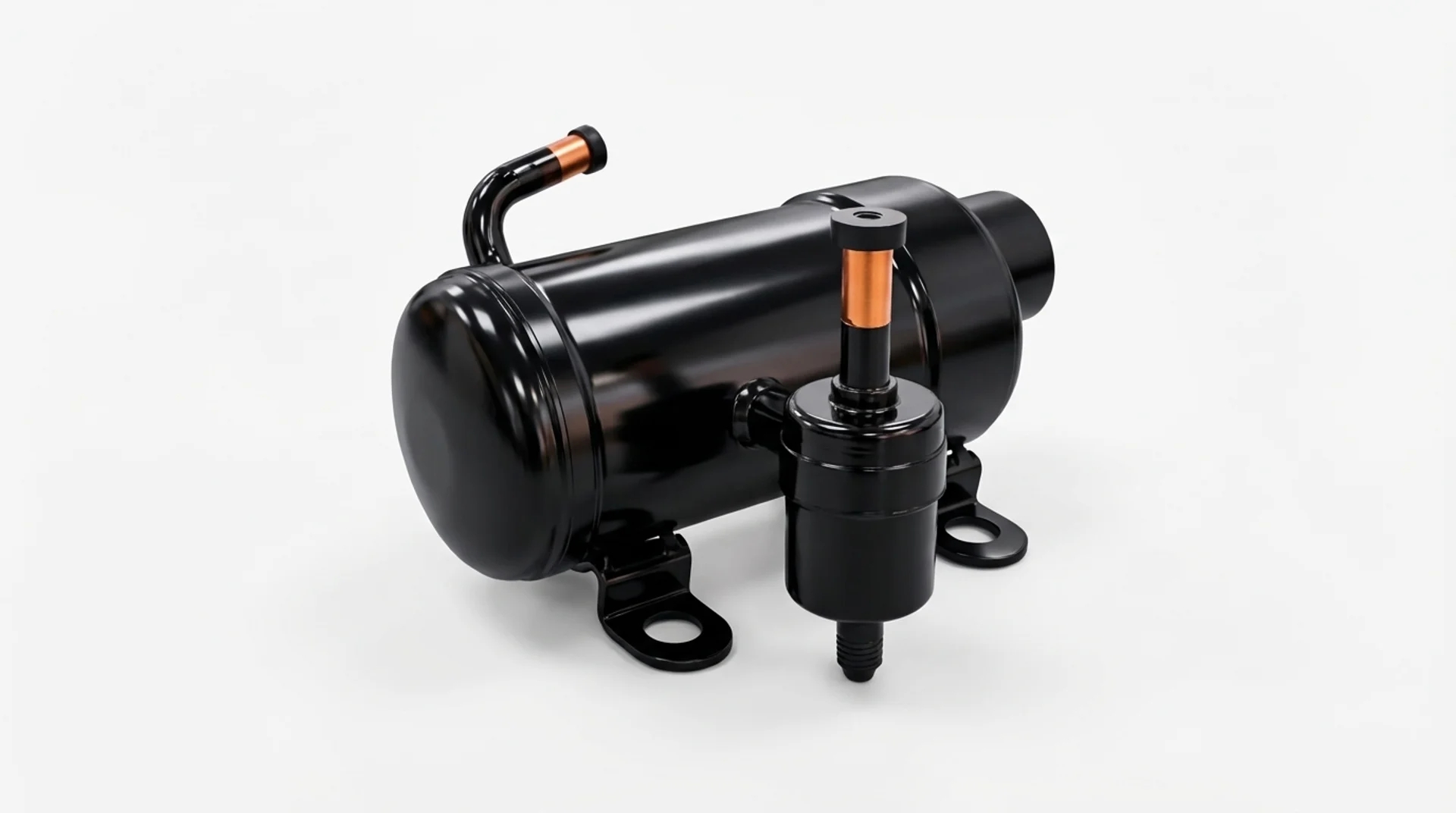 The refrigeration cycle itself is standard vapor-compression: refrigerant (R134a or R600a) is compressed into high-pressure gas, condensed into liquid in the condenser coil, expanded through a capillary tube or expansion valve, and evaporated in the evaporator coil to absorb heat. The compressor’s job is to maintain the pressure differential that drives this cycle.
Compressor Sizing: Matching Capacity to Fridge Volume
Undersizing a compressor means your fridge never reaches target temperature in hot weather. Oversizing wastes power and money. The sizing calculation depends on fridge volume, insulation quality, ambient temperature, and usage pattern.
A general guideline for well-insulated portable fridges: 2.5-3.5W of cooling capacity per liter of internal volume in moderate climates (70-85°F ambient), 3.5-4.5W per liter in hot climates (85-100°F), and 4.5-5.5W per liter in extreme heat (100°F+) or poorly insulated boxes.
For a 40L portable fridge with 2-inch foam insulation operating in 85°F ambient conditions, you need approximately 140-180W of cooling capacity. A QX1901VDL compressor (110-360W range) is appropriately sized—it can maintain temperature at low speed (110-140W) and has reserve capacity to pull down a warm load.
For a 60L fridge in the same conditions, you need 210-270W. A QX1902VDL (125-400W at 24V) or QX3202VDL (550W at 24V) would be suitable, though the latter is oversized unless you’re operating in extreme heat or need rapid pulldown.
For a 100L chest fridge or RV refrigerator, you’re looking at 350-450W minimum. A QX3202VDL (550W) or QX8848VDL (1,067W at 48V) provides adequate capacity with margin for door openings and thermal mass.
Voltage Selection: 12V, 24V, or 48V?
Compressor voltage must match your electrical system voltage. Most portable fridges and small RV refrigerators use 12V systems because they integrate with the vehicle’s existing battery. Larger systems and off-grid installations often use 24V or 48V for efficiency.
12V systems are standard in automotive and marine applications. A 12V compressor drawing 200W consumes approximately 16.7A at full load. This requires 10 AWG wire for runs up to 10 feet, 8 AWG for 10-20 feet, to keep voltage drop under 3%. The advantage is compatibility with existing vehicle electrical systems. The disadvantage is high current draw, which stresses wiring and connectors.
24V systems are common in larger RVs, trucks, and off-grid setups. The same 200W load draws only 8.3A at 24V, allowing smaller wire (12 AWG for most runs) and reducing resistive losses. Many commercial portable fridges use 12/24V auto-switching compressors that detect input voltage and adjust accordingly.
48V systems are used in electric vehicles, heavy equipment, and high-capacity refrigeration. A 500W compressor draws only 10.4A at 48V, enabling long cable runs with minimal voltage drop. The QX8848VDL delivers 1,067W at 48V, suitable for walk-in coolers or multi-zone refrigeration systems.
Power Consumption and Battery Sizing
Understanding compressor power consumption is critical for battery bank sizing and solar panel calculations.
A 12V compressor rated at 200W doesn’t draw 200W continuously. It cycles based on thermostat settings and thermal load. In a well-insulated fridge at steady-state (maintaining 38°F in 75°F ambient), the compressor typically runs 25-35% of the time—called the duty cycle.
If the compressor draws 200W when running and operates at 30% duty cycle, average power consumption is 60W. Over 24 hours, that’s 1,440Wh (1.44kWh). At 12V, that’s 120Ah from the battery bank.
But duty cycle varies dramatically with conditions. In 95°F ambient with frequent door openings, duty cycle can reach 60-70%, doubling power consumption to 2,880Wh (240Ah per day). In cool weather (60°F ambient) with minimal door openings, duty cycle drops to 15-20%, reducing consumption to 720-960Wh (60-80Ah per day).
For battery sizing, use worst-case assumptions: high ambient temperature, frequent door openings, and add 20% margin for battery aging and inefficiency. A fridge consuming 240Ah per day in worst-case conditions requires a minimum 300Ah lithium battery bank (allowing discharge to 20% state of charge) or 480Ah lead-acid bank (50% depth of discharge limit).

Compressor Specifications: What the Numbers Mean
Compressor datasheets list several key specifications. Understanding these numbers helps you compare models and predict performance.
Displacement: Measured in cubic centimeters (cc), this is the volume of refrigerant the compressor moves per revolution. A QX1901VDL has approximately 6.5cc displacement. Higher displacement generally means higher capacity, but efficiency matters more than raw displacement.
Cooling capacity: Measured in watts or BTU/hr under standard conditions (typically 90°F ambient, 0°F evaporator temperature, R134a refrigerant). The QX1901VDL is rated 110-360W depending on speed. Real-world capacity varies with ambient temperature, evaporator temperature, and refrigerant type.
Power input: The electrical power consumed by the compressor motor. At maximum speed, the QX1901VDL draws approximately 360W input to produce 360W cooling—but this is at ideal conditions. At partial load, efficiency improves: 140W input might produce 140W cooling.
COP (Coefficient of Performance): The ratio of cooling output to power input. A COP of 1.5 means the compressor produces 1.5W of cooling for every 1W of electrical input. Variable-speed DC compressors typically achieve COP of 1.2-1.8 depending on operating conditions. Higher COP means better efficiency and longer battery runtime.
Speed range: The minimum and maximum RPM the compressor can operate. The QX1901VDL runs 2,000-6,000 RPM. Wider speed range allows better capacity modulation and efficiency at partial load.
Voltage range: The acceptable input voltage. A 12V compressor typically operates from 10.5V to 15V, allowing for battery voltage sag under load and charging voltage rise. Operating below minimum voltage triggers low-voltage protection on the drive board.
Drive Board Selection and Configuration
The drive board (also called controller or inverter board) is as important as the compressor itself. It converts DC battery voltage into the three-phase AC waveform that drives the BLDC motor, regulates speed, and provides protection functions.
A typical 12V compressor drive board like the DA1510 includes:
- Speed control: PWM regulation from 2,000-6,000 RPM based on thermostat input or manual setting
- Soft start: Gradual current ramp-up to avoid inrush spikes that stress batteries
- Overcurrent protection: Shuts down if current exceeds safe limits (locked rotor, refrigerant overcharge)
- Thermal protection: Monitors compressor temperature and reduces speed or shuts down if overheating occurs
- Low voltage cutoff: Protects batteries from over-discharge by shutting down at 10.5V (12V systems) or 21V (24V systems)
Drive boards are matched to specific compressor models. A DA1510 board is designed for the QX1901VDL compressor and won’t work properly with other models. Always use the manufacturer-specified drive board or a confirmed compatible replacement.
Refrigerant Compatibility: R134a vs R600a
Most 12V DC compressors are designed for either R134a (HFC refrigerant) or R600a (isobutane, a hydrocarbon refrigerant). The two are not interchangeable—using the wrong refrigerant destroys efficiency and can damage the compressor.
R134a systems use synthetic PAG or POE oil, operate at higher pressures (typically 150-200 PSI high side, 20-30 PSI low side), and require larger capillary tubes. R134a is non-flammable, widely available, and compatible with standard refrigeration components. Most commercial portable fridges use R134a.
R600a systems use mineral oil, operate at lower pressures (80-120 PSI high side, 10-20 PSI low side), and require smaller capillary tubes. R600a has excellent thermodynamic properties and near-zero global warming potential, but it’s flammable (A3 classification). European and Asian portable fridges often use R600a for environmental reasons.
If you’re building a custom fridge, choose a compressor designed for your preferred refrigerant. If you’re replacing a compressor, use the same refrigerant type as the original system. Converting between R134a and R600a requires changing the capillary tube, oil, and possibly other components—not a simple swap.
Installation Considerations
Proper compressor installation ensures reliable operation and maximum efficiency.
Mounting orientation: Most miniature compressors can mount in any orientation, but check the datasheet. Some models require upright mounting (compressor vertical) to ensure proper oil return. Horizontal mounting is generally acceptable for rotary compressors.
Vibration isolation: Compressors generate vibration, especially at high speed. Mount on rubber grommets or isolation pads to prevent noise transmission to the fridge cabinet. Rigid mounting amplifies vibration and creates annoying hum.
Ventilation: The compressor and condenser coil reject heat. Ensure adequate airflow around the compressor—at least 2 inches clearance on all sides. Blocked airflow causes the compressor to overheat, reducing efficiency and triggering thermal protection.
Wiring: Use wire sized for maximum current draw with minimal voltage drop. For a 12V compressor drawing 30A, use 10 AWG for runs up to 10 feet, 8 AWG for 10-20 feet. Install a fuse or circuit breaker rated 125% of maximum current (37.5A fuse for a 30A compressor) within 18 inches of the battery positive terminal.
Refrigerant lines: Use copper tubing sized per the compressor datasheet. Typical sizes: 1/4″ OD for suction line, 3/16″ OD for discharge line. Keep lines as short as practical, avoid sharp bends, and insulate the suction line to prevent condensation.
Troubleshooting Common Issues
Compressor won’t start: Check battery voltage under load. If voltage drops below 10.5V (12V system) when the compressor tries to start, the drive board’s low-voltage protection activates. Solution: charge the battery or reduce other loads. Also check fuse, wiring connections, and drive board power LED.
Compressor runs but doesn’t cool: Check for refrigerant leak (look for oil stains at fittings), blocked condenser airflow, or failed condenser fan. If the compressor is hot to touch but the condenser coil is cool, refrigerant is low. If both are hot, airflow is blocked.
Compressor cycles on/off rapidly: This is short-cycling, usually caused by low refrigerant charge, thermostat set too cold, or oversized compressor for the load. Check refrigerant level first. If charge is correct, adjust thermostat to a warmer setting or add thermal mass (water bottles) to the fridge to stabilize temperature.
High power consumption: Check door seal for leaks, ensure adequate insulation, verify condenser coil is clean, and confirm ambient temperature isn’t excessive. A dirty condenser coil can increase power consumption 20-30%. Clean with compressed air or soft brush.
Compressor overheating: Ensure adequate ventilation around compressor and condenser. Check condenser fan operation. Verify refrigerant charge—overcharge causes high head pressure and overheating. If the compressor is hot but the condenser coil is only warm, the system is overcharged.
Comparing Compressor Models
When selecting between compressor models, consider these factors:
QX1901VDL (12V, 110-360W): Ideal for 30-50L portable fridges, small RV refrigerators, and compact cooling applications. Draws 3-30A depending on speed. Best for applications where 12V compatibility is required and cooling load is moderate.
QX1902VDL (24V, 125-400W): Suitable for 50-70L fridges and medium-duty applications. Draws 5-16A at 24V. Better efficiency than 12V equivalent due to lower current. Available in tropical version (QX1902VDL-T) rated for 130°F ambient.
QX3202VDL (24V, 550W): Designed for 80-120L fridges, chest freezers, and high-capacity applications. Draws up to 23A at 24V. Provides rapid pulldown and maintains temperature in extreme conditions.
QX8848VDL (48V, 1,067W): Heavy-duty compressor for walk-in coolers, multi-zone systems, and commercial applications. Draws 22A at 48V. Requires 48V electrical system but offers excellent efficiency at high capacity.
For detailed specifications and application guidance, see our 12V compressor product line.
Future Developments
Compressor technology continues to evolve. Emerging trends include higher-efficiency motors (magnetic bearings, optimized winding designs), wider speed ranges (1,500-7,000 RPM for better part-load efficiency), and smart controls with IoT connectivity for remote monitoring and predictive maintenance.
Refrigerant transitions are ongoing. R134a is being phased out in favor of lower-GWP alternatives like R513A (GWP 631) and R1234yf (GWP 4). R600a adoption is increasing in portable fridges due to environmental benefits, despite flammability concerns.
Compressor miniaturization continues. Next-generation designs may achieve 400-500W capacity in packages smaller than current 200W models, enabling more compact portable fridges and new applications in medical transport, drone cooling, and wearable climate control.