
12V Freezer Compressor: Why a Freezer Is Not Just a Colder Fridge
Swap the thermostat on a 12V fridge build for one that reads −18 °C and the box will try to become a freezer. Sometimes it gets there. Often it runs flat out for hours, never quite reaches temperature on a warm day, drains the battery, and fills the evaporator with frost. The hardware looks the same; the operating conditions are not.
A 12V freezer compressor works at a much lower evaporating temperature than the same compressor in a fridge, and almost every property that matters — capacity, pressure ratio, oil return, suction pressure, frost — changes with it. The difference between a fridge and a freezer is not ten or twenty degrees on a thermostat; it is a different operating regime for the compressor.
This guide explains what changes below −18 °C, works through a heat load for a small DC chest freezer, and lists what to check before choosing a compressor for a freezer rather than a fridge.
The Evaporating Temperature Sets Everything
The number that governs the compressor is not the box temperature but the evaporating temperature — the temperature at which refrigerant boils inside the evaporator. To pull heat from air or a plate at a given temperature, the refrigerant has to be colder than that surface by a working margin.
| Application | Typical box temperature | Typical evaporating temperature |
|---|---|---|
| Fridge | +2 to +5 °C | Roughly −10 to −15 °C |
| Fridge-freezer set cold | −10 °C | Roughly −18 to −22 °C |
| Freezer | −18 °C | Roughly −25 to −30 °C |
Values are typical, not fixed: a large, well-designed evaporator runs a smaller margin; a small cold plate in a crowded box runs a larger one. The point is that moving from fridge to freezer duty pushes the compressor’s evaporating temperature down by something like fifteen degrees, and compressor behavior is strongly non-linear in that range.
Capacity Falls Faster Than Temperature
A 12V freezer compressor delivers far less cooling at −28 °C evaporating than at −10 °C, even at the same speed. The mechanism is suction gas density. At a lower evaporating temperature the refrigerant vapor entering the compressor is thinner, so each revolution moves less mass — and cooling capacity is proportional to the mass of refrigerant circulated.
- Mass flow drops because suction density drops, so capacity falls steeply as evaporating temperature goes down.
- Pressure ratio rises, because condensing pressure stays set by ambient while suction pressure falls. Higher ratios mean higher discharge temperature and lower volumetric efficiency.
- Input power usually falls somewhat, but not as fast as capacity, so efficiency drops as well.
This is why a published capacity figure has to be read with its test conditions. RIGID’s QX1901VDL(H) 12V miniature compressor is published at 100–455 W across 2,000–6,000 rpm, but the conditions behind that range are not stated on the product page. Do not size a freezer on a capacity number whose evaporating temperature you do not know; ask for performance data at the evaporating temperature your freezer will actually run.
Many compressors are also classified by application: LBP (low back pressure, for freezers), MBP (medium, for fridges and coolers) and HBP (high, for air conditioning and chillers). RIGID’s miniature compressor range is listed for all three duties, which makes it more important, not less, to confirm which model and configuration suits a freezer.
The Suction Line Goes Below Atmospheric Pressure
One consequence of freezer duty is specific to the refrigerant. R134a, which the QX series uses, boils at about −26 °C at atmospheric pressure. A freezer evaporator running colder than that has suction pressure below atmospheric.
That changes how a leak behaves. In a fridge, a small leak pushes refrigerant out. In a freezer running below −26 °C evaporating, a leak on the low side can pull air and moisture in. Moisture can freeze at the capillary tube or expansion device and block flow intermittently; air raises condensing pressure and cuts capacity further. That is one possible cause of a freezer that cools, stops, warms up and starts again, although supply voltage and controller protection should be checked first.
For custom builds this raises the standard for brazing, evacuation and leak testing on the low side. A joint that would be merely slow to leak in a fridge can quietly ruin a freezer.
Sizing the Heat Load for a Small DC Freezer
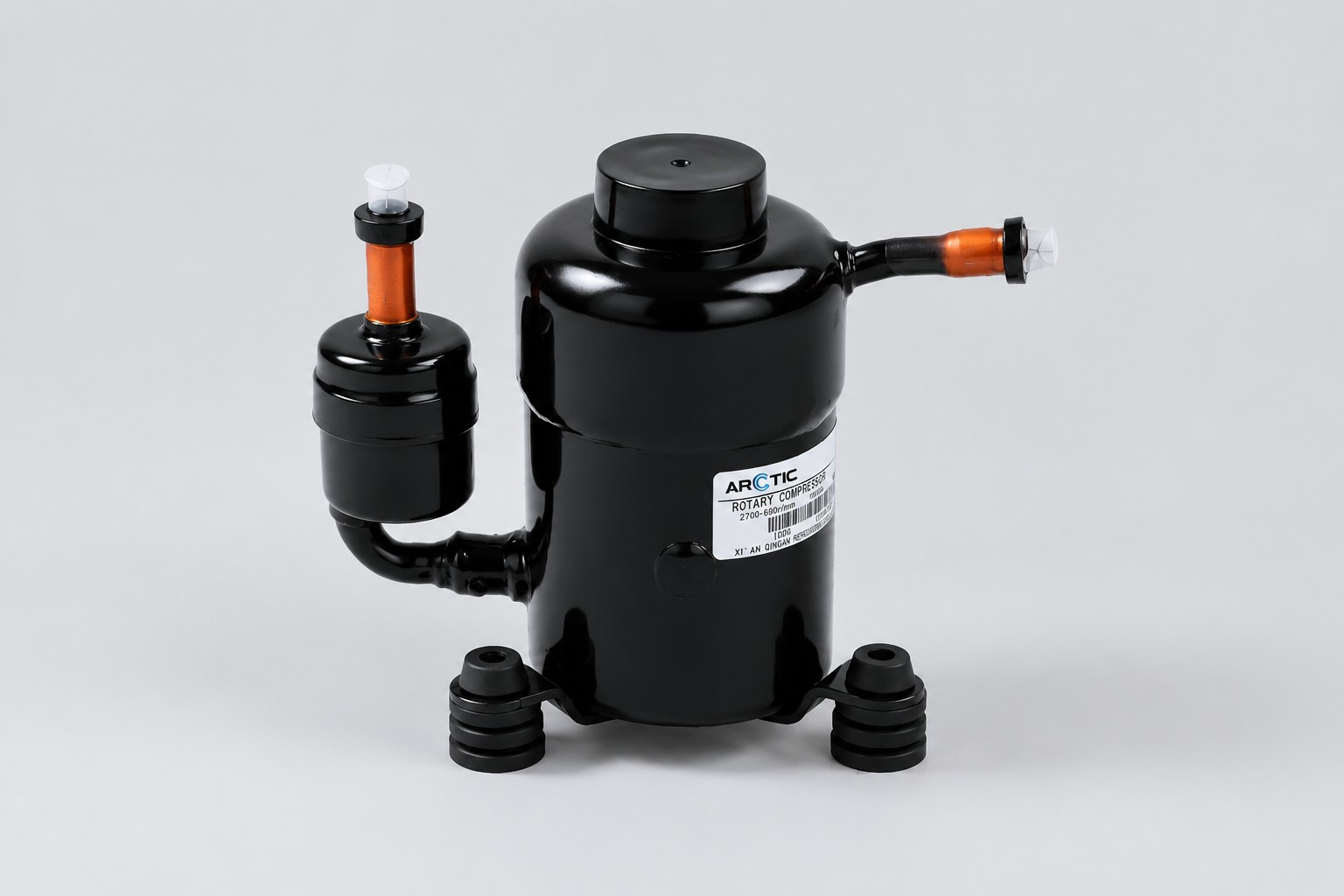 The heat load is where many 12V freezer builds are underestimated. Take a 50 L chest freezer in a vehicle. All values are assumed for illustration.
| Input | Value used | Basis |
|---|---|---|
| Internal surface area | 1.5 m² | Assumed for a 50 L chest box |
| Insulation | 50 mm polyurethane, k = 0.024 W/m·K | Assumed, typical rigid foam |
| Ambient | 32 °C | Assumed hot vehicle interior |
| Box temperature | −18 °C | Freezer target |
| Lid gasket, openings, product loading | 15 W average | Assumed |
Conduction through the walls: U = 0.024 / 0.05 = 0.48 W/m²·K. Load = 0.48 × 1.5 × (32 − (−18)) = 36 W. Adding 15 W for the lid and openings gives about 51 W steady.
The same box as a fridge at +4 °C conducts 0.48 × 1.5 × 28 = 20 W, or about 35 W with the same allowance. The freezer load is roughly 1.5 to 2 times the fridge load from the same box, and it has to be met at an evaporating temperature where the compressor delivers much less capacity. Both effects work in the same direction.
Two practical conclusions follow. First, insulation thickness matters more for a freezer than for a fridge, because the temperature difference is larger; the diminishing-returns analysis in our fridge insulation thickness guide shifts toward thicker walls when the box runs at −18 °C. Second, a pull-down allowance on top of steady load is essential, because a freezer starting warm with food inside can take many hours to reach temperature on a small compressor.
Choosing the Compressor and Its Speed
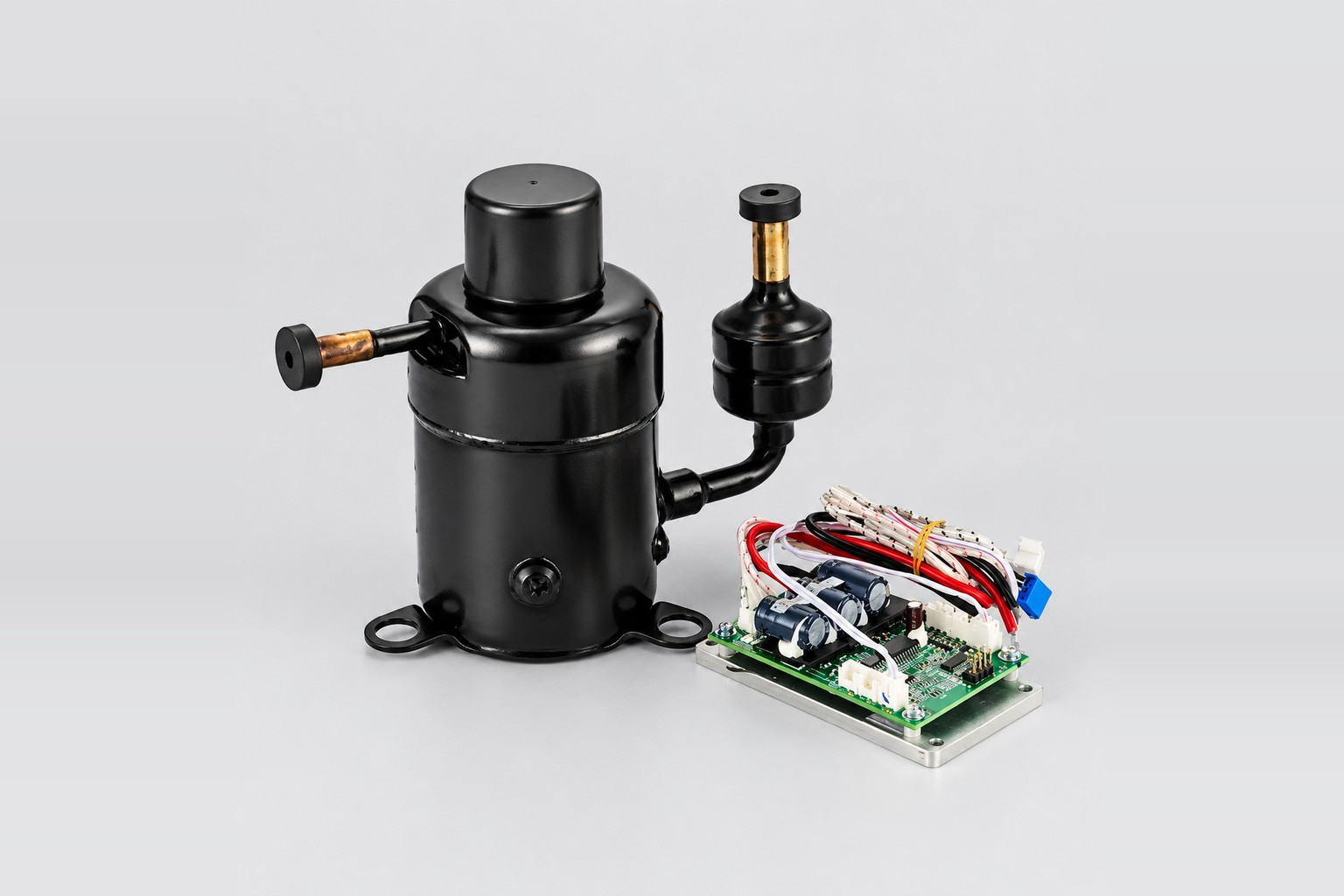 Speed is the main lever a variable-speed 12V freezer compressor gives you. Running faster moves more refrigerant mass and recovers some of the capacity lost to low suction density. Running slower saves current and noise once the box is at temperature.
- Size for the pull-down and hot-day steady load at freezer evaporating temperatures, not for the rated capacity at an unstated condition.
- Expect a freezer to spend more of its time at higher speed than the same compressor in a fridge, with correspondingly higher average current. The QX1901VDL(H) is published with a 2,000–6,000 rpm range; current draw is not published for that model, so budget battery capacity from measured data rather than assumptions.
- Consider the 24V version where the vehicle or battery system allows it. The QX1902VDL(H) is published at the same 100–455 W range; at the same input power, a 24V supply halves the current, which halves the voltage drop in a given cable and cuts its resistive loss to a quarter.
- For larger freezers, check whether a bigger compressor is more appropriate than running a small one at maximum speed continuously. RIGID’s 12V range also includes the XB075Z-12 at a published 850 W, though its application class and test conditions should be confirmed for freezer duty.
A broader selection walkthrough for DC fridge and freezer compressors is in our 12V DC fridge compressor guide, and the full model list is on the 12V compressor product page.
Capillary Tube, Charge and Oil Return
A compressor that works well in a fridge can still fail as a freezer if the rest of the circuit is not adjusted.
- Metering device. A capillary tube chosen for fridge duty may not suit freezer pressures. Depending on the circuit it can overfeed or underfeed the evaporator, so recheck the capillary, the charge and the whole operating envelope for freezer conditions rather than applying one fixed rule.
- Refrigerant charge is critical in small systems. A charge that is correct for a fridge can be wrong for the same circuit run as a freezer; small systems tolerate only a few grams of error.
- Oil return depends on refrigerant velocity. At low mass flow, oil can log in the evaporator and suction line, especially in long or vertical runs, starving the compressor. Keep suction lines short, sized for velocity, and sloped toward the compressor where practical.
- Discharge temperature rises with pressure ratio. Good condenser airflow and a condenser sized for hot ambient keep condensing pressure, and therefore the ratio, as low as possible.
Frost, Defrost and Lid Discipline
Frost builds faster in a freezer. Every time the lid opens, humid air enters, and its moisture freezes onto the coldest surface — the evaporator. Frost insulates that surface, which forces a lower evaporating temperature to move the same heat, which cuts capacity further.
Chest designs with top-opening lids lose far less cold air per opening than upright designs, which is one reason most DC freezers are chests. Even so, a freezer needs a practical defrost routine and somewhere for the meltwater to go; our defrost and meltwater drainage guide covers the options for DC builds.
What Goes Wrong in 12V Freezer Builds
| Symptom | Likely cause | What to check |
|---|---|---|
| Runs constantly, never reaches −18 °C on warm days | Capacity at freezer evaporating temperature below the load | Heat load, insulation, compressor data at the real evaporating temperature |
| Cools, stops, warms, cools again | Supply voltage sagging to the controller cutoff, a protection trip, or moisture freezing in the capillary | Voltage at the compressor during start, controller fault indication, then leak test and filter drier |
| High battery drain | Compressor running at high speed most of the time | Insulation, 24V option, measured current rather than assumed |
| Evaporator iced solid | Frequent lid openings, no defrost routine | Lid discipline, defrost interval, gasket condition |
| Compressor hot, capacity drifting down | High pressure ratio, poor condenser airflow | Condenser clearance, ambient, airflow path |
Checklist Before Choosing a 12V Freezer Compressor
- Calculate the steady heat load at −18 °C and your hottest expected ambient, then add pull-down margin.
- Estimate the evaporating temperature your evaporator design will run, and get compressor performance data at that temperature.
- Confirm the compressor’s application class and refrigerant suit freezer duty.
- Budget battery capacity from measured current at freezer conditions, and consider 24V if available.
- Recheck the capillary or expansion device and the charge for freezer pressures, not fridge pressures.
- Plan insulation thickness, lid design and defrost before finalizing the compressor, because they change the load it has to meet.
If you want a freezer build reviewed, send the following and our engineers will advise: box volume and insulation, target temperature, hottest ambient, supply voltage and battery capacity, evaporator type and size, and whether the freezer must pull down from warm with product inside. Send your freezer build details to our engineering team.
Frequently Asked Questions
Can I use a fridge compressor as a 12V freezer compressor?
Sometimes, but not automatically. The same compressor delivers much less capacity at freezer evaporating temperatures, runs at a higher pressure ratio, and may need a different capillary tube and charge. Check the compressor’s application class and ask for performance data at around −25 to −30 °C evaporating before relying on it for freezer duty.
How much does a 12V freezer compressor need to deliver?
Enough to meet the steady heat load at freezer temperature on your hottest day, plus pull-down margin — measured at the evaporating temperature the freezer will actually run. In the worked example above, a 50 L chest box with 50 mm polyurethane insulation needs about 51 W steady at 32 °C ambient, roughly 1.5 to 2 times the same box as a fridge.
Why does my DC freezer cool, then stop, then start again?
Start with the electrical side: measure the voltage at the compressor while it starts and check the controller for fault or protection indications, because a supply that sags below the cutoff produces exactly this pattern. If the supply is sound, moisture freezing inside the capillary tube is another possible cause. Freezer evaporators using R134a can run below atmospheric pressure, so a low-side leak can draw in air and moisture; leak testing, thorough evacuation and a fresh filter drier address that.
Is 24V better than 12V for a freezer?
At the same input power, a 24V system draws half the current, so a given cable has half the voltage drop and a quarter of the resistive loss — useful for a freezer that runs at high speed much of the time. RIGID’s QX1902VDL(H) is published at the same 100–455 W range as the 12V QX1901VDL(H).
How thick should freezer insulation be?
Thicker than for a fridge, because the temperature difference across the walls is much larger. In the example, 50 mm of polyurethane conducts 36 W at −18 °C box and 32 °C ambient; doubling the thickness roughly halves that. Beyond a point the returns diminish, but the optimum sits further out for a freezer than for a fridge.
Why does a freezer frost up so quickly?
Every lid opening lets in humid air, and its moisture freezes onto the evaporator — the coldest surface in the box. Frost insulates the evaporator, which lowers the evaporating temperature and cuts capacity further. Chest lids, good gaskets and a regular defrost routine keep it under control.