
24V DC Air Conditioner: Quick Answer for Equipment Operators
If you need a compact cooling solution that runs directly on your vehicle’s 24V electrical system — without an inverter, without idling the engine, and without tearing apart your cab — a 24V DC air conditioner with a BLDC compressor is the most practical option available today. These units deliver 550W to 900W of cooling capacity while drawing only 8–12A, making them suitable for forklift cabs, excavator cabins, golf carts, small truck cabs, and enclosed equipment compartments up to 4 cubic meters.
TL;DR: Match your cab volume and heat load to the right unit. The DV2820E-AC (700W) covers most standard cabs. Go smaller with the DV3220E-AC (550W) for golf carts and compact enclosures, or step up to the DV3820E-AC (900W) for excavator cabs with large glass areas. All three run on 24V DC with R134a refrigerant and variable-speed BLDC compressors.
Who This Guide Is For
This selection guide is written for:
- Fleet managers looking to reduce idle time and fuel costs while keeping operators comfortable across a mixed fleet
- Equipment operators who spend 8+ hours in cabs that reach 50°C+ in direct sun and need reliable cooling without engine dependency
- Vehicle upfitters integrating aftermarket cooling into custom builds — utility trucks, mobile workshops, specialty vehicles
- Facility managers responsible for operator welfare in warehouses, ports, and construction sites where equipment runs on 24V systems
If you’re outfitting a large semi-truck sleeper cab (volumes above 4m³), you’ll need a higher-capacity system like the HS23P (2,300W). This guide focuses on compact cab environments where space, weight, and power draw are primary constraints.
Why 24V DC Matters for Heavy Equipment Cooling
Most heavy equipment — forklifts, excavators, wheel loaders, mining trucks, and military vehicles — runs on 24V electrical systems. Traditional vehicle AC requires the engine to run, wasting fuel and adding wear. Aftermarket 110V/220V units need bulky inverters that introduce conversion losses and failure points.
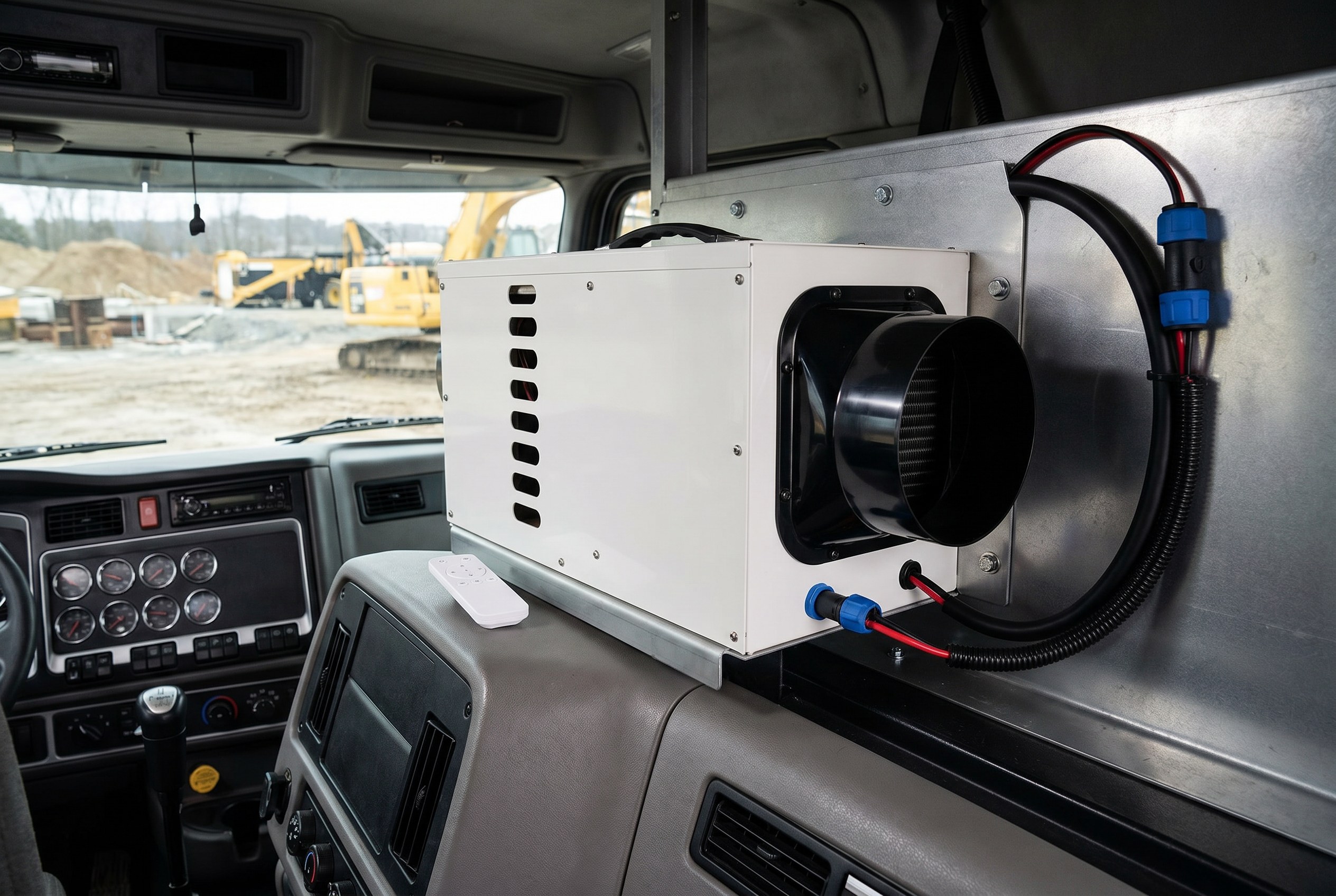
A purpose-built 24V DC air conditioner connects directly to the existing electrical system. No inverter. No engine idling. No additional alternator upgrades in most cases. The BLDC (brushless DC) compressor technology used in these units provides variable-speed operation that adjusts cooling output to actual demand — drawing less current at partial load and extending battery life during engine-off periods.
Decision Framework: How to Choose the Right 24V Unit
Selecting the correct unit comes down to four factors:
1. Cab Volume and Insulation Quality
Measure your interior space in cubic meters. A standard forklift cab runs 1.5–2.5m³. An excavator cab is typically 2.5–3.5m³. A golf cart canopy enclosure is around 1–1.5m³. The insulation quality of your cab determines how much cooling capacity you actually need — a well-insulated metal cab retains cool air far better than a glass-heavy excavator cabin.
2. Heat Load Sources
Consider solar gain through windows, heat radiation from the engine or hydraulics, number of occupants, and ambient temperature extremes. Excavators with large windshields in direct sun face significantly higher heat loads than enclosed forklift cabs in warehouses.
3. Available Electrical Budget
Check your alternator output and existing electrical loads. A 24V system with a 60A alternator has roughly 1,440W total capacity. Subtract existing loads (lights, electronics, hydraulic controls) to determine what’s available for cooling. The DV2820E-AC draws 8A at rated speed — just 192W from your electrical budget at cruise.
4. Physical Space and Mounting
These split-system units have an indoor evaporator and outdoor condenser. Measure available mounting locations. The evaporator needs airflow into the cab. The condenser needs exterior airflow and drainage for condensate.
Selection Matrix: 24V DC Air Conditioner Comparison
| Specification | DV3220E-AC | DV2820E-AC | DV3820E-AC |
|---|---|---|---|
| Cooling Capacity | 550W (1,876 BTU) | 700W (2,388 BTU) | 900W (3,070 BTU) |
| Voltage | 24V DC | 24V DC | 24V DC |
| Working Current | ~6A | 8A | ~10A |
| Refrigerant | R134a | R134a | R134a |
| Compressor Type | BLDC Variable Speed | BLDC Variable Speed | BLDC Twin Cylinder |
| Speed Range | 1,000–4,500 RPM | 1,000–4,500 RPM | 1,000–4,500 RPM |
| COP (Rated) | ~2.5 | ~2.5 | ~2.5 |
| Recommended Cab Volume | 1–2m³ | 2–3.5m³ | 3–4m³ |
| Ideal Applications | Golf carts, small enclosures, instrument cabinets | Forklift cabs, small truck cabs, utility vehicles | Excavator cabs, large equipment cabins |
Note: COP improves at partial load. When the BLDC compressor runs at lower speeds during maintenance cooling (after initial pulldown), efficiency increases above the rated 2.5 figure. This means real-world energy consumption is often lower than peak-load calculations suggest.
Need Help Sizing Your System?
Our engineering team can review your cab dimensions, operating conditions, and electrical system to recommend the right configuration. Request a consultation — we’ll respond within 24 hours with a tailored recommendation.
Application Breakdown by Equipment Type
Forklift Cabs
Electric and diesel forklifts with enclosed cabs are one of the most common applications. Warehouse forklifts face moderate heat loads (no direct sun) but operators demand consistent comfort during long shifts. The DV2820E-AC at 700W handles most forklift cabs comfortably. For outdoor forklifts in hot climates, consider the DV3820E-AC.
Excavator and Construction Equipment
Excavator cabs present the highest challenge: large glass areas, direct sun exposure, and heat radiation from hydraulic systems below the cab floor. The DV3820E-AC (900W) is the recommended starting point. Ensure the condenser mounting location has adequate airflow and is protected from debris.
Golf Carts and Utility Vehicles
Golf carts and small utility vehicles have minimal cab volume (often under 1.5m³) but limited battery capacity. The DV3220E-AC at 550W provides adequate cooling with the lowest current draw — critical for battery-electric vehicles where every amp-hour counts.
Truck Cabs (Day Cabs and Small Sleepers)
For day cabs and small truck cabins under 3.5m³, the DV2820E-AC delivers solid performance. It’s particularly effective for delivery trucks, utility trucks, and service vehicles where the driver needs cooling during stops without idling. For full-size sleeper cabs, these units are undersized — look at the higher-capacity DC air conditioning systems designed for larger volumes.
Installation Considerations for Vehicle and Equipment Cabs
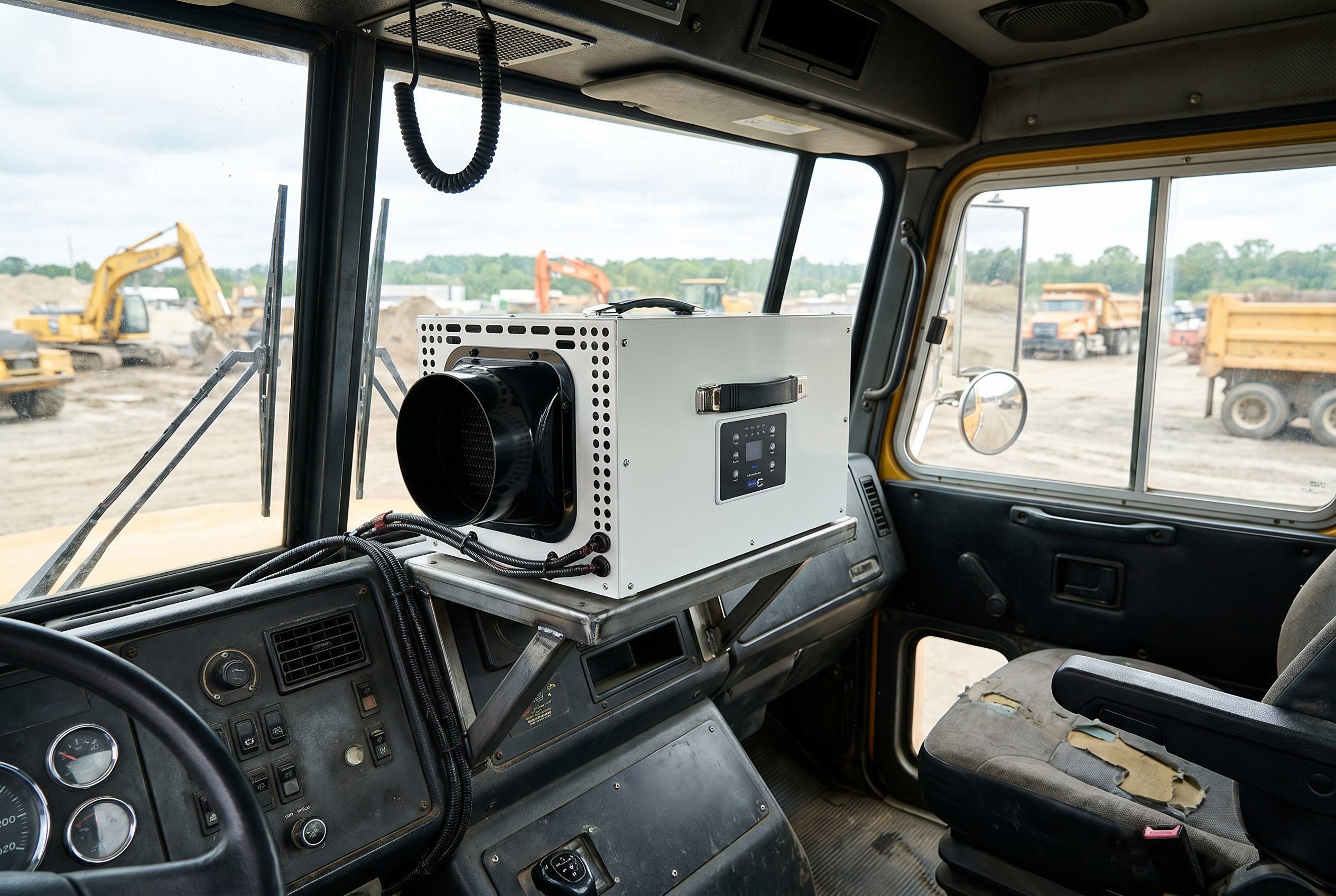
Proper installation determines whether your 24V DC air conditioner performs to spec or underdelivers. The split-system design separates the evaporator (inside the cab) from the condenser (outside), connected by refrigerant lines. Since these units ship pre-charged with R134a, installation does not require vacuum pumps or refrigerant handling — but physical mounting and electrical connections must be done correctly.
Key points for a successful installation:
- Condenser placement: Mount where airflow is consistent — roof-mounted works well for most equipment. Avoid locations behind radiators or near exhaust.
- Evaporator positioning: Direct airflow toward the operator. Overhead or dash-mounted positions work depending on cab geometry.
- Wiring: Use appropriately sized cable for the current draw (minimum 2.5mm² for 8A runs under 3m). Include a fuse or circuit breaker rated 15–20% above maximum draw.
- Drainage: Route condensate away from electrical components and operator areas. In dusty environments, add a filter to the drain line.
- Vibration isolation: Heavy equipment vibrates. Use rubber mounts for the compressor and secure all refrigerant lines with cushioned clamps.
- Controller placement: Mount the temperature controller and speed control interface within operator reach. Most units include a digital display showing setpoint, current temperature, and compressor speed — useful for monitoring system health.
For fleet installations across multiple identical vehicles, document your first installation thoroughly. Standardized mounting templates and pre-made wiring harnesses reduce installation time from 4–6 hours to under 2 hours per vehicle on subsequent units.
Cost Analysis: 24V DC AC vs. Engine-Driven and Inverter Systems
| Factor | 24V DC (BLDC) | Engine-Driven AC | Inverter + 110V Unit |
|---|---|---|---|
| Upfront Cost | $800–$1,500 | $2,000–$4,000 | $600–$1,200 |
| Installation Complexity | Low–Medium | High (belt/clutch) | Medium (inverter + unit) |
| Fuel/Energy Cost per Hour | ~$0.15–$0.25 | $2.50–$5.00 (idle) | ~$0.30–$0.50 |
| Maintenance | Minimal (no belts, no brushes) | High (belts, clutch, compressor) | Medium (inverter + AC unit) |
| Engine-Off Operation | Yes (battery) | No | Yes (battery + inverter) |
| Efficiency Loss | None (direct DC) | Mechanical losses | 10–15% inverter loss |
Calculate Your ROI
For fleets running 8+ hours daily, the fuel savings from eliminating idle-for-cooling typically pay back the 24V DC system within 3–6 months. Contact our team for a fleet-specific cost analysis.
Frequently Asked Questions
Can a 24V DC air conditioner run on batteries without the engine?
Yes. At 8A draw (DV2820E-AC), a 100Ah battery bank provides roughly 12 hours of cooling at partial load. The variable-speed BLDC compressor reduces current draw once the cab reaches target temperature, extending battery runtime significantly beyond simple calculations.
Will a 24V DC air conditioner cool a full-size semi-truck sleeper cab?
No. These compact units (550W–900W) are designed for cab volumes up to 4m³. Full-size sleeper cabs require 2,000W+ systems like the HS23P (2,300W). Using an undersized unit results in continuous full-speed operation without reaching target temperature.
What refrigerant do these units use, and is it serviceable in the field?
All three models use R134a, which is widely available and serviceable by any certified HVAC technician. The systems come pre-charged from the factory — no field charging required for initial installation.
How loud is a 24V DC air conditioner in a small cab?
At partial load (maintenance cooling), noise levels are comparable to a quiet desk fan — typically 35–45 dB at the operator position. The BLDC compressor produces less vibration than traditional reciprocating compressors, and variable speed means it rarely runs at full power after initial pulldown.
Can I run a 24V unit on a 12V system with a converter?
Technically possible with a DC-DC boost converter, but not recommended. The converter adds cost, weight, heat, and a failure point. If your vehicle runs 12V, choose a purpose-built 12V model instead. Mixing voltages introduces complexity that defeats the simplicity advantage of DC systems.
How does the variable speed BLDC compressor save energy compared to fixed-speed?
A fixed-speed compressor cycles on and off — full power or nothing. The BLDC variable-speed compressor (1,000–4,500 RPM range) modulates output continuously. Once the cab reaches temperature, it slows to 1,500–2,000 RPM, drawing 3–4A instead of 8–10A. This PID-controlled approach delivers higher COP at partial load and eliminates temperature swings.
What maintenance does a 24V DC air conditioner require?
Minimal. Clean or replace the air filter monthly in dusty environments. Check condenser fins for debris quarterly. Inspect refrigerant lines annually for chafing from vibration. The BLDC compressor has no brushes to wear and no belts to replace. Expected service life exceeds 10,000 operating hours.
Is R290 (propane) available as an alternative refrigerant?
Some models support R290 as a factory option. R290 offers slightly higher efficiency and lower environmental impact (GWP of 3 vs. 1,430 for R134a). However, R290 is flammable and requires compliance with local regulations for use in enclosed vehicle cabs. Consult with our team on availability and regulatory requirements for your region.
Can these units handle extreme ambient temperatures (50°C+)?
The units are rated for ambient temperatures up to 55°C. At extreme ambients, cooling capacity decreases by approximately 15–20% compared to rated conditions (35°C ambient). For consistent performance in extreme heat, size up one model — use the DV3820E-AC where you’d normally choose the DV2820E-AC.
Do I need to upgrade my alternator to run a 24V DC air conditioner?
In most cases, no. The DV2820E-AC draws 8A — just 192W at rated speed. Most 24V heavy equipment alternators produce 40–80A. As long as your existing electrical loads plus the AC unit don’t exceed 80% of alternator capacity, no upgrade is needed. Check your total load budget before installation.
Making Your Selection
The right 24V DC air conditioner depends on your specific application. Here’s the simplified decision path:
- Cab under 2m³, battery-limited: DV3220E-AC (550W) — lowest draw, adequate for small enclosed spaces
- Standard cab 2–3.5m³, general use: DV2820E-AC (700W) — the workhorse choice for most applications
- Large cab or high heat load: DV3820E-AC (900W) — for excavators, glass-heavy cabs, or extreme ambient conditions
All three share the same 24V BLDC platform with variable speed control, R134a refrigerant, and compact form factors designed for equipment integration. The difference is cooling output matched to your thermal load.
Ready to Keep Your Operators Cool?
Whether you’re outfitting a single machine or an entire fleet, we provide technical support from sizing through installation. Get in touch with your cab dimensions and operating conditions — we’ll recommend the right system and provide a quote within one business day.