
What an Active Medical Cooler Must Do That Passive Boxes Cannot
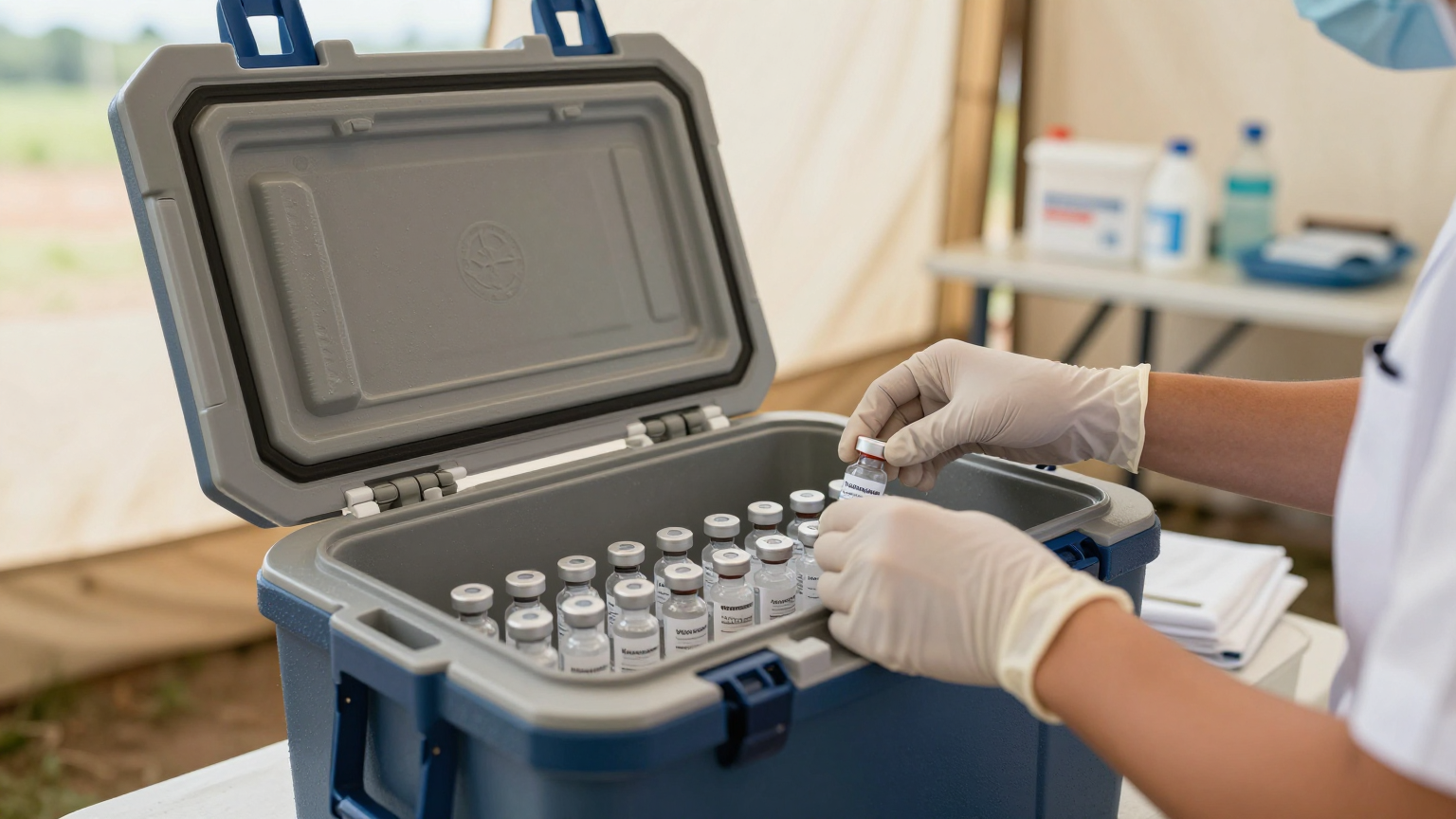
Blood products, vaccines, and biologics share one non-negotiable requirement: the payload must arrive within a defined temperature window, typically 2–8°C for most vaccines and certain blood components, or 20–24°C for platelet concentrates and some cell therapies. Deviation in either direction — too warm or too cold — can render the payload unusable. In many cases, the damage is invisible: a vial of vaccine that experienced a 30-minute excursion above 8°C looks identical to one that stayed at 4°C, but its potency may be compromised.
Passive transport systems — insulated boxes with phase-change coolant packs — handle this well enough in controlled logistics chains where ambient temperatures stay within a predictable range and transit times are short. But the moment conditions shift outside that envelope — a tarmac delay in summer heat, a last-mile delivery in a sub-zero winter, a field clinic in a region with 40°C diurnal swings — passive systems begin to fail. They have no mechanism to add or remove heat in response to changing conditions. They are thermal buffers, not thermal controllers.
An active medical cooler changes the equation by introducing closed-loop temperature regulation: a refrigeration system that can both cool and heat the payload chamber, maintaining the target temperature regardless of what happens outside the box. This is the fundamental difference between hoping the coolant packs last long enough and knowing the temperature will hold.
Why Bidirectional Control Matters in Medical Transport
The term “cooler” is misleading for medical transport applications. In a significant number of real-world scenarios, the system needs to heat, not cool. Consider a vaccine shipment moving through a cold chain in northern Canada during winter. Ambient temperatures may drop to −30°C. A passive cooler designed for summer conditions will allow the payload to freeze — and freezing destroys many vaccine formulations as effectively as overheating.
Bidirectional thermal control — the ability to both cool below ambient and heat above ambient using the same system — addresses this directly. A vapor-compression heat pump reverses the refrigerant flow through a four-way valve, switching between cooling mode and heating mode without additional hardware. The same compressor, the same heat exchangers, the same control loop. In cooling mode, the system extracts heat from the payload chamber and rejects it to ambient. In heating mode, it extracts heat from ambient air and delivers it to the payload chamber.
For medical logistics teams, this means a single transport unit that works year-round, across climate zones, without swapping coolant pack configurations or maintaining separate winter and summer packaging protocols. The operational simplification is often as valuable as the thermal performance improvement.
Thermal Failure Modes in Passive Medical Transport
Understanding where passive systems fail helps clarify where active cooling provides the most value. The common failure modes fall into three categories:
Excursion from Extended Transit Time
Passive coolers are validated for a specific duration — often 24, 48, or 72 hours — under defined ambient conditions. Any delay beyond the validated window puts the payload at risk. Flight diversions, customs holds, vehicle breakdowns, and last-mile delivery delays are routine in medical logistics. A passive system has no way to extend its thermal protection window once the coolant packs are depleted.
Ambient Temperature Outside Validation Range
Most passive cooler validations assume an ambient temperature range of 15–30°C or 20–35°C. When the actual ambient falls outside this range — a common occurrence in tropical, desert, or arctic environments — the system may overcool or undercool the payload. Phase-change materials are designed to absorb or release heat at a specific temperature, but they cannot adapt to conditions they were not designed for.
Door-Opening and Reloading Events
In field clinic scenarios, the transport container is opened repeatedly to access individual vials or units. Each opening introduces ambient air and disrupts the thermal equilibrium. Passive systems have no recovery mechanism — each opening shortens the remaining protection window. An active system recovers to setpoint within minutes after each door event, regardless of how many times the container is accessed.
How Vapor-Compression Active Cooling Works in a Medical Transport Context
The core technology behind an active medical cooler is the same vapor-compression cycle used in household refrigerators and automotive air conditioning — but miniaturized to fit inside a portable transport case. The key components are:
- A miniature DC compressor — typically brushless DC, operating on 12V or 24V from a battery pack or vehicle power supply
- A condenser that rejects heat to ambient air
- An evaporator that absorbs heat from the payload chamber
- A four-way reversing valve that switches between cooling and heating modes
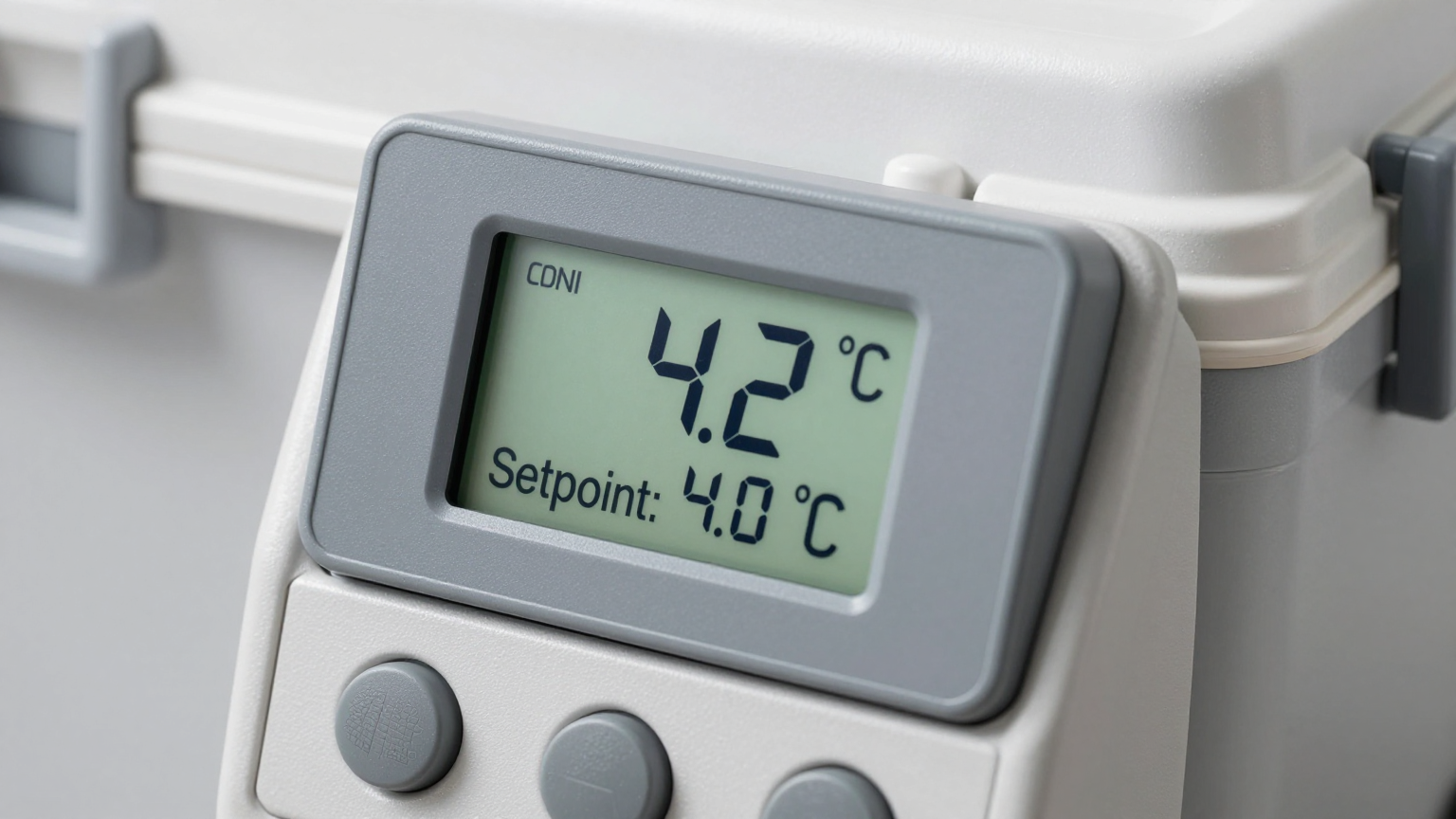
- A controller with temperature sensor feedback for closed-loop regulation
The entire system can be compact enough to integrate into a transport case no larger than a standard airline carry-on. Pre-charged refrigerant eliminates field brazing and vacuum procedures — the unit arrives ready to operate. Variable-speed compressor control enables precise temperature regulation: rather than cycling on and off (which creates temperature oscillations), the compressor adjusts its speed continuously to match the thermal load, maintaining tighter temperature stability.
For medical applications, this precision matters. A ±0.5°C control band is achievable with variable-speed vapor compression, compared to the ±2–5°C swings typical of passive systems as coolant packs transition through their phase-change plateau.
Power Budget and Runtime: Making Active Cooling Practical for Field Use
The most common objection to active medical coolers is power consumption. A passive box needs no electricity — it works until the coolant packs are spent. An active system needs a continuous power source. This is a legitimate constraint, but the math often favors active cooling more than expected.
A miniature DC compressor maintaining a 5°C payload temperature in a well-insulated 20-liter chamber at 35°C ambient typically draws 30–60W, depending on insulation quality and door-opening frequency. At 24V, that is 1.25–2.5A. A 24V, 50Ah lithium battery pack (roughly the size of a laptop battery) provides 40–80 hours of continuous runtime — well beyond the 24–48 hour window that most passive coolers are validated for.
In heating mode at −20°C ambient, the heat pump advantage becomes even more pronounced. Because the system moves heat rather than generating it resistively, the electrical draw for maintaining 4°C internal temperature is typically lower than the cooling-mode draw at high ambient — the temperature differential is smaller and the COP advantage of the heat pump amplifies the available heating capacity.
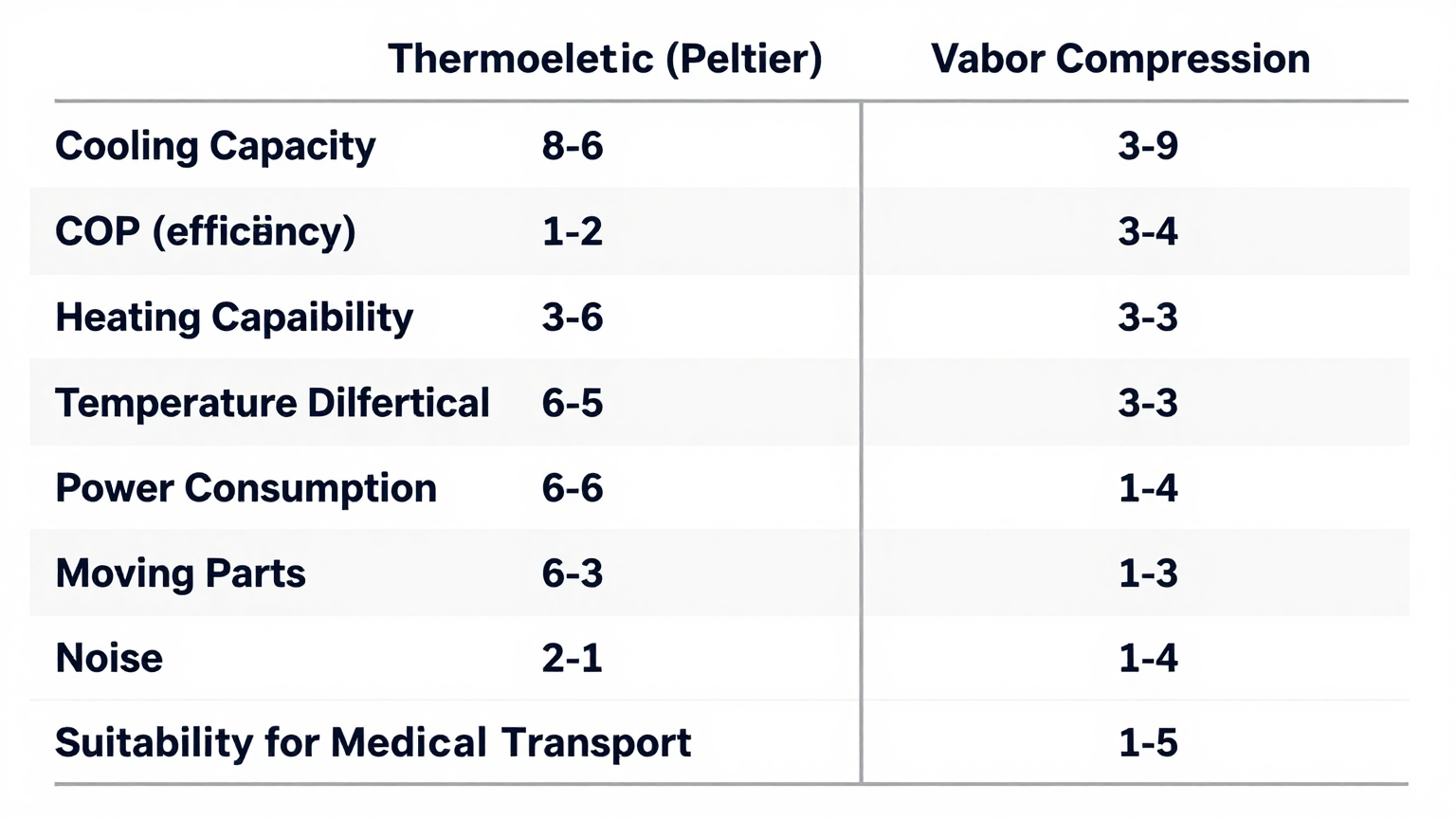
For vehicle-mounted applications — ambulances, blood bank delivery vans, mobile vaccination units — the 12V or 24V vehicle power supply provides continuous operation without any battery limitation. The DC-native compressor connects directly to the vehicle electrical system, eliminating the need for an inverter and its associated 15–20% power conversion loss.
Integration Architecture for Medical Transport Systems
Integrating an active cooling module into a medical transport system involves four primary design decisions:
Chamber Design and Airflow
The payload chamber must provide uniform air circulation around the stored products. Dead zones — areas with poor airflow — create temperature gradients that can push individual vials or bags outside the acceptable range even when the average chamber temperature reads correctly. A small internal fan circulating air across the evaporator and through the payload space addresses this. Chamber walls should be insulated to at least R-5 (roughly 25mm of polyurethane foam) to minimize thermal load on the compressor.
Temperature Monitoring and Logging
Regulatory requirements for medical cold chain transport typically mandate continuous temperature logging with tamper-evident records. The active cooler’s control board can integrate directly with data logging systems, providing real-time temperature data, alarm thresholds, and excursion records. This is a significant advantage over passive systems, where temperature loggers are separate devices placed inside the box with no ability to influence the thermal environment.
Shock and Vibration Considerations
Medical transport involves handling, vehicle vibration, and occasional drops. The compressor mounting must accommodate this — anti-vibration grommets and flexible refrigerant lines are standard practice in mobile cooling applications. Miniature rotary compressors designed for mobile use are inherently more vibration-tolerant than reciprocating designs, with fewer moving parts and lower vibration signatures.
Regulatory and Validation Pathway
Active medical coolers used for regulated products (blood, vaccines, cell therapies) must undergo thermal validation — typically a series of temperature mapping studies demonstrating that all points within the payload chamber remain within specification under defined ambient conditions and operational scenarios. The advantage of an active system is that validation results tend to be more robust: the system actively maintains temperature rather than relying on a decaying thermal buffer, so validation windows can be extended and ambient condition ranges broadened.
Application Scenarios Where Active Cooling Delivers the Highest Value
Not every medical transport scenario requires active cooling. Short-distance transfers in temperate climates with predictable transit times are well served by validated passive systems. Active cooling delivers disproportionate value in specific scenarios:
Long-Duration Field Deployments
Mobile vaccination campaigns, disaster relief medical stations, and remote field clinics often operate for days or weeks with limited resupply. An active cooler connected to a solar panel or vehicle battery can maintain temperature indefinitely, eliminating the need to rotate coolant packs or schedule resupply logistics for thermal consumables.
Extreme Ambient Temperature Environments
Desert regions with daytime temperatures exceeding 45°C, arctic environments dropping below −30°C, and tropical locations with high humidity all push passive systems beyond their validation limits. An active medical cooler with bidirectional control handles the full range — cooling in the heat, heating in the cold — with the same hardware configuration.
High-Value or Irreplaceable Payloads
Cell therapy products, rare blood types, and custom-manufactured biologics may be irreplaceable if lost to a temperature excursion. The cost of the active cooling system is trivial compared to the value of the payload and the clinical consequences of a failed shipment. In these applications, the active cooler functions as insurance — the thermal equivalent of a redundant power supply.
Multi-Stop Distribution Routes
Blood bank delivery routes and pharmacy distribution runs involve multiple stops with repeated door openings. Each stop disrupts the thermal environment. An active system recovers to setpoint between stops, maintaining consistent conditions throughout the route regardless of the number of deliveries. Passive systems degrade progressively with each opening.
Comparing Active Cooling Technologies for Medical Use
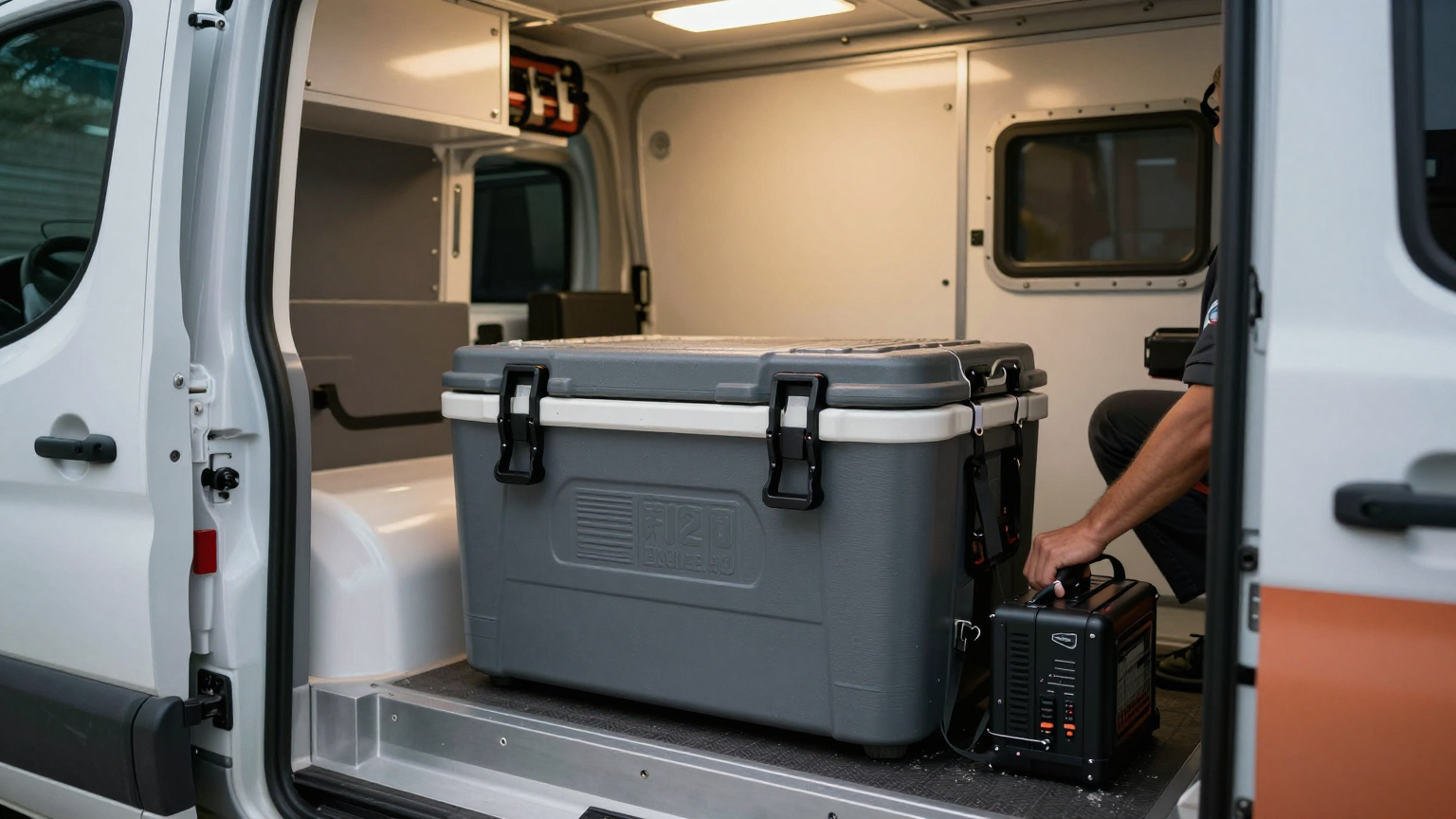
Within the active cooling category, two primary technologies compete: thermoelectric (Peltier) modules and vapor-compression systems. The choice depends on the application constraints:
| Parameter | Thermoelectric (Peltier) | Vapor Compression |
|---|---|---|
| Cooling capacity | Typically under 50W | Typically 100–550W |
| COP (cooling efficiency) | 0.3–0.6 | 2.0–3.5 |
| Heating capability | Reverse polarity (limited) | Heat pump mode (efficient) |
| Temperature differential | Limited to 15–20°C below ambient | Can reach well below 0°C |
| Power consumption | High relative to cooling output | Low relative to cooling output |
| Moving parts | None (solid state) | Compressor, fan |
| Noise | Silent | Low (depends on compressor design) |
| Suitability for medical transport | Small payloads, mild conditions | Larger payloads, extreme conditions |
For small, lightly insulated containers in mild ambient conditions, Peltier modules can be adequate. For anything requiring reliable temperature control across a wide ambient range, with meaningful cooling or heating capacity, vapor compression is typically the more robust choice. The efficiency advantage compounds over longer runtimes — a Peltier system drains its battery roughly three to five times faster than a vapor-compression system delivering the same cooling output.
Frequently Asked Questions
Can an active medical cooler maintain 2–8°C in 50°C ambient?
With adequate insulation and a properly sized vapor-compression system, yes. The key variables are insulation R-value, chamber volume, and compressor cooling capacity. A well-insulated 20-liter chamber with a compact DC compressor module can typically maintain 2–8°C at ambient temperatures up to 50°C, though power consumption increases with the temperature differential.
How long can an active cooler run on battery power?
Runtime depends on battery capacity, ambient conditions, and insulation quality. As a general reference, a 24V 50Ah battery powering a miniature compressor in a well-insulated chamber typically provides 40–80 hours of continuous operation at moderate ambient temperatures. Solar charging can extend this indefinitely for field deployments.
Is an active cooler heavier than a passive system?
The compressor module and battery add weight compared to an empty passive box. However, passive systems require coolant packs that can weigh several kilograms. When comparing a fully packed passive system (box plus coolant packs for 48 hours) against an active system (box plus compressor plus battery), the weight difference is often smaller than expected — and the active system does not get heavier for longer missions.
What happens if the compressor fails during transport?
A well-designed active medical cooler retains its insulation value even if the compressor stops. The insulated chamber functions as a passive cooler, providing a thermal buffer while the issue is addressed. This fail-safe behavior means the system degrades gracefully rather than catastrophically — the payload is protected for hours, not minutes, after a power interruption.
Can the system be validated for GDP and WHO PQS requirements?
Active coolers can be validated under Good Distribution Practice (GDP) guidelines and WHO Performance, Quality and Safety (PQS) standards. The validation process involves thermal mapping studies under defined conditions. Active systems often achieve broader validation envelopes than passive systems because they actively control temperature rather than relying on a time-limited thermal buffer.
Does vibration from the compressor affect sensitive biologics?
Miniature DC rotary compressors produce very low vibration levels — typically less than the vibration experienced during normal vehicle transport. Anti-vibration mounting further isolates the compressor from the payload chamber. For most biologics, the vibration from the cooling system is negligible compared to road and handling vibration.
From Cold Chain Compliance to Cold Chain Confidence
The shift from passive to active medical cooling is not about replacing a simple solution with a complex one. It is about replacing uncertainty with control. Passive systems work within their validated envelope. Active systems expand that envelope — handling longer durations, wider ambient ranges, and repeated access events that would compromise a passive box.
For medical logistics operations that routinely encounter conditions outside the passive comfort zone — extreme temperatures, unpredictable transit times, field deployment scenarios — a compact cool-and-heat module built around a DC-native miniature compressor provides the thermal control needed to protect high-value payloads with confidence rather than hope.
If your transport scenarios involve conditions that push passive systems to their limits, or if you are evaluating active cooling for a new medical device or transport platform, we can review the specific thermal requirements and discuss a configuration path that aligns with your payload, ambient range, and regulatory validation needs.