
The Active vs Passive Cooling Decision Is Not About Preference — It Is About Physics
Every thermal design begins with a choice: passive cooling (heatsinks, natural convection, radiation) or active cooling (fans, thermoelectric coolers, compressor-based systems). For many applications, passive cooling is sufficient, cheaper, and more reliable — no moving parts, no power consumption, no maintenance. For many others, passive cooling is physically incapable of maintaining the required temperature. The boundary between these two domains is not a matter of opinion or budget preference. It is determined by the laws of thermodynamics.
The decision tree is straightforward: if the required component temperature is above ambient temperature and the heat load is within the passive dissipation capacity of the available surface area, passive cooling works. If either condition fails — if the component must be cooled below ambient, or if the heat density exceeds what passive surfaces can dissipate — active cooling is required.
This guide maps that decision boundary for OEM engineers designing enclosures, modules, and systems that must operate reliably across a range of ambient conditions. The goal is not to advocate for active cooling — it is to identify precisely when passive cooling stops working so that the right technology is applied to the right problem.
Passive Cooling: Capabilities and Limits
Passive cooling encompasses any heat dissipation method that does not consume energy or require moving parts:
- Natural convection — warm air rises from heated surfaces, replaced by cooler ambient air
- Radiation — heated surfaces emit infrared radiation to cooler surroundings
- Conduction — heat transfers through solid materials to larger dissipation surfaces
The practical limit of passive cooling is determined by the thermal resistance between the heat source and the ambient environment. For a heatsink in natural convection, the heat dissipation capacity is approximately 5 to 15 watts per degree Celsius of temperature rise per 100 square centimeters of fin area, depending on heatsink geometry and orientation. This means a heatsink with 500 square centimeters of fin area can dissipate approximately 25 to 75 W with a 10-degree temperature rise above ambient.
For a component that must stay below 85 degrees in a 35-degree ambient (50-degree allowable rise), a well-designed passive heatsink can handle moderate heat loads — typically up to 100 to 200 W depending on available surface area. For a component that must stay below 40 degrees in a 35-degree ambient (5-degree allowable rise), even the most generous heatsink can dissipate only a few watts passively. The allowable temperature rise above ambient — not the absolute heat load — determines whether passive cooling is viable.
Forced Convection (Fan Cooling): The Middle Ground
Adding a fan to a heatsink increases the convective heat transfer coefficient by 3 to 10 times compared to natural convection. This extends the practical cooling capacity to 200 to 1,000 W or more, depending on fan speed, heatsink design, and allowable temperature rise. Fan cooling is active (it consumes power and has moving parts) but it is thermodynamically passive — it cannot cool below ambient temperature.
Fan cooling fails at the same boundary as natural convection, just at a higher heat load. When the ambient temperature approaches or exceeds the target component temperature, no amount of airflow can maintain the required temperature. A fan blowing 45-degree air across a heatsink cannot cool the heatsink below 45 degrees — it can only bring the heatsink temperature closer to 45 degrees, not below it.
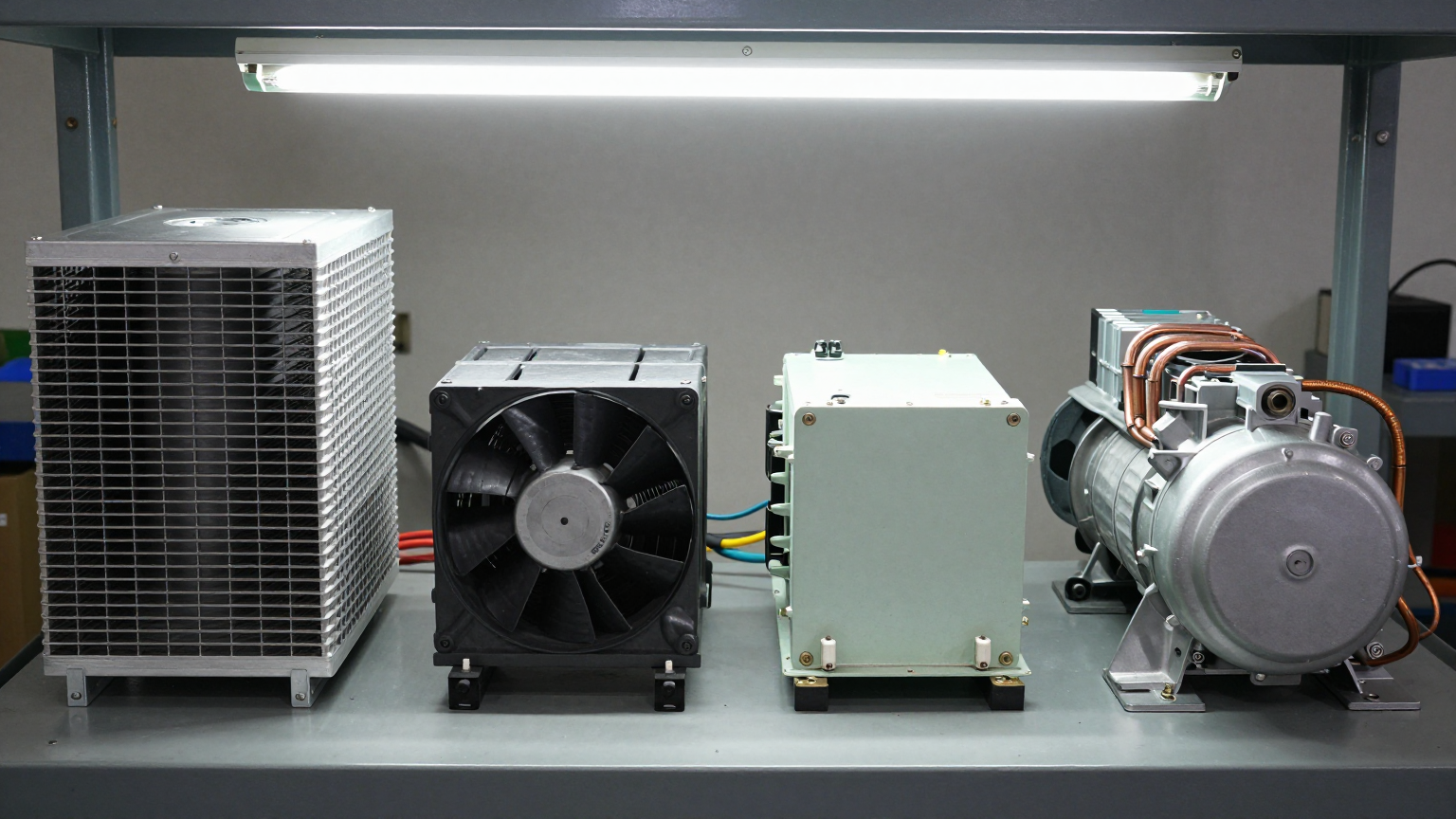
| Cooling Method | Can Cool Below Ambient? | Typical Capacity Range | Power Consumption | Moving Parts |
|---|---|---|---|---|
| Natural convection (passive) | No | 5-200 W | Zero | None |
| Forced convection (fan) | No | 50-1,000+ W | Low (5-50 W) | Fan motor |
| Thermoelectric (TEC) | Yes (limited) | 10-200 W | High (COP 0.5-1.5) | None (but needs fan) |
| Compressor (vapor compression) | Yes | 100-10,000+ W | Moderate (COP 2.0-3.5) | Compressor, fan |
The 35 Degree Threshold
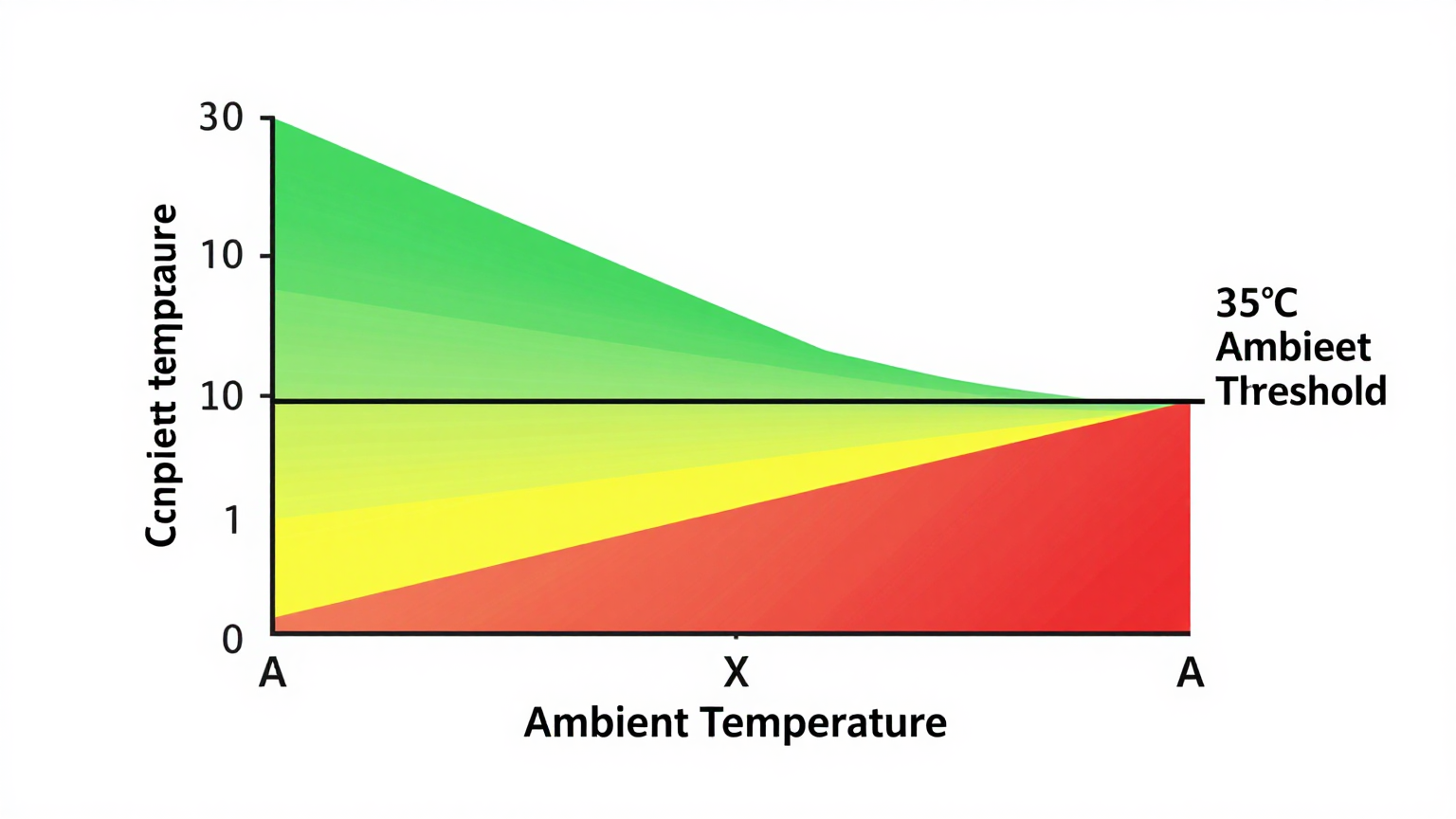
For most electronics and industrial applications, the practical threshold where fan cooling becomes insufficient and compressor cooling becomes necessary falls around 35 degrees ambient. This is not a universal constant — it depends on the specific heat load and target temperature — but it represents the boundary for a common design scenario:
- Component maximum temperature: 70 to 85 degrees (typical for electronics)
- Thermal resistance from junction to case: 5 to 15 degrees
- Thermal resistance from case to heatsink: 2 to 5 degrees
- Available temperature rise from heatsink to ambient: 20 to 40 degrees at 35 degree ambient
At 25 degrees ambient, the available rise is 30 to 50 degrees — generous for most heat loads with fan cooling. At 35 degrees, the available rise shrinks to 20 to 40 degrees. At 45 degrees (common in desert, tropical, and non-climate-controlled environments), the available rise is 10 to 30 degrees — insufficient for many applications without dramatically oversizing the heatsink or reducing the heat load.
When the deployment environment includes ambient temperatures above 35 degrees — whether from climate, solar gain, or heat accumulation in enclosed spaces — compressor-based cooling should be on the design table from the start, not added as a retrofit after field failures.
Below-Ambient Cooling: Where Only Compressors Work
Some applications require component temperatures below ambient — not just below the component’s maximum rating, but below the surrounding air temperature. These applications include:
- Laser diode cooling — maintaining diode junctions at 20 to 25 degrees in 30 to 40 degree environments
- Medical device sample cooling — keeping reagents and biological samples at 4 to 8 degrees
- Dew point control — maintaining surfaces above the dew point in humid environments requires controlling the surface temperature, not just the air temperature
- Precision optical systems — thermal stability within plus or minus 0.5 degrees at a specific setpoint regardless of ambient
For below-ambient cooling, passive methods are physically impossible (they cannot transfer heat from cold to warm), fan cooling is physically impossible (it cannot cool below air temperature), and thermoelectric cooling is inefficient at differentials above 15 to 20 degrees. Compressor-based cooling — vapor compression with a DC compressor, evaporator, and condenser — is the only practical technology for sustained below-ambient cooling at heat loads above approximately 50 to 100 W.
Decision Framework for OEM Engineers
The following decision framework applies to most enclosure and module thermal designs:
Step 1: Define the thermal requirement. What is the maximum allowable internal or component temperature? What is the worst-case ambient temperature? What is the total heat load?
Step 2: Calculate the required temperature differential. Target temperature minus ambient temperature equals the available delta-T for heat dissipation.
Step 3: If delta-T is greater than 20 degrees and heat load is under 500 W, fan cooling is likely sufficient. Design a heatsink or ventilated enclosure.
Step 4: If delta-T is less than 20 degrees, or heat load exceeds the fan-heatsink capacity, or the target temperature is below ambient, compressor-based cooling is required.
Step 5: If delta-T is less than 15 degrees and heat load is under 100 W, a thermoelectric cooler may be viable — but verify the total waste heat (heat load plus TEC power consumption) can be rejected by the hot-side heatsink at the worst-case ambient.
Total Cost of Ownership: Active vs Passive
The initial cost comparison favors passive cooling: a heatsink costs 5 to 50 USD, a fan assembly costs 10 to 100 USD, and a compressor module costs 200 to 2,000 USD depending on capacity. But initial cost is only one input to the total cost of ownership calculation.
For products deployed in controlled environments (server rooms, climate-controlled factories, temperate indoor locations), passive or fan cooling delivers the lowest total cost because the ambient temperature stays within the passive system’s capability. The compressor is an unnecessary expense.
For products deployed in uncontrolled environments — outdoor installations, non-climate-controlled facilities, tropical and desert climates, or enclosed spaces where heat accumulates — the compressor module’s total cost of ownership is frequently lower than passive cooling’s total cost of ownership. The reason is failure cost. A passive system that fails in hot conditions generates warranty claims (100 to 500 USD per incident), field service visits (200 to 1,000 USD per visit), replacement units (full product cost), and customer dissatisfaction (unquantifiable but real). A single summer of field failures in a 1,000-unit deployment can cost more than equipping all 1,000 units with compressor cooling from the start.
The decision framework is not about whether compressor cooling is more expensive per unit. It is about whether the deployment environment will ever push the passive design beyond its capability — and what the cost will be when it does.
Common Field Questions
Is compressor cooling always more expensive than fan cooling?
The component cost is higher. The total cost of ownership may not be. A fan-cooled system that fails in hot environments requires field replacements, warranty claims, customer dissatisfaction, and redesign costs. A compressor-cooled system that works in all environments avoids these costs. For products deployed in variable or hot climates, the compressor system often has lower lifetime cost despite higher initial cost.
Can I combine passive and active cooling?
Yes — and this is often the optimal approach. Use passive dissipation (large surfaces, thermally conductive paths, radiation) to handle the base heat load, and add compressor cooling for the peak load or the high-ambient condition. The compressor runs less, consumes less energy, and lasts longer because the passive system handles part of the work.
What about heat pipes — are they passive or active?
Heat pipes are passive heat transfer devices — they move heat from one location to another using evaporation and condensation of an internal working fluid, with no external power input. They are excellent for spreading heat from a concentrated source to a larger dissipation area but do not cool below ambient. They extend the reach of passive cooling but do not change its fundamental temperature limitations.
At what heat load does a compressor become more efficient than a TEC?
At temperature differentials above 15 to 20 degrees and heat loads above 50 to 100 W, a compressor-based system is more efficient (higher COP) than a TEC. Below these thresholds, a TEC may be simpler and more appropriate. The crossover point depends on the specific TEC and compressor specifications — there is no universal threshold, but the range is consistent across most available products.

Integration Support
The passive-to-active cooling transition is a design decision that affects product reliability, deployment flexibility, and total cost of ownership. If your thermal design is marginal — working in the lab but failing in hot field conditions — or if your application requires below-ambient temperature control, the Rigid engineering team can evaluate the requirements and recommend the appropriate cooling approach. The Rigid Micro DC Aircon module is a compact, DC-powered, compressor-based cooling sub-system for applications where passive methods have reached their physical limits.
Passive cooling works until it does not. The question is not whether to use active cooling — it is whether your operating environment will ever push the thermal design beyond the passive boundary. If the answer is yes, even occasionally, the compressor module belongs in the design from the beginning. Retrofitting cooling after field failures costs more in every dimension — money, time, reputation, and engineering effort — than designing it in from the start.