
A battery powered air conditioner represents the intersection of two critical technologies: efficient DC cooling and portable energy storage. When these systems work together properly, you get genuine air conditioning anywhere—no generator, no shore power, no compromises. When they don’t, you get a dead battery and a hot tent at 2 AM.
The difference comes down to understanding power consumption, battery capacity, and realistic runtime expectations. This guide covers the engineering fundamentals, real-world performance data, and practical considerations for selecting and operating a battery powered air conditioner in off-grid applications.
How Battery Powered Air Conditioners Actually Work
A true battery powered air conditioner uses a vapor-compression refrigeration cycle—the same technology as your home AC, just scaled down and optimized for DC power. This is fundamentally different from evaporative coolers, thermoelectric devices, or battery-powered fans that marketers sometimes call “air conditioners.”
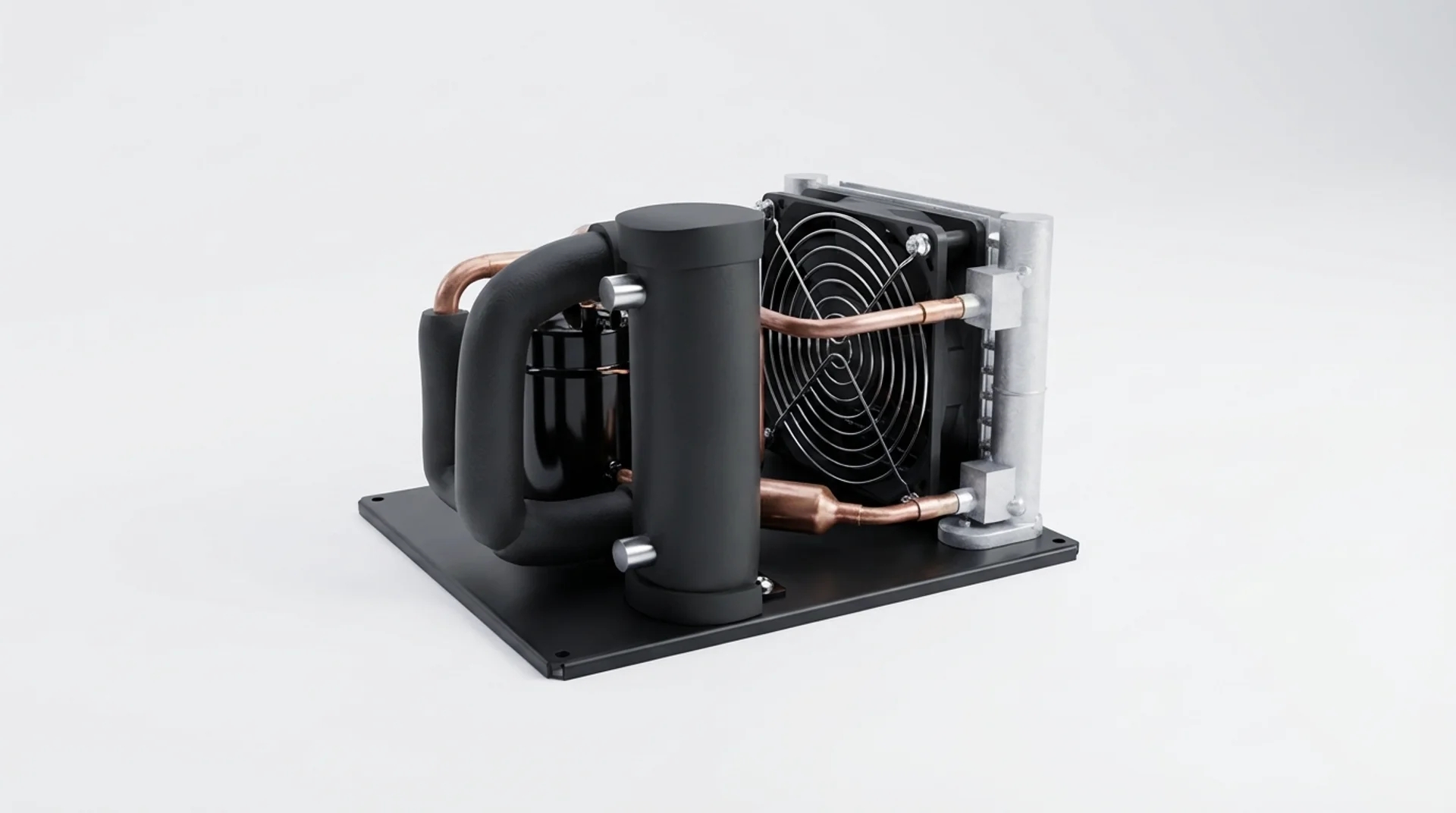
The system consists of four main components: a DC compressor that compresses refrigerant gas, a condenser coil that rejects heat to the outside air, an expansion device that drops refrigerant pressure, and an evaporator coil that absorbs heat from the space you’re cooling. The compressor is powered by a brushless DC motor that runs directly from battery voltage—12V, 24V, or 48V depending on the unit.
Modern units like the LC2810E-AC deliver 700W (2,387 BTU) of cooling capacity at 12V. The compressor draws approximately 58A at full load, but variable-speed control allows it to modulate down to 20-30A when maintaining temperature. This variable-speed operation is critical for battery-powered applications—it’s the difference between 3 hours of runtime and 8 hours from the same battery bank.
Battery Capacity and Runtime Calculations
The most common question: “How long will it run on my battery?” The answer depends on cooling load, ambient temperature, insulation quality, and battery capacity.
Start with the unit’s power consumption. A 700W air conditioner at 12V draws 58A at maximum speed. If it runs continuously at full load, a 100Ah lithium battery would last 1.7 hours (100Ah ÷ 58A). But continuous full-load operation rarely happens in real-world use.
In a well-insulated space with moderate ambient temperature (80-85°F), the compressor typically runs at 40-60% duty cycle once the space reaches target temperature. This means it’s actually drawing power 40-60% of the time, with average consumption of 23-35A. A 100Ah battery now provides 2.9-4.3 hours of runtime.
For overnight cooling (8 hours), you need approximately 184-280Ah of battery capacity at 12V. With lithium batteries safely discharged to 20% state of charge, that’s a 230-350Ah battery bank. With lead-acid batteries limited to 50% discharge, you need 368-560Ah capacity.
Temperature matters significantly. In 95°F ambient with poor insulation, duty cycle can reach 70-80%, increasing average power draw to 41-46A and requiring 328-368Ah for 8 hours. In cooler conditions (70°F ambient), duty cycle drops to 25-35%, reducing requirements to 161-224Ah.
Lithium vs Lead-Acid: Battery Chemistry Matters
Battery chemistry dramatically affects system performance and cost.
Lithium (LiFePO4) batteries deliver consistent voltage throughout the discharge cycle. A 12V lithium battery maintains 12.8-13.2V from 100% to 20% state of charge, ensuring the air conditioner runs at full capacity until the battery is nearly depleted. Lithium batteries also handle high discharge rates (1C to 2C) without voltage sag, support 2,000-5,000 charge cycles, and weigh 50-60% less than equivalent lead-acid capacity.
Lead-acid batteries (AGM or flooded) experience significant voltage drop under load. A 12V lead-acid battery starts at 12.7V when fully charged but drops to 11.8-12.0V at 50% discharge under 50A load. This voltage sag reduces compressor speed and cooling capacity by 10-15%. Lead-acid batteries are limited to 50% depth of discharge for reasonable cycle life (300-500 cycles), effectively doubling the required capacity. They also weigh 2-3x more than lithium for the same usable energy.
For a battery powered air conditioner, lithium is strongly preferred unless budget absolutely prohibits it. The higher upfront cost ($800-1,200 for 300Ah lithium vs $400-600 for 600Ah lead-acid) is offset by longer lifespan, better performance, and reduced weight.
Sizing Your Battery Bank
Proper battery sizing ensures reliable operation without over-investing in capacity you don’t need.
Calculate your cooling hours per day. For overnight use (8 hours), multiply average power draw by runtime: 30A × 8h = 240Ah. Add 20% margin for battery aging and inefficiency: 240Ah × 1.2 = 288Ah. With lithium batteries discharged to 20%, you need 360Ah usable capacity—a 400Ah battery bank provides comfortable margin.
For intermittent use (4-6 hours during hottest part of day), you need less capacity. At 35A average draw for 5 hours: 35A × 5h × 1.2 = 210Ah, requiring a 260Ah lithium bank or 300Ah with margin.
For 24-hour operation in extreme heat, you’re looking at 600-800Ah lithium capacity plus solar charging to offset daytime consumption. This is the realm of serious off-grid installations with 800-1,200W of solar panels.
Don’t forget other loads. If you’re also running lights (5A), water pump (8A intermittent), and phone charging (2A), add these to your calculation. Total system load determines battery bank size, not just the air conditioner.

Solar Integration and Recharging
Solar panels extend runtime by recharging batteries during the day. The question is whether solar can keep up with consumption.
A 700W air conditioner consuming 30A average at 12V uses 360W. To offset this with solar, you need approximately 500-600W of panels (accounting for 70-80% system efficiency including charge controller losses, panel angle, and weather). In full sun (5-6 peak hours per day), 600W of panels generates 3,000-3,600Wh, or 250-300Ah at 12V.
This means 600W of solar can sustain 8-10 hours of air conditioner operation per day in good conditions, assuming you’re not running other loads. In practice, you’ll run the AC during the hottest part of the day (when solar production is highest) and rely on batteries for evening/night cooling.
For true off-grid autonomy, size your solar array to recharge batteries fully in one day of good sun. If you consume 300Ah overnight, you need to generate 300Ah during the day plus cover daytime AC use. That’s 300Ah + (6 hours × 30A) = 480Ah, requiring 800-1,000W of solar panels.
Charge controller selection matters. Use an MPPT controller for maximum efficiency—it extracts 20-30% more power from panels than PWM controllers, especially in hot conditions when panel voltage drops.
Comparing Battery Powered AC Options
Several manufacturers offer battery powered air conditioners, but performance and design vary significantly.
The RIGID LC2810E-AC delivers 700W (2,387 BTU) at 12V, drawing 58A maximum. It uses a variable-speed DC compressor with R134a refrigerant, weighs 48 lbs, and operates from external batteries (not included). This design separates the cooling unit from the power source, allowing you to size the battery bank for your specific needs. Price: $1,400.
Zero Breeze Mark 2 delivers 2,300 BTU with an integrated 1,150Wh battery providing 3-5 hours of runtime. The all-in-one design is convenient but limits battery expansion. When the internal battery depletes, you must recharge it or connect external power. Weight: 32 lbs. Price: $1,899.
EcoFlow Wave 2 delivers 5,100 BTU with a 1,159Wh integrated battery providing 3-8 hours runtime depending on mode. It includes heating capability and app control. The higher capacity suits larger spaces but draws more power. Weight: 35 lbs. Price: $1,299.
The key difference: integrated battery units are convenient but inflexible. External battery systems let you scale capacity independently—add more batteries for longer runtime without replacing the entire unit.
Applications and Use Cases
Battery powered air conditioners excel in specific applications where grid power is unavailable or impractical.
Tent camping: A 700W unit cools a 6-8 person tent (100-120 sq ft) comfortably in 85-90°F conditions. Exhaust the hot air through a window panel or vent. A 200Ah lithium battery provides 6-8 hours of overnight cooling. This transforms summer camping from miserable to comfortable.
RV and van life: Boondockers without hookups rely on battery power. A DC air conditioner eliminates the need for a generator or large inverter, saving weight and cost. Pair with 400-600W of roof-mounted solar for extended off-grid stays.
Truck cab cooling: Anti-idling regulations prohibit running the engine for AC during rest periods. A battery powered unit allows drivers to sleep comfortably without idling, saving 0.8-1.2 gallons of diesel per hour. Fleet operators report 12-18 month payback from fuel savings.
Emergency backup: During power outages, a battery powered AC provides critical cooling for medical needs, pet safety, or simply maintaining livable conditions. A 300Ah battery bank and 400W of portable solar panels create a resilient backup cooling system.
Outdoor events: Weddings, festivals, and outdoor work sites benefit from portable cooling without generator noise. Set up a cooling tent or canopy with battery powered AC for guest comfort or worker safety.
Installation and Setup
Proper installation ensures maximum efficiency and reliability.
Battery connection: Use wire sized for maximum current draw with minimal voltage drop. For 60A at 12V, use 6 AWG wire for runs up to 10 feet, 4 AWG for 10-20 feet. Install a fuse or circuit breaker rated 125% of maximum current (75A for a 60A unit) within 18 inches of the battery positive terminal. Use marine-grade tinned copper wire and crimped terminals—no twist-on connectors.
Ventilation: The condenser must exhaust hot air outside the cooled space. Use a window panel, vent hose, or dedicated exhaust port. Recirculating hot air back into the tent/van defeats the purpose and overworks the compressor. Ensure at least 12 inches clearance around the condenser for airflow.
Insulation: Every watt of cooling capacity is precious when running on batteries. Insulate your space as much as practical—reflective window covers, insulated panels, sealed gaps. Good insulation can reduce power consumption 30-40%, extending runtime significantly.
Thermostat setting: Set the thermostat to the warmest comfortable temperature (76-78°F). Every degree cooler increases power consumption 5-8%. A 2-degree difference (76°F vs 74°F) can reduce runtime by 30 minutes on a 200Ah battery.
Maintenance and Troubleshooting
Battery maintenance: Lithium batteries require minimal maintenance but benefit from occasional balancing (full charge to 100%). Avoid storage below 20% or above 80% state of charge for extended periods. Lead-acid batteries need regular equalization charging and water level checks (flooded types).
Condenser cleaning: Dust and debris on the condenser coil reduce efficiency. Clean monthly with compressed air or a soft brush. A dirty coil can increase power consumption 20-30%.
Refrigerant level: If cooling capacity drops significantly, check for refrigerant leaks. Look for oil stains around fittings. Low refrigerant requires professional service—never attempt to add refrigerant without proper equipment and certification.
Common issues: If the unit won’t start, check battery voltage under load. Low voltage triggers protection circuits. If it runs but doesn’t cool, verify the condenser is exhausting outside the cooled space. If runtime is shorter than expected, check for air leaks, poor insulation, or excessive ambient temperature.
Cost Analysis and Payback
A complete battery powered AC system costs $2,000-3,500 depending on battery capacity and solar integration.
Basic setup: $1,400 (AC unit) + $800 (200Ah lithium battery) + $200 (wiring/fusing) = $2,400. This provides 6-8 hours of overnight cooling with daily recharging from vehicle alternator or shore power.
Solar-integrated setup: $1,400 (AC) + $1,200 (400Ah lithium) + $600 (600W solar + controller) + $300 (wiring/mounting) = $3,500. This provides true off-grid capability with indefinite runtime in good sun.
Compare to generator-based cooling: A 2,000W generator ($500-800) plus a portable AC unit ($400-600) costs $900-1,400 upfront but requires fuel ($4-6 per night for 8 hours), creates noise, and needs maintenance. Over 100 nights of use, fuel costs add $400-600, bringing total cost to $1,300-2,000 plus the hassle factor.
For frequent off-grid users, battery powered AC pays for itself in 2-3 seasons through eliminated fuel costs, reduced noise, and improved reliability.
Future Developments
Battery and compressor technology continue to improve. Next-generation lithium batteries (solid-state, lithium-sulfur) promise 50-100% higher energy density, reducing weight and cost. Compressor efficiency improvements—magnetic bearings, optimized refrigerant circuits—are pushing cooling capacity per watt higher.
Integration with smart power management systems will optimize runtime automatically, adjusting compressor speed based on battery state of charge, solar production, and predicted weather. Expect to see units that communicate with battery monitors and solar controllers to maximize efficiency.
For current specifications and availability, see our portable DC air conditioner product line.