
Why bldc ac compressor partial-load efficiency matters more than peak rating
When engineers compare compact cooling systems, the first figure they often see is nominal cooling capacity. That number matters, but it does not tell the whole story for battery-powered equipment. In real use, a small air conditioning module rarely stays at one steady design point. It sees pull-down after startup, moderate load during steady operation, ambient swings across the day, heat bursts from electronics, and long periods when only a fraction of peak cooling is needed. In those conditions, partial-load efficiency often affects real energy use more than a full-load headline figure alone.
That is why the control strategy behind a BLDC variable-speed compressor deserves close attention. A DC-native, inverter-driven compressor can slow down when the thermal load drops instead of repeating a fixed-speed on/off cycle. At system level, that changes how often the compressor starts, how smoothly current is drawn from the battery, how tightly temperature is held, and how much energy is lost during repeated overshoot and recovery. For mobile OEM teams working on compact battery-powered systems, those differences often show up as longer usable runtime, more stable thermal performance, and less stress on the electrical architecture.
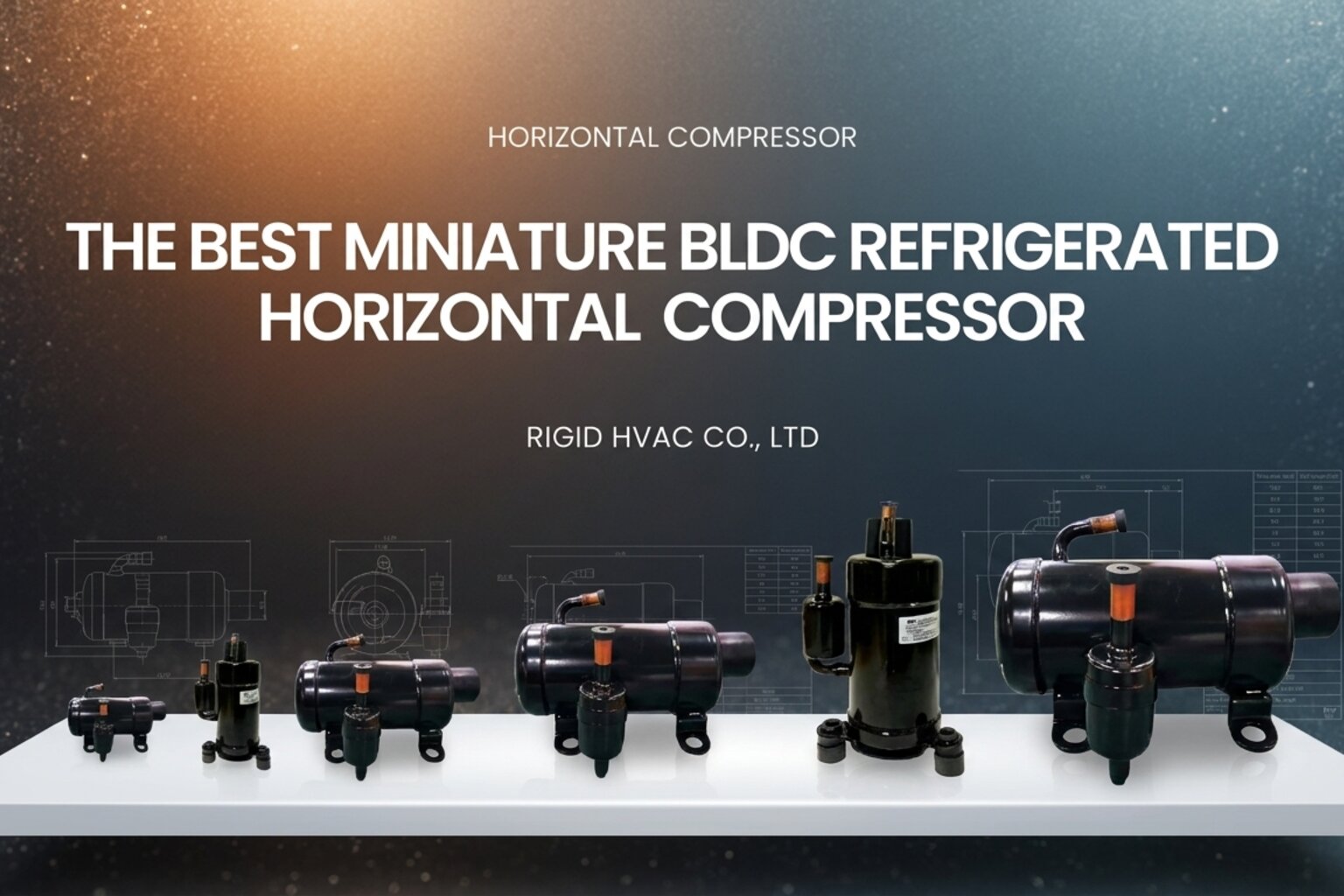
RIGID’s compact Micro DC Aircon range is a useful example of this design approach. The public lineup spans 450 W to 900 W of cooling capacity across 12 V, 24 V, and 48 V configurations, with listed models including DV1910E-AC, DV1920E-AC, DV1930E-AC, DV3220E-AC, DV2820E-AC, DV2820E-AC-T, DV3820E-AC, and DV3830E-AC. These systems are described as DC-native, based on BLDC sine-wave inverter drive, variable speed control, a 5°C to 30°C cooling range, and an approximately 5 kg package. For engineers, the key point is not the model list itself. It is that compressor speed can follow the thermal load instead of fighting it with repeated fixed-speed cycling.
Why real duty cycles make partial-load behavior more important than lab snapshots
Most battery-powered cooling applications do not live at peak load. A remote enclosure may face a hot afternoon but only modest load overnight. A vehicle auxiliary cabin cooler may need a quick pull-down after parking, then much lower cooling once surfaces and cabin air settle. A mobile medical device may spend hours protecting a narrow internal temperature band with only small corrections. In each case, the compressor spends much of its life below peak demand.
If a system can only run at one fixed speed, it usually responds by turning fully on, pulling the controlled space below target, turning off, and waiting until temperature drifts back up. That method can meet the average load, yet it often wastes energy in ways that are easy to miss during a quick specification review. Every restart creates transient losses. Every overshoot pushes the system farther from the actual required operating point. Every off period allows temperatures, pressures, and controlled-space conditions to drift, which then calls for another recovery cycle.
A variable-speed BLDC system approaches the same problem differently. Once the initial pull-down is complete, it can reduce speed and keep operating nearer the load line of the application. Instead of alternating between too much cooling and no cooling, it aims for a steadier balance. In practice, that tends to mean less wasted cycling, fewer hard starts, and a lower average electrical demand over the course of a duty cycle.
BLDC variable speed vs fixed-speed cycling
The core engineering difference is simple. A fixed-speed compressor has only two practical states: full output or off. A BLDC compressor with inverter control can modulate speed over a range, so its mass flow and cooling output can move up or down with demand. The result is not just a smoother temperature trace. It changes the operating character of the refrigeration loop.
First, soft-start behavior matters. In a variable-speed BLDC system, startup can be managed more gently than a repeated full-speed cycling pattern. That reduces the frequency and severity of electrical transients seen by batteries, wiring, converters, and protection devices. In a mobile platform where every margin is shared with other loads, smoothing those events can simplify system design.
Second, speed control improves load matching. A compact cooling system usually faces changing heat rejection conditions, changing internal heat gains, and changing user demand. When compressor speed can be adjusted, the system has a way to follow those shifts instead of forcing the evaporator and condenser to swing between extremes. That often means less hunting around the setpoint and more time in a stable operating window.
Third, fixed-speed systems pay a penalty for repeated starts and stops. Oil return, refrigerant distribution, pressure equalization, and heat exchanger conditions all move around during cycling. None of that means a fixed-speed design cannot work. It means some energy is spent re-establishing the same operating state again and again. A variable-speed system avoids part of that penalty by staying closer to a steady condition during long hold periods.
Fourth, low-load comfort or process control is usually better with continuous modulation. In a compact cabin or electronics enclosure, the target is often not the lowest possible air temperature. The target is a narrow band with fewer swings. A BLDC speed-controlled system can hold that band with smaller corrections, which improves user comfort, process repeatability, or component protection depending on the application.
This is also where DC-native design matters. Using a compressor and control architecture intended for 12 V, 24 V, or 48 V battery systems avoids some of the complexity of forcing a conventional AC-centered approach into a mobile platform. For teams studying compact micro DC aircon options, the useful question is not only whether the system cools enough at maximum speed. The better question is how efficiently it spends most of its operating life once peak pull-down has passed.
How partial-load efficiency affects battery life at system level
Battery runtime is not decided by compressor technology alone, but compressor behavior often becomes one of the biggest moving parts in the energy budget. For that reason, engineers should think in terms of average power draw across the full mission profile, not just the top-end load during startup or pull-down.
A useful rule of thumb is to break runtime into phases. Phase one is pull-down, when the system starts hot and works hard to bring air, surfaces, or protected equipment toward target temperature. Phase two is hold, when the system mainly offsets ongoing heat gain from ambient conditions, leakage, solar load, occupants, electronics, or product loading. In many compact battery applications, phase two lasts much longer than phase one. That is exactly where partial-load efficiency matters.
If a variable-speed system can spend most of phase two at reduced speed, the average draw seen by the battery may be lower than a fixed-speed system that repeatedly jumps to full output and shuts off. The point is not that one can claim a universal runtime number. Real outcomes depend on insulation, ambient temperature, condenser airflow, evaporator design, battery condition, control tuning, and thermal mass. Runtime should be estimated from the shape of the duty cycle, not from cooling capacity alone.
Another system-level factor is startup transients. Batteries and DC buses do not experience a compressor as a simple average. They feel the peaks, dips, and repetition of the load. Frequent hard starts can create larger current spikes, more bus disturbance, and tighter design pressure on connectors, fusing, converters, and battery management settings. A variable-speed BLDC system that starts gently and stays running at lower speed can reduce those disturbances, even before total energy use is calculated.
There is also a thermal feedback effect. When temperature swings are wider, the system often has to work harder during recovery. When the controlled space is kept closer to target, the next correction is usually smaller. That matters for battery life because avoiding temperature overshoot and rebound can trim unnecessary cooling work over time. In other words, thermal stability is not only a comfort or product-protection issue. It is part of the energy story.
For engineering teams, a practical battery-life framework looks like this:
- Define the mission profile by ambient range, duration, and expected pull-down events.
- Separate startup behavior from steady hold behavior.
- Compare how much time the compressor is likely to spend near peak speed versus reduced speed.
- Check how often the control logic is expected to cycle fully off and back on.
- Review electrical margins such as converter headroom, battery sag tolerance, and shared loads on the same bus.
- Review temperature-band requirements, because tighter control can reduce repeated recovery work.
This framework gives better runtime estimates than any shortcut based only on nominal cooling output. It also keeps the discussion honest: battery life in the field is application-specific, and no serious OEM should accept a single number without duty-cycle context.
Applications where the advantage is easiest to see
Not every cooling use case rewards variable speed in the same way. The biggest gains usually appear in battery-powered compact systems that spend long periods below peak thermal load.
One clear example is remote boxes and enclosures. Telecom cabinets, sensor stations, field instruments, and protected electronics often face changing outdoor temperature and intermittent internal heat release. The cooling system may need strong response during the hottest hours, but far less at night or during lighter equipment duty. A BLDC variable-speed approach fits that profile because it can maintain a stable internal environment without repeating unnecessary full-output cycles.
Another strong fit is EV auxiliary cooling. Auxiliary thermal systems are often judged not only by whether they cool, but by how gently they share energy with traction or storage demands. In parked or low-load conditions, a compact DC air conditioning module that can stay at lower speed may help preserve usable battery energy while keeping electronics, cabins, or compartments within range.
Mobile medical and laboratory devices are also good candidates. These systems often carry strict temperature requirements, but their actual heat loads can vary over time. The ability to avoid large swings is valuable for samples, devices, and user confidence. A compressor that modulates instead of slamming on and off is often easier to tune for stable protection.
Compact cabins, sleepers, vans, trailers, and specialty vehicles can benefit for similar reasons. Occupant comfort is sensitive to air temperature swings, noise pattern, and power availability. A speed-controlled BLDC system can support a steadier environment during rest periods when the goal is not rapid pull-down, but sustained comfort from a limited battery source.
These are the kinds of applications where public RIGID product characteristics make sense: compact package size, battery-friendly DC voltages, variable-speed inverter drive, and a product span from 450 W to 900 W for small enclosed spaces rather than building-scale HVAC.
When the variable-speed advantage matters less
It is just as important to define the boundary. A variable-speed BLDC air conditioning module is not automatically the right answer for every project.
If the application stays near maximum load most of the time, then partial-load benefits naturally shrink. A system that must fight constant high solar load, large infiltration, or a heavily loaded large cabin may spend much of its life at or near top speed. In that case, peak capacity, heat exchanger design, and installation quality may dominate results more than low-load modulation.
The same caution applies to large central HVAC duties. These compact DC systems are a fit for battery-powered equipment, mobile platforms, and small thermal zones. They are not intended to replace high-load central air conditioning for buildings or large occupied volumes. When the mission is large-scale continuous cooling, the design priorities shift.
There are also cases where runtime is not the limiting factor. If an application always has abundant shore power or generator support, battery-life gains may not justify the same level of attention. Even then, smoother control can still help temperature stability, but the value case changes.
How the RIGID product range maps to OEM design needs
For OEM teams, model selection should begin with thermal load and system voltage, then move outward to packaging and refrigerant preference. In the published range, the 450 W class includes DV1910E-AC at 12 V, DV1920E-AC at 24 V, and DV1930E-AC at 48 V. The 550 W class is represented by DV3220E-AC at 24 V. The 700 W class includes DV2820E-AC at 24 V with R134a and DV2820E-AC-T at 24 V with R290. The 900 W class includes DV3820E-AC at 24 V and DV3830E-AC at 48 V, both listed with R134a.
Those options do not mean bigger is always safer. Oversizing a compact cooling system can increase cycling, widen control swings, and reduce the amount of time spent in an efficient low-load operating band, depending on control logic and heat exchanger match. Undersizing, on the other hand, can leave the system pinned at high speed whenever ambient conditions rise. The right choice is the model that covers pull-down and peak ambient needs while leaving room for steady partial-load operation during normal duty.
That is one reason speed control and application fit should be discussed together. A variable-speed compressor shows its value when the rest of the system lets it modulate around the real operating point. Good airflow, sensible heat exchanger sizing, clean DC power architecture, and realistic mission profiling all help turn the control advantage into battery-life benefit.
Selection checklist for battery-powered compact cooling
When comparing a BLDC air conditioning module with a fixed-speed alternative, use a checklist that reflects field reality rather than catalog shorthand.
- Start with the real thermal mission: pull-down load, hold load, ambient range, and daily duration.
- Check whether the compressor is DC-native at the available system voltage: 12 V, 24 V, or 48 V.
- Look for speed modulation behavior, not just nominal capacity.
- Ask how the system handles starts, stops, and low-load operation.
- Review how tightly the application needs to hold temperature and how costly wide swings would be.
- Match the cooling class to the actual space and heat gain instead of choosing the largest unit by default.
- Confirm refrigerant, packaging size, and weight against platform constraints.
- Evaluate the battery bus as part of the cooling design, because wiring, converters, and protection settings affect real outcomes.
For many compact, mobile, and battery-backed systems, the winning design is not the one with the loudest peak specification. It is the one that spends long hours working quietly near the true load, with fewer transients and better control. That is where a bldc ac compressor with variable-speed drive can make a meaningful difference to system efficiency and practical battery life.