
You are evaluating compressors for a portable refrigeration project. Understanding bldc compressor advantages starts here. The spec sheet says 12V or 24V DC input, maybe solar-powered, definitely battery-compatible. The conventional AC compressor with an inverter gets the job done, but it wastes energy in the conversion, generates electrical noise, and takes up space you do not have. The BLDC compressor eliminates those problems at the hardware level.
This article breaks down the specific BLDC compressor advantages that matter for portable and off-grid refrigeration. Not theory. Real engineering trade-offs that affect your bill of materials, your battery runtime, and your thermal performance in the field.
BLDC Compressor Advantages Over Conventional AC Compressors
A brushless DC (BLDC) compressor drives the motor with electronically commutated permanent magnets instead of mechanical brushes. The practical advantages cascade from this single design difference:
- No inverter stage required. Conventional compressors need AC power. In a 12V or 24V DC system, that means adding an inverter — extra cost, extra weight, 10-15% conversion loss. A BLDC compressor runs directly from the DC bus.
- Variable speed operation. The electronic controller adjusts motor RPM continuously to match the cooling load. Instead of cycling on and off at full power, the compressor modulates. This reduces inrush current, extends compressor life, and maintains tighter temperature control.
- Higher COP at partial load. Most refrigeration systems spend 70-80% of operating time at partial load. A BLDC compressor operating at reduced speed achieves higher coefficient of performance (COP) than a fixed-speed unit cycling between full power and off.
- Lower noise and vibration. No mechanical brush contact means less friction noise. Variable speed means the compressor rarely operates at maximum RPM. Typical operating noise for a miniature BLDC compressor is 35-45 dB — quiet enough for occupied spaces.
- Longer service life. Brush wear is the primary failure mode in conventional DC motors. Eliminate the brushes and you eliminate that failure path. Expected lifespan exceeds 50,000 hours under normal operating conditions.
- Compact form factor. The motor-compressor integration in a BLDC rotary design yields units as small as 158mm × 89mm for a 12V, 110-360W cooling capacity compressor. That is small enough to embed in portable medical equipment, battery enclosures, or vehicle instrument panels.
How Variable Speed Changes Battery Runtime Calculations
Fixed-speed compressors create a deceptive runtime calculation problem. They draw full current when running (say 8A at 12V = 96W), but cycle on and off. The duty cycle depends on insulation quality, ambient temperature, and setpoint. You end up estimating 50-60% duty cycle and hoping.
A BLDC compressor with variable speed control changes this equation. At steady state with moderate ambient temperature, the compressor might run continuously at 3A instead of cycling between 8A and 0A. The math becomes straightforward:
- 100Ah battery at 12V = 1,200Wh usable (assuming 80% depth of discharge = 960Wh)
- Continuous draw at 3A × 12V = 36W
- Runtime = 960Wh ÷ 36W = 26.7 hours
Compare that to the fixed-speed scenario: same 8A peak current means your wiring, fuse, and battery must handle the inrush. The total energy consumed might be similar, but the peak loads are 2-3× higher, requiring heavier cables and larger fuses for the same net cooling output.
For solar-coupled systems, the variable speed advantage compounds. A 200W solar panel rarely delivers 200W continuously. Clouds, angle changes, and partial shading create fluctuating input. A BLDC compressor with proper controller tracks available power, ramping cooling capacity up and down with solar input rather than tripping off when voltage sags.
Temperature Stability: Why On-Off Cycling Costs More Than Energy
For many portable refrigeration applications, temperature stability matters as much as energy efficiency. Consider vaccine transport (2-8°C required), biological sample preservation, or precision electronics cooling. A fixed-speed compressor cycling between -2°C and +5°C technically averages within range but subjects contents to thermal stress at each cycle.
BLDC variable speed maintains ±0.5°C stability by adjusting compressor speed continuously. The evaporator temperature stays consistent, airflow remains steady, and sensitive contents experience minimal thermal cycling. This is not a luxury feature — for pharmaceutical cold chain compliance, it is a regulatory requirement.
The thermal mass of your refrigerated compartment determines how much this matters. Small volumes (under 50 liters) with thin insulation experience rapid temperature swings from on-off cycling. These are exactly the applications where portable BLDC refrigeration excels: cooler boxes, transport cases, equipment enclosures.
Refrigerant Compatibility and System Design Flexibility
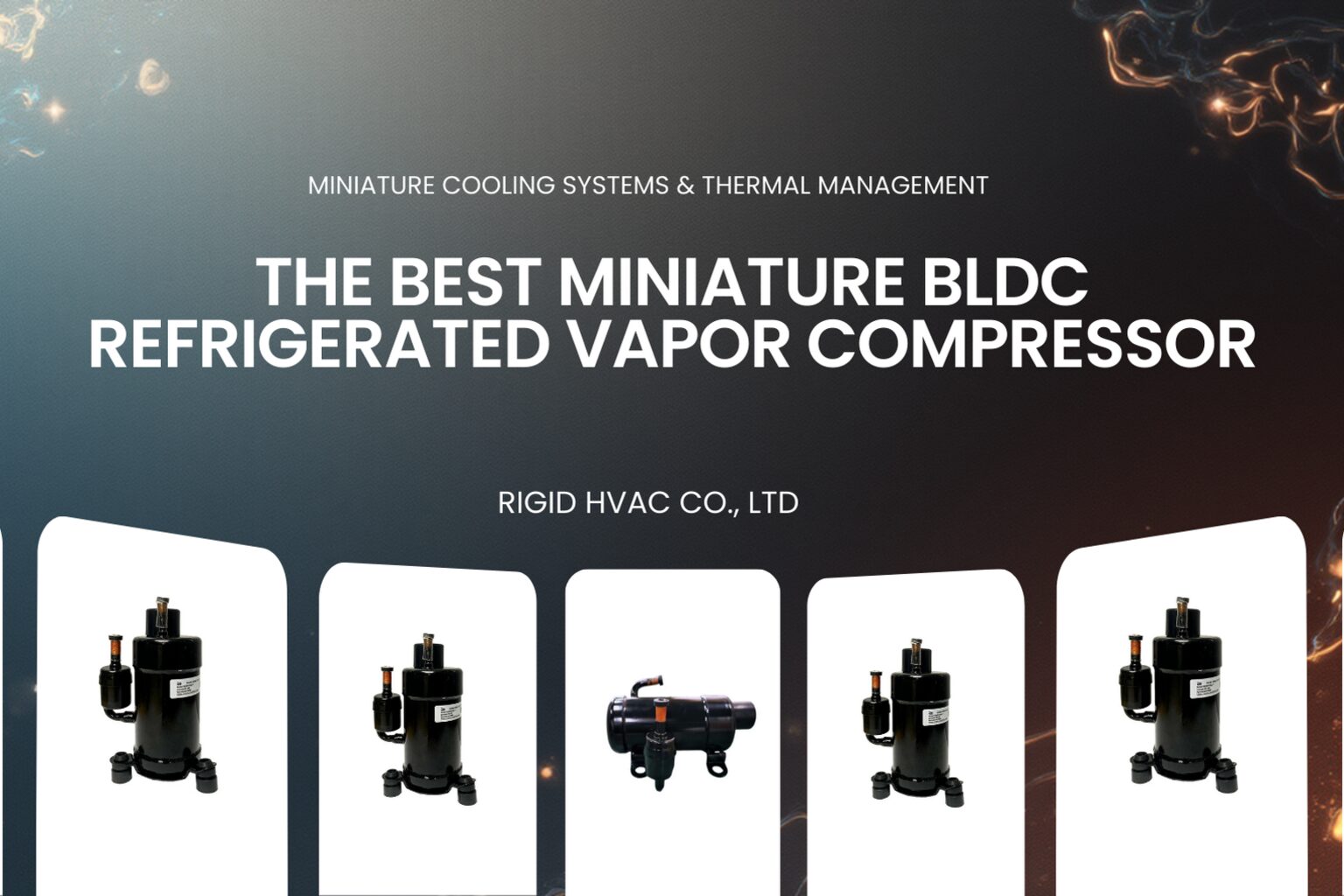
BLDC compressors from RIGID support multiple refrigerants including R134a, R290 (propane), and R513A. This flexibility matters because refrigerant choice affects system design in ways that interact with the BLDC advantages:
- R134a: The established choice for most applications. Wide operating temperature range, well-characterized performance curves, compatible with standard elastomers and oils. Available in all RIGID QX-series compressor models.
- R290 (propane): Lower GWP (3 vs 1,430 for R134a), higher thermodynamic efficiency in the 0-40°C range. Requires additional safety engineering due to flammability. RIGID offers dedicated R290 models (QX2802VDL-T, DV2820E-AC-T) with charge limits engineered for safe operation.
- R513A: A drop-in replacement for R134a with 56% lower GWP. Supported in higher-capacity models (QX3002VDL, QX8848VDL, QX3803VDL) for applications where regulatory compliance drives refrigerant selection.
The variable speed capability of BLDC compressors provides additional system design latitude. Because the compressor adjusts to load rather than cycling, you can size the evaporator and condenser closer to the average load rather than over-designing for peak cycling transients. Smaller heat exchangers save weight and volume — critical for portable systems.
Voltage Options and Application Matching
Choosing the right BLDC compressor voltage depends on your power source:
- 12V DC: Compatible with standard automotive batteries, small solar systems, and single lithium cell packs. The QX1901VDL delivers 110-360W cooling capacity at 12V. Best for small portable coolers, pet enclosures, and single-person sleeping solutions.
- 24V DC: The sweet spot for most professional applications. Lower current draw than 12V for the same power (half the amps, half the cable size). Models range from QX1902VDL (125-400W) through QX3202VDL (550W) to twin-cylinder QX2802VDL (550W with smoother output).
- 48V DC: Higher voltage means even lower current for high-capacity applications. The QX8848VDL delivers 1,067W (3,638 BTU) cooling at 48V — enough for equipment cabinets, large enclosures, or multi-zone cooling. Also matches EV battery pack voltage directly.
The electronic controller in a BLDC system typically accepts a voltage range (not a single value). A 24V-rated compressor may operate from 18-32V, accommodating battery charge and discharge curves without performance cliffs. Check the specific model datasheet for operating voltage range.
Noise and Vibration in Occupied Spaces
Portable refrigeration frequently operates near people. In vehicle sleeping areas, camping tents, medical transport, or office environments, noise matters. A fixed-speed compressor at full tilt produces 50-55 dB — noticeable in a quiet space. When it kicks on at 2 AM after the temperature drifts, it wakes people up.
BLDC compressors at partial load operate significantly quieter. At moderate cooling demand, noise levels drop to 35-40 dB — below typical background noise in most environments. The continuous operation (no startups) eliminates the click-and-hum cycle that makes conventional compressor noise so noticeable.
Vibration follows the same pattern. Lower RPM means lower vibration amplitude and frequency. For vehicle-mounted systems, this reduces stress on mounting hardware and connected tubing. For portable units, it means the compressor does not walk across the floor or rattle against enclosure walls.
Integration Considerations for OEM Engineers
If you are designing a product around a BLDC compressor, several integration factors distinguish it from conventional compressor integration:
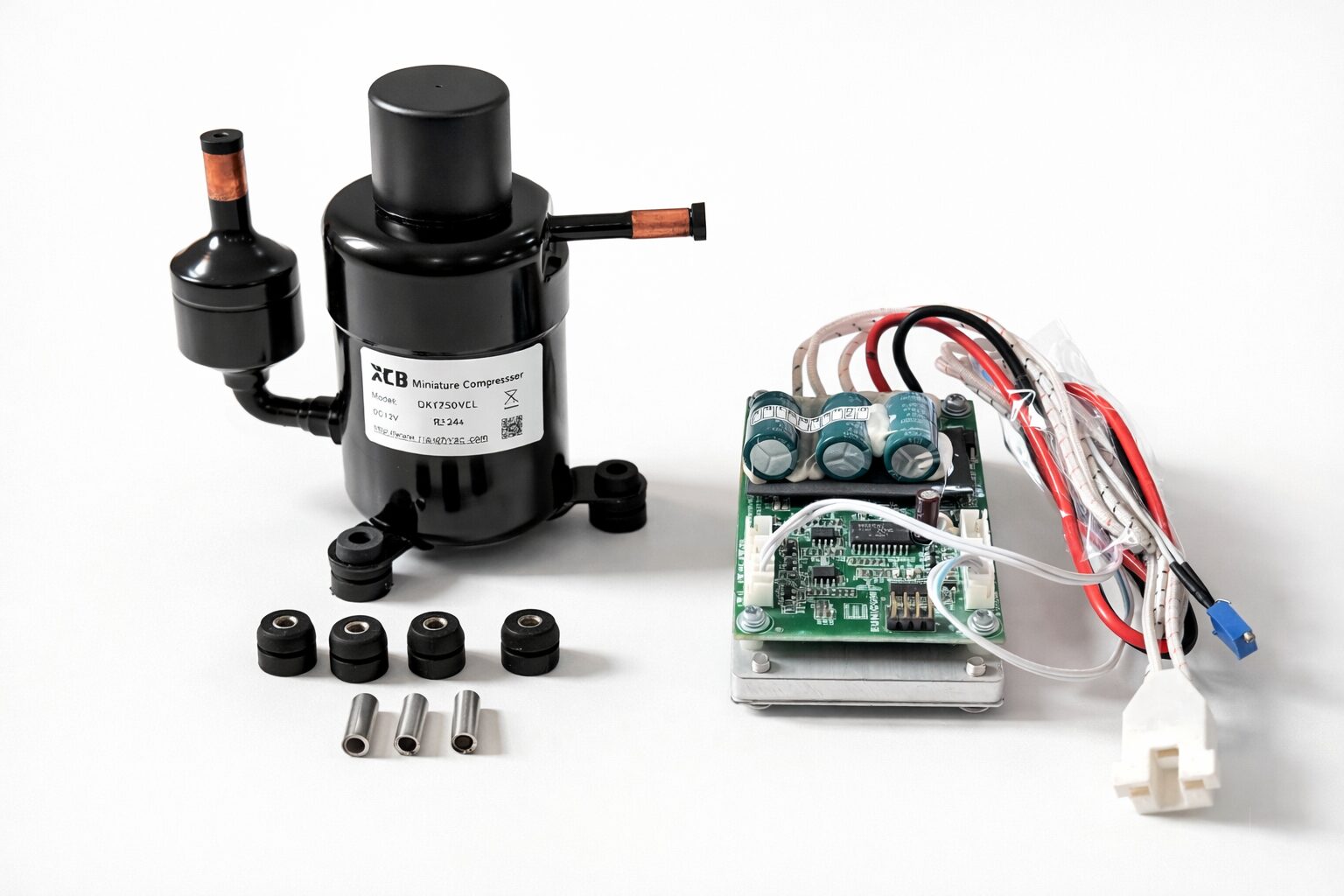
- Controller interface: BLDC compressors require an electronic speed controller (ESC) — sometimes integrated, sometimes separate. The controller accepts a speed command (analog voltage, PWM, or serial protocol) and drives the motor phases. Ensure your control architecture accommodates this interface.
- Soft start built-in: The electronic controller ramps speed gradually at startup. No inrush current spike, no need for oversized contactors or time-delay relays. This simplifies the power distribution design.
- Thermal protection: Most BLDC compressor controllers include over-temperature shutdown. The compressor monitors winding temperature and reduces speed or stops if limits are exceeded. Your system-level thermal management benefits from this self-protection.
- EMC considerations: The switching frequency of the BLDC driver can generate electromagnetic interference. Plan for appropriate filtering on power lines and shield sensitive signal traces from the compressor wiring.
For a complete line of BLDC rotary compressors spanning 12V to 48V in capacities from 110W to over 1,000W, see the RIGID BLDC Rotary Compressor series.
When BLDC Compressors Are Not the Right Choice
Honesty builds trust. BLDC compressors excel in the portable, off-grid, and DC-native applications discussed above. They are not always the optimal choice:
- High-capacity stationary systems: For cooling loads above 2-3 kW where grid power is available, traditional AC compressors with mature supply chains and lower per-watt costs remain practical.
- Extreme low-temperature applications: Below -40°C, specialized cascade or reciprocating compressors designed for those conditions outperform small rotary designs. Stirling coolers handle cryogenic ranges.
- Cost-only decisions: If the application tolerates noise, cycling, and AC power conversion losses, a conventional compressor with inverter may have lower upfront cost (though higher lifetime operating cost).
The BLDC compressor sweet spot is 50W to 1,100W cooling capacity, operating from DC power (battery, solar, vehicle electrical), in space-constrained or noise-sensitive environments, where variable speed efficiency translates directly to longer runtime or smaller battery packs.
Real-World Performance: BLDC vs Fixed-Speed in Field Conditions
Laboratory specifications tell part of the story. Field performance tells the rest. In real deployments, the gap between BLDC and fixed-speed compressors widens because real conditions rarely match laboratory standards.
Consider a portable vaccine transport cooler operating in tropical conditions. Ambient temperature reaches 42°C during the afternoon, drops to 28°C at night. The door opens several times per day for access. Solar input varies with cloud cover. A fixed-speed compressor in this scenario cycles aggressively during cooler ambient periods (wasting energy on over-cooling) and runs continuously at maximum during peak heat (potentially failing to maintain setpoint if undersized for worst-case).
The BLDC compressor responds differently. At 28°C ambient with stable setpoint, it runs at perhaps 40% speed — drawing 2A instead of 6A, extending battery runtime by hours. When ambient climbs to 42°C, it ramps to 80% speed, maintaining setpoint without the thermal inertia penalty of on-off cycling. When the door opens and temperature spikes 3°C, it accelerates to pull down quickly, then returns to steady state.
This responsive behavior produces measurable results in the field:
- 15-25% better energy efficiency compared to equivalent fixed-speed systems over a full operating day with varying conditions
- Tighter temperature control — typically ±0.5°C versus ±2-3°C with cycling
- Reduced mechanical stress — no high-current startups means less wear on electrical connections, contactor (eliminated), and compressor bearings
- Quieter operation during 70%+ of operating time when partial load suffices
Cost Analysis: Total System Cost vs Component Cost
OEM purchasing decisions often focus on component unit cost. A BLDC compressor costs more than a basic AC compressor of equivalent capacity. The comparison fails when you account for total system cost:
Components eliminated by BLDC:
- DC-AC inverter (for DC-powered applications): $30-80
- Starting capacitor and relay: $5-15
- Soft-start module (if required for inrush): $10-25
- Heavier gauge wiring for inrush current: $5-20 per meter savings
- Larger fuse or breaker rated for inrush: $5-10
Design simplification benefits:
- Smaller battery pack for same runtime (due to efficiency gains): significant system cost reduction
- Reduced heat rejection requirement at condenser (less waste heat from conversion losses)
- Simplified power distribution board layout
- Fewer components means fewer failure points — reduced warranty cost
For a typical portable cooling product, the BLDC compressor premium of $50-100 over a basic compressor is recovered by eliminating $80-150 in supporting components plus reducing battery pack size. The production BOM often comes out equal or lower, with better performance and reliability.
Selecting the Right BLDC Compressor for Your Application
A structured selection process prevents the common mistake of choosing by specifications alone:
- Define the thermal load. Calculate heat gain at worst-case conditions (maximum ambient, maximum internal heat generation, minimum insulation performance after aging). Add 20% margin.
- Identify the power source constraints. Available voltage, maximum continuous current, transient tolerance. This narrows your voltage class immediately.
- Set the physical constraints. Maximum dimensions, weight budget, mounting orientation requirements, vibration environment.
- Choose refrigerant based on regulatory context. Where does the product ship? Indoor or outdoor? What charge limits apply?
- Request samples for evaluation. Bench test in your thermal setup before committing to production tooling. Measure actual COP at your operating point — not just the datasheet rating.
The complete RIGID BLDC compressor range, from 110W at 12V to over 1,000W at 48V, covers the portable and embedded refrigeration envelope comprehensively. Each model includes detailed performance curves at multiple operating conditions, mechanical drawings, and controller interface specifications through the RIGID BLDC Rotary Compressor product page.