
Why a BLDC Compressor Changes the Equation for Micro Air Conditioning
When cooling capacity sits below 1 kW and the power source is a battery or a DC bus, the compressor you choose defines the entire thermal system. A brushless DC (BLDC) compressor paired with a sine-wave inverter drive gives engineers something that fixed-speed AC compressors and thermoelectric coolers cannot: continuous, proportional speed adjustment from a native DC supply. That single capability reshapes energy budgets, acoustic profiles, and temperature stability in ways that matter at the system level.
This article compares three cooling technology routes—BLDC variable-speed compressors, conventional fixed-speed AC compressors, and Peltier/TEC modules—through the lens of micro air conditioning design. The goal is to help OEM engineers and system integrators pick the right approach for enclosures, cabins, and equipment bays where space, weight, and DC power are real constraints.
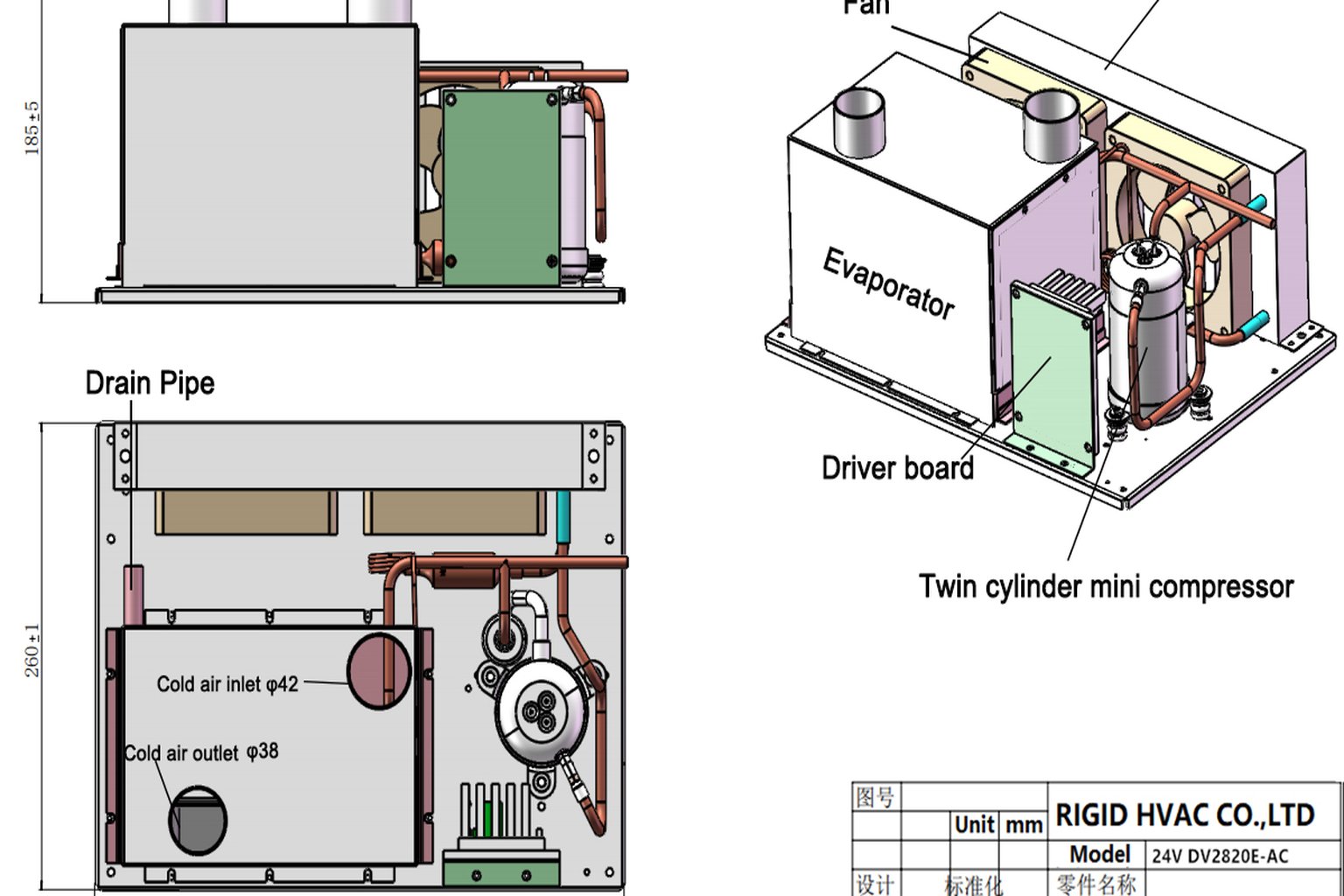
Three Cooling Technology Routes Compared: BLDC vs Fixed-Speed AC vs Peltier
Each technology route carries distinct trade-offs. Understanding them early prevents costly redesigns later in the integration cycle.
Fixed-Speed AC Compressors
Traditional AC compressors run at a single speed determined by the supply frequency (typically 50 Hz or 60 Hz). Temperature regulation happens through on/off cycling: the compressor runs at full capacity until the setpoint is reached, shuts down, then restarts when temperature drifts. This cycling creates several problems in micro-scale applications:
- Inrush current spikes at each startup can be 3–5 times the running current—a serious concern when the power source is a battery or a solar array with limited peak output.
- Temperature swings between the on and off thresholds can reach several degrees Celsius, which is unacceptable for sensitive electronics or biological samples.
- An inverter (DC-to-AC conversion stage) is required when the source is DC, adding weight, cost, and conversion losses.
- Acoustic noise follows a binary pattern—full noise or silence—which can be more noticeable than a steady low hum.
Fixed-speed compressors remain a reasonable choice for mains-powered, cost-sensitive applications where tight temperature control is not critical. They are widely available, well understood, and supported by a deep supply chain. But in battery-powered or DC-bus environments, the inverter requirement and cycling losses erode their advantages quickly. The added weight and volume of a DC-to-AC inverter also works against the compact form factors that micro air conditioning applications demand.
Peltier / Thermoelectric Coolers (TEC)
Peltier modules use the thermoelectric effect to pump heat across a semiconductor junction. They have no moving parts, which makes them attractive for vibration-sensitive applications. However, their coefficient of performance (COP) drops sharply as the temperature differential increases. A rule of thumb: TEC modules work well for temperature differentials under 20°C and heat loads under roughly 50–100 W. Beyond that range, the electrical power consumed by the TEC itself becomes a dominant heat source, and system COP can fall below 0.5.
For micro air conditioning tasks—cooling a cabin, an enclosure, or a rack where the heat load is several hundred watts and the ambient-to-setpoint differential may exceed 20°C—TECs are generally not practical as the primary cooling method. The electrical power required to maintain cooling at these loads would exceed the cooling output itself, making the system a net heat generator rather than a heat remover. TECs find their niche in spot cooling, laser diode temperature stabilization, and small analytical instruments where the heat load is measured in single-digit watts.
BLDC Variable-Speed Compressors
A BLDC compressor uses permanent magnets on the rotor and electronically commutated stator windings. The integrated inverter drive controls motor speed continuously, which means cooling output tracks the actual thermal load in real time. When the load drops, the compressor slows down rather than shutting off. When the load rises, it speeds up. This proportional behavior delivers several engineering benefits that the other two routes cannot match simultaneously:
- No inrush spikes—soft-start ramps keep peak current close to running current.
- Temperature stability within a narrow band, because the compressor modulates rather than cycles.
- Native DC operation—no external inverter needed when the source is 12 V, 24 V, or 48 V DC.
- Lower acoustic signature at partial load, since fan and compressor speeds both decrease.
RIGID’s Micro DC Aircon product line uses a BLDC sine-wave inverter drive across all models, from the 450 W (1,535 BTU) DV1910E-AC at 12 V to the 900 W (3,069 BTU) DV3830E-AC at 48 V. Every unit runs directly from a DC bus with no AC conversion stage required.
The Engineering Value of Variable Speed Control
Variable speed is not just a feature label—it changes how the thermal system behaves under real operating conditions. Here are the three areas where it matters most.
Precision Temperature Regulation
In a fixed-speed system, the smallest possible cooling increment is “full capacity.” The system overshoots the setpoint, turns off, undershoots, turns on again. The resulting temperature ripple depends on thermal mass and insulation, but it is inherent to the on/off control method.
A variable-speed BLDC compressor can reduce its output to match a partial load. If the enclosure only needs 60% of rated capacity to hold setpoint, the compressor runs at a corresponding lower speed. The temperature band tightens because the system never fully overshoots or undershoots. For applications like medical device cooling or telecom cabinet climate control, where component reliability correlates with temperature stability, this is a meaningful advantage.
RIGID’s Micro DC Aircon units support a cooling temperature range of 5°C to 30°C, giving integrators a wide setpoint window to work within.
Energy Efficiency and Battery Life
Compressor efficiency at partial load is where variable speed earns its keep. A fixed-speed compressor running at 50% duty cycle (on half the time, off half the time) consumes more energy than a variable-speed compressor running continuously at 50% speed. The reasons are thermodynamic: lower speed means lower pressure ratios, reduced friction losses, and better heat exchanger utilization because refrigerant flow rates match the actual load.
For battery-powered systems—electric vehicles, mobile medical units, off-grid telecom sites—this efficiency difference translates directly into runtime. As a starting estimate, variable-speed operation can extend battery-supported cooling time by 20–30% compared to fixed-speed cycling under partial-load conditions, though actual results depend heavily on load profile, ambient temperature, and insulation quality. In a 24 V system running a DV2820E-AC at 700 W rated capacity, partial-load operation at reduced speed draws significantly less current than cycling the same compressor at full speed for half the time, reducing both average power draw and peak current demands on the battery management system.
Acoustic Performance
Noise matters in occupied spaces. A compressor running at reduced speed produces less vibration and less airflow noise than one running at full speed. More importantly, it produces steady noise rather than the start-stop pattern of a cycling compressor. Human perception of noise is strongly influenced by variability—a constant low hum is far less intrusive than repeated startup transients. In EV cabin cooling or patient-side medical equipment, this difference affects user acceptance.

Speed Control Interfaces: Choosing the Right Signal for Your System
RIGID’s Micro DC Aircon units accept four speed control input types. Each suits different integration architectures, and choosing the right one early avoids rework during prototyping.
Potentiometer (Analog Resistive)
A simple variable resistor sets the speed. This is the lowest-complexity option—no microcontroller needed. It works well for manual-adjust applications like operator cabins or portable cooling units where the user turns a knob. The downside is that it offers no closed-loop feedback; the system cannot automatically adjust speed based on temperature readings without additional control hardware.
0–5 V Analog Voltage Signal
A 0 to 5 V DC signal maps linearly to compressor speed. This interface integrates cleanly with analog output modules from PLCs, building management systems, or custom control boards. It supports closed-loop temperature control when paired with a temperature sensor and a simple PID controller. Cable runs should be kept short or shielded to avoid noise pickup on the signal line.
PWM (Pulse Width Modulation)
A digital square wave where the duty cycle sets the speed. PWM is the natural choice when the host controller is a microcontroller (Arduino, STM32, ESP32, or similar). It is noise-resistant over longer cable runs compared to analog voltage, and it requires only a single GPIO pin. Most OEM integrations in our experience default to PWM because it balances simplicity, noise immunity, and compatibility with common embedded platforms.
TTL (Serial Digital)
A TTL-level serial interface allows the host controller to send discrete speed commands and, in some configurations, read back status data. This is the most capable interface for systems that need bidirectional communication—for example, a central controller that monitors compressor status, adjusts speed, and logs operating data. It requires more firmware development than the other options but provides the richest integration. For fleet deployments or remote-monitored installations, TTL serial communication enables centralized diagnostics and predictive maintenance workflows that simpler interfaces cannot support.
For engineers evaluating which interface to specify, the decision tree is straightforward: if there is no microcontroller in the system, use a potentiometer or 0–5 V signal. If there is a microcontroller, PWM is the default starting point. If bidirectional data exchange is needed, use TTL.
Application Scenarios: Where Variable-Speed Micro AC Fits—and Where It Does Not
Variable-speed micro air conditioning is not a universal solution. It excels in specific conditions and is the wrong choice in others. Being clear about both helps engineers avoid misapplication.
Strong Fit: Battery-Powered Mobile Systems
Electric vehicles, autonomous ground vehicles, mobile medical carts, and field-deployed telecom shelters all share a common constraint: limited DC power and a need to maximize runtime. The combination of native DC input (12 V, 24 V, or 48 V options across the RIGID Micro DC Aircon line), no-inverter operation, and variable-speed efficiency makes BLDC micro AC a natural fit. The DV1910E-AC at 12 V is sized for smaller EV cabins or single-rack enclosures, while the DV3820E-AC and DV3830E-AC at 900 W (3,069 BTU) handle larger thermal loads in 24 V or 48 V systems.
Strong Fit: Precision-Controlled Enclosures
Telecom outdoor cabinets, unmanned drone charging stations, and medical device housings often require temperature to stay within a defined band regardless of ambient swings. Variable speed control, combined with a closed-loop PID controller reading an enclosure temperature sensor, can hold setpoint with minimal ripple. The RIGID Micro DC Aircon product line supports this architecture directly through its PWM, 0–5 V, and TTL control inputs.
Strong Fit: Noise-Sensitive Environments
Patient rooms, recording studios adjacent to equipment racks, and EV passenger cabins all benefit from the reduced and steady acoustic output of a variable-speed compressor running at partial load. At approximately 5 kg (11 lbs), the compact form factor also helps in space-constrained installations where a larger split system would not fit.
Marginal Fit: Very Low Heat Loads (Under ~100 W)
If the total heat load is consistently below 100 W and the required temperature differential is small (under 15°C), a Peltier/TEC module may be simpler and cheaper to integrate. A vapor-compression system is oversized for this range and adds mechanical complexity that may not be justified. Evaluate the actual load profile before defaulting to a compressor-based solution.
Not a Fit: Mains-Powered, Cost-First Applications
If the installation has reliable AC mains power, no battery constraints, and the primary selection criterion is upfront cost, a conventional AC-powered mini-split or window unit will typically be less expensive. The advantages of DC-native operation and variable speed control are real but carry a cost premium that is justified by the operating environment, not by the cooling task alone.
Not a Fit: Very High Capacity Requirements
The RIGID Micro DC Aircon line tops out at 900 W (3,069 BTU). Applications requiring multiple kilowatts of cooling—server rooms, large vehicle cabins, or industrial process cooling—need larger equipment. Micro DC air conditioning is designed for compact, distributed cooling, not centralized high-capacity plants.
Refrigerant Considerations
Most models in the line ship pre-charged with R134a. The DV2820E-AC-T variant uses R290 (propane), a natural refrigerant with lower global warming potential. R290 carries flammability classification A3, which means enclosure design and installation must comply with applicable safety standards. Engineers should verify local regulatory requirements before specifying R290 in their application.
Integration Notes for OEM Engineers
All RIGID Micro DC Aircon units ship pre-charged and ready to connect—no field brazing or vacuum pump required. The electrical interface is a DC power connection plus the chosen speed control signal, which keeps the integration scope manageable even for teams without deep HVAC experience. For detailed specifications, wiring diagrams, and dimensional drawings, contact RIGID’s engineering support team to discuss your specific enclosure geometry and thermal load profile. Early engagement during the enclosure design phase helps avoid common pitfalls like insufficient airflow around the condenser, undersized DC wiring, or control signal routing that picks up electrical noise from motor drives or switching power supplies.