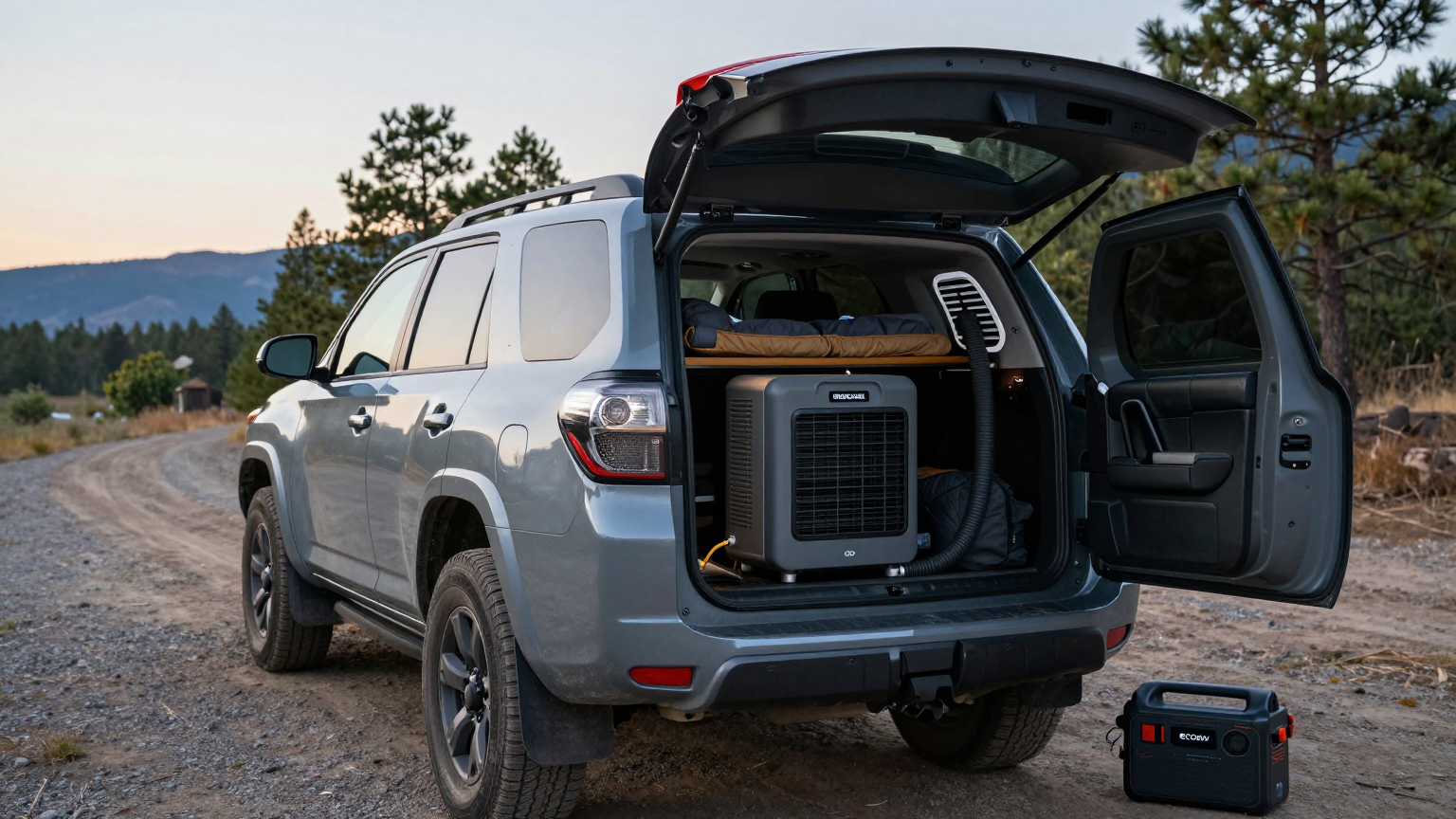
The Greenhouse Effect: Why Your Car is an Oven
Car camping has exploded in popularity, offering a secure, weather-proof alternative to tents. However, every summer camper discovers the same brutal physics lesson: vehicles are designed to trap heat. The combination of steel conductivity and glass windows creates massive solar gain. Even after the sun goes down, the chassis retains heat for hours, radiating it back into the cabin like a slow-release thermal battery.
Cracking a window or using a USB fan simply moves this hot air around (convection) without removing the thermal energy. To actually lower the cabin temperature from a stifling 30°C (86°F) to a sleep-inducing 21°C (70°F), you need active heat rejection. You need a dedicated car camping ac that physically pumps heat out of the vehicle.
This guide covers the complete engineering approach: exhaust management, power strategy, placement, and the specific advantages of using a RigidChill Portable DC Air Conditioner for vehicle-based camping.
The Thermodynamics of Vehicle Cooling
Unlike a house with insulated walls, a car has very poor R-value (thermal resistance). Thin sheet metal and large glass panels mean the cooling unit must fight a constant battle against heat intrusion from the environment. Success depends on two critical factors: BTU Capacity and Airflow Management.
A standard 12V rooftop RV air conditioner is too power-hungry (often drawing 50A+ continuous) and requires permanent roof modification—impractical for a daily-driver SUV. Household portable ACs are bulky, run on 110V AC (requiring a large inverter), and are not designed for the vibration and tilt angles of vehicle use.
The RigidChill Portable DC Air Conditioner bridges this gap. It is compact enough to sit on a center console or folded seat, yet powerful enough (2,300 – 2,800 BTU) to cool the specific volume of a sleeping area. Critically, it runs natively on DC power, eliminating the need for an inverter entirely.
Critical Success Factor: The Exhaust Setup
The #1 reason car camping AC setups fail is improper exhaust venting. An air conditioner does not “create cold”; it moves heat. It absorbs heat from the cabin air at the evaporator (front) and ejects it outside via the condenser (rear exhaust). If you do not duct this hot exhaust air completely outside the vehicle, you are simply running a heater and a cooler in the same box. The net result is actually a slight temperature increase, because the compressor motor itself generates waste heat.
The Window Vent Solution
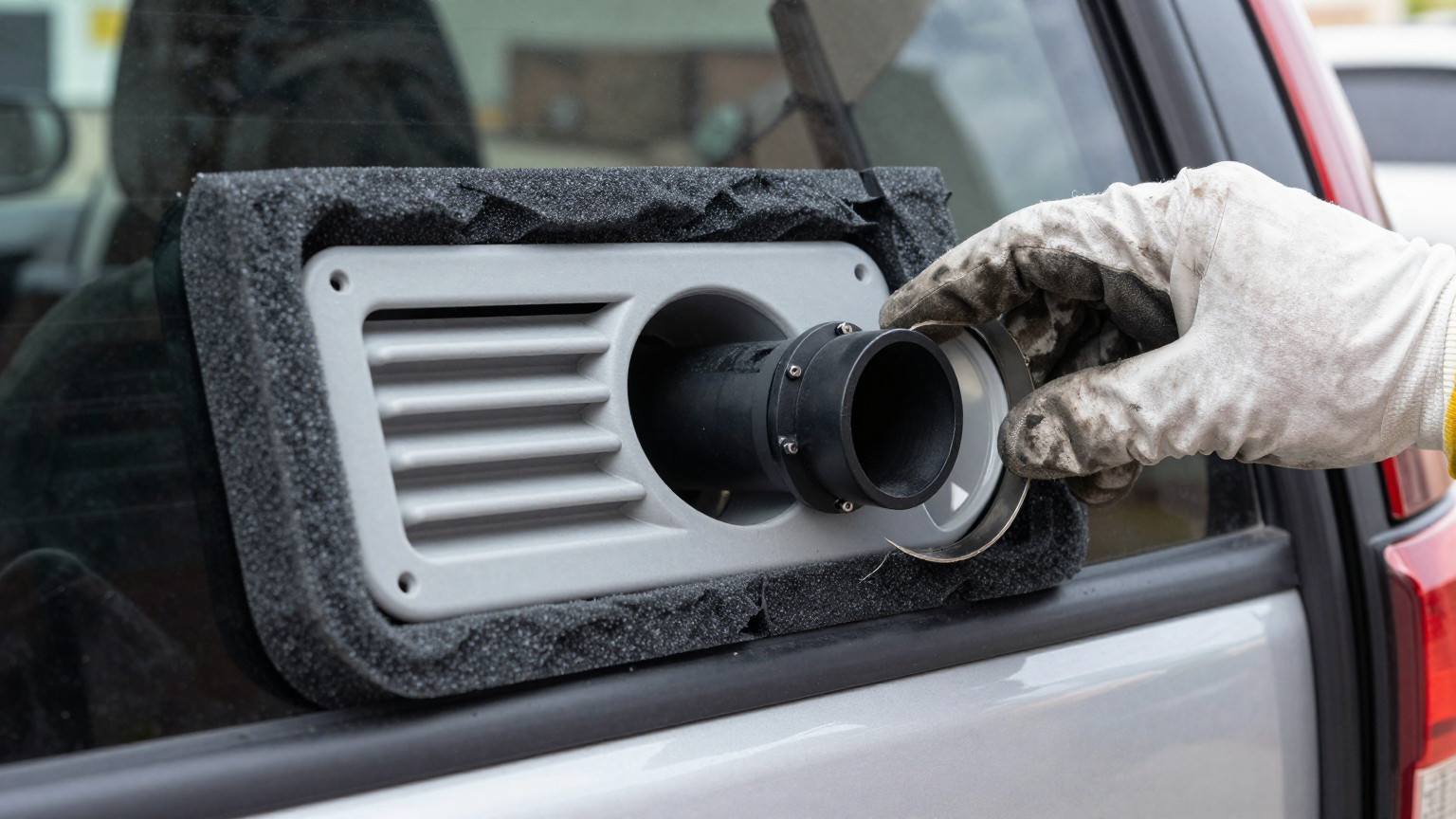
For SUV campers (Toyota 4Runner, Subaru Outback, Ford Explorer, Jeep Grand Cherokee), the rear passenger window is the ideal exhaust point. You need a Window Vent Kit—a sealed panel that replaces the open window gap.
- Materials: You can buy a universal kit, but many overlanders make custom inserts using Coroplast (corrugated plastic), acrylic sheet, or thin plywood cut to the exact shape of the window opening.
- Seal: The insert must fit snugly into the window channel. Roll the window up against the bottom edge of the insert to lock it in place. Use adhesive weather stripping or closed-cell foam tape around all edges to ensure it is airtight. Any gap will allow hot exhaust air to recirculate back into the cabin.
- Hose Port: Cut a circular hole matching the RigidChill 4-inch (100mm) exhaust hose diameter. Use a flange adapter or PVC coupling to create a smooth, sealed connection.
- Hose Routing: Keep the exhaust hose as short and straight as possible. Every curve adds back-pressure to the compressor, reducing efficiency. Insulate the hose with a neoprene sleeve or reflective wrap to prevent the heat radiating from the plastic tube back into your cool cabin.
Powering the Chill: Battery Strategy
Idling your engine all night to run the dashboard AC is dangerous (carbon monoxide risk), noisy, illegal in many campgrounds, and terrible for your engine. The modern solution is a Portable Power Station (often called a Solar Generator) like an EcoFlow Delta, Jackery Explorer, or Bluetti AC200.
Sizing Your Battery
The RigidChill LC2810E is engineered for efficiency, drawing only 100W-250W depending on the cooling mode and ambient temperature.
- 1000Wh Battery (1kWh): Good for 4-6 hours of cooling. Suitable for pre-cooling the car before bed or for shorter spring/fall nights where ambient temps drop naturally after midnight.
- 2000Wh Battery (2kWh): The Gold Standard for summer camping. This will run the unit on Eco Mode (maintaining a comfortable sleeping temperature of 22-24°C) for 10-14 hours, easily covering a full night’s sleep plus morning coffee power.
The DC Direct Advantage
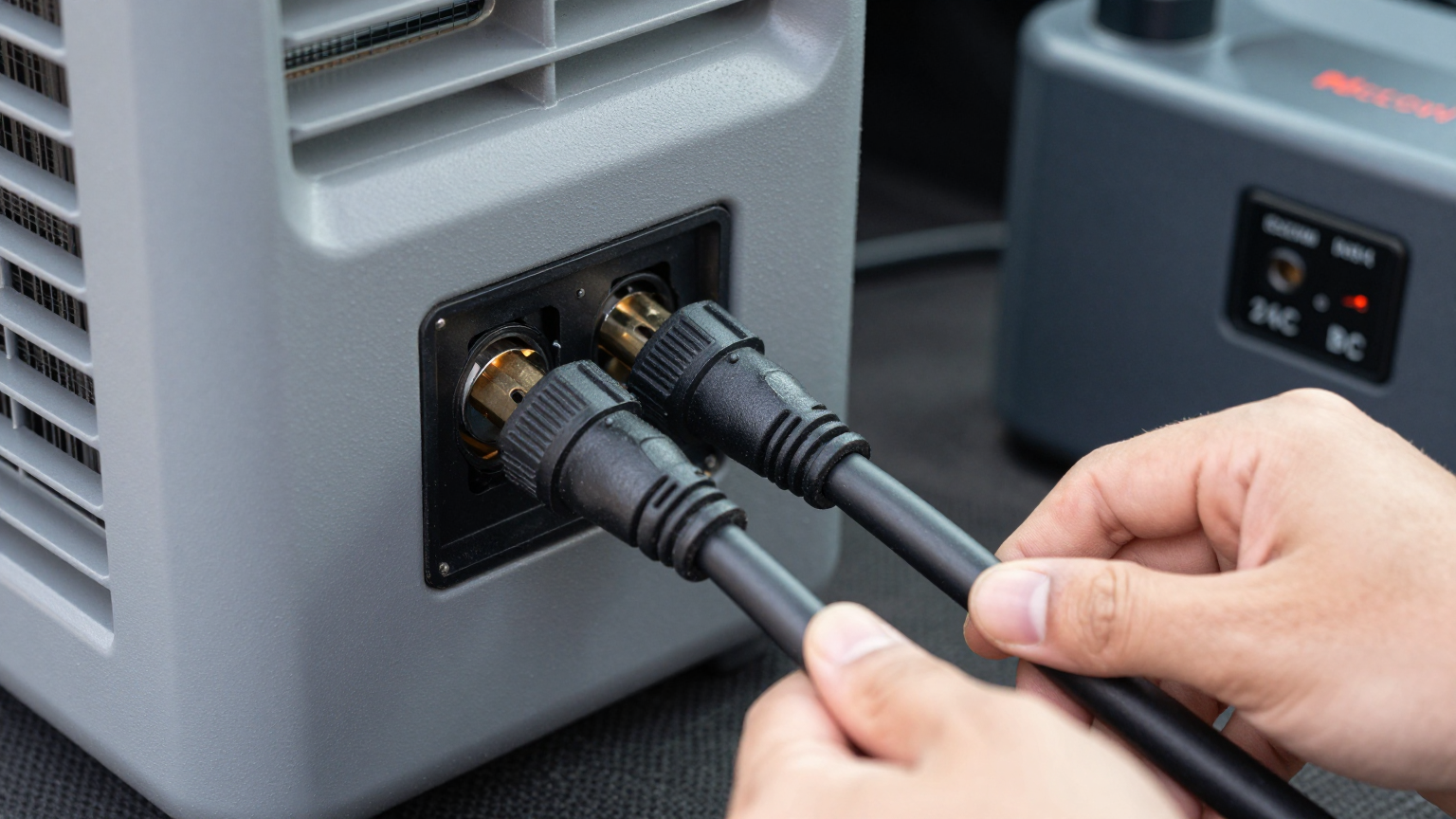
This is the single most important efficiency tip: Do not use the AC outlet on your power station. That forces the internal inverter to run, converting DC battery power to 110V AC, only for the air conditioner to convert it back to DC internally. This double conversion wastes 15-25% of your stored energy as heat.
Instead, use the 24V DC output (or a 12V-to-24V step-up converter) to power the RigidChill unit directly. This “DC-to-DC” connection is the secret to maximizing all-night runtime. It is the core engineering advantage of choosing a DC-native air conditioner over a household portable unit.
Placement Configurations for Different Vehicles
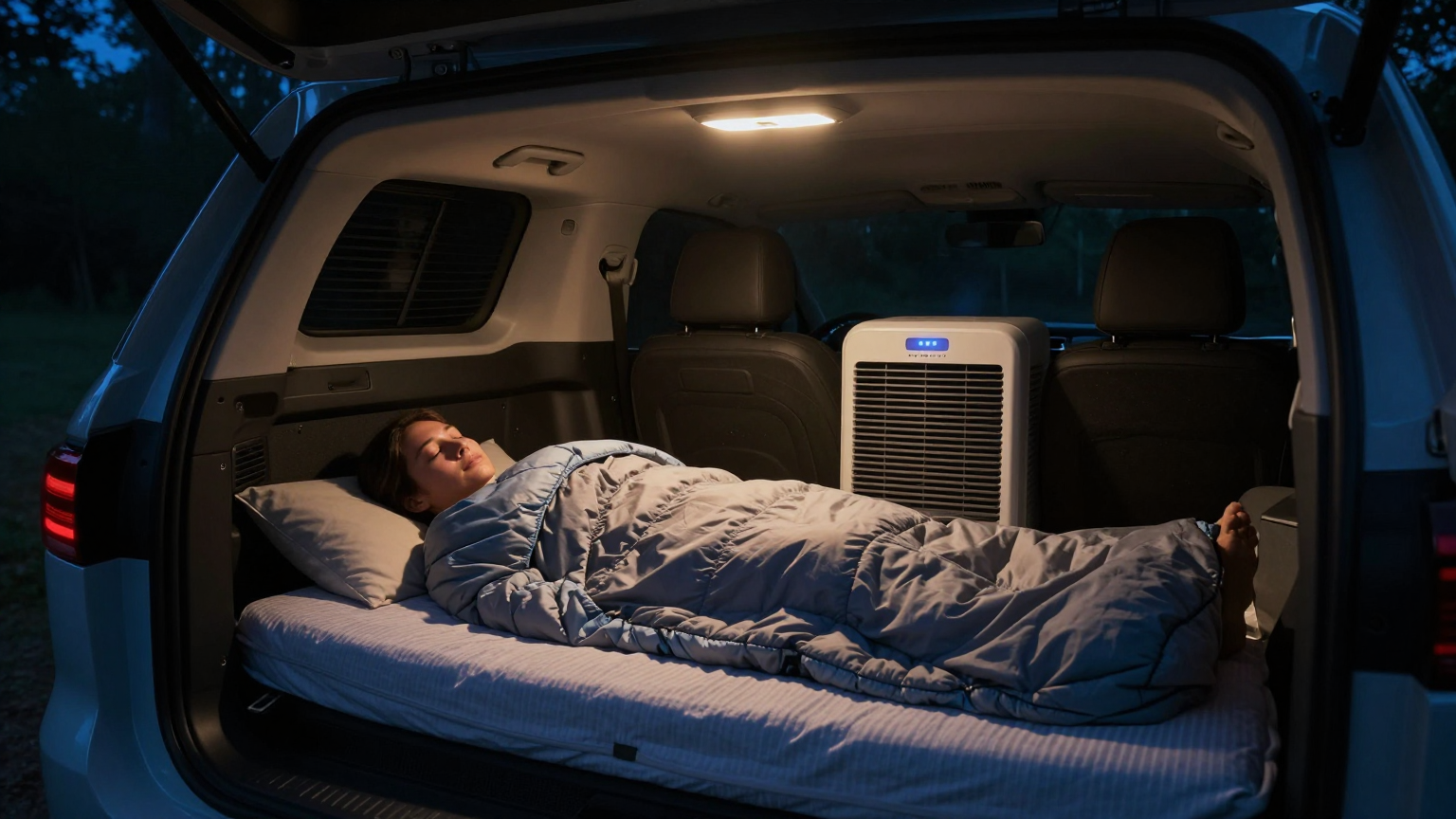
Where do you put the unit in a cramped SUV? Here are the three most popular configurations used by our customers:
- Front Seat Setup (Most Popular): Place the unit on the driver or passenger seat. Run the exhaust hose out the front window via a vent insert. Aim the cold air vents toward the rear sleeping area. This maximizes sleeping space and keeps the noisy compressor furthest from your head.
- Rear Cargo Area: For wagons and hatchbacks where you sleep with the rear seats folded flat, place the unit in the far corner of the cargo area. Exhaust out the rear side window. Cold air blows directly across your sleeping pad.
- Footwell: Place it in the rear footwell behind the front seats. This is the stealthiest option and keeps the unit low and stable, but requires careful hose routing up to the window.
Case Study: The Tesla Camping Mode Alternative
Tesla owners often use the built-in “Camp Mode,” which keeps the main HVAC running while parked. While effective for cooling, it consumes 10-15% of the main traction battery per night (approximately 7-10 kWh). That translates to 30-50 miles of lost driving range.
For overlanders camping in remote areas—National Parks, BLM land, forest roads—where Superchargers are hours away, this range loss can be the difference between making it home and needing a tow. By using a separate RigidChill unit powered by a small, portable 1-2kWh expansion battery, you preserve 100% of your vehicle’s driving range. The external battery can be recharged via a small solar panel during the day while you hike.
This same logic applies to any EV or hybrid owner who wants to camp without sacrificing their “get home” fuel reserve.
Fresh Air and CO2 Management
Standard car camping can get stuffy. With windows sealed for AC efficiency, CO2 levels rise as you breathe. The RigidChill unit recirculates cabin air through its cooling coil, but it does not introduce fresh outside air.
The solution is simple: crack a front window on the opposite side of the vehicle from the exhaust vent, just 1/2 inch (12mm), covered with a fine mesh bug screen. The slight negative pressure created by the exhaust fan will naturally draw a small volume of fresh air through this gap, keeping the cabin oxygenated without significantly impacting cooling performance. This passive ventilation strategy is used by professional vehicle upfitters for K9 units and mobile command centers.
Noise Management for Better Sleep
The RigidChill LC2810E features a variable-speed BLDC compressor with “Soft Start” technology. Unlike fixed-speed compressors that cycle on and off with a jarring click every 15 minutes, the RigidChill unit ramps up gradually and continuously modulates its speed to match the exact cooling load. Once the cabin reaches the target temperature, it slows to a quiet hum (approximately 42-48 dB at 1 meter—quieter than a household refrigerator and significantly quieter than a window AC unit).
For light sleepers, placing the unit on the front seat (furthest from your head in the rear sleeping area) and using a folded towel or anti-vibration pad underneath for dampening can reduce perceived noise even further. Many of our customers report that the gentle white noise of the fan actually helps them fall asleep faster than in complete silence.
Comparison to Alternatives
Running a gas generator outside the vehicle produces 65-75 dB of noise—enough to violate quiet hours at any campground and disturb neighboring campers. Even “quiet” inverter generators produce 50-58 dB. The RigidChill unit, running on a silent battery, eliminates this social friction entirely. You cool your car without becoming the least popular person in the campground.
Integration Support
Whether you drive a compact crossover or a full-size truck, the RigidChill engineering team can advise on the optimal placement, hose routing, and power configuration for your specific vehicle. We also offer custom window vent adapters for popular models.
Check out the RigidChill Portable AC models and accessories.