
How to Cool a Lab-Scale Reactor: A Practical Chiller Sizing Guide
Temperature control can make or break a synthesis. Whether you are running an exothermic polymerization, a crystallization step, or a sensitive organometallic coupling, the heat generated inside your reactor vessel needs somewhere to go. Tap water and ice baths served early-stage research well enough, but once you move to reproducible process development, a dedicated chiller for reactor cooling becomes essential.
This guide walks you through the practical side of chiller sizing for lab-scale jacketed reactors in the 1–50 L range. No complex thermodynamic equations here — just tables, rules of thumb, and real-world considerations that help you pick the right unit the first time.
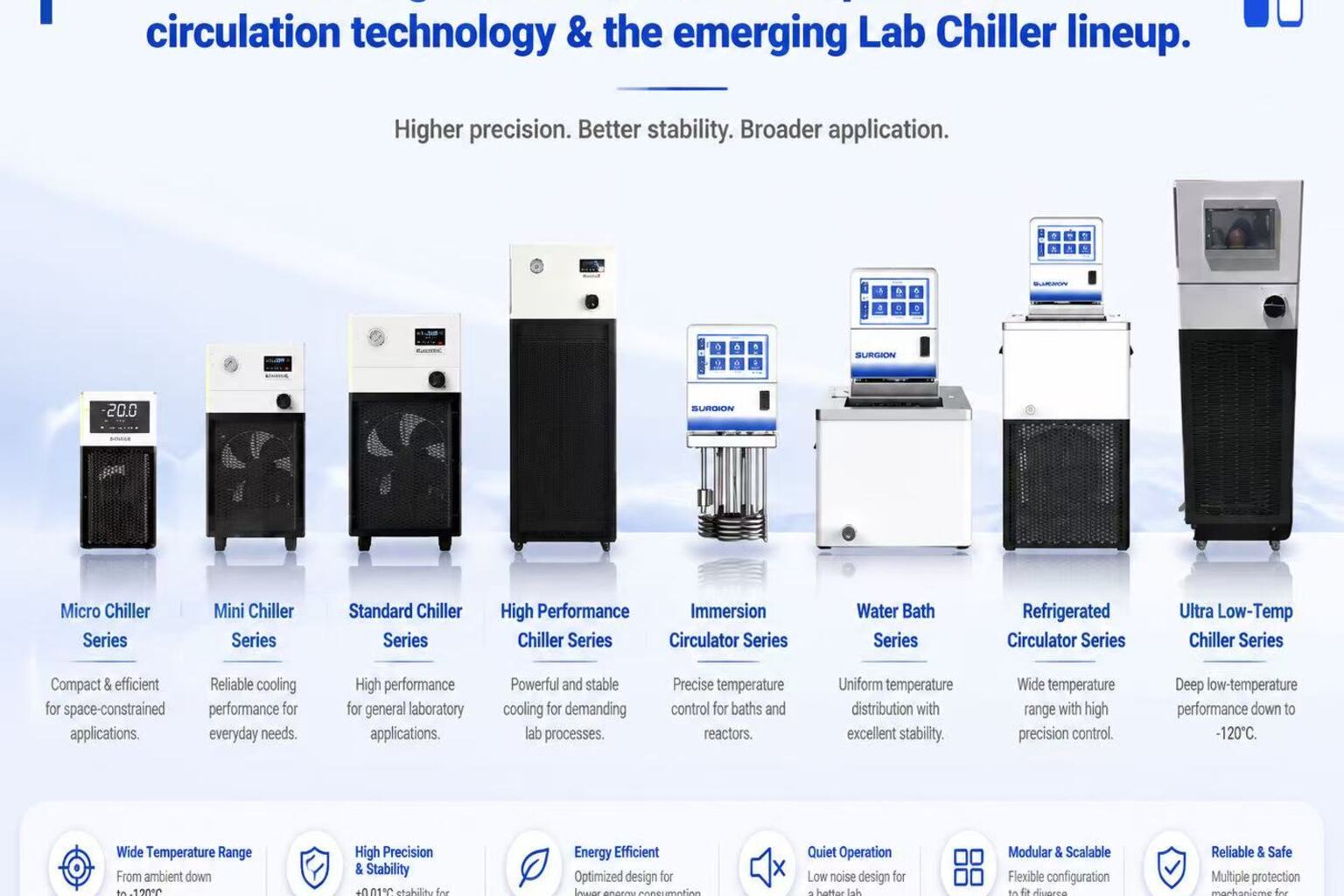
Why Every Reactor Needs a Dedicated Chiller for Reactor Cooling
Laboratory reactors generate heat in ways that are difficult to predict from one batch to the next. Exothermic reactions release energy rapidly, and without consistent removal of that heat, temperatures can spike beyond your target setpoint. The consequences range from reduced selectivity and lower yields to runaway conditions that compromise safety.
Tap water cooling — still common in teaching labs — introduces several problems at the process development stage:
- Inconsistent inlet temperature. Municipal water varies seasonally, sometimes by 15°C or more between summer and winter. That variability makes it nearly impossible to hold a tight temperature window.
- No sub-ambient capability. Many reactions require cooling to 0°C, -20°C, or lower. Tap water simply cannot reach those temperatures.
- Wastewater and cost. Running water continuously down the drain adds up — both financially and in terms of lab sustainability goals.
- No feedback control. A recirculating chiller with a PID controller adjusts coolant flow and temperature in real time, responding to the thermal load as it changes throughout the reaction profile.
A dedicated chiller provides stable, repeatable cooling at any setpoint you need. It recirculates the same fluid in a closed loop, which means consistent performance batch after batch — exactly what process development demands.
Types of Reactor Cooling: Jackets, Coils, and External Heat Exchangers
Before sizing a chiller, it helps to understand how that cooling capacity actually reaches your reaction mass. The three most common configurations for lab-scale reactors are:
Jacketed Reactors
The most widely used approach at the 1–50 L scale. A jacket surrounds the reactor vessel, and chilled fluid circulates through the annular space between the inner and outer walls. Heat transfers from the reaction mass, through the glass or steel wall, and into the circulating coolant.
Jacketed reactors offer good surface-area-to-volume ratios at smaller scales, making them efficient for heat removal. They also keep the reactor interior unobstructed, which is important for stirring and sampling.
Internal Cooling Coils
Some reactor designs route coolant through a coil immersed directly in the reaction mass. This provides excellent heat transfer because there is no vessel wall between coolant and product. However, coils reduce available volume, can interfere with agitation, and introduce cleaning challenges. They are more common in larger pilot-scale systems than in bench-top setups.
External Heat Exchangers
In a recirculation loop, the reaction mass is pumped out of the vessel, through a shell-and-tube or plate heat exchanger, and back in. This approach is typical for continuous-flow reactors or when the vessel geometry does not accommodate a jacket. It adds complexity (pumps, extra tubing, potential dead volume) but can handle very high heat loads efficiently.
For most lab-scale applications in the 1–50 L range, a jacketed reactor paired with a recirculating chiller is the standard configuration. The sizing guidance in this article assumes that setup unless noted otherwise.
How to Estimate Cooling Load Without Complex Calculations
In theory, determining the exact cooling requirement involves knowing the enthalpy of reaction, heat capacity of your mixture, heat transfer coefficient of the jacket, and several other variables. In practice, most chemists and engineers rely on rules of thumb and manufacturer guidelines to get a reliable starting estimate.
Here is a practical approach:
Rule of Thumb: 50–100 W per Litre of Reactor Volume
For moderately exothermic reactions in glass-jacketed reactors, a common guideline is to budget 50–100 watts of cooling per litre of working volume. This accounts for typical organic synthesis reactions, including additions, neutralizations, and moderate polymerizations.
For highly exothermic processes — such as nitrations, strong acid-base reactions, or fast polymerizations — you may need 100–150 W/L or more. Conversely, if you are simply maintaining a sub-ambient temperature with minimal heat generation (holding a crystallization at -10°C, for example), 30–50 W/L may suffice.
Factor in Ambient Heat Gain
Your reactor is not perfectly insulated. Heat leaks in from the surrounding laboratory environment, especially when the setpoint is well below ambient. As a guideline, add 10–20% to your estimated load for every 20°C difference between setpoint and room temperature.
Consider the Temperature Differential
A chiller’s rated capacity drops as the coolant temperature decreases. A unit rated at 3 kW at 20°C might only deliver 1.5 kW at -20°C. Always check the capacity curve at your actual operating temperature, not just the headline number.
Chiller Sizing Table by Reactor Volume
The following table provides practical sizing recommendations for glass-jacketed reactors running moderately exothermic reactions. These values assume a coolant temperature between -20°C and +10°C, typical of most synthesis and crystallization work.
| Reactor Volume | Typical Heat Load | Recommended Chiller Capacity | Notes |
|---|---|---|---|
| 1–2 L | 100–200 W | 1–1.5 kW | Bench-top synthesis, small-scale screening |
| 5–10 L | 400–800 W | 2–3 kW | Process development, kilo-lab work |
| 20–50 L | 1–3 kW | 3–5 kW | Scale-up, pilot batches, crystallization studies |
Important: These are starting guidelines. If your reaction is particularly exothermic, or if you need to cool rapidly from a high temperature, size up. It is always better to have headroom — a chiller running at 60–70% load is more efficient and longer-lived than one running at full capacity continuously.
Why Oversizing Slightly Is Good Practice
An oversized chiller reaches setpoint faster, responds more quickly to thermal spikes, and operates with lower compressor stress. The energy penalty for modest oversizing is minimal because modern chillers modulate their output. Think of it as buying a safety margin rather than wasting capacity.
Temperature Profile Considerations
Chiller sizing is not only about peak load — it is also about the temperature profile your process demands. Different phases of a reaction may require very different things from your cooling system.
Ramp-Down Speed
How quickly do you need to reach setpoint? If you are pre-cooling a reactor from 20°C to -20°C before adding reagents, the thermal mass of the vessel, jacket fluid, and any solvent already charged all contribute to the load. A larger chiller covers this faster, reducing wait time between batches.
Holding at Setpoint
Once at temperature, the steady-state load is usually much lower than the peak load during ramp-down or during the most exothermic phase of the reaction. A well-sized chiller handles both phases without struggling.
Temperature Cycling
Some processes require cycling between temperatures — for example, heating to reflux, then rapidly cooling for crystallization. In these cases, the chiller needs enough capacity to pull the system down quickly even after the jacket fluid has warmed during the heating phase. Pay attention to the recovery time specified by the manufacturer.
Low-Temperature Performance
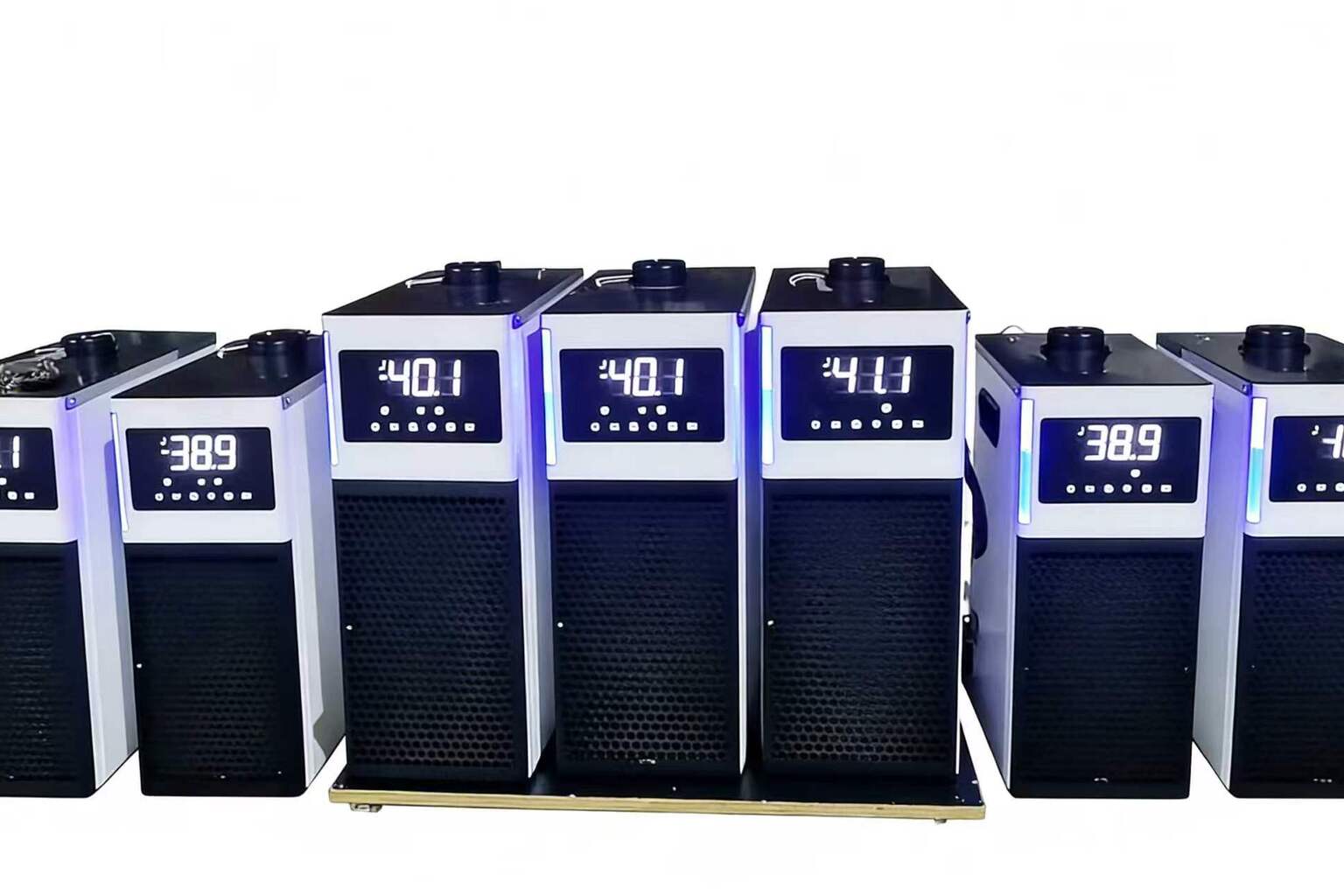
Chiller capacity always decreases at lower temperatures. If your process needs -30°C or -40°C, verify the unit’s capacity at that specific temperature. A chiller rated at 4 kW at 0°C might deliver only 2 kW at -30°C. The RIGID MidiCool™ series, for example, provides 1.3–4.6 kW of cooling capacity with an operating range from -40°C to 0°C and a built-in 1.2 bar circulation pump — making it well-suited for lab-scale reactor applications across a wide temperature window.
Practical Tips for Reactor Chiller Installations
Getting the right chiller is only part of the equation. How you set up and operate the system matters just as much for consistent performance.
Choose the Right Heat Transfer Fluid
The fluid circulating through your jacket determines how efficiently heat moves from the reactor to the chiller. Common options include:
- Water: Excellent heat transfer, but limited to above-freezing temperatures. Suitable for processes at 5°C and above.
- Water-glycol mixtures: Extend the usable range to -20°C or lower depending on concentration. A 50/50 ethylene glycol-water mix is common for operations down to -30°C. Be aware that glycol increases viscosity, which can reduce flow rates and heat transfer at very low temperatures.
- Silicone oils: Useful for wide temperature ranges (down to -40°C or below) and where chemical compatibility with water is a concern. However, their heat transfer coefficient is lower than glycol-water, so you may need more chiller capacity to compensate.
Match your fluid choice to the temperature range and ensure the chiller pump can handle the fluid viscosity at your lowest operating temperature.
Insulate Your Lines and Jacket
Uninsulated tubing between the chiller and reactor loses energy to the room. At sub-ambient temperatures, condensation forms on cold surfaces, dripping water onto equipment and the floor. Foam pipe insulation is inexpensive and makes a measurable difference — reducing parasitic heat gain by 30–50% on long runs.
If your reactor jacket is exposed glass, consider an insulating wrap or at least a splash guard. Every watt of heat you keep out is a watt the chiller does not need to remove.
Pre-Cool Before You React
Start circulating coolant through the jacket before you begin adding reagents. This allows the thermal mass of the vessel, jacket fluid, and any solvent charge to equilibrate at setpoint. When the exothermic reaction begins, the chiller is already operating in its comfort zone rather than scrambling to catch up.
Mind the Flow Rate
Turbulent flow through the jacket transfers heat much more effectively than laminar flow. Ensure your chiller’s pump provides adequate flow for the jacket volume and geometry. Most glass reactor manufacturers specify a recommended flow rate — typically 10–20 L/min for 10–50 L vessels. If the built-in pump is insufficient, an external booster pump may be needed.
Keep the Condenser Clean
Air-cooled chillers rely on clean condenser fins to reject heat. Dust buildup reduces efficiency over time. A quick wipe-down every few weeks keeps performance consistent and prevents the compressor from working harder than necessary.
Plan Your Tubing Runs
Keep the distance between chiller and reactor as short as practical. Every metre of tubing adds fluid volume (more thermal mass to cool) and pressure drop (reduced flow). Use the largest tubing diameter the fittings allow, and minimize sharp bends.
Frequently Asked Questions
Can I use tap water instead of a chiller for reactor cooling?
Tap water works for basic teaching labs or reactions that only need mild cooling above ambient. For process development, it introduces too many variables — seasonal temperature swings, inconsistent pressure, no sub-ambient capability, and high water waste. A recirculating chiller provides stable, repeatable cooling at any temperature within its range, which is what you need for reliable results.
What coolant should I use in a reactor chiller operating below -20°C?
For temperatures between -20°C and -40°C, a high-concentration ethylene glycol-water mixture (60–70% glycol) or a low-viscosity silicone oil works well. Check your chiller’s compatibility list — not all pump seals and gaskets tolerate every fluid. Also verify that the pump can deliver adequate flow at the higher viscosity your fluid will have at low temperatures.
How do I know if my chiller is undersized for my reactor?
Common signs include: the chiller cannot reach setpoint within a reasonable time, the reactor temperature overshoots during exothermic phases and the chiller cannot recover, or the compressor runs continuously at full load without maintaining the desired temperature. If any of these occur, you likely need a unit with higher capacity at your operating temperature.
Is it better to oversize or undersize a chiller for reactor applications?
Modest oversizing is almost always preferable. An oversized chiller reaches setpoint faster, handles unexpected thermal loads with less temperature excursion, and runs at partial load — which reduces compressor wear and energy consumption. Undersizing forces the compressor to run at maximum capacity continuously, shortens component life, and risks losing temperature control during critical reaction phases. A good target is selecting a chiller with 20–30% more capacity than your estimated peak load at the relevant operating temperature.