
Recirculating Chiller for Laser Cooling: What You Need to Know
Lasers generate intense, focused energy — but a significant portion of that energy converts to heat rather than light. Without proper thermal management, even a high-end laser system will drift out of spec, degrade prematurely, and produce inconsistent results. A dedicated recirculating chiller for laser cooling is not optional equipment; it is a core part of the system architecture.
Whether you operate a fiber laser for metal cutting, a CO2 laser for engraving, or a diode laser for scientific research, understanding how cooling affects performance will help you protect your investment and maintain process quality. This guide covers everything laser operators and lab managers need to know about selecting and using a recirculating chiller for laser applications.
Why Lasers Need a Dedicated Chiller for Laser Cooling
Every laser converts electrical energy into optical output — but the conversion is never perfectly efficient. A fiber laser operating at 30-40% wall-plug efficiency still dumps 60-70% of its input power as heat. That thermal energy must go somewhere, and if the cooling system cannot remove it quickly and consistently, three critical problems emerge.
Wavelength Drift
Laser wavelength is temperature-dependent. As the gain medium or diode junction heats up, the emission wavelength shifts. For applications requiring precise wavelength control — spectroscopy, telecommunications testing, or medical procedures — even a fraction of a nanometer of drift can invalidate results. A stable coolant temperature keeps the laser operating at its designed wavelength.
Reduced Component Lifetime
Thermal cycling and sustained elevated temperatures accelerate degradation in laser diodes, optical coatings, and crystal gain media. Operating a laser just 10°C above its recommended temperature can significantly reduce the expected lifetime of pump diodes. The cost of a proper chiller is trivial compared to premature replacement of laser components.
Beam Quality Degradation
Thermal lensing occurs when uneven heating creates refractive index gradients within the gain medium. This distorts the beam profile, increases divergence, and reduces focusability. For cutting and welding applications, degraded beam quality means wider kerf, rougher edges, and slower processing speeds. For scientific applications, it means unreliable measurements.
These effects are not independent — they compound. A laser running hot produces a shifted wavelength with a degraded beam while simultaneously wearing out faster. Proper cooling addresses all three simultaneously.
Types of Lasers and Their Cooling Requirements
Different laser technologies generate heat in different ways and have varying sensitivity to temperature fluctuations. The table below summarizes typical requirements across the most common laser types found in industrial and laboratory settings.
| Laser Type | Typical Heat Load | Recommended Coolant Temp | Temperature Tolerance | Primary Cooling Target |
|---|---|---|---|---|
| Fiber Laser | 1–6 kW (scales with output power) | 20–25°C | ±0.5°C or tighter | Pump diodes, fiber splice points |
| CO2 Laser | 0.5–4 kW | 15–22°C | ±1°C typical | Discharge tube, mirrors, optics |
| Diode Laser | 0.2–2 kW | 20–25°C | ±0.1°C for wavelength-critical apps | Diode bar/stack, micro-channel cooler |
| DPSS Laser | 0.1–0.5 kW | 18–25°C | ±0.1–0.5°C | Pump diode, crystal mount, harmonic stages |
Fiber lasers present the highest absolute heat loads in industrial settings, but diode and DPSS lasers often demand the tightest temperature control relative to their size. A 50W DPSS laser used for precision micro-machining may need stricter thermal stability than a 2kW fiber laser used for bulk cutting.
CO2 lasers are somewhat more tolerant of temperature variation but still benefit from consistent cooling — particularly for the optical train, where thermal expansion of mirror mounts can shift beam alignment over time.
What Makes a Laser Chiller Different from a General Lab Chiller
Not all recirculating chillers are built for laser applications. A chiller designed for general laboratory use — cooling reaction vessels or analytical instruments — may lack the specific characteristics that laser systems demand. Here are the key differences.
Tighter Temperature Stability
General lab chillers often maintain temperature within ±0.5°C to ±1°C. For many laser applications, this is insufficient. Wavelength-sensitive systems require ±0.1°C or better. This level of stability demands more sophisticated control algorithms, faster-responding sensors, and appropriately sized heating and cooling elements that avoid overshoot.
Fluid Cleanliness and Filtration
Laser cooling circuits often include micro-channel heat exchangers with passages as narrow as 200–500 micrometers. Particulate contamination that would pass harmlessly through a standard lab chiller can clog these channels, creating hot spots and flow imbalances. Laser chillers incorporate finer filtration — typically 5 microns or better — and use materials that minimize corrosion byproducts in the fluid loop.
Low Vibration
Vibration from the chiller’s compressor and pump can transmit through fluid lines and mounting surfaces to the laser. For precision applications — interferometry, lithography, or micro-machining — this vibration translates directly into beam pointing instability. Quality laser chillers use vibration-isolated compressors, low-pulsation pumps, and flexible fluid connections to minimize mechanical coupling.
Compact Footprint
Laser labs and production floors are often space-constrained. A chiller designed for laser use typically prioritizes a smaller footprint compared to general-purpose units of equivalent cooling capacity. This is achieved through efficient heat exchanger designs and optimized component layout.
Key Specifications to Evaluate When Choosing a Laser Chiller
When selecting a recirculating chiller for your laser system, focus on these specifications rather than relying solely on cooling capacity ratings.
Temperature Stability
Look for ±0.1°C stability as a baseline for diode and DPSS lasers. For CO2 and some fiber laser applications, ±0.5°C may be acceptable, but tighter control never hurts. The RIGID MiniCool™ achieves ±0.1°C stability, making it well-suited for wavelength-critical laser applications where thermal drift directly affects output quality.
Pay attention to how stability is specified — some manufacturers quote stability at steady state with no load changes, which is less meaningful than stability under varying heat loads typical of real laser operation.
Flow Rate and Pressure
Your laser’s cooling circuit has a specific flow resistance. The chiller must provide adequate flow rate at the system’s operating pressure drop. Insufficient flow leads to hot spots even if the bulk coolant temperature is correct. Check both the maximum flow rate and the flow rate at your system’s actual back-pressure — these can differ significantly.
For micro-channel coolers common in diode lasers, flow rates of 1–3 liters per minute at 2–4 bar pressure are typical. Larger fiber laser systems may require 10–20 liters per minute at lower pressure drops.
Fluid Compatibility and Cleanliness
Verify that the chiller’s wetted materials are compatible with your required coolant. Many laser systems specify deionized water, sometimes with corrosion inhibitors. The chiller should maintain fluid cleanliness through appropriate filtration and use materials (stainless steel, certain polymers) that do not shed particles or leach contaminants.
Noise and Vibration Levels
If the chiller will sit in the same room as the laser, noise matters for operator comfort and vibration matters for beam stability. Look for specifications below 50 dB(A) for lab environments. Better yet, choose a unit designed with vibration-damped compressor mounting and low-pulsation pump technology.
Cooling Capacity with Margin
Size your chiller for 20–30% more cooling capacity than your laser’s maximum heat load. This margin prevents the compressor from running at maximum output continuously, which reduces wear and improves temperature stability. However, avoid gross oversizing — a chiller rated for 5x your heat load will cycle frequently, causing temperature oscillations.
Common Mistakes in Laser Cooling
Years of field experience reveal recurring mistakes that laser operators make with their cooling systems. Avoiding these pitfalls will extend equipment life and improve process consistency.
Using Tap Water or Unfiltered Coolant
Tap water contains dissolved minerals, chlorine, and biological contaminants. Over weeks and months, mineral deposits form inside micro-channels, restricting flow and creating insulating layers that reduce heat transfer. Biological growth can clog filters and produce acidic byproducts that corrode metals. Always use deionized or distilled water with an appropriate corrosion inhibitor as recommended by your laser manufacturer.
Choosing the Wrong Coolant Mixture
Adding too much glycol to prevent freezing significantly reduces heat transfer capacity and increases viscosity. If your laser operates in a temperature-controlled environment, you may not need glycol at all. When freeze protection is necessary, use the minimum concentration required — typically 20–30% by volume — and account for the reduced cooling performance in your capacity calculations.
Oversizing the Chiller
It seems logical that bigger is better, but an oversized chiller causes problems. When the heat load is a small fraction of the chiller’s capacity, the compressor cycles on and off frequently. Each cycle creates a temperature bump, and frequent cycling wears the compressor faster. The result is worse temperature stability and shorter chiller life — the opposite of what was intended.
Neglecting Maintenance
Recirculating chillers require periodic maintenance: filter changes, coolant replacement, condenser cleaning, and fluid quality monitoring. Skipping these tasks leads to gradual performance degradation that may not be immediately obvious but shows up as subtle changes in laser output quality over time.
Ignoring Ambient Conditions
A chiller rated for 500W of cooling at 20°C ambient may only deliver 350W at 30°C ambient. If your facility experiences seasonal temperature swings or your chiller sits near other heat-generating equipment, you need to account for the worst-case ambient temperature when sizing the unit.
Why the RIGID MiniCool™ Works for Laser Applications
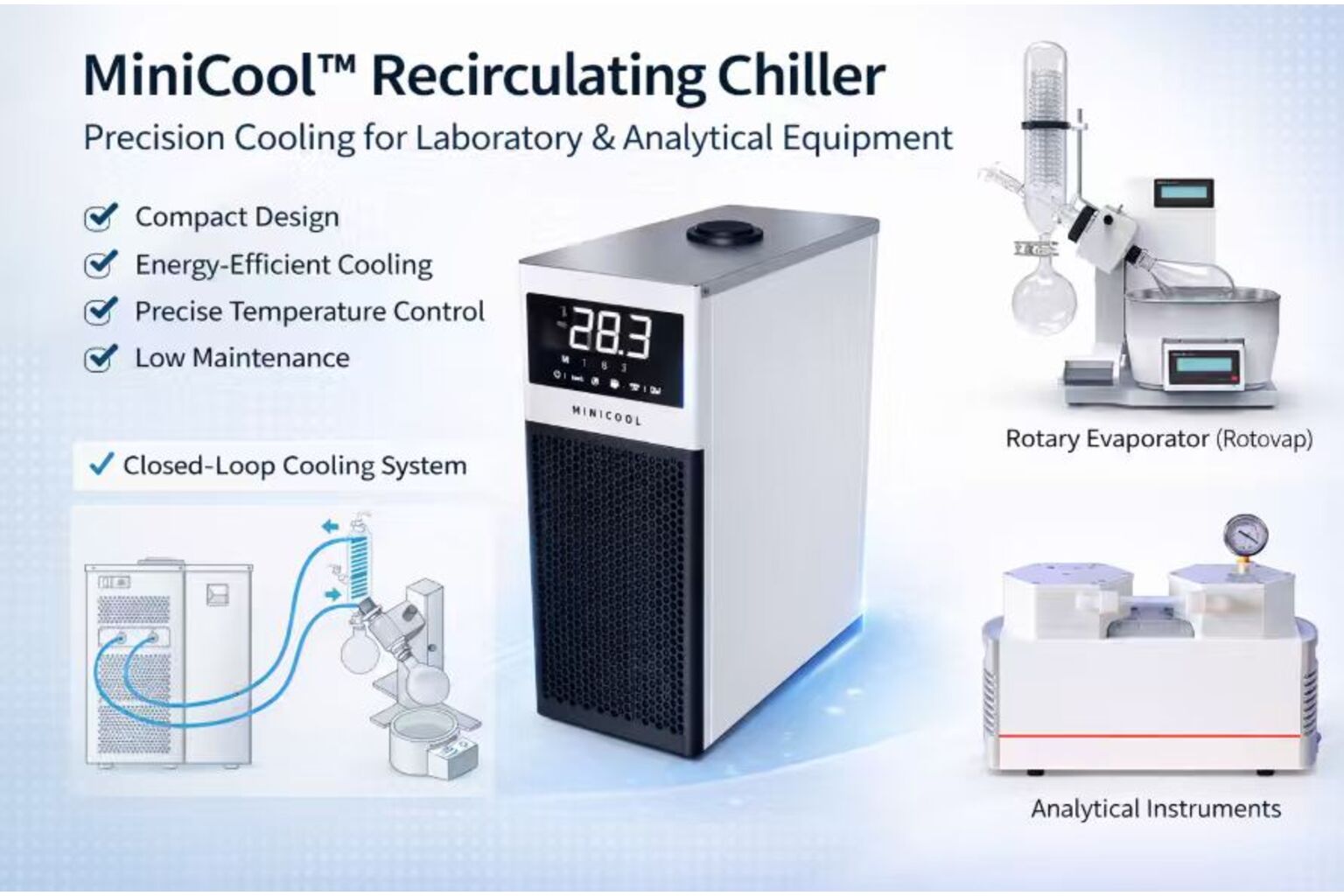
The MiniCool™ from RIGID addresses the specific demands of laser cooling in a compact, countertop-friendly package. With ±0.1°C temperature stability, it meets the stringent requirements of diode and DPSS laser systems where wavelength stability is critical.
Its small footprint makes it practical for crowded laser labs where floor space is at a premium. The unit is designed to maintain consistent performance without the cycling issues that plague oversized chillers paired with smaller laser systems. For operators running low-to-medium power lasers — particularly in research, medical device manufacturing, or precision marking applications — the MiniCool™ provides the thermal stability needed without over-engineering the solution.
The recirculating design means coolant stays clean and contained within a closed loop, reducing contamination risk and eliminating the waste associated with single-pass cooling. Combined with quiet operation suitable for lab environments, the MiniCool™ represents a purpose-built approach to laser thermal management rather than a repurposed general-purpose unit.
Putting It All Together: Choosing the Right Chiller for Your Laser
Selecting a recirculating chiller for laser cooling comes down to matching the chiller’s capabilities to your laser’s specific thermal demands. Start with the heat load and required temperature stability, then verify flow rate, fluid compatibility, and environmental factors like ambient temperature and available space. Avoid the temptation to simply buy the largest unit available — proper sizing with appropriate margin delivers better stability and longer service life than brute-force overcapacity.
Document your system’s requirements before shopping: heat load in watts, required coolant temperature and tolerance, flow rate and pressure specifications, coolant type, and any vibration sensitivity. With these numbers in hand, you can make an informed selection that protects your laser investment for years to come.
Frequently Asked Questions
What coolant should I use in a recirculating chiller for laser cooling?
Most laser manufacturers recommend deionized (DI) water with a corrosion inhibitor specifically formulated for laser cooling circuits. Avoid tap water, which contains minerals that deposit inside heat exchangers. If freeze protection is needed, use a propylene glycol mixture at the minimum effective concentration (typically 20–30%) and factor the reduced heat transfer into your capacity planning. Always check your laser manufacturer’s coolant specifications first.
How often should I change the coolant in my laser chiller?
A general guideline is every 3–6 months for DI water systems, though this varies based on operating hours and environmental conditions. Monitor coolant conductivity (for DI water systems, rising conductivity indicates contamination), pH level, and visual clarity. If you notice discoloration, particles, or biological growth, change the coolant immediately regardless of schedule. Replace inline filters according to the chiller manufacturer’s recommendations or when flow rate drops noticeably.
Can I use one chiller to cool multiple lasers simultaneously?
It is possible but requires careful planning. You need sufficient total cooling capacity plus margin, a manifold system that balances flow between lasers, and temperature requirements that are compatible across all units. The main risk is that if one laser changes its heat load suddenly, it can affect coolant temperature for all connected systems. For wavelength-critical applications, dedicated chillers for each laser are typically preferred to eliminate cross-coupling of thermal disturbances.
What temperature stability do I actually need for my laser?
It depends on your application’s sensitivity to wavelength and beam quality. For industrial cutting and welding with fiber lasers, ±0.5°C is often adequate. For scientific applications, spectroscopy, or any process where wavelength precision matters, target ±0.1°C. DPSS lasers with harmonic generation stages (frequency doubling, tripling) typically need ±0.1°C or better because phase-matching is strongly temperature-dependent. When in doubt, consult your laser’s documentation for the recommended coolant temperature tolerance.