
What a Chiller Power Failure Does to a Sub-Zero Loop
On a loop running near room temperature, a chiller power failure is mostly an inconvenience. The water warms by a few degrees, the instrument pauses, and everything resumes when power returns. On a loop running at −20 °C or −30 °C, the same outage sets off a chain of problems that do not simply reverse when the lights come back on.
Samples and reactions start warming immediately. Frost on hoses, jackets and fittings begins to melt and drip. Coolant expands as it warms, and in an open reservoir it can pick up moisture. And when power returns, a cold, thick loop is harder for the pump to start than a warm one. The damage from a chiller power failure on a sub-zero loop is decided mostly by what was planned before the outage, not by what is done after it.
This guide estimates how fast a typical sub-zero loop warms, lists what goes wrong during the outage, explains why restart is harder when the loop is cold, and sets out the backup and planning options that limit the damage.
How Fast the Loop Warms
How quickly a loop warms depends on two things: how much heat leaks in, and how much thermal mass the loop and its load contain. The example below uses assumed values for illustration.
| Input | Insulated loop | Poorly insulated loop |
|---|---|---|
| Loop temperature at outage | −30 °C | −30 °C |
| Coolant in reservoir, hoses and jacket | About 6 L, heat capacity about 14 kJ/K | Same |
| Vessel contents and hardware | About 6.5 kJ/K combined | Same |
| Total thermal mass | About 20 kJ/K | About 20 kJ/K |
| Heat gain at −30 °C in a 22 °C room | About 80 W | About 200 W |
| Initial warming rate | About 14 K per hour | About 35 K per hour |
| Time to warm the first 10 K | Roughly 45 minutes | Roughly 17 minutes |
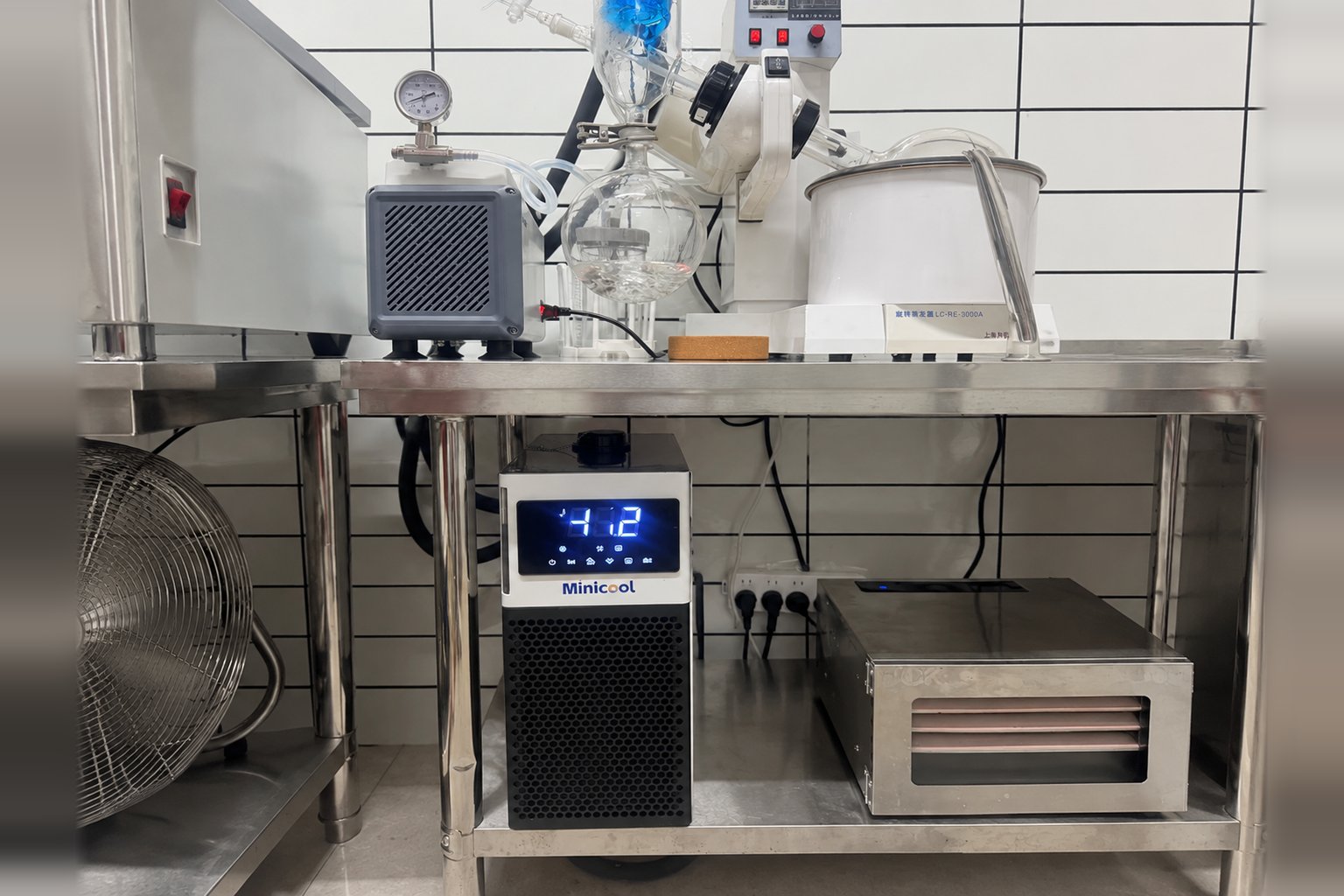 This is a simple lumped model for a loop without reaction heat, treating everything as one well-mixed mass. It is not a safe holding time for any particular sample. The estimate is simple: warming rate equals heat gain divided by thermal mass. It slows as the loop warms, because the temperature difference to the room shrinks. Even so, the table shows why insulation matters twice. It reduces the load while the chiller runs, and it buys time when the chiller stops.
Run the same arithmetic for your own loop before an outage happens. The number that matters is how long your samples or reaction can tolerate the warming, compared with how long a typical outage in your building lasts.
Two further details change the answer. A jacket full of reaction mixture has far more thermal mass than an empty coil, so a full vessel buys more time than a nearly empty one. And once the pump stops, the loop stops mixing: coolant in a warm hose section and coolant in the reservoir no longer exchange heat, so local hot spots can run well ahead of the average warming rate.
What Goes Wrong During the Outage
Several things happen at once while the loop warms.
- Samples and products warm. Anything whose quality depends on staying below a temperature starts losing margin immediately.
- Frost melts as surfaces warm past 0 °C. Ice on hoses, valve bodies, jacket nozzles and couplings turns to water, which can run onto benches, into insulation or toward electrical connections.
- Coolant expands. Most coolants take up more volume as they warm, so a reservoir filled near its maximum at −30 °C can approach its overflow level.
- Moisture enters open systems. An open or loosely capped reservoir exposed to humid air during a long outage can take up water, which changes the coolant’s low-temperature behavior.
- Condensation forms inside poor insulation as cold surfaces pass through the dew point, and stays there after the loop is cold again.
Reactions Without Cooling: A Safety Question First
If the loop is cooling a chemical reaction, a chiller power failure can be a process safety issue rather than a quality issue. Many low-temperature reactions are run cold precisely because they release heat, and some accelerate as they warm.
- Identify in advance which reactions depend on active cooling to stay under control.
- Stop reagent additions automatically or immediately when cooling is lost; dosing into an uncooled vessel adds heat just when it can no longer be removed.
- Have a documented response for each such reaction, agreed through the laboratory’s normal safety review.
- Do not rely on restarting the chiller as the safety measure. Restart can take minutes, and it may fail on a cold, viscous loop.
This article covers the cooling equipment side. The chemistry side belongs to the laboratory’s own hazard assessment.
Restarting: Why Cold Loops Are Harder
When power returns after a short outage, the loop is still cold, and cold coolant is thicker. A pump sized for the coolant at operating temperature with the loop flowing may struggle to establish flow from a standstill, especially through long or narrow hoses. If a flow switch or low-flow protection trips, circulation stops and the loop stays cold and thick. Our article on chiller cold-start problems in winter laboratories describes the same mechanism from a cold-room angle.
Compressors add a second constraint. Refrigeration controllers commonly enforce a minimum off time before the compressor restarts, so cooling does not resume the instant power returns. Short, repeated interruptions, such as a flickering supply, can keep the compressor waiting while the loop keeps warming.
A safe restart sequence after a chiller power failure looks like this:
- Check the area for melted frost and water near electrical connections before switching anything on.
- Check the reservoir level and look for leaks at couplings that warmed and cooled.
- Start circulation first and confirm flow before asking for cooling.
- If flow will not establish, warm the loop modestly or shorten the circuit rather than repeatedly resetting protection.
- Resume cooling, and stage the set point down rather than demanding the coldest value at once.
- Record the outage, the temperatures reached and any samples affected.
After a long outage, when the whole loop has returned close to room temperature, restart is easier in one sense because the coolant is no longer thick, but the pull-down then starts from scratch. Budget the full pull-down time before relying on the loop again, and dry any frost meltwater out of the insulation before it refreezes inside it.
Protection Options
Protection falls into three groups: keep equipment running, slow the warming, and respond well.
| Option | What it protects | Limits |
|---|---|---|
| UPS for the chiller controller and pump | Keeps circulation and monitoring alive; slows warming at equipment hot spots | Loop still warms without the compressor; only possible where the equipment design allows separate supply |
| UPS, battery system or generator for the whole chiller | Keeps cooling running through the outage | Must be sized for compressor start-up as well as running power |
| Insulation and larger thermal mass | Buys time for any outage | Does not stop warming, only slows it |
| Alarms and remote notification | Gets people to the equipment quickly | Only useful if someone can act |
| Sample triage plan and backup cold storage | Protects the most valuable material | Needs space kept free in advance |
The cheapest protection is usually time. Better insulation, a slightly larger coolant volume and a practiced sample-move routine often cover the short outages that make up most interruptions, and leave backup power for the loops that truly cannot warm.
Sizing Backup Power Without Guessing
Backup power fails most often because it was sized on a label rather than a measurement.
- Measure the chiller’s real input power at the operating set point, not just the rated figure, using a power meter that measures true power. A clamp meter on its own reads current, not real power.
- Account for start-up. Compressor and pump motors draw more current when starting than when running, and an inverter or generator that cannot supply that surge will trip at the worst moment.
- Estimate runtime from usable battery energy divided by average load, and remember that a compressor cycling at a cold set point may run most of the time.
- Test the arrangement with a planned switch-over before relying on it.
If a generator is part of the plan, check what happens during its start and transfer. A few seconds without power still stops the chiller, and the compressor’s minimum off time then adds to the gap. For some loops that short gap is harmless; for others it is the reason to keep the pump and controller on a UPS even when a generator is available, where the equipment allows them to be supplied separately.
The supply type can also simplify backup. Some compact chillers can run from DC, which lets a battery system feed them without an inverter in between.
A Written Plan for a Sub-Zero Laboratory
 A written plan turns a stressful outage into a routine one. It does not need to be long.
- List each sub-zero loop, what it cools, and how long its load can tolerate warming.
- Mark which reactions need an immediate safety response when cooling stops.
- Name who is notified by alarms, and who decides on moving samples.
- Reserve backup cold storage for the most valuable samples.
- Keep the restart checklist next to each chiller.
- Review the plan after every real outage.
Choosing Equipment With Outages in Mind
Outage behavior is worth considering when choosing a chiller for sub-zero work. Look at how the unit behaves when power returns, how its protection reacts to low flow on a cold loop, what alarms it offers, and what supply options it has.
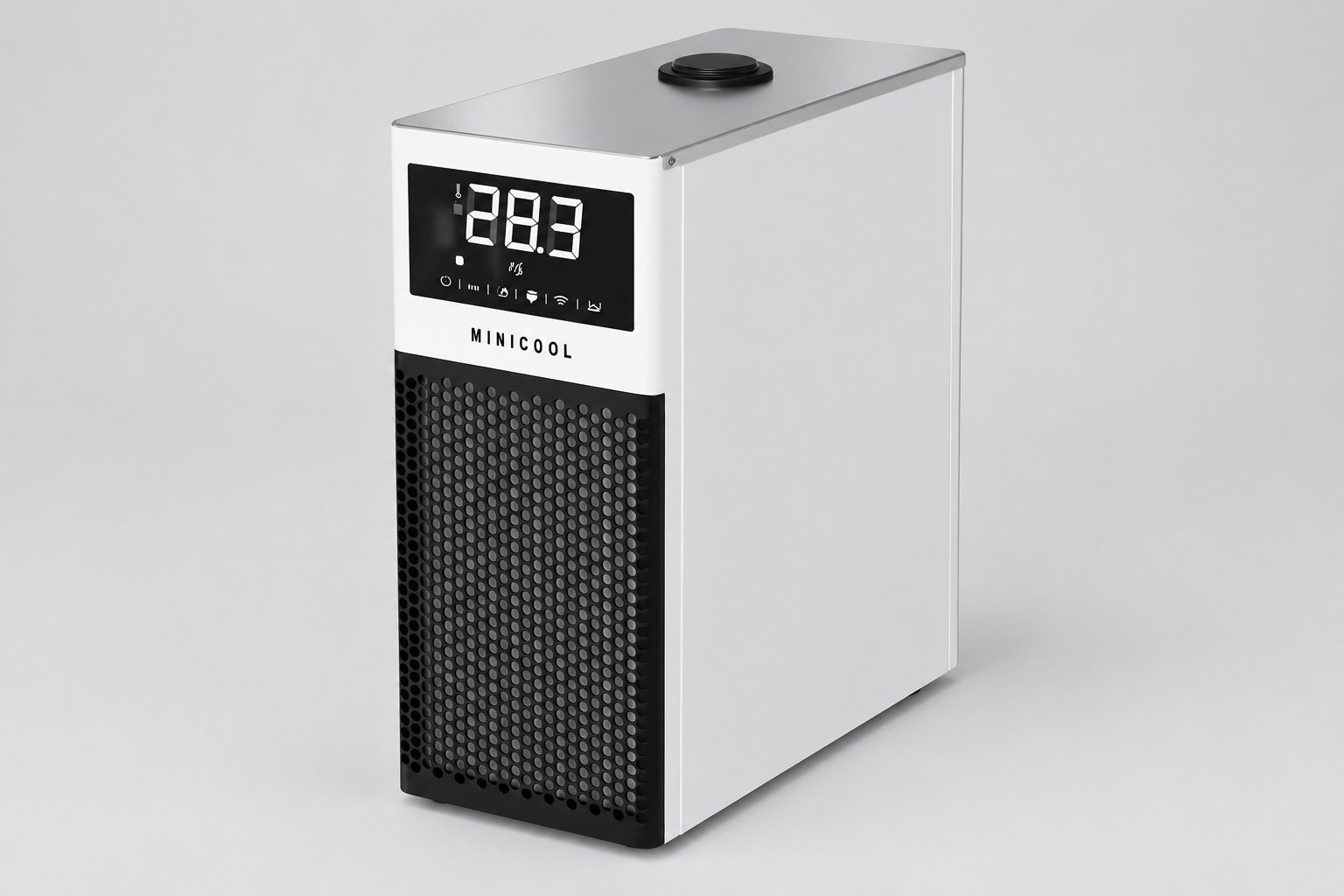
RIGID’s MiniCool countertop recirculating chiller is listed with a temperature range of 0 to −40 °C, cooling capacities of 450, 800 and 850 W, temperature stability of ±0.1 °C (test conditions not stated), and AC (120–240 V) or DC supply options. The DC option is relevant for battery-backed setups; confirm the DC input specification and start-up requirements with the supplier before designing backup around it. The coolant also matters for restart, as our lab chiller coolant selection guide explains.
For the wider picture of what runs well at −40 °C and what needs a colder system, see our overview of low-temperature circulator applications.
Common Mistakes
- Treating a chiller power failure on a sub-zero loop as a simple pause.
- Sizing a UPS or generator on rated power and forgetting start-up current.
- Leaving reactions with additions running when cooling stops.
- Repeatedly resetting low-flow protection on a cold, thick loop.
- Filling the reservoir to the top at −30 °C, with no room for expansion as it warms.
- Having no plan for melted frost near electrical connections.
If you are planning sub-zero cooling with outages in mind, send us your loop temperature, coolant volume, load, supply options and how long your samples can tolerate warming, and our engineers will help work through the cooling side. Send your sub-zero loop details to our engineering team.
Frequently Asked Questions
What happens to a sub-zero loop during a chiller power failure?
Circulation and cooling stop, and the loop starts warming at a rate set by heat gain and thermal mass. Samples warm, frost melts, coolant expands and, on open reservoirs, moisture can enter. Restart is also harder because the coolant is cold and thick.
How fast does a −30 °C loop warm without power?
In the worked example, an insulated loop with about 20 kJ/K of thermal mass warmed at roughly 14 K per hour at first, and a poorly insulated one at about 35 K per hour. Your own loop will differ, so run the same estimate with your volumes and heat gain. It is an average for a mixed, non-reacting loop; local temperatures can rise faster once circulation stops.
Why won’t my chiller restart properly after an outage?
Common reasons are cold, viscous coolant that the pump cannot move from standstill, a flow or low-flow protection trip, and a compressor minimum off-time delay. Start circulation first, confirm flow, then resume cooling.
Should a recirculating chiller be on a UPS?
It depends on what the loop protects. Where the equipment design allows the controller and pump to be powered separately, a small UPS keeps circulation and alarms alive. Keeping cooling running requires backup sized for the whole chiller, including compressor start-up current.
Is a chiller power failure a safety risk?
It can be when the loop cools an exothermic reaction. Additions should stop when cooling is lost, and each such reaction should have a response agreed through the laboratory’s safety review.
Can insulation help during an outage?
Yes. Insulation reduces heat gain, which slows warming and buys time for power to return or for samples to be moved. It does not stop warming on its own.