
Why Chiller Reservoir Level Changes at Sub-Zero Temperatures
A recirculating chiller filled to the mark at room temperature looks perfectly full. A few hours later, running at −35 °C, the level in the sight glass has dropped, and the low-level alarm may even trip. The next morning, after the loop warms up overnight, coolant is weeping from the filler cap or overflow. Nothing has leaked. The coolant has simply shrunk and grown again.
Almost every liquid used as a chiller coolant takes up less volume when it gets colder. On a loop that swings between room temperature and −35 or −40 °C, that change is large enough to matter. Chiller reservoir level on a sub-zero loop is a moving target, and the fill level has to be set with that movement in mind.
This guide shows how much common coolants contract, works through an 8 L loop, explains how to fill a loop that will run cold, and covers overflow on warm-up, drain-back, air ingress and how to tell normal contraction from a real leak.
How Much Coolant Contracts
Contraction depends on the fluid and on how far the temperature changes. Water-glycol mixtures change less than alcohol-based fluids over the same range. The figures below are approximate and come from published density and expansion data; your coolant supplier’s data sheet is the reference for a specific product.
| Coolant | Data used | Approximate volume change from 20 °C |
|---|---|---|
| Ethylene glycol and water, 50% by mass | Density about 1,079 kg/m³ at 20 °C and 1,103 kg/m³ at −35 °C | About 2.2% smaller at −35 °C |
| Ethylene glycol and water, 60% by mass | Density about 1,095 kg/m³ at 20 °C and 1,124 kg/m³ at −35 °C | About 2.6% smaller at −35 °C |
| Ethanol | Volumetric expansion coefficient about 0.00109 per °C near room temperature | Roughly 6 to 7% smaller at −40 °C |
| Plain water | Not usable at sub-zero temperatures | Freezes; do not use below 0 °C |
Two points stand out. First, a 50% glycol mixture loses about 2 liters of volume for every 100 liters of loop between 20 °C and −35 °C, so even small laboratory loops see a visible change. Second, an alcohol-based coolant can contract roughly three times as much over a similar range, which is why sight-glass levels on ethanol loops move so noticeably. The ethanol figure uses a room-temperature coefficient over a wide range, so treat it as an estimate.
Worked Example: An 8 L Sub-Zero Loop
The example below uses assumed volumes for illustration: a chiller reservoir plus hoses and an external jacket holding 8 L of coolant in total.
| Item | 50% glycol mixture | Ethanol-based coolant |
|---|---|---|
| Total loop volume at 20 °C | 8.0 L | 8.0 L |
| Running temperature | −35 °C | −40 °C |
| Approximate contraction | About 2.2% | About 6.5% |
| Volume lost from the reservoir when cold | About 0.18 L | About 0.52 L |
| Volume returning when the loop warms to 20 °C | About 0.18 L | About 0.52 L |
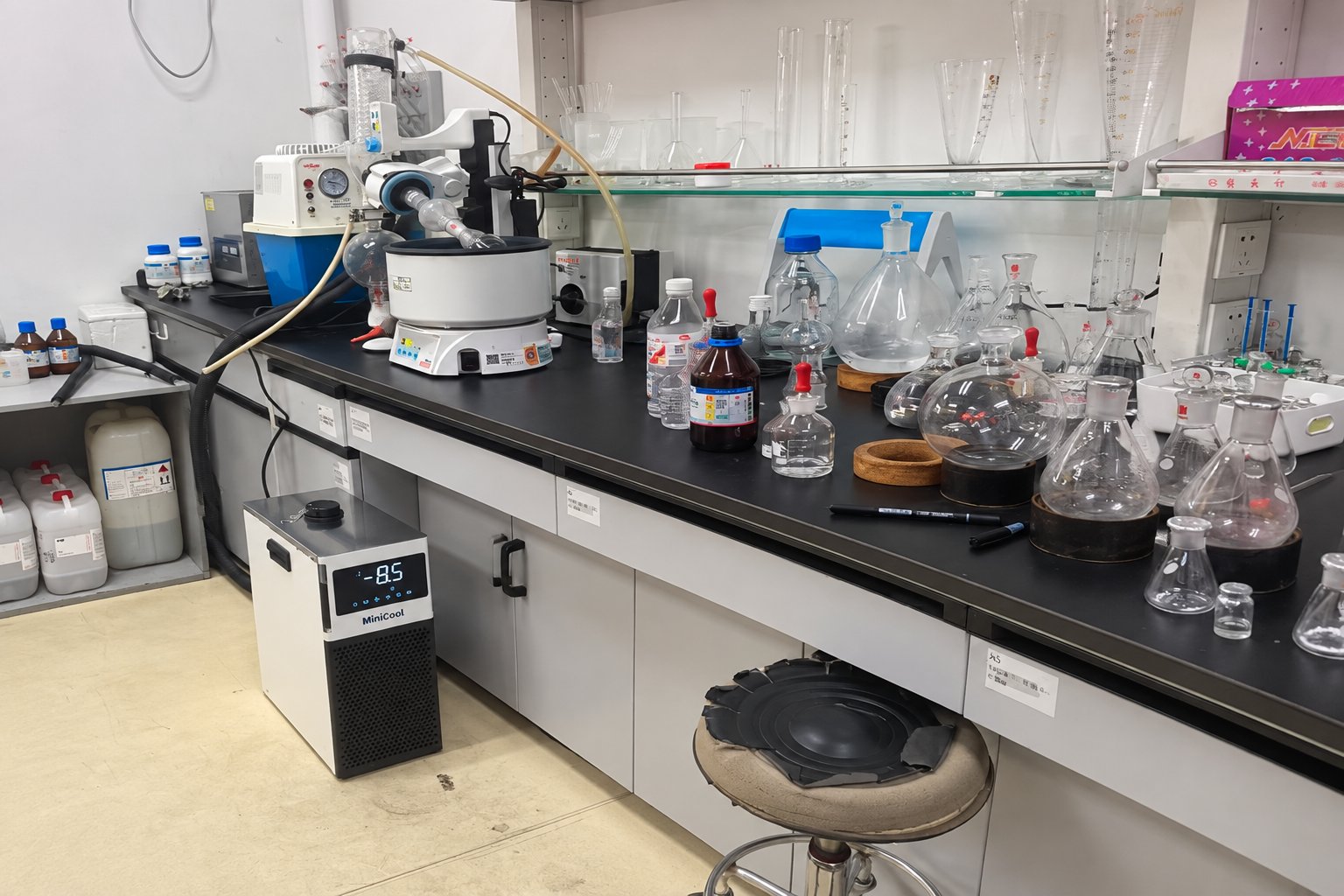 The worked example shows why the same loop can trip a low-level alarm cold and overflow warm. All of the contraction appears in the reservoir, because the hoses and jacket stay full. A small reservoir that has, say, 1 L of usable space between its minimum and maximum marks loses half of that range to an ethanol loop’s contraction alone.
The external circuit makes the effect bigger. Every liter of coolant in long hoses, a large jacket or a heat exchanger contributes to the change, even though only the reservoir level shows it. When a chiller is connected to a large external volume, the reservoir has to absorb the whole loop’s contraction.
Filling a Loop That Will Run Cold
Filling is the step that decides whether contraction becomes a problem. Use this order.
- Fill the reservoir, hoses and external equipment at room temperature, and run the pump to purge air before cooling.
- Top up to a level that leaves room for expansion if the loop warms above its fill temperature, rather than filling to the brim.
- Cool the loop to the working set point and let it stabilize.
- Check the chiller reservoir level at the working temperature. It must sit comfortably above the minimum mark and above the pump inlet.
- If it is too low when cold, add coolant at the cold condition, but only enough to reach a safe level. Remember that everything added cold will come back as extra volume on warm-up.
- Mark or record the normal cold level and normal warm level for that loop, so later checks compare like with like.
Never top up a cold loop to the maximum mark. A loop filled to the top at −35 °C will overflow as it warms, and on an ethanol loop the returned volume can be well over half a liter even on a small system.
Overflow on Warm-Up and Drain-Back
Two different mechanisms push coolant out of a reservoir, and they need different fixes.
- Thermal expansion on warm-up. A loop filled too high when cold expands as it returns toward room temperature, and the excess leaves through the overflow or filler cap. The fix is filling to the right level, as above.
- Drain-back from equipment above the chiller. If the jacket, heat exchanger or hoses sit higher than the chiller and the loop is open to the reservoir, coolant can flow back down into the reservoir when the pump stops. If the reservoir cannot hold that volume, it overflows.
- Siphoning through the return line. With the return line submerged in the reservoir and equipment higher up, a stopped pump can let coolant siphon back until air breaks the flow.
For drain-back and siphoning, check how the external equipment is positioned relative to the chiller and whether the loop needs an anti-siphon arrangement, a check valve or a shut-off valve. Follow the chiller maker’s installation guidance, since some units are designed to accept drain-back and others are not. Loop layout and pressure effects are covered in more detail in our guide to liquid chiller loop design and pressure drop.
Air in the Loop After Contraction
A low reservoir level at sub-zero temperature is not only an alarm nuisance. If the level falls toward the pump inlet, the pump can start drawing air.
- Air entering the pump causes noisy running, fluctuating flow and eventually loss of circulation.
- Air bubbles collect at high points in jackets and heat exchangers, where they create warm spots and reduce heat transfer.
- Cold coolant is thicker, so trapped air clears more slowly than it would at room temperature.
- Flow switches and low-flow protection may trip, stopping circulation on a loop that is still cold.
If a cold loop has drawn air, raise the level to a safe mark, run circulation to purge the air at the high points, and only then return to full cooling. Low-flow protection on sub-zero loops is covered in our article on chiller low-flow protection and flow switches.
Normal Contraction or a Leak?
 Before deciding that a loop is leaking, compare the level at the same temperature on different days. Contraction is reversible; a leak is not.
| What you see | Likely cause | What to check |
|---|---|---|
| Level lower when cold, returns when warm | Normal contraction | Compare with the recorded cold and warm levels |
| Level lower at the same temperature each week | Leak or evaporation | Fittings, hoses, jacket seals, external equipment |
| Level drops after each shutdown, then recovers on start | Drain-back or siphoning | Equipment elevation, return line position, valves |
| Coolant at the overflow after warm-up | Filled too high when cold | Fill level at working temperature |
| Low-level alarm trips only when cold, no coolant lost | Contraction brings the level down to the alarm point | Fill level at working temperature versus the alarm point |
A chiller reservoir level that keeps trending down at the same temperature means coolant is leaving the loop. Look for wet fittings and hose ends, check the external equipment, and inspect any quick-connect couplings that are connected and disconnected often. A routine for these checks is part of our lab chiller maintenance schedule.
Moisture, Evaporation and Open Reservoirs
A reservoir that is open to room air changes the coolant slowly as well as moving its level.
- Glycol mixtures and alcohols take up moisture from humid air over time, which changes their freezing behavior and viscosity at low temperature.
- Volatile coolants such as ethanol evaporate from an open or loosely capped reservoir, lowering the level at every temperature and changing concentration in mixtures.
- Frost that forms on a cold filler neck can drop into the reservoir and dilute the coolant.
- Keep the reservoir cap in place, check concentration periodically, and replace coolant that has absorbed water or changed noticeably.
Choosing a coolant with margin below the coldest set point also reduces how much these small changes matter.
Where a Compact Recirculating Chiller Fits
On a compact chiller, the reservoir is small by design, so contraction takes a larger share of the usable level range. That does not make compact units unsuitable for sub-zero work, but it does make filling practice and external loop volume more important.
RIGID’s MiniCool countertop recirculating chiller is listed with a temperature range of 0 to −40 °C, cooling capacities of 450, 800 and 850 W, temperature stability of ±0.1 °C (test conditions not stated), quick-connect or threaded ports, and a 200 × 430 × 450 mm footprint. Reservoir volume and level marks are not listed on the product page, so confirm the usable reservoir range with the supplier and compare it with your loop’s expected contraction before connecting a large external circuit. For coolant choices at the bottom of that range, see our lab chiller coolant selection guide.
A quick estimate helps before installation: multiply the total loop volume by the approximate contraction for your coolant and temperature. If the result approaches the reservoir’s usable range, reduce external volume, choose a coolant with lower contraction, or plan a separate expansion allowance.
Common Mistakes
- Topping up a cold loop to the maximum mark and overflowing on warm-up.
- Filling at room temperature and never checking the chiller reservoir level at the working temperature.
- Connecting a large external volume to a small reservoir without estimating contraction.
- Treating reversible contraction as a leak, or a slow leak as contraction.
- Leaving the reservoir cap off, so volatile coolant evaporates and moisture gets in.
- Ignoring drain-back from equipment mounted above the chiller.
If you are planning a sub-zero loop, send us the coolant type, total loop volume, lowest set point, where the external equipment sits relative to the chiller and how often the loop warms up, and our engineers will help check level and expansion allowance. Send your sub-zero loop details to our engineering team.
Frequently Asked Questions
Why does my chiller reservoir level drop when it gets cold?
Coolant contracts as it cools, and because hoses and external equipment stay full, the whole loop’s contraction appears in the reservoir. A 50% ethylene glycol mixture is about 2.2% smaller at −35 °C than at 20 °C, and an ethanol-based coolant contracts roughly three times as much.
How much should I fill a chiller that runs below zero?
Fill and purge at room temperature, cool to the working set point, and check the level cold. It should sit safely above the minimum mark and pump inlet when cold, with enough space left to absorb expansion when the loop warms again.
Why does coolant overflow when the chiller warms up?
Usually because the loop was topped up while cold, so the coolant expands past the reservoir’s capacity as it warms. Drain-back from equipment mounted above the chiller can also overfill the reservoir when the pump stops.
How can I tell contraction from a leak?
Compare levels at the same temperature on different days. Contraction reverses when the loop warms; a level that keeps falling at the same temperature means coolant is leaving the loop.
Can low reservoir level damage the pump?
It can. If the level falls toward the pump inlet, the pump can draw air, which causes noise, unstable flow and loss of circulation, and trapped air reduces heat transfer at high points in the loop.
Which coolant changes volume least at low temperature?
Among common options, water-glycol mixtures change less than alcohol-based coolants over the same temperature range. Check the supplier’s density data for the exact product and concentration you use.