
Chiller Reservoir Volume Buys Stability and Costs Responsiveness
Reservoir volume is one of the few chiller specifications that cannot be optimized in one direction. More fluid means more thermal mass, which absorbs load spikes and smooths the temperature the process sees. It also means more mass to pull down at startup, and a slower response when the setpoint changes. The two properties are the same property viewed from opposite ends, and the correct chiller reservoir volume depends entirely on which behavior your application needs.
Process cooling guidance does not actually specify reservoir volume directly, and a figure quoted that way is worth treating with suspicion — a reservoir is part of the system it sits in, so it cannot be a multiple of the total volume that contains it. What manufacturers specify is a minimum total system volume, usually expressed per unit of capacity, below which the machine short-cycles or cannot hold temperature.
That distinction changes the calculation entirely:
- Take the minimum system volume the manufacturer states for the model and capacity.
- Add up the volume the loop already contains — hoses, jacket or heat exchanger, and the application’s internal passages.
- The reservoir, or any buffer vessel you add, makes up the difference. Where the loop already exceeds the minimum, no additional volume is required at all.
Approached that way the question has a determinate answer rather than a range, and the range that circulates in general guidance turns out to be describing something else. The right total is set by the manufacturer’s minimum and the shape of your load, not by a ratio.
This guide works the trade in both directions, shows how to estimate the buffering a given volume actually provides, and covers what to do when the volume you have is fixed.
What Thermal Mass Actually Does
Chiller reservoir volume matters because a reservoir stores energy. When a load spike arrives faster than the refrigeration system can respond, that stored energy absorbs the excess and the temperature rise is limited by the mass rather than by the compressor.
The governing relationship is straightforward:
ΔT = Q × t ÷ (m × c)
where Q is the excess heat input, t the duration, m the fluid mass and c its specific heat. Two things follow immediately:
- Doubling the reservoir mass halves the temperature excursion for the same disturbance.
- The benefit only exists for disturbances shorter than the system’s response time. Against a sustained load increase, thermal mass buys time and nothing more — the compressor still has to remove the heat eventually.
The distinction between buying time and adding capacity shows up clearly in the units. Thermal mass is measured in kJ/K — energy per degree — while capacity is measured in watts, energy per second. A reservoir can absorb a fixed quantity of energy for a given temperature rise, and once it has absorbed it, it is full. Only the compressor removes energy continuously.
That second point is the one most often misunderstood. Reservoir volume does not add capacity. It converts a fast temperature excursion into a slower one, giving the control loop time to react.
Putting a Number on the Buffer
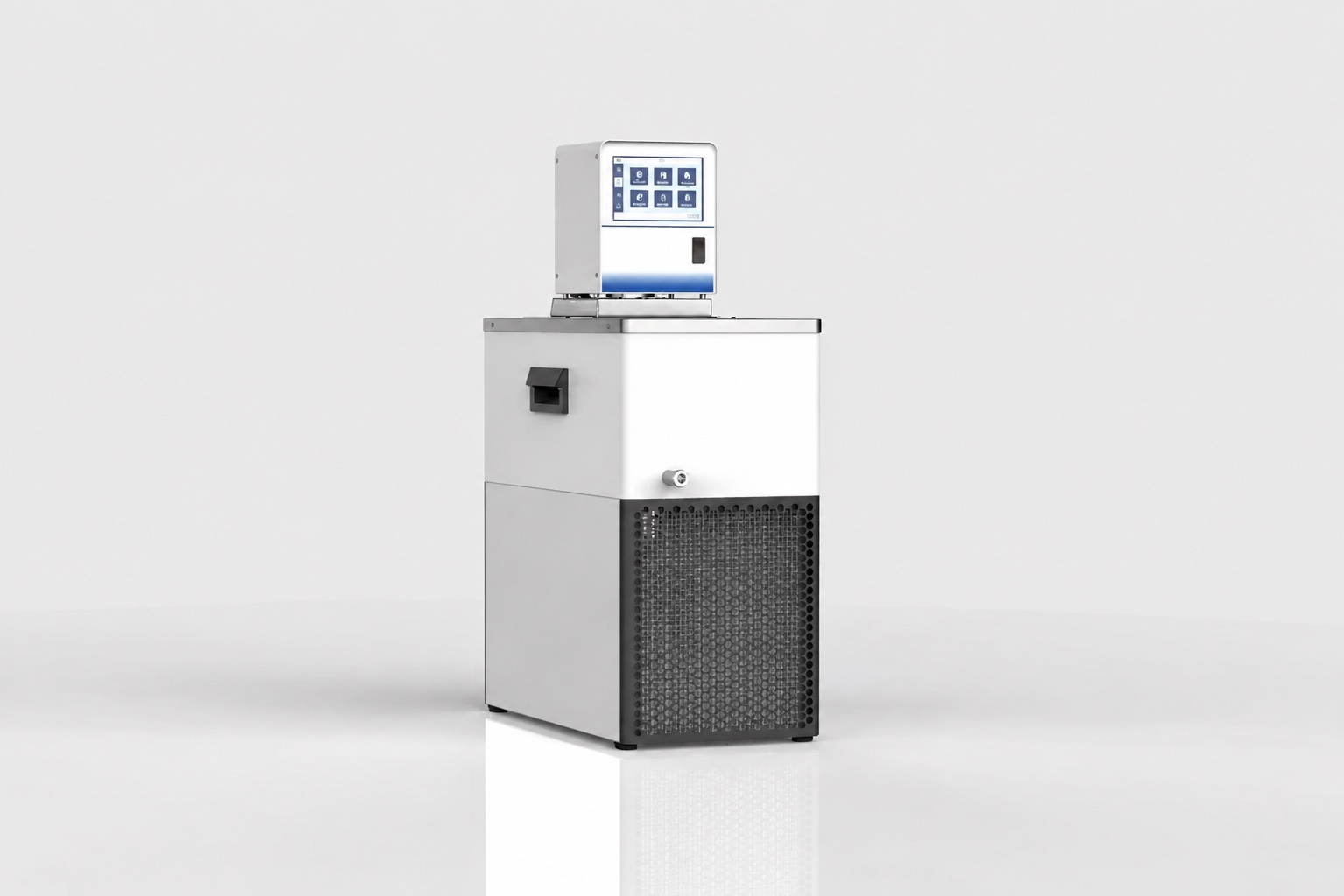 Whether a given chiller reservoir volume is adequate is answerable arithmetically. Take a laboratory loop with a sudden load step — a warm sample loaded, an instrument switching from standby to full duty.
| Input | Value used | Basis |
|---|---|---|
| Reservoir plus loop volume | 3.0 L | Assumed; actual volume not published for this range |
| Coolant | 50 % propylene glycol | Assumed for a sub-zero loop |
| Fluid density | ≈ 1.04 kg/L | Reference property |
| Specific heat | ≈ 3.4 kJ/kg·K | Reference property for this mixture |
| Load step | 200 W above steady state | Assumed disturbance |
| Control response time | 60 s to bring capacity to match | Assumed |
Fluid mass: 3.0 L × 1.04 kg/L = 3.12 kg
Thermal capacity: 3.12 kg × 3.4 kJ/kg·K = 10.6 kJ/K
Energy arriving before the control loop catches up: 200 W × 60 s = 12.0 kJ
Temperature excursion: 12.0 ÷ 10.6 = 1.13 K
Whether that is acceptable depends entirely on the application. For a process tolerating ±2 K it is comfortable. For a measurement requiring tenths of a degree it is not, and the answer is either more volume or a faster control response — because with the volume fixed, the only other lever is reducing the time the loop takes to respond.
Run the same arithmetic at 6 L and the excursion halves to 0.57 K. Run it with water instead of glycol, at roughly 4.18 kJ/kg·K, and it improves again — one of several reasons glycol loops give up performance beyond their freeze protection.
The Cost Side: Pull-Down and Setpoint Changes
The other side of chiller reservoir volume is that the same mass absorbing disturbances must be cooled at startup and moved whenever the setpoint changes.
Continuing the example, bringing 3.12 kg of that fluid from 22 °C to −20 °C requires:
3.12 kg × 3.4 kJ/kg·K × 42 K = 445 kJ
At 300 W of surplus capacity available for pull-down, that is roughly 25 minutes for the fluid alone, before adding the wetted mass of the application and the losses along the way. Double the reservoir and the pull-down doubles with it.
Where this matters most:
- Protocols that ramp between setpoints. A large reservoir makes every transition slow, and a method requiring several temperature steps per run becomes limited by the chiller rather than by the chemistry.
- Shared instruments where the chiller is set differently for different users, so transitions happen daily.
- Installations where session start-up time is part of the working day, since a long pull-down is dead time.
Conversely, a loop that runs at one setpoint continuously pays the pull-down cost once and enjoys the buffering permanently. That case argues for volume.
There is a second cost that rarely appears in a specification: fluid inventory. A larger reservoir means more heat transfer fluid to purchase, more to dispose of at each change interval, and a longer flush when the fluid is replaced. On a glycol or silicone loop that is a recurring operating expense rather than a one-time cost, and it scales directly with the volume chosen.
Which Behavior Does Your Load Need?
| Load pattern | Wants | Reason |
|---|---|---|
| Steady, one setpoint, occasional spikes | More volume | Buffering is free once pull-down is paid |
| Frequent setpoint changes or ramps | Less volume | Every transition is slowed by mass |
| Batch loading of warm samples | More volume | The spike is exactly what mass is for |
| Continuous, well-characterized load | Volume is nearly irrelevant | Nothing to buffer; capacity decides everything |
| Long compressor minimum off-time | More volume | Mass has to carry the load through the off period |
| Session start-up time matters | Less volume | Pull-down dominates the working day |
The fifth row deserves attention because it is the least obvious. Every compressor has a minimum off-time to allow pressure equalization, and during that window the loop is uncooled. Thermal mass is what stops the process temperature climbing during those minutes. A small reservoir with a long off-time produces a visible sawtooth at the process even though the chiller is behaving exactly as designed.
Volume Is Not a Substitute for Control
A recurring assumption is that a large reservoir compensates for a slow or coarse control loop. It does the opposite of what that assumption expects.
Mass slows the rate at which temperature changes, which does make a poorly tuned loop look calmer — the excursions it produces are smaller and slower. But it also delays the feedback the loop depends on, because the sensor now sees the effect of a control action much later than the action was taken. A loop that was marginally stable with a small volume can become sluggish and prone to overshoot with a large one, since its gains were tuned against a faster plant.
Published observations on modern process chillers make the point from the other direction: PID control paired with variable-speed compression can hold tight stability with relatively small internal volumes, precisely because the control loop is fast enough not to need mass to hide behind. Where that combination exists, volume is being asked to do less work.
The practical rule is to treat volume and control as separate specifications. Volume handles disturbances faster than the loop can respond; the loop handles everything slower than that. Neither substitutes for the other.
When the Volume Is Fixed
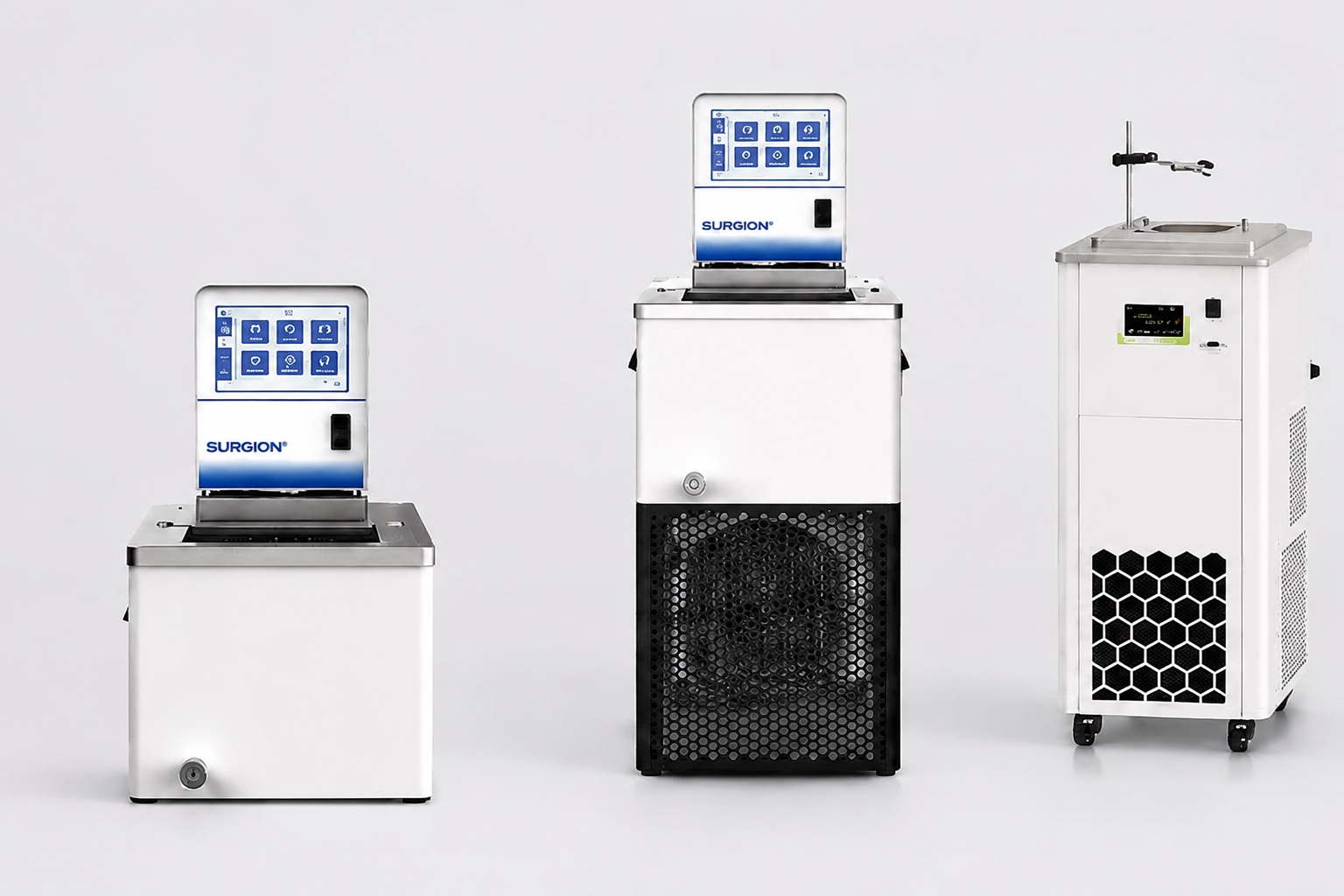 In practice chiller reservoir volume is usually a property of the machine you can buy rather than a variable you can set — and it is not published for the MiniCool range, so it is a figure to request when the application is sensitive to it. Where the internal volume is what it is, three levers remain:
- Add external volume. An insulated buffer vessel in the loop adds thermal mass without changing the chiller. It also adds pressure drop and pull-down time, so size it against the excursion you are trying to control rather than adding as much as fits.
- Increase loop volume deliberately. Larger-bore hose adds a modest amount of mass and reduces pressure drop at the same time, which is a rare combination of benefits.
- Reduce the disturbance instead of buffering it. Pre-cooling samples before loading, or staging an instrument’s transition to full duty, removes the spike rather than absorbing it — usually cheaper than any hardware change.
The third option is the one engineers reach for last and should reach for first. A 200 W step applied over five minutes instead of instantaneously produces a fraction of the excursion, and it costs nothing but a change in procedure.
Loop-level design including hose sizing and pressure drop is covered in our liquid chiller system design guide, and sizing against intermittent peaks rather than averages in our discussion of analytical laboratory chiller peak load sizing. Model data for the MiniCool 450, 800 and 850, all sharing a 200 × 430 × 450 mm envelope, is on the MiniCool product page.
If you want the buffering checked against your actual load pattern, send the following and our engineers will advise: setpoint and whether it changes during a run, the size and duration of the largest load step, the temperature excursion your process can tolerate, total loop volume including the application, coolant fluid and concentration, and whether session start-up time is a constraint. Send your load profile to our engineering team.
Frequently Asked Questions
How much reservoir volume does a recirculating chiller need?
Not as a ratio, because the reservoir is part of the system it sits in and cannot be a multiple of the total that contains it. Manufacturers specify a minimum total system volume for a given capacity; subtract the volume your loop already contains — hoses, jacket, application passages — and the reservoir or buffer vessel makes up whatever remains. Beyond that minimum, size against the excursion your largest load step would produce and compare it with what your process tolerates.
Does a bigger reservoir mean better temperature stability?
Against short disturbances, yes — doubling the mass halves the excursion for the same energy input. Against a sustained load increase it only buys time, because the compressor still has to remove the heat. Thermal mass converts a fast excursion into a slower one; it does not add capacity, and no amount of volume compensates for an undersized machine.
Why does my process temperature sawtooth even though the chiller is fine?
Most often because the compressor’s minimum off-time is longer than the loop’s thermal mass can cover. During the off period nothing is removing heat, so the temperature climbs until the compressor restarts. A larger reservoir, external buffer volume, or a reduced load during that window all flatten it. The chiller is behaving exactly as designed.
Can I add an external buffer tank?
Yes, and it is the usual answer when the machine’s internal volume is fixed. An insulated vessel in the loop adds thermal mass without changing the chiller. Size it against the excursion you are trying to control rather than adding as much as fits, because it also lengthens pull-down and adds pressure drop — and on a sub-zero loop with viscous fluid, pressure drop is not free.
Does coolant choice affect buffering?
Substantially. Specific heat sets how much energy a given mass absorbs per degree, and glycol mixtures sit well below water — around 3.4 kJ/kg·K for a 50 percent propylene glycol mixture against roughly 4.18 for water. A sub-zero loop therefore buffers less per liter than a chilled water loop of the same volume, which is one more reason those loops need attention to load steps.
How do I reduce excursions without changing hardware?
Reduce the disturbance rather than absorbing it. Pre-cool samples before loading, or stage an instrument’s transition to full duty over several minutes instead of switching it on at once. A step applied gradually produces a fraction of the excursion of the same step applied instantaneously, and it costs nothing but a change in procedure.