
Compact Water Chiller Application Guide: How to Choose the Right Unit for Laser, 3D Printing, and Lab Use
Thermal management is one of those engineering problems that only becomes visible when it fails. A laser diode drifts off wavelength. A 3D-printed part warps mid-build. An analytical instrument returns inconsistent readings. In each case, the root cause is often the same — uncontrolled heat that a simple fan or ambient air stream cannot handle.
A compact water chiller solves this by circulating temperature-controlled liquid through a closed loop, pulling heat away from the source and rejecting it elsewhere. Unlike bulky floor-standing units designed for factory-scale loads, compact models are sized for benchtop equipment, small laser systems, and laboratory instruments where space, noise, and precision all matter.
This guide walks through the most common applications for compact water chillers, explains how to estimate the heat load your equipment produces, and outlines the key specifications that separate a good chiller from a poor fit. Near the end, we introduce the RIGID MiniCool™ series as one solution worth evaluating.
What Is a Compact Water Chiller and Why Does It Matter?
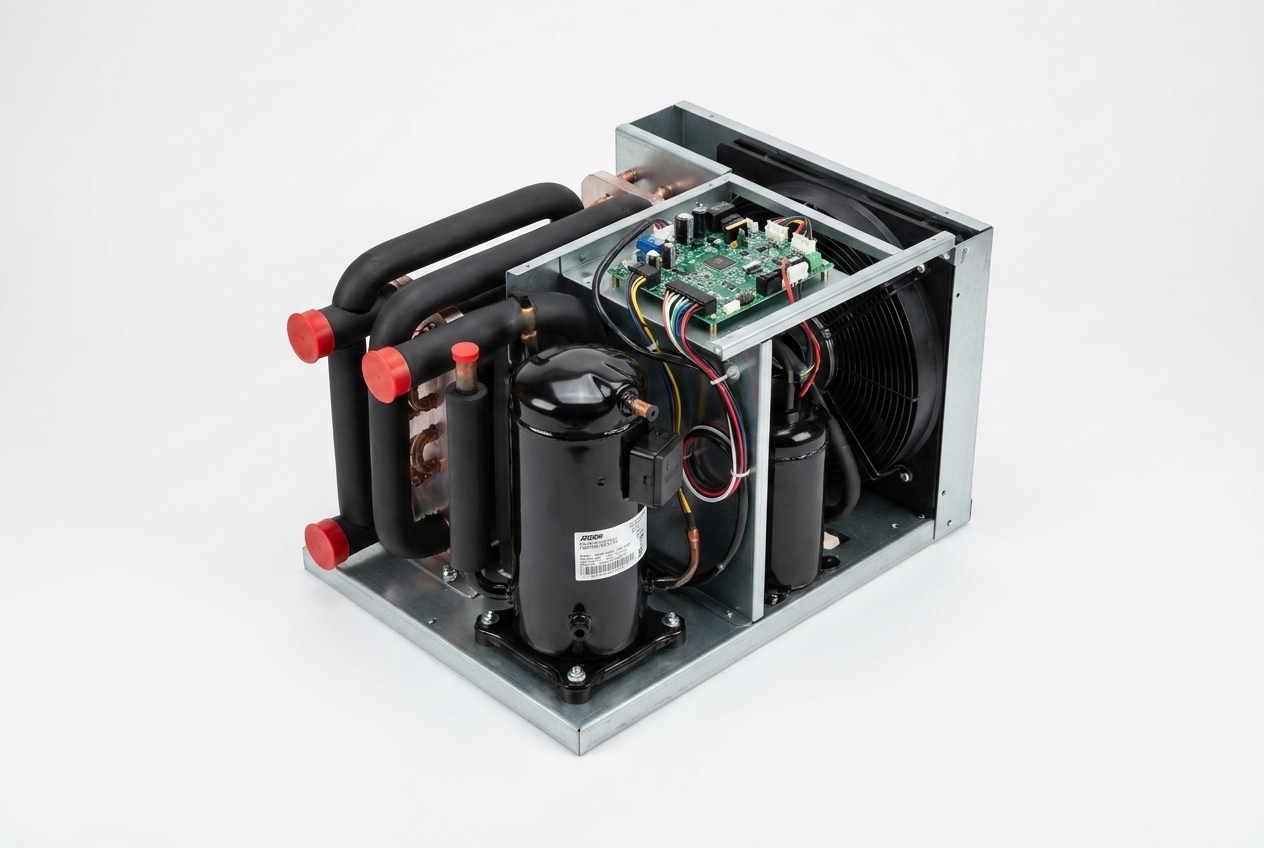
A compact water chiller is a self-contained, closed-loop recirculating cooling system small enough to sit on a countertop, slide under a fume hood, or mount inside an equipment cabinet. It uses a vapor-compression refrigeration cycle — the same thermodynamic principle behind household refrigerators — to chill a working fluid (typically distilled water or a water-glycol mixture) and pump it through your equipment.
The “compact” distinction is important. Traditional recirculating chillers can weigh over 50 kg and occupy half a square meter of floor space. A compact unit, by contrast, is engineered to deliver meaningful cooling capacity — often between 300 W and 1.5 kW — in a footprint roughly the size of a desktop computer tower.
Why does this matter for end users? Three reasons:
- Space constraints are real. Most laboratories, maker spaces, and small production rooms do not have unused floor space. A unit that fits on or under a bench is not a luxury; it is a requirement.
- Noise levels affect work quality. A chiller running next to an operator or inside a quiet lab must stay below roughly 50 dB(A) to avoid disrupting concentration and communication.
- Precision matters more than raw power. Many applications need temperature stability of ±0.5°C or better, not simply a large volume of cold water. A well-designed compact chiller can achieve ±0.1°C stability, which larger units sometimes sacrifice for throughput.
Key Applications for Compact Water Chillers
Compact water chillers serve a wide range of thermal management needs. Below are the three application categories where they deliver the most value for individual users and small teams.
Laser Systems and Optics Cooling
Laser diodes, CO₂ laser tubes, and fiber laser sources all generate significant waste heat relative to their output power. A 60 W CO₂ laser tube, for example, may dissipate 200–400 W of thermal energy that must be removed to maintain beam quality and extend tube life.
Temperature fluctuations cause wavelength drift in diode lasers and power instability in gas lasers. For applications like laser engraving, cutting, or spectroscopy, even a 1–2°C swing can degrade results. A compact water chiller with tight temperature control — ideally ±0.1°C to ±0.5°C — keeps the laser source operating within its designed thermal envelope.
Key considerations for laser cooling:
- Match the chiller’s cooling capacity to the laser’s actual thermal dissipation, not its optical output power (a common mistake — see the sizing section below).
- Use deionized or distilled water to prevent mineral buildup in narrow coolant channels.
- Ensure the chiller’s flow rate meets the laser manufacturer’s minimum specification, typically 2–5 liters per minute for small laser systems.
- If the laser operates in short bursts, consider whether you need continuous cooling or if intermittent operation is acceptable.
3D Printing and Additive Manufacturing
Water cooling in 3D printing is most relevant for high-temperature FDM/FFF hot ends, resin (SLA/DLP) vat temperature control, and metal sintering systems. As desktop and semi-professional printers push toward engineering-grade materials like PEEK, PEI, and polycarbonate, the thermal demands on the hot end and build chamber increase accordingly.
A compact water chiller can serve several roles in a 3D printing setup:
- Hot-end cooling for high-temperature extruders — maintaining a consistent melt zone while preventing heat creep into the cold end.
- Resin temperature regulation — some photopolymer resins perform best within a narrow temperature window (typically 25–35°C), and a chiller helps maintain that range in warm environments.
- Build plate and chamber cooling — for materials that benefit from controlled cooling rates to minimize warping and residual stress.
The heat loads in 3D printing applications are generally modest — often 50–300 W — so a compact chiller with 450 W or more of cooling capacity provides adequate headroom for most desktop and benchtop systems.
Laboratory and Analytical Instruments
Many common laboratory instruments require external cooling to maintain measurement accuracy or protect sensitive components. Examples include:
- Rotary evaporators — the condenser coil needs chilled coolant to efficiently recover solvents. A chiller set to -10°C or lower captures most volatile solvents effectively.
- ICP-OES and ICP-MS plasma sources — these instruments generate substantial heat at the torch and interface region, and many manufacturers specify an external chiller.
- X-ray diffractometers and electron microscopes — cooling the X-ray tube or electron gun extends source life and stabilizes output.
- PCR thermal cyclers and biological sample storage — precise, rapid temperature cycling requires a reliable cold source.
In laboratory settings, a compact form factor is especially valuable because fume hoods and bench space are shared among multiple users and instruments. A chiller that can fit under the bench or inside the fume hood enclosure avoids the need for long coolant runs to a remote unit.
How to Size a Compact Water Chiller by Heat Load
Choosing the right chiller starts with understanding how much heat your equipment actually produces. Undersizing leads to poor temperature control and shortened compressor life; oversizing wastes energy and money.
Step 1: Determine Your Heat Load
The heat load is the amount of thermal energy (in watts) that the chiller must remove per unit of time. There are three ways to estimate it:
- Manufacturer’s specification — the most reliable source. Check the equipment manual or data sheet for “thermal dissipation,” “heat rejection,” or “cooling requirement.” This is usually stated in watts.
- Input power minus useful output — if the spec is not available, you can approximate the heat load by subtracting the useful work output from the electrical input power. For a laser, for instance, a 60 W optical output laser drawing 300 W from the wall dissipates roughly 240 W as heat. Note: this is an approximation that assumes all non-useful energy becomes heat routed to the coolant, which is not always the case — some heat escapes via convection and radiation from the device housing.
- Calorimetric measurement — run the equipment with a known volume of coolant, measure the temperature rise over a set time, and calculate heat load using the formula: Q = m × Cp × ΔT, where m is mass flow rate (kg/s), Cp is specific heat capacity (4,186 J/kg·°C for water), and ΔT is the temperature rise.
Important: do not confuse the chiller’s electrical input power with its cooling capacity. A chiller that draws 500 W from the outlet does not necessarily deliver 500 W of cooling. The cooling capacity depends on the refrigeration cycle’s coefficient of performance (COP), which for small vapor-compression systems typically ranges from 1.5 to 3.0. Always refer to the chiller’s rated cooling capacity at the temperature you need.
Step 2: Add a Safety Margin
As a rule of thumb, add 20–30% to your calculated heat load when selecting a chiller. This margin accounts for:
- Ambient temperature variations (a chiller’s capacity drops as room temperature rises)
- Equipment aging and efficiency degradation over time
- Measurement uncertainty in your heat load estimate
- Potential future upgrades that may increase thermal output
For example, if your equipment dissipates 350 W, look for a chiller rated for at least 420–455 W of cooling capacity at your target coolant temperature.
Step 3: Match Temperature Range and Stability
Cooling capacity alone is not enough. You also need to confirm that the chiller can reach your required coolant temperature and maintain it within acceptable fluctuations:
- If you need coolant at 20°C for electronics cooling, most compact chillers will handle this easily.
- If you need -20°C for a rotary evaporator condenser or cold trap, verify that the chiller’s rated capacity at -20°C still exceeds your heat load. Cooling capacity decreases significantly at lower setpoints — a unit rated for 1 kW at 20°C might deliver only 400–600 W at -20°C.
- For applications requiring ±0.1°C stability (laser diodes, spectroscopy cells), look for chillers with PID-based temperature controllers rather than simple on/off thermostats.
Other Specifications That Affect Your Decision
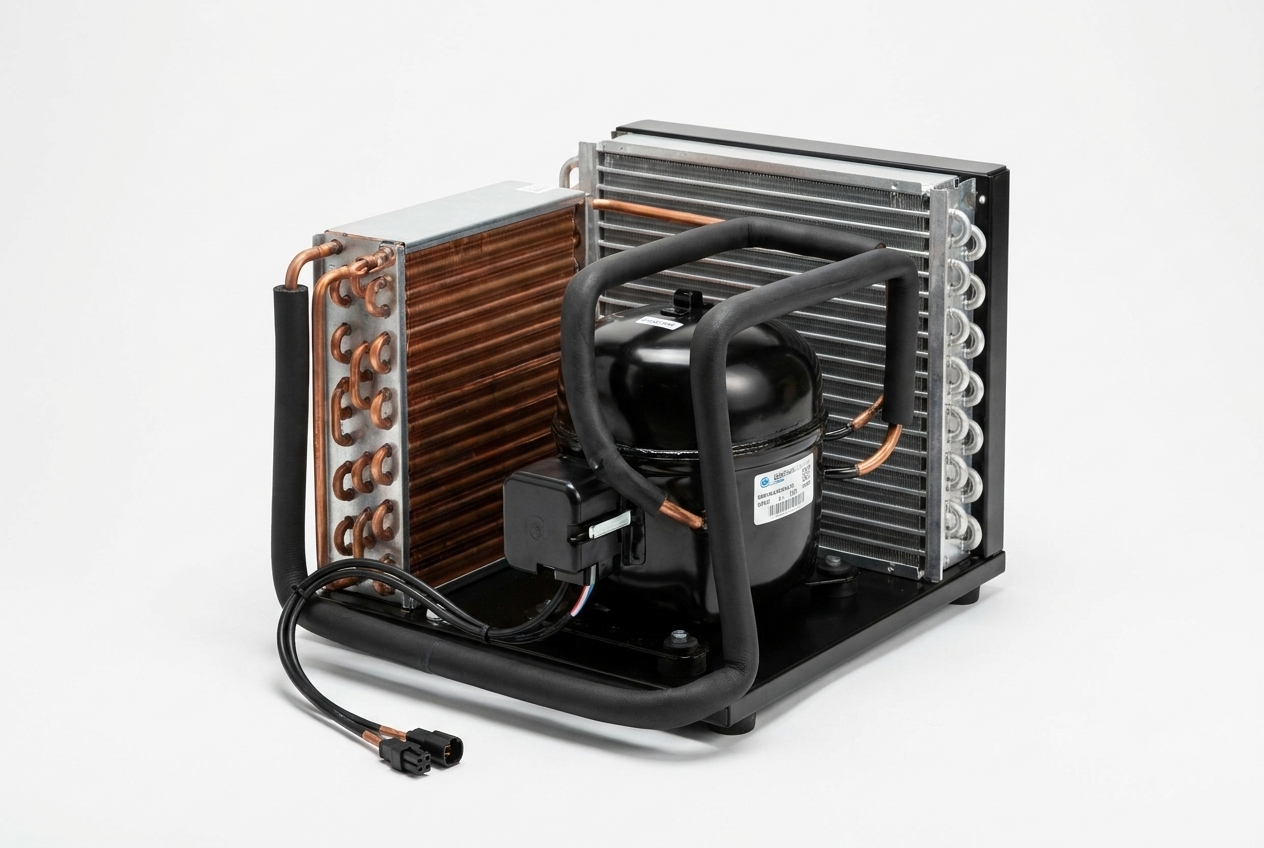
Beyond cooling capacity and temperature range, several additional factors influence whether a compact water chiller will work well in your specific setup.
Flow Rate and Pressure
The chiller’s built-in pump must deliver enough coolant flow to your equipment. Check:
- The minimum flow rate required by your equipment (typically specified in L/min or GPM)
- The pump’s head pressure, which determines how far and how high it can push coolant through your tubing and connectors
- Whether the flow rate is adjustable — some applications benefit from lower flow rates to maximize the temperature differential across the heat exchanger
Refrigerant Type
Modern compact chillers use several refrigerant options:
- R134a — widely used, proven reliability, but being phased out in some regions due to its global warming potential (GWP of 1,430)
- R290 (propane) — very low GWP (3), excellent thermodynamic properties, but classified as flammable (A3 safety group), which may affect placement in certain facilities
- R1234yf — low GWP (4), non-flammable in most classifications, increasingly adopted as an R134a replacement
If your lab or facility has policies regarding refrigerant types — particularly around flammability or environmental compliance — check the chiller’s refrigerant before purchasing.
Power Supply Flexibility
Some compact chillers operate only on standard AC mains (120 V or 240 V). Others accept DC input (12 V, 24 V, or 48 V), which is useful for:
- Battery-powered or solar-powered field deployments
- Integration into equipment that already has a DC power bus
- Mobile platforms, vehicles, or remote monitoring stations
Noise Level
Compact chillers vary widely in noise output — from under 40 dB(A) for premium units to over 55 dB(A) for less optimized designs. In a shared laboratory or clinical setting, noise can be a deciding factor. Ask for noise specifications measured at 1 meter under standard operating conditions, not just marketing claims of “ultra-quiet” operation.
Coolant Compatibility
Confirm that the chiller’s wetted materials (pump, heat exchanger, tubing) are compatible with your preferred coolant. Common options include:
- Distilled or deionized water (most common for laser and electronics cooling)
- Water-ethylene glycol mixtures (for sub-zero operation)
- Water-propylene glycol mixtures (food-safe alternative)
- Specialized dielectric fluids (rare in compact chillers, but used in some electronics applications)
Common Mistakes When Selecting a Small Water Chiller
Based on field experience, these are the errors that most often lead to poor cooling performance or premature equipment failure:
- Confusing input power with cooling capacity. A chiller’s wattage rating on the nameplate is its electrical consumption, not its cooling output. Always check the cooling capacity specification separately.
- Ignoring ambient temperature effects. A chiller rated for 800 W at 20°C ambient may only deliver 600 W when the room is 30°C in summer. Ask for performance curves at different ambient temperatures if available.
- Overlooking coolant maintenance. Closed-loop systems still need periodic coolant replacement, typically every 6–12 months, and the use of biocide or algaecide to prevent microbial growth in the reservoir.
- Placing the chiller in a poorly ventilated space. The chiller rejects heat to the surrounding air via its condenser. If it is enclosed in a cabinet without airflow, the ambient temperature around the chiller rises, reducing its capacity and potentially triggering thermal protection shutdowns.
- Not accounting for tubing length. Longer coolant runs introduce additional heat gain from the environment and pressure drop, both of which reduce effective cooling at the equipment. Keep tubing runs as short and well-insulated as practical.
When a Compact Water Chiller Is — and Isn’t — the Right Choice
Compact water chillers excel within a specific performance envelope. Understanding their boundaries helps you avoid buying a unit that cannot meet your needs.
A compact chiller is a good fit when:
- Your heat load falls between roughly 100 W and 1.5 kW
- You need coolant temperatures between +30°C and -40°C
- Space is limited — benchtop, under-bench, or in-cabinet installation
- Noise must stay below 50 dB(A)
- You need precise temperature control (±0.1°C to ±1.0°C)
A compact chiller may not be sufficient when:
- Your heat load exceeds 1.5–2 kW — consider a mid-range recirculating chiller instead
- You need coolant temperatures below -40°C — this requires cascade refrigeration systems or specialized ultra-low-temperature chillers
- Your application demands very high flow rates (>10 L/min) — compact pumps typically max out around 5–8 L/min
- You are cooling multiple large instruments simultaneously — a single compact unit will likely be undersized
For heat loads in the 1.3 kW to 4.6 kW range, a mid-size recirculating chiller is the more appropriate choice. For loads above 5 kW, you are likely looking at floor-standing industrial units with three-phase power requirements.
The RIGID MiniCool™ Series: A Compact Chiller Worth Considering
The RIGID MiniCool™ series is a line of compact, closed-loop recirculating liquid chillers designed for the applications discussed throughout this guide. Here is what the MiniCool brings to the table:
- Cooling capacity from 450 W to over 1 kW — covering the thermal management needs of most small laser systems, 3D printing setups, and laboratory instruments
- Temperature range of 0°C to -40°C with ±0.1°C stability — suitable for demanding applications like rotary evaporator condensing, laser diode cooling, and sample temperature control
- Multiple refrigerant options (R134a, R290, R1234yf) — allowing you to select the option that aligns with your facility’s environmental and safety policies
- AC and DC power compatibility — the series supports 120 V to 240 V AC as well as DC input, making it adaptable for both laboratory and field deployments
- Countertop form factor — MiniCool units are designed to sit on a bench, fit under a fume hood, or mount inside equipment cabinets, eliminating the need for dedicated floor space
- Priced between $1,500 and $1,700 — positioning it in the accessible range for individual researchers, small labs, and maker spaces
The MiniCool series is built by RIGID Technology, a manufacturer with nearly a decade of experience in miniature refrigeration systems. The units use BLDC (brushless DC) compressor technology, which contributes to their compact size, low noise output, and energy efficiency compared to conventional AC compressor designs found in many competing products at similar price points.
One practical advantage worth noting: some MiniCool models can also function as heating/cooling baths, providing both warming and chilling capability in a single unit. This dual-mode operation is useful in laboratory settings where you may need to maintain samples at elevated temperatures for one protocol and sub-zero temperatures for another.
Quick Sizing Checklist Before You Buy
Use this checklist to organize the information you need before selecting any compact water chiller:
- What is your equipment’s thermal dissipation in watts? (Check the manual or measure it.)
- What coolant temperature does your equipment require?
- What is the minimum coolant flow rate specified by your equipment?
- What is the typical ambient temperature in the room where the chiller will operate?
- Do you need the chiller to operate on AC, DC, or both?
- Are there refrigerant restrictions in your facility?
- How much space (length × width × height) is available for the chiller?
- What is your maximum acceptable noise level?
- Does your coolant system require specific materials compatibility (e.g., all-stainless wetted path)?
- Will you need the chiller to both cool and heat the working fluid?
With these answers in hand, you can compare any compact water chiller on the market — including the MiniCool — against your actual requirements rather than relying on marketing headlines.
Final Thoughts
A compact water chiller is a practical investment for anyone working with heat-sensitive equipment in a space-constrained environment. Whether you are cooling a laser source, stabilizing a 3D printing process, or maintaining instrument accuracy in the lab, the right chiller removes a variable that can undermine the quality of your work.
The key to a good purchase is honest sizing. Measure or estimate your heat load, add a safety margin (a rule of thumb is 20–30%), verify the chiller’s capacity at your actual operating temperature, and confirm that the flow rate, noise level, and physical dimensions work in your space. Avoid the common trap of choosing based on price alone — a slightly more capable unit that runs within its design limits will outlast and outperform a cheaper one that is constantly maxed out.
The RIGID MiniCool™ series checks many of the boxes that matter for small-scale precision cooling: adequate capacity, tight temperature control, flexible power input, and a footprint that does not demand a room of its own. It is worth adding to your shortlist as you evaluate your options.