
What Is a Compact Water Chiller and How Does It Work?
A compact water chiller is a refrigeration system designed to remove heat from a liquid coolant (typically water or a water-glycol mixture) and maintain precise temperature control in space-constrained environments. Unlike traditional chillers that occupy entire equipment rooms, compact water chillers deliver industrial-grade cooling performance in footprints compact enough to fit within a 4U rack space or beneath a workbench.
The working principle follows the vapor-compression refrigeration cycle. A DC compressor circulates refrigerant through four key components: the evaporator (where heat absorption occurs), compressor (pressure and temperature increase), condenser (heat rejection), and expansion valve (pressure reduction). As coolant flows through the evaporator’s heat exchanger, the refrigerant absorbs thermal energy, dropping the liquid temperature to the setpoint—often as low as 5°C (41°F) for precision applications.
What distinguishes compact water chillers from air-cooled spot coolers is the heat transfer medium. Water’s thermal conductivity is roughly 25 times higher than air, enabling more efficient heat removal per unit volume. This makes liquid cooling the preferred solution when cooling density exceeds 15-20 watts per square inch, a threshold commonly reached in laser systems, medical imaging equipment, and high-power electronics enclosures.
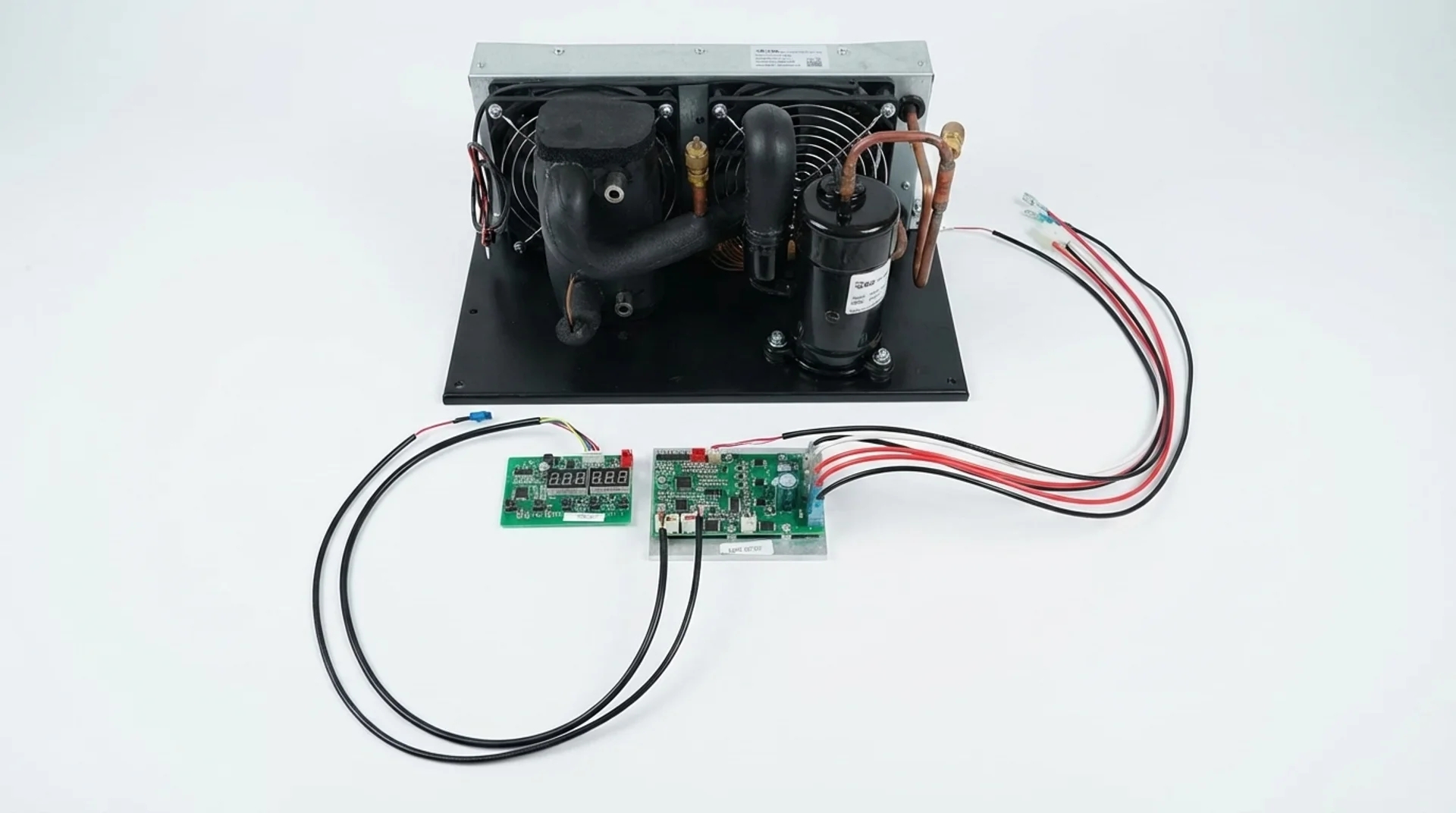
Key Components of a Compact Water Chiller System
Understanding the core components helps in troubleshooting and optimizing performance:
DC Compressor: The heart of the system. Brushless DC (BLDC) compressors offer variable-speed operation, allowing the chiller to modulate cooling output based on real-time load. This improves energy efficiency compared to fixed-speed AC compressors, particularly during partial-load conditions. Typical compact chillers use miniature rotary or scroll compressors rated between 450W and 850W cooling capacity.
Heat Exchanger Type: Compact chillers employ either plate heat exchangers or coaxial (tube-in-tube) designs. Plate exchangers provide higher surface area in smaller volumes, making them ideal for applications requiring rapid temperature response. Coaxial exchangers offer better resistance to fouling and are preferred in environments with particulate-laden coolant or high mineral content water.
Refrigerant Circuit: Most compact chillers use R134a refrigerant, though R290 (propane) variants are available for applications requiring lower global warming potential. The refrigerant is pre-charged at the factory, eliminating the need for field brazing and refrigerant handling certifications during installation. This plug-and-play approach reduces commissioning time from days to hours.
Control System: Modern compact chillers integrate PID temperature controllers with digital displays, allowing setpoint adjustment in 0.1°C increments. Advanced models include RS485 or CAN bus interfaces for integration with building management systems or industrial PLCs.
Sizing a Compact Water Chiller: Cooling Load Calculation
Proper sizing prevents two common failure modes: undersized chillers that cannot maintain setpoint under peak load, and oversized units that short-cycle, reducing compressor lifespan and temperature stability.
The fundamental sizing equation is: Cooling Capacity (W) = Heat Load (W) × Safety Factor
Heat load sources include:
- Process heat: Power dissipation from the equipment being cooled (e.g., a 500W fiber laser generates approximately 500W of waste heat)
- Ambient heat gain: Thermal transfer through piping and reservoir walls, typically 5-10% of process heat in insulated systems
- Pump heat: Circulation pumps add 50-150W depending on flow rate and head pressure
Safety factors range from 1.15 (well-characterized loads in controlled environments) to 1.3 (variable loads or high ambient temperatures). For a 600W laser system with 10% ambient gain and 100W pump heat: (600 + 60 + 100) × 1.2 = 912W required cooling capacity.
Flow rate requirements depend on the allowable temperature rise (ΔT) across the load: Flow Rate (L/min) = Cooling Load (W) / (4186 × ΔT), where 4186 is water’s specific heat in J/(kg·°C). A 5°C rise across a 900W load requires 2.6 L/min minimum flow.
Applications: Where Compact Water Chillers Excel
Compact water chillers serve industries where space, weight, or DC power availability constrain traditional chiller options:
Laser Cooling: Fiber lasers, CO2 lasers, and diode laser arrays generate concentrated heat that must be removed to prevent wavelength drift and optical damage. Compact chillers maintain ±0.5°C stability, critical for applications like laser welding and medical laser surgery. The DV-series chillers commonly cool 200-1000W laser systems in portable or OEM-integrated configurations.
Medical Equipment: MRI gradient coils, CT scanner X-ray tubes, and analytical instruments (mass spectrometers, NMR) require precise thermal management. Compact chillers fit within equipment cabinets, reducing installation footprint in space-constrained medical facilities. Low acoustic emissions (typically <50 dBA) prevent patient discomfort during procedures.
EV Charging Infrastructure: DC fast chargers dissipate 3-5% of throughput power as heat in power modules and cables. A 150kW charger generates 4.5-7.5kW of waste heat requiring active cooling. Compact liquid chillers cool power electronics and cable cooling jackets, enabling higher charge rates without thermal derating.
3D Printing and Additive Manufacturing: Selective laser sintering (SLS) and metal 3D printers use high-power lasers that require stable cooling. Compact chillers maintain powder bed temperature uniformity, improving part quality and reducing warping. The small footprint allows integration into printer enclosures.
Electronics Enclosure Cooling: Telecom cabinets, industrial control panels, and outdoor electronics enclosures in harsh environments benefit from liquid cooling when ambient temperatures exceed 40°C (104°F). Compact chillers paired with liquid-to-air heat exchangers provide localized cooling without introducing outdoor air contaminants.

Compact vs. Standard Chiller: When to Choose Each
The decision between compact and standard chillers hinges on cooling capacity, installation constraints, and total cost of ownership:
Cooling Capacity: Compact chillers typically range from 450W to 2000W (1,535 to 6,800 BTU/h). Standard chillers start around 3kW and scale to hundreds of kilowatts. For loads under 2kW, compact units offer better value and efficiency.
Footprint and Weight: A 700W compact chiller occupies roughly 0.03 cubic meters and weighs 15-25 kg, versus 0.2+ cubic meters and 80+ kg for an equivalent standard chiller. This 6-8x volume reduction enables installation in equipment racks, under workbenches, or within OEM machinery.
Power Input: Compact chillers designed for DC operation (12V, 24V, 48V) eliminate the need for AC-to-DC conversion, avoiding 15-20% inverter losses. DC-native systems eliminate the 15-20% conversion loss inherent in AC-powered chillers operating from battery or solar sources. This makes them ideal for mobile applications, off-grid installations, and vehicles.
Installation Complexity: Standard chillers require dedicated electrical circuits, water supply connections, and often building permits. Compact chillers with pre-charged refrigerant eliminate field brazing, reducing installation to connecting coolant hoses and plugging in power. This simplicity enables rapid deployment and field serviceability.
Noise and Vibration: Compact chillers using miniature DC compressors generate 45-55 dBA at 1 meter, comparable to a quiet office. Standard chillers with larger compressors and fans often exceed 65 dBA, requiring acoustic enclosures in noise-sensitive environments.
Installation Best Practices for Compact Water Chillers
Proper installation maximizes performance and longevity:
Mounting Orientation: Most compact chillers are designed for horizontal mounting with the compressor at the lowest point to ensure proper oil return. Vertical mounting may be possible but requires manufacturer confirmation to avoid lubrication issues.
Ventilation Requirements: Air-cooled condensers require clearance for airflow—typically 150mm (6 inches) on intake and exhaust sides. Blocked airflow causes high condensing pressure, reducing capacity and triggering thermal shutdowns. In enclosed cabinets, add ventilation fans to exhaust heat.
Coolant Selection: Deionized water provides optimal heat transfer but requires corrosion inhibitors in systems with mixed metals. Propylene glycol mixtures (20-30% concentration) offer freeze protection to -10°C but reduce heat transfer by 10-15%. Ethylene glycol is more efficient but toxic, limiting use in food and medical applications.
Piping and Insulation: Use flexible hoses or copper tubing with 10-15mm inner diameter for flow rates under 5 L/min. Insulate all cold-side piping to prevent condensation and maintain temperature stability. Quick-disconnect fittings simplify maintenance and equipment swaps.
Electrical Connections: DC chillers require proper polarity and voltage matching. Undersized wiring causes voltage drop, reducing compressor performance. Use wire gauges per manufacturer specifications—typically 14 AWG for 12V systems under 20A, 16 AWG for 24V systems under 10A.
Maintenance and Troubleshooting
Compact water chillers require minimal maintenance compared to larger systems, but routine checks prevent downtime:
Monthly Tasks: Inspect coolant level and top off as needed. Check for leaks at hose connections and heat exchanger fittings. Clean condenser fins with compressed air or a soft brush to remove dust buildup that impedes heat rejection.
Quarterly Tasks: Test coolant pH and conductivity. Deionized water should maintain pH 6.5-7.5 and conductivity below 10 μS/cm. High conductivity indicates contamination; flush and refill the system. Replace inline filters if pressure drop exceeds 5 psi.
Annual Tasks: Inspect compressor mounting bolts for tightness. Check refrigerant charge by monitoring superheat and subcooling—deviations indicate leaks or overcharge. Verify temperature controller calibration against a reference thermometer.
Common Issues: Insufficient cooling often stems from low coolant flow (check pump operation and filter clogs), high ambient temperature (verify condenser airflow), or undersized chiller for the load. Temperature instability suggests PID tuning issues or thermal mass mismatches. Compressor short-cycling indicates oversizing or refrigerant problems.
Selecting the Right Compact Water Chiller
When evaluating compact chiller options, prioritize these factors:
Cooling Capacity Match: Calculate actual heat load and apply appropriate safety factors. Avoid the temptation to oversize—a chiller operating at 60-80% capacity delivers better efficiency and temperature stability than one cycling on/off at 20% load.
Temperature Range: Verify the chiller can achieve your required setpoint at maximum ambient temperature. Most compact chillers maintain 5-35°C coolant temperature in 25°C ambient. High-ambient or low-temperature applications may require specialized models.
Voltage Compatibility: Match chiller voltage to available power. Battery-powered applications benefit from 24V or 48V models that interface directly with battery banks. Grid-powered installations can use 12V models with appropriate power supplies.
Control Interface: Basic models offer manual setpoint adjustment via potentiometer. Advanced units provide digital displays, remote control, and communication protocols (Modbus, CANbus) for integration with supervisory systems.
Customization Options: OEM applications often require modified dimensions, custom mounting brackets, or specific connector types. Look for manufacturers offering OEM customization with sample quantities from 1 unit, enabling prototyping without minimum order quantity constraints.
For detailed specifications and application support, explore compact liquid chiller solutions designed for space-constrained cooling challenges.