
Compact Water Chiller Selection: Key Factors That Determine the Right Fit
Choosing the right compact water chiller for your application is not as simple as picking the unit with the highest cooling capacity. Undersizing leads to thermal runaway and component damage, while oversizing wastes energy, adds unnecessary weight, and increases cost. Whether you are building a portable laser system, integrating cooling into a medical device, or designing a laboratory test bench, the selection process comes down to matching your thermal load to the chiller’s capabilities within your space and power constraints.
This guide walks you through the critical parameters — cooling capacity, flow rate, physical footprint, voltage compatibility, and ambient conditions — so you can confidently select a compact water chiller that fits your specific requirements.
Understanding Cooling Capacity: Watts, BTUs, and What They Mean for You
Cooling capacity is the single most important specification when selecting a chiller. It tells you how much heat the unit can remove from your process per unit of time. You will see it expressed in watts (W) or British Thermal Units per hour (BTU/h).
For compact liquid chillers in the RIGID product range, cooling capacity spans from 100W to 550W (approximately 300 BTU/h to 1,600 BTU/h). This range covers a wide variety of small-footprint applications, from precision laser diode cooling at the lower end to electronics enclosure cooling and small battery thermal management at the upper end.
To determine the cooling capacity you need, start with your heat load. This is the total thermal energy your system generates that must be removed. Common sources include:
- Electrical components converting power to heat (CPUs, GPUs, power electronics)
- Laser diodes and optical systems
- Chemical or biological reactions in laboratory equipment
- Friction and mechanical energy in moving parts
A practical rule of thumb: estimate your heat load, then select a chiller with approximately 20-30% more cooling capacity than your calculated load. This safety margin accounts for ambient temperature variations, system aging, and peak load conditions. Note that this is an approximation — actual requirements may vary based on your specific operating conditions.
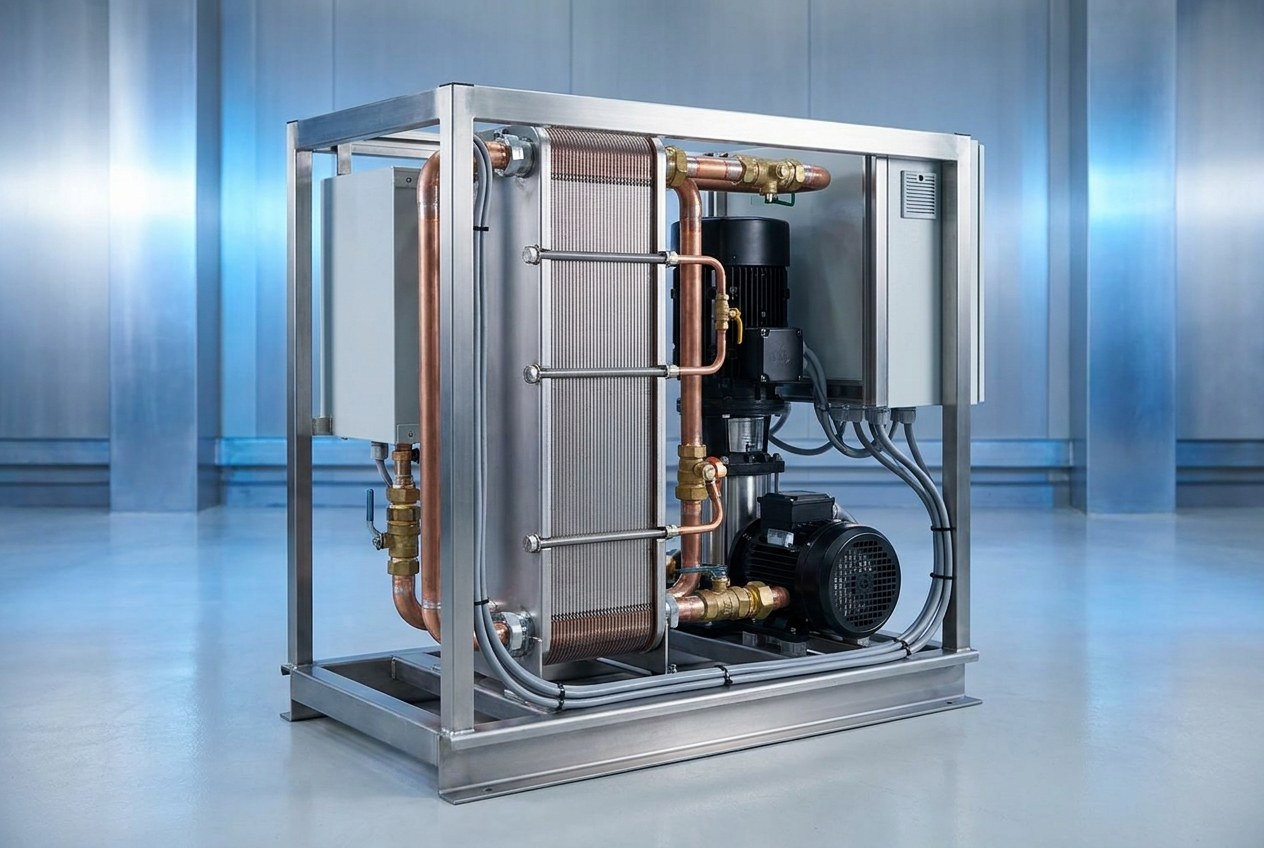
Physical Footprint: When Every Inch Matters
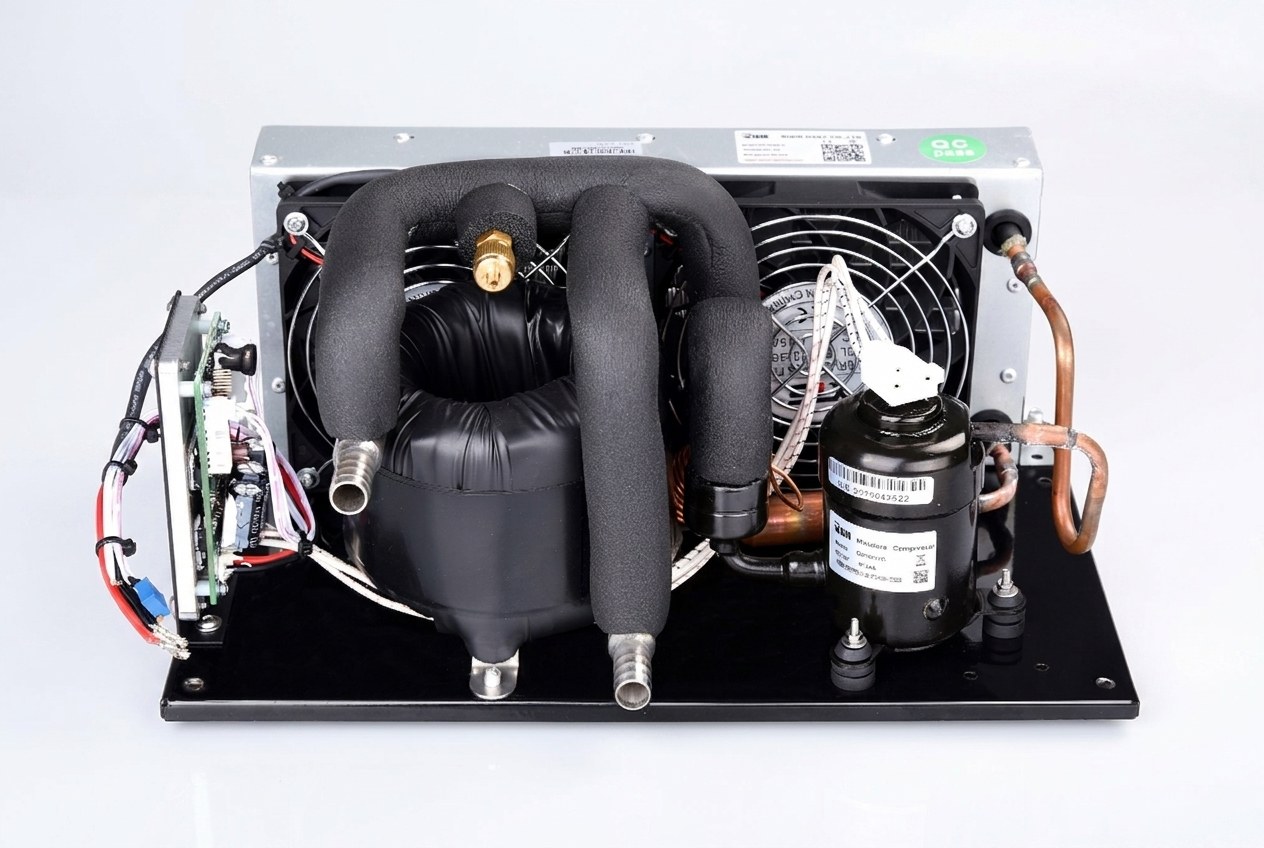
One of the defining advantages of a compact water chiller over traditional rack-mounted or floor-standing units is its minimal physical footprint. The RIGID compact liquid chiller module measures just 7.85 × 6.3 × 6.7 inches and weighs only 6.6 lbs (3.0 kg). To put that in perspective, that is roughly the size of a small shoebox.
This compact form factor makes these chillers suitable for integration directly into end products rather than existing as separate standalone equipment. Consider these scenarios:
- Portable medical devices: The chiller module fits inside the device housing, eliminating external cooling connections
- Laboratory instruments: Bench space is precious — a compact chiller can mount underneath or beside the instrument
- Mobile and vehicle-mounted systems: Weight and volume directly affect payload capacity and fuel consumption
- Drone docking stations: Space inside the docking enclosure is extremely limited
When evaluating footprint, also consider the condenser airflow path. The unit needs adequate ventilation for the air-cooled condenser to reject heat. Plan for at least 2-3 inches of clearance around the condenser for proper airflow, or more in enclosed installations.
Voltage and Power Source Compatibility
Unlike conventional AC-powered chillers, compact DC liquid chillers operate on 12V, 24V, or 48V DC power. This is a critical advantage for applications that run on batteries, solar panels, vehicle alternators, or fuel cells.
Selecting the correct voltage version depends on your available power source:
- 12V DC: Ideal for automotive, marine, and small battery-powered applications. Common in portable medical devices and vehicle-mounted cooling systems.
- 24V DC: The most versatile option. Compatible with standard industrial battery banks, solar panel arrays, and telecommunications power systems.
- 48V DC: Best for higher-capacity applications where you want to minimize current draw. Common in telecommunications, server cooling, and larger battery storage systems.
The variable-speed brushless DC compressor adjusts its speed based on cooling demand, which means power consumption scales with your actual thermal load rather than running at full power continuously. This is particularly important for battery-powered applications where energy efficiency directly translates to runtime.
Flow Rate and Coolant Loop Design
The chiller module cools your process fluid (typically water or a water-glycol mixture) as it passes through the evaporator. The flow rate through this loop affects both cooling performance and temperature stability.
Higher flow rates generally improve heat transfer at the cold plate or heat exchanger in contact with your heat source, but they also reduce the temperature differential across the loop. Lower flow rates create a larger temperature difference between supply and return, which can be acceptable for some applications but problematic for others that require tight thermal uniformity.
Key considerations for your coolant loop:
- Pump selection: An external pump is required in the system. Size it to overcome the pressure drop through your entire loop including the evaporator, tubing, fittings, and cold plate.
- Reservoir: Some configurations include a built-in reservoir. If yours does not, add one to accommodate thermal expansion and provide a buffer for air removal.
- Tubing diameter: Match tubing to your flow rate requirements. Undersized tubing creates excessive pressure drop and reduces flow.
- Coolant type: Water provides the best heat transfer. Add glycol only if freeze protection is needed, and note that glycol reduces heat transfer capacity.
The system provides temperature control precision of ±0.5°C, which is sufficient for most laser cooling, medical device, and laboratory applications that require stable thermal conditions.
Ambient Temperature Considerations
Every chiller rejects heat to its surrounding environment. The ambient temperature directly affects how much cooling capacity the unit can deliver. Higher ambient temperatures reduce the temperature differential available for heat rejection, which decreases effective cooling capacity.
Standard RIGID compact liquid chiller modules require a minimum ambient temperature of +5°C for proper compressor lubrication. For applications in hot environments, the T-tropical series compressor operates at ambient temperatures up to 55°C, though cooling capacity will be derated at elevated temperatures.
Consider your installation environment:
- Indoor, climate-controlled: Standard modules work well in typical 20-25°C environments with full rated capacity available.
- Enclosed cabinets: Heat buildup inside the enclosure effectively raises the ambient temperature. Ensure adequate ventilation or factor in the temperature rise.
- Outdoor or vehicle-mounted: Temperature extremes require the tropical-rated compressor option and potentially a larger capacity unit to account for derating.
- High-altitude: Reduced air density at altitude decreases condenser effectiveness. Consider oversizing for installations above 2,000 meters.
Application Matching: Which Capacity Fits Your Use Case
To help you narrow down the right size, here is how different cooling capacity ranges typically map to applications:
100W – 200W Range
Suitable for single laser diodes, small optical systems, individual electronic components, and miniature analytical instruments. These are precision cooling tasks where the heat load is modest but temperature stability is critical.
200W – 350W Range
Covers most portable medical devices (aesthetic cooling, surgical tool cooling), small laboratory water baths, LED array cooling, and moderate electronics cooling. This is the most common range for integrated OEM applications.
350W – 550W Range
Appropriate for multi-component electronics cooling, small battery thermal management systems, vertical farming climate modules, and applications with higher heat loads or elevated ambient temperatures that require additional capacity margin.
If your heat load exceeds 550W, you are beyond the range of the standard compact liquid chiller module. RIGID offers large power chiller options in the 880W to 1,780W range for higher-capacity requirements.
What Compact Water Chillers Are NOT Suitable For
Understanding the boundaries of these systems is just as important as knowing their capabilities. Compact water chillers in the 100W-550W range are not appropriate for:
- Large-scale industrial processes: Injection molding, CNC machine cooling, or process cooling above 1 kW requires larger equipment.
- Building HVAC: These are precision cooling modules, not space conditioning systems.
- High-flow applications: If your process requires very high coolant flow rates (above 5-6 liters per minute), the compact evaporator may create excessive pressure drop.
- Sub-zero cooling: While the system can cool below ambient, achieving and maintaining temperatures well below 0°C requires specialized low-temperature configurations.
- Corrosive or viscous fluids: The standard evaporator is designed for water and water-glycol mixtures. Aggressive chemicals or highly viscous fluids require custom heat exchanger materials.
Integration Considerations for System Designers
If you are a system integrator building the chiller into a larger product, several additional factors affect your selection:
Communication and control: The system includes a communication port for monitoring performance and setting the operating temperature. This allows integration with your product’s control system for automated thermal management.
Mounting orientation: The compressor has preferred mounting orientations for optimal oil return. Verify the installation requirements for your specific mounting configuration.
Vibration and shock: The chiller is designed to meet requirements for mobile applications where it may be subjected to shock and vibration. However, if your application involves continuous high-vibration environments, confirm the specifications match your vibration profile.
Noise: The variable-speed compressor and condenser fan generate some acoustic noise. For noise-sensitive applications like medical devices used in clinical settings, consider the noise output at your expected operating speed and whether additional acoustic isolation is needed.
For applications requiring both heating and cooling capabilities, the system can provide thermally regulated coolant in both directions, making it suitable for environmental test chambers and processes that require temperature cycling.
Making Your Final Selection: A Step-by-Step Approach
Here is a practical process for selecting the right compact water chiller:
- Calculate your heat load: Sum all heat sources in your system. Include safety margin of approximately 20-30%.
- Define your temperature requirements: What coolant supply temperature do you need? What is your acceptable temperature variation?
- Assess your space constraints: Measure the available volume for the chiller module. Remember to include clearance for airflow and service access.
- Identify your power source: Determine available voltage (12V, 24V, or 48V DC) and maximum current budget.
- Consider your ambient environment: What is the maximum ambient temperature the chiller will experience? Is the tropical-rated option necessary?
- Plan your coolant loop: Determine tubing runs, select an appropriate pump, and identify your cold plate or heat exchanger interface.
With these parameters defined, you can match your requirements against the available chiller configurations. If your application falls between standard options or has unique requirements, custom configurations are available to match specific cooling demands.
Comparing Compact Chillers to Alternative Cooling Technologies
Before finalizing your selection, it is worth understanding why a vapor-compression compact chiller may be the right choice over alternatives:
Versus thermoelectric (Peltier) coolers: Above 100W cooling capacity, vapor compression systems using a miniature compressor offer significantly better performance — typically one-quarter to one-half the weight and volume, and one-third to one-half the power consumption compared to thermoelectric systems. Thermoelectric coolers may still make sense below 50W where their simplicity (no moving parts, no refrigerant) outweighs their efficiency disadvantage.
Versus passive cooling (heat sinks and fans): Passive cooling cannot reduce temperatures below ambient. If your application requires coolant temperatures at or below the surrounding air temperature, active refrigeration is necessary.
Versus large conventional chillers: If your heat load is under 550W, a full-size chiller is overkill — heavier, larger, more expensive, and consuming more power than necessary.
The compact water chiller occupies a specific niche: applications that need active refrigeration below ambient temperature, in a small and lightweight package, powered by DC sources. If your application fits this profile, it is likely the most efficient solution available.
For more information about compact DC cooling solutions and related applications, explore our micro DC air conditioning and cooling systems to see how these technologies extend across different product categories.
Summary
Selecting the right compact water chiller comes down to honestly assessing your thermal load, space constraints, power availability, and environmental conditions. The RIGID compact liquid chiller range covers 100W to 550W in a package measuring just 7.85 × 6.3 × 6.7 inches at 6.6 lbs — making it one of the smallest vapor-compression cooling solutions available for OEM integration and system design.
Start with your heat load calculation, add appropriate safety margin, verify that your space and power budget accommodate the unit, and confirm that your ambient conditions fall within the operating range. With these factors aligned, you will have a reliable, efficient cooling solution sized correctly for your specific application.