
Why Every Compact Water Chiller Laser Setup Needs Active Cooling
Laser systems generate substantial heat as a byproduct of the lasing process. Whether you operate a CO2 laser cutter for acrylic signage, a fiber laser for metal marking, or a diode laser for engraving, thermal management is not optional — it is a core requirement for reliable operation. Without active cooling, laser tubes degrade faster, beam quality deteriorates, and in worst cases, thermal runaway can permanently damage expensive optical components.
The challenge for small workshops and independent operators is finding a cooling solution that matches the scale of their equipment. Industrial water chillers designed for factory floors are oversized, expensive, and require three-phase power. On the other end, passive cooling methods like radiators and fans simply cannot maintain the tight temperature tolerances that laser sources demand. This is where compact water chillers purpose-built for laser cooling fill a critical gap.
A properly sized compact water chiller maintains your laser source within its optimal temperature window — typically between 15°C and 25°C depending on the laser type — regardless of ambient conditions. This consistency translates directly into longer tube life, stable output power, and repeatable cut or engrave quality across production runs.
Understanding Heat Load Across Laser Types
Before selecting a chiller, you need to understand how much heat your specific laser system produces. Different laser technologies have different electrical-to-optical conversion efficiencies, and the waste energy manifests primarily as heat that must be removed from the system.
CO2 Lasers
CO2 lasers are among the most common in small workshop environments, used extensively for cutting and engraving non-metallic materials. These lasers typically operate at 10-15% wall-plug efficiency for sealed tube designs, meaning that for every watt of laser output, roughly 6-9 watts of electrical input is consumed, with the difference dissipated as heat. A 40W CO2 laser tube might draw 200-350W of electrical power, generating a significant thermal load that must be continuously removed from the tube’s water jacket.
The glass tubes used in most desktop and mid-format CO2 lasers are particularly sensitive to temperature. Operating above the manufacturer’s recommended range accelerates gas degradation inside the sealed tube and can cause thermal stress fractures in the glass envelope. Many operators have learned this lesson the hard way after a summer heatwave pushed their workshop temperatures — and consequently their coolant temperatures — beyond safe limits.
Fiber Lasers
Fiber lasers offer significantly better electrical efficiency, typically in the 30-50% range for modern units. However, they still produce considerable waste heat, particularly at higher power levels. A 50W fiber laser marking system might generate 50-100W of waste heat that needs removal. The fiber laser source itself is less temperature-sensitive than a CO2 tube, but maintaining stable temperatures improves beam quality consistency and extends diode pump lifetime.
Diode Lasers
Direct diode lasers used in engraving applications operate at varying efficiencies depending on wavelength and design. While lower-power diode modules (under 10W optical) can often manage with heatsink and fan cooling alone, higher-power diode arrays and multi-diode systems benefit substantially from liquid cooling. The semiconductor junction temperature directly affects both output wavelength and lifetime, making temperature stability particularly valuable for applications requiring precise wavelength control.
Estimating Your Heat Load
As a starting point for estimation, consider the total electrical input power to your laser source minus the optical output power. This gives you a rough upper bound on the heat that needs to be removed. For example, if your laser system draws 500W from the wall and produces 60W of optical output, approximately 440W of heat needs to be managed. In practice, some of this heat dissipates through the machine frame and enclosure, so the actual cooling load on the water circuit is somewhat lower — but sizing your chiller to handle the full calculated load provides a safety margin for hot ambient conditions.
Note that these are estimates and starting points. Actual heat loads vary by manufacturer, operating duty cycle, and system design. Always consult your laser manufacturer’s specifications for recommended cooling capacity when available.
Why Compact DC Chillers Fit Small Workshops
Traditional industrial chillers present several problems for small workshop environments. They require AC mains power (often 220V single-phase or three-phase), produce significant noise, take up considerable floor space, and are designed for cooling loads far exceeding what a desktop or mid-format laser requires. Running an oversized chiller wastes energy and can actually cause problems — an oversized unit may short-cycle, leading to poor temperature stability and increased compressor wear.
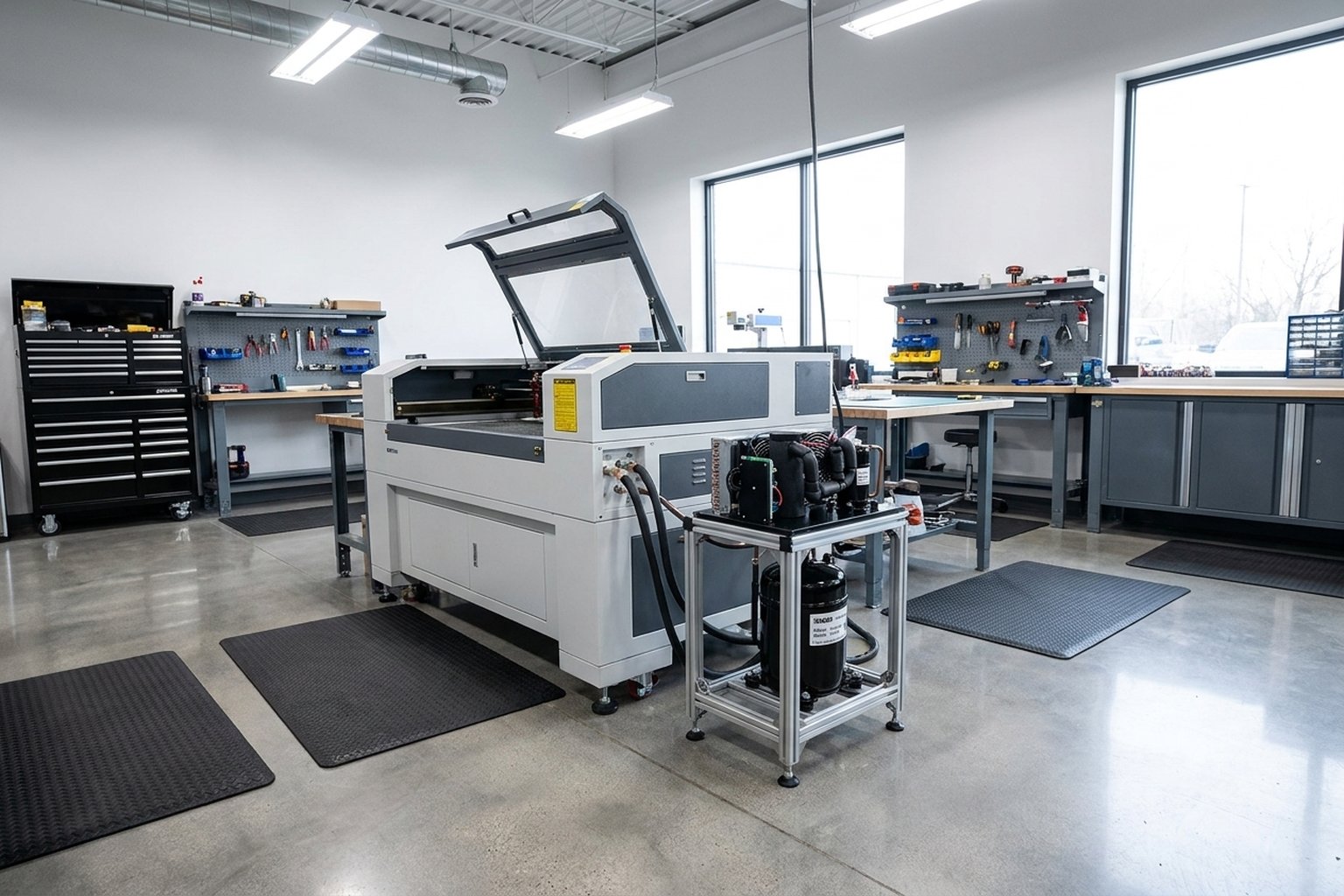
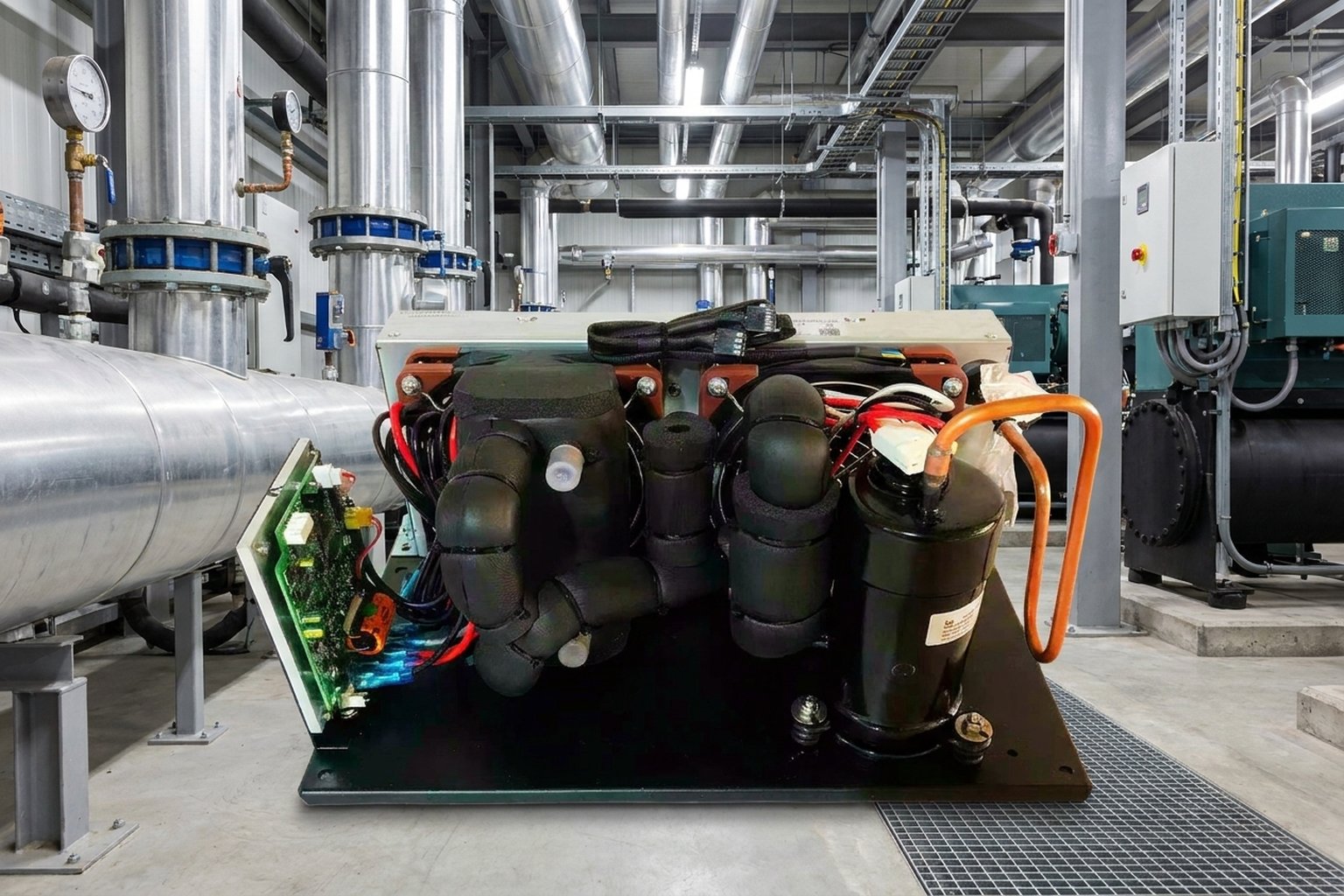
Compact DC-powered chillers solve these problems through a fundamentally different design approach. Units in the DV series operate on 12V, 24V, or 48V DC power, use BLDC (brushless DC) variable-speed compressors with R134a refrigerant, and deliver cooling capacities from 200W to over 900W in a fraction of the footprint of conventional units. The variable-speed compressor is key — it modulates cooling output to match the actual load, maintaining tight temperature control without the on-off cycling that plagues fixed-speed systems.
For workshop operators, the DC power architecture offers additional flexibility. These units can run directly from a DC power supply, integrate with battery backup systems for uninterrupted operation during power fluctuations, or even operate from solar installations in off-grid workshops. No inverter is needed between the power source and the chiller, eliminating a common point of failure and electrical noise that can interfere with sensitive laser control electronics.
The compact footprint means the chiller can sit beside or beneath the laser system without consuming valuable workshop floor space. Many operators mount them on the same rolling cart as their laser, creating a self-contained mobile cutting station.
Key Selection Criteria for Laser Cooling
Choosing the right compact water chiller for your laser system involves matching several parameters. Getting this right ensures reliable cooling without overspending on unnecessary capacity.
Cooling Capacity
This is the most critical specification. Your chiller’s rated cooling capacity must exceed your laser system’s heat rejection requirement. As discussed above, estimate your heat load from the electrical input minus optical output, then select a chiller with at least 20-30% additional capacity as a safety margin. This margin accounts for elevated ambient temperatures, aging effects, and the fact that rated capacity is typically specified at a particular ambient and coolant temperature condition.
The DV series offers models ranging from approximately 200W to over 900W of cooling capacity, covering the vast majority of small-to-medium format laser systems used in workshops. For reference, this range comfortably handles CO2 lasers up to approximately 100-150W optical output, fiber lasers up to several hundred watts, and multi-diode arrays.
Temperature Control Range and Stability
The DV series provides adjustable temperature control from 5°C to 30°C, which covers the requirements of virtually all common laser types. CO2 glass tubes typically want coolant between 15°C and 25°C, while fiber laser sources may specify a narrower band. The variable-speed compressor enables tighter temperature stability than fixed-speed units, which is particularly important for applications where beam quality consistency matters — such as precision cutting or marking where dimensional accuracy is critical.
Coolant Compatibility
These chillers work with water or water-glycol mixtures. Pure distilled water offers the best heat transfer performance but provides no freeze protection and can promote biological growth without additives. A water-glycol mix (typically 20-30% propylene glycol) provides freeze protection for unheated workshops and inhibits biological growth, at the cost of slightly reduced heat transfer capacity. Choose based on your environment — if your workshop never drops below 5°C, distilled water with an algae inhibitor is the simplest approach.
Voltage Selection
Available in 12V, 24V, and 48V DC configurations, the choice depends on your existing power infrastructure. 24V is the most common selection for workshop installations, as 24V DC power supplies are readily available, affordable, and the current draw at 24V is manageable with standard wiring. 48V units draw less current for the same power, which can simplify wiring in installations where the chiller is located some distance from the power supply. 12V units are ideal for mobile or vehicle-mounted laser systems.
Heat Exchanger Type
The DV series offers plate-type, coaxial, and coil-type heat exchangers. Plate-type exchangers (used in models like the DV1920E-C, DV3220E-P, DV2820E-P, and DV3820E-P) offer excellent heat transfer efficiency in a compact package and are the most common choice for laser cooling applications. Coaxial types provide good performance with lower pressure drop, which can be advantageous in systems with longer tubing runs. Coil types offer simplicity and are well-suited to applications with less demanding temperature precision requirements.
What Compact Chillers Are NOT Suitable For
It is important to understand the boundaries of compact DC chiller systems. These units are designed for small-to-medium thermal loads and are not appropriate for every laser cooling application.
High-power industrial lasers exceeding approximately 5kW optical output generate heat loads far beyond the capacity of compact chillers. These systems require industrial-grade cooling infrastructure with cooling towers, large reservoir tanks, and redundant pumping systems. Similarly, multi-laser production cells running multiple high-power sources simultaneously will exceed the capacity of a single compact unit.
Applications requiring coolant temperatures significantly below ambient (such as some specialized scientific laser systems requiring sub-zero coolant) may exceed the capabilities of these units depending on the ambient conditions and required temperature differential.
If your application falls outside these boundaries, you likely need a larger industrial chiller system. The DV series is optimized for the sweet spot of small workshop and light production environments where cooling loads range from 200W to 900W.
Installation Basics
Proper installation ensures your compact chiller delivers its rated performance and operates reliably over its full service life.
Placement
Position the chiller where it has adequate airflow around the condenser (the warm side that rejects heat to the room). Allow at least 15-20cm clearance on the air intake and exhaust sides. Avoid placing the unit in enclosed cabinets without ventilation — the rejected heat needs somewhere to go, and recirculating warm air through the condenser reduces cooling capacity significantly.
Keep the chiller at or below the level of the laser system if possible. This simplifies priming and reduces the risk of air pockets in the cooling loop. If the chiller must be positioned above the laser, ensure the system is properly bled of air after filling.
Tubing and Connections
Use tubing appropriate for your coolant and temperature range. Silicone tubing is popular for its flexibility and chemical resistance, though reinforced PVC or braided lines provide better kink resistance for permanent installations. Size the tubing to match the chiller’s port fittings — do not restrict flow with undersized tubing, as this increases pressure drop and reduces flow rate through the laser’s cooling jacket.
Keep tubing runs as short as practical and avoid unnecessary bends or loops that can trap air. Use hose clamps at all connections — push-fit connections can work loose over time, especially with temperature cycling.
Coolant Filling and Bleeding
Fill the system with your chosen coolant (distilled water or water-glycol mix) and run the pump to circulate fluid through the entire loop. Air bubbles trapped in the system reduce heat transfer and can cause localized hot spots. Most systems self-bleed over 15-30 minutes of operation, but gently tilting the laser system or tapping on tubing high points can help dislodge stubborn air pockets.
Maintenance for Long-Term Reliability
Compact water chillers are relatively low-maintenance devices, but a few regular tasks keep them operating at peak performance.
Coolant Monitoring
Check coolant level weekly — a dropping level indicates a leak somewhere in the system that needs attention before it becomes a failure. Inspect coolant clarity monthly. Cloudy or discolored coolant suggests biological growth or material degradation and should be replaced. For pure water systems, a complete coolant change every 3-6 months prevents buildup of biological contamination and dissolved minerals.
Filter and Strainer Cleaning
If your system includes an inline filter or strainer (recommended), clean it monthly or whenever flow rate appears reduced. Debris from tubing degradation, biological growth, or particulates in the water can gradually restrict flow, reducing cooling effectiveness before any temperature alarm triggers.
Condenser Cleaning
The air-cooled condenser accumulates dust over time, particularly in workshop environments with cutting debris, sawdust, or metal particles in the air. Inspect monthly and clean with compressed air or a soft brush as needed. A dirty condenser forces the compressor to work harder, reducing efficiency and potentially triggering high-pressure safety cutoffs on hot days.
Electrical Connections
Periodically check DC power connections for tightness and signs of heating (discoloration or melted insulation). Vibration from the compressor can gradually loosen terminal connections, and a poor connection creates resistance heating that wastes energy and can become a fire hazard.
Seasonal Considerations
If your workshop is unheated and experiences freezing temperatures, either drain the cooling system for winter storage or ensure you are running an appropriate concentration of glycol antifreeze. Water expanding as it freezes can crack heat exchangers, split tubing, and damage pump housings — an expensive lesson that is entirely preventable.
Choosing the Right Model
For most small workshop laser systems, the selection process is straightforward. Estimate your heat load, add a safety margin, and select the DV series model whose cooling capacity comfortably exceeds that figure. The DV series compact liquid chiller product page provides detailed specifications for each model, including cooling capacity curves at various ambient and coolant temperature conditions.
If you are uncertain about your heat load or have an unusual application, the engineering team can help with sizing recommendations. They work with laser integrators regularly and understand the specific thermal challenges of different laser architectures. Custom configurations — including modified temperature ranges, alternative refrigerants, or integrated pump and reservoir packages — are available for OEM applications where a standard unit does not quite fit the requirement.
Getting Started
Thermal management should not be an afterthought in your laser system. A properly sized compact water chiller protects your investment, maintains cut quality, and eliminates the frustration of heat-related downtime during critical production runs. For operators running CO2, fiber, or diode lasers in the 200W to 900W heat load range, the DV series provides the cooling performance of industrial equipment in a package that fits the scale and power infrastructure of a small workshop.
Whether you are setting up a new laser system or upgrading from an unreliable cooling arrangement, start by calculating your heat load and matching it to the appropriate chiller capacity. The difference between hoping your laser stays cool and knowing it will is a compact chiller sized correctly for your application