
Condensation in Sealed Enclosures: Engineering Dew Point Control and Prevention
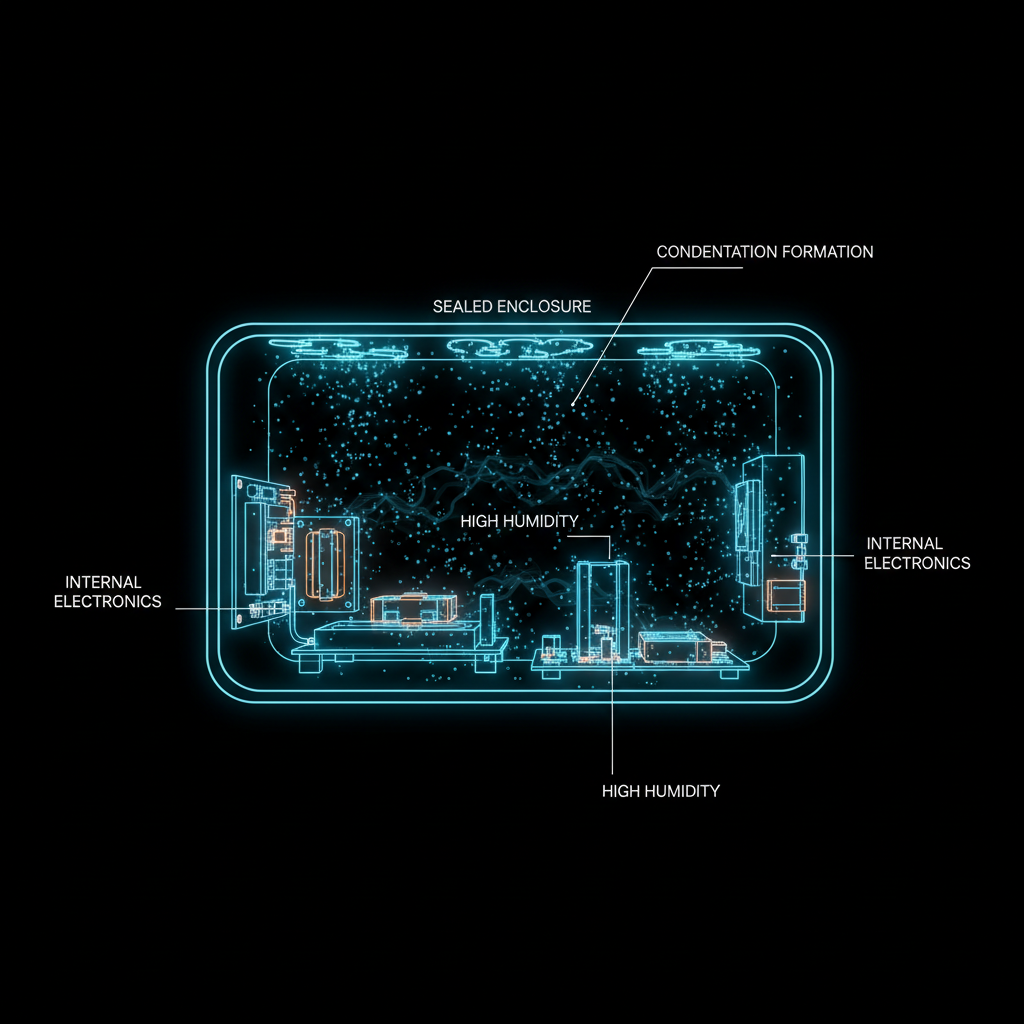
For OEM engineers and system integrators deploying electronics in outdoor or harsh industrial environments, the “sealed” enclosure is often viewed as the ultimate protection. We specify NEMA 4X or IP65/66 ratings, verify gasket integrity, and assume the internal components are safe from the elements. However, field data consistently reveals a paradox: the most tightly sealed cabinets often suffer the most severe moisture damage. This phenomenon, known as condensation in sealed enclosures, is a primary cause of premature failure in remote telemetry, telecom base stations, and outdoor power systems.
The presence of moisture inside a rated enclosure does not necessarily indicate a breach in the seal. Instead, it often points to a misunderstanding of thermodynamics—specifically, the relationship between temperature, pressure, and the dew point. When an enclosure is exposed to the diurnal cycle of solar heating and night-time cooling, the internal environment undergoes drastic shifts. Without active management, these shifts can turn a protective cabinet into a humidity trap, leading to “enclosure rain” that shorts out PCBs and corrodes contacts.
This engineering guide analyzes the physics behind condensation in sealed enclosures, the limitations of passive mitigation strategies, and how to implement robust dew point control using active thermal solutions like the Micro DC Aircon. We will move beyond simple IP ratings to discuss the dynamic management of internal atmospheres.
The Context: Where the “Sealed” Strategy Fails
Condensation is rarely a problem in climate-controlled server rooms. The issue arises in unconditioned spaces where ambient variables fluctuate wildly. We see this most frequently in three specific deployment scenarios:
- Remote Telecom & Monitoring: Roadside cabinets or tower-mounted amplifiers exposed to direct sun during the day and rapid radiative cooling at night.
- Mobile & Transport: Vehicle-mounted electronics where the unit moves between different climatic zones (e.g., a truck moving from a humid valley to a cold mountain pass).
- Renewable Energy: Solar inverters and battery storage systems where internal heat generation varies with load, creating complex internal thermal gradients.
In these scenarios, the enclosure acts as a micro-climate. If the internal surface temperature drops below the dew point of the air trapped inside, phase change occurs. Water vapor turns to liquid. If this happens on the ceiling of the enclosure, it drips onto components. If it happens on a circuit board, it bridges traces.
Failure Modes: The Cost of Moisture
Water is destructive, but the specific mechanisms of failure in electronics are often more subtle than a direct short circuit. Understanding these modes is critical for justifying the cost of thermal management.
- Electrochemical Migration (Dendritic Growth): In the presence of moisture and a DC voltage bias, metal ions (commonly copper or silver) can migrate between adjacent conductors. This forms conductive filaments or “dendrites” that eventually cause a short. This can happen even with a thin film of condensation that is barely visible.
- Galvanic Corrosion: When dissimilar metals are in contact with an electrolyte (condensed water often absorbs salts or pollutants from the air), corrosion accelerates, leading to increased contact resistance and mechanical failure of connectors.
- Dielectric Breakdown: Moisture absorption by PCB substrate materials (like FR-4) can lower the dielectric strength and insulation resistance, leading to signal integrity issues or high-voltage arcing.
- Mold and Fungal Growth: In high-humidity environments, organic materials can support mold growth, which retains moisture and releases acidic byproducts that further attack components.
Engineering Fundamentals: The Physics of the “Breathing” Enclosure
To solve condensation in sealed enclosures, we must first understand how the moisture gets there. Even in an IP66 cabinet, air exchange occurs. No seal is perfect forever, but more importantly, pressure differentials drive air movement.
1. The Ideal Gas Law and Pressure Differentials
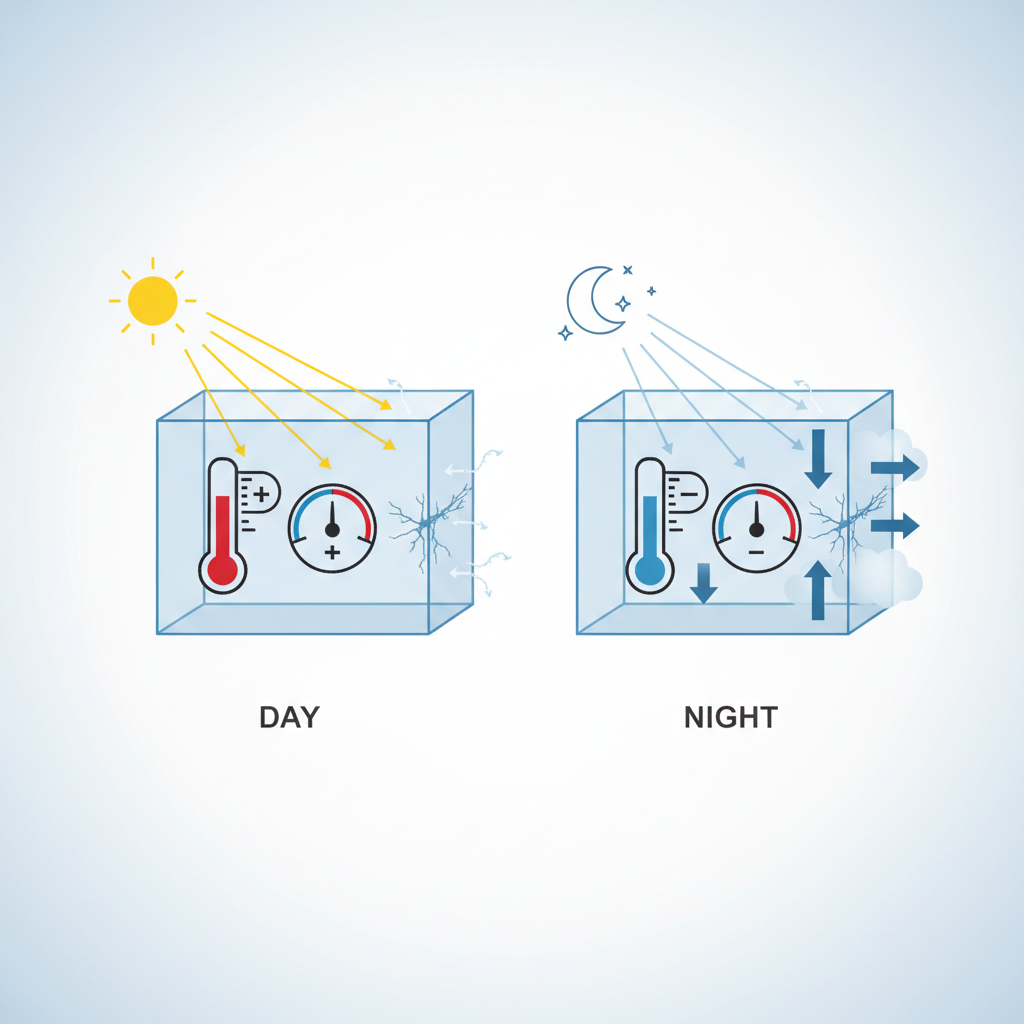
Consider an enclosure heating up during the day due to solar load and internal electronics. According to the Ideal Gas Law ($PV = nRT$), as temperature ($T$) rises, pressure ($P$) increases (assuming volume $V$ is constant). This positive pressure pushes air out through microscopic gaps in gaskets or cable glands.
At night, the reverse happens. The enclosure cools down, creating a partial vacuum. This negative pressure pulls external air in. If the external air is humid (which is common at night or early morning), moisture enters the cabinet. Over repeated cycles, this “breathing” effect can accumulate significant water inside the enclosure, a process sometimes called “ratcheting.”
2. Dew Point and Relative Humidity
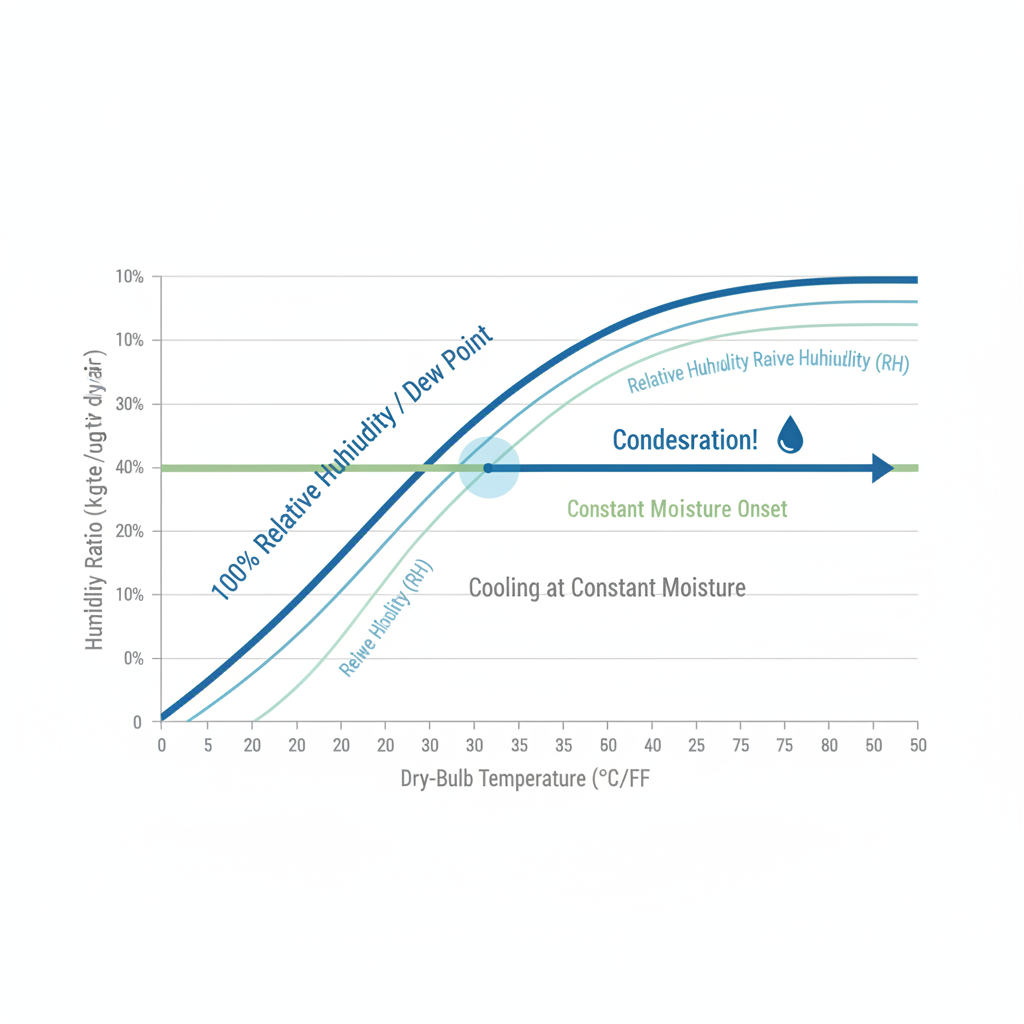
Relative Humidity (RH) is relative to temperature. Warm air can hold more water vapor than cold air.
Scenario: An enclosure stabilizes at 35°C with 50% RH during the day. The dew point is approximately 23°C.
Event: A sudden thunderstorm or sunset rapidly cools the enclosure walls to 20°C.
Result: The air near the walls cools below the 23°C dew point. The air can no longer hold the water vapor, and it condenses on the cold metal surfaces.
Mitigation Strategies: Passive vs. Active
Engineers typically rely on three methods to combat condensation: heating, venting, and active cooling. Each has specific trade-offs.
Passive Venting (Pressure Equalization)
Using a semi-permeable membrane (like ePTFE) allows air molecules to pass through to equalize pressure while blocking liquid water.
Pros: Prevents the vacuum effect; low cost.
Cons: Does not remove moisture; allows internal humidity to track ambient humidity. If ambient is 95% RH, internal will be 95% RH. If the temperature drops, condensation still occurs.
Anti-Condensation Heaters
Resistive heaters are used to keep the internal temperature slightly above the ambient temperature, ensuring the internal surfaces stay above the dew point.
Pros: Simple; effective in cold climates.
Cons: Consumes power (problematic for solar/battery apps); adds heat load to an enclosure that might already struggle with high daytime temperatures. It solves the night-time problem but exacerbates the day-time thermal burden.
Active Cooling (Micro DC Aircon)
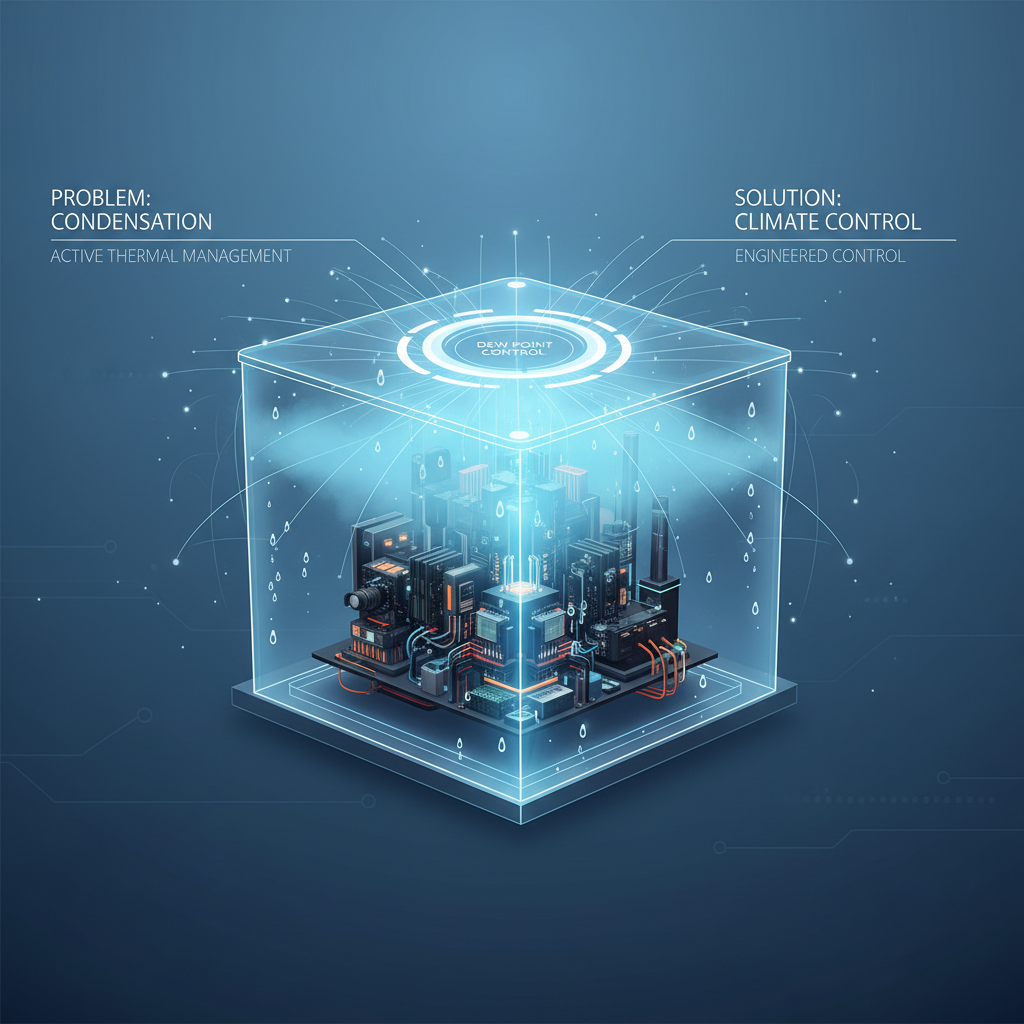
This is the most robust solution for harsh environments. A vapor-compression cycle (like a Micro DC Aircon) actively removes heat and moisture. As air passes over the cold evaporator coil, moisture condenses on the coil (which is designed to handle it) and is drained away, effectively dehumidifying the enclosure.
Pros: Controls both temperature and humidity; lowers dew point; prevents overheating.
Cons: Higher initial cost; requires power budget.
Verified Specs: Active Cooling Capabilities
When selecting an active cooling solution to manage condensation in sealed enclosures, the cooling capacity must be sufficient to handle the solar load and internal heat generation, while the form factor must fit compact cabinets. The following specifications from the Arctic-tek Micro DC Aircon series illustrate the performance density available for these applications.
| Model (Series Example) | Voltage (DC) | Nominal Cooling Capacity | Refrigerant | Application Focus |
|---|---|---|---|---|
| DV1910E-AC (Pro) | 12V | 450W | R134a | Mobile / Solar / Battery |
| DV1920E-AC (Pro) | 24V | 450W | R134a | Telecom / Industrial |
| DV1930E-AC (Pro) | 48V | 450W | R134a | Telecom / Base Stations |
| DV3220E-AC (Pro) | 24V | 550W | R134a | High-Heat Enclosures |
Note: Capacity varies by model and operating conditions. The “Pro” series integrates driver boards for precise inverter control, allowing the system to ramp up for rapid cooling or ramp down to maintain steady-state dryness without excessive cycling.
Implementation Checklist for Dew Point Control
To ensure your enclosure remains dry and operational, follow this engineering checklist during the design and deployment phase.
1. Mechanical Sealing & Insulation
- Gasket Audit: Use continuous-pour gaskets or high-quality EPDM. Avoid butt-joints in gasket strips where gaps can form.
- Insulation: Insulate the enclosure walls. This reduces the rate of temperature change (thermal shock) and prevents the walls from becoming the coldest surface where condensation forms first.
- Cable Entry: Use rated cable glands (IP68). Do not leave open knockouts.
2. Thermal Management Selection
- Calculate Heat Load: Determine if you need cooling for electronics protection or just moisture control.
- Select Strategy:
- If Ambient T < Electronics Max T AND Humidity is low: Fans + Vents.
- If Ambient T < Electronics Max T AND Humidity is high: Heaters + Vents (keep T > Dew Point).
- If Ambient T > Electronics Max T OR Humidity is critical: Active Cooling (Micro DC Aircon).
3. Drainage Management
- Drain Plugs: Even with active cooling, some moisture may enter. Install a one-way drain plug at the bottom of the enclosure to allow any accumulated liquid to escape by gravity.
- Evaporator Management: If using a Micro DC Aircon, ensure the condensate drain tube is routed outside the enclosure and is not kinked.
FAQ: Common Questions on Enclosure Condensation
Q: Can I just use silica gel packets to stop condensation?
A: Silica gel is effective only for a short time in a perfectly sealed environment. In a real-world enclosure that “breathes,” the desiccant will eventually reach saturation (often within weeks) and become useless. It requires regular replacement, which is high-maintenance.
Q: Why does my IP65 enclosure have water at the bottom?
A: This is likely due to the “breathing” effect described above. The IP rating prevents water jets from entering, but it does not stop vapor ingress due to pressure differentials. Once the vapor condenses inside, the IP rating effectively keeps the liquid water in, preventing it from draining.
Q: How does a Micro DC Aircon prevent condensation?
A: It lowers the relative humidity by condensing moisture on the cold evaporator coil and draining it outside. By maintaining the internal temperature at a stable level, it also prevents the rapid thermal cycling that causes dew point excursions.
Q: What is the ideal internal temperature to prevent condensation?
A: There is no single “ideal” temperature, but the goal is to keep the internal surface temperatures above the internal dew point. Generally, maintaining the enclosure 5°C to 10°C above the ambient dew point is a safe margin.
Q: Do I need a heater if I have an air conditioner?
A: Sometimes. In extremely cold environments where the electronics are powered off or in standby, a heater may be needed to prevent freezing or condensation on startup. However, during normal operation, the waste heat from electronics plus the climate control of the aircon is usually sufficient.
Q: Is a hygmostat better than a thermostat for controlling heaters?
A: A hygmostat (humidity controller) is more direct for condensation prevention. It turns the heater on only when RH is high, saving energy compared to a thermostat that runs based solely on temperature. A combination of both is often the best practice.
Q: Can I use a breather vent with an air conditioner?
A: Generally, no. If you are using active cooling (closed loop), you want to isolate the internal air from the external air to maximize efficiency. Adding a vent re-introduces humidity and heat load that the air conditioner has to fight against.
Conclusion
Condensation in sealed enclosures is not an unavoidable act of nature; it is a thermodynamic challenge with clear engineering solutions. Relying solely on gaskets and IP ratings is a passive strategy that often fails in the dynamic conditions of outdoor and remote deployments. The “breathing” of the cabinet, driven by solar loading and night-time cooling, pumps moisture in that inevitably condenses.
For critical electronics where reliability is non-negotiable, active management of the internal environment is the only sure fix. While heaters and vents have their place, active cooling solutions like the Micro DC Aircon series offer a comprehensive approach by stabilizing temperature and actively dehumidifying the air volume. By understanding the physics of dew point and implementing a robust thermal strategy, engineers can ensure their “sealed” enclosures truly protect the sensitive components inside.
If you are designing an outdoor enclosure and need assistance calculating heat loads or selecting the right thermal management strategy, contact the Arctic-tek engineering team for a consultation on sizing and integration.