
Crankcase Heater Questions Start with a Cold Morning
The pattern repeats every winter: a refrigeration unit that ran faultlessly all summer fails to start cleanly on the first cold morning, rattles for a few seconds, trips, and then — most confusingly — runs perfectly by mid-day. Nothing is broken in any way a meter can find. The explanation is not electrical. It is that the compressor spent the night filling with the wrong liquid, and the first seconds of the start were spent pumping it back out.
A crankcase heater is the standard defense in large equipment, and the first question for anyone running a compact DC system in an unheated space is whether they need one too. The honest answer needs the mechanism first, because the small hermetic units used in DC condensing systems sit differently in the risk landscape than the big semi-hermetics the advice was written for.
Refrigerant Migration: the Off-Cycle Problem
Refrigerant vapor moves toward the coldest point in a connected system and condenses there. During running, that is the evaporator by design. During a long off-cycle, it is wherever physics finds — and on a winter night, an outdoor or garage-mounted compressor shell is frequently the coldest metal in the circuit.
So the refrigerant migrates: vapor leaves the warmer indoor coil, drifts down the suction line, and condenses into the compressor shell, where it does what refrigerant does best — it dissolves into the lubricating oil. By morning the crankcase holds not oil but an oil-refrigerant solution, thin, and ready to boil the moment pressure drops.
 The failure sequence at the compressor on start is quick and mechanical:
- Startup drops crankcase pressure abruptly.
- The dissolved refrigerant flashes to vapor inside the oil, foaming it violently.
- Foam lubricates nothing; it is also pumpable, so it leaves with the refrigerant, carrying the oil charge out of the sump.
- Bearings and journals run their first seconds thin or dry; in the worst case, slugs of liquid reach the cylinder, and liquid does not compress.
One bad morning rarely kills a compressor. A hundred winters of them is a wear program, and the intermittent, cold-morning-only symptom pattern is the diagnostic signature. It is also why the failure statistics skew toward installations that sit idle in cold — holiday homes, seasonal equipment, backup units — rather than machines that run daily: migration needs a long off-cycle to accumulate, and a compressor that runs every few hours keeps redistributing its own charge before the sump can fill.
What a Crankcase Heater Actually Does
A crankcase heater is a small resistive element — a band around the shell or a cartridge in the sump — that keeps the compressor a few degrees warmer than everything else during the off-cycle. That is the entire trick: migration follows the coldest point, so the defense is to make sure the compressor is never it. Warm oil also holds less dissolved refrigerant, so whatever arrives re-evaporates instead of accumulating. Note what the heater does not do: it adds no starting torque, cures no low voltage, and thins no cold oil — it only wins the overnight competition for “coldest metal in the circuit”.
The costs are modest and continuous: a few tens of watts drawn all off-cycle (assumed, varies by size), a heater that must be energized hours before a cold start to do any good, and one more component. In large air conditioning and refrigeration plant the trade is settled practice. The open question is at the small end.
Where a Small DC System Differs
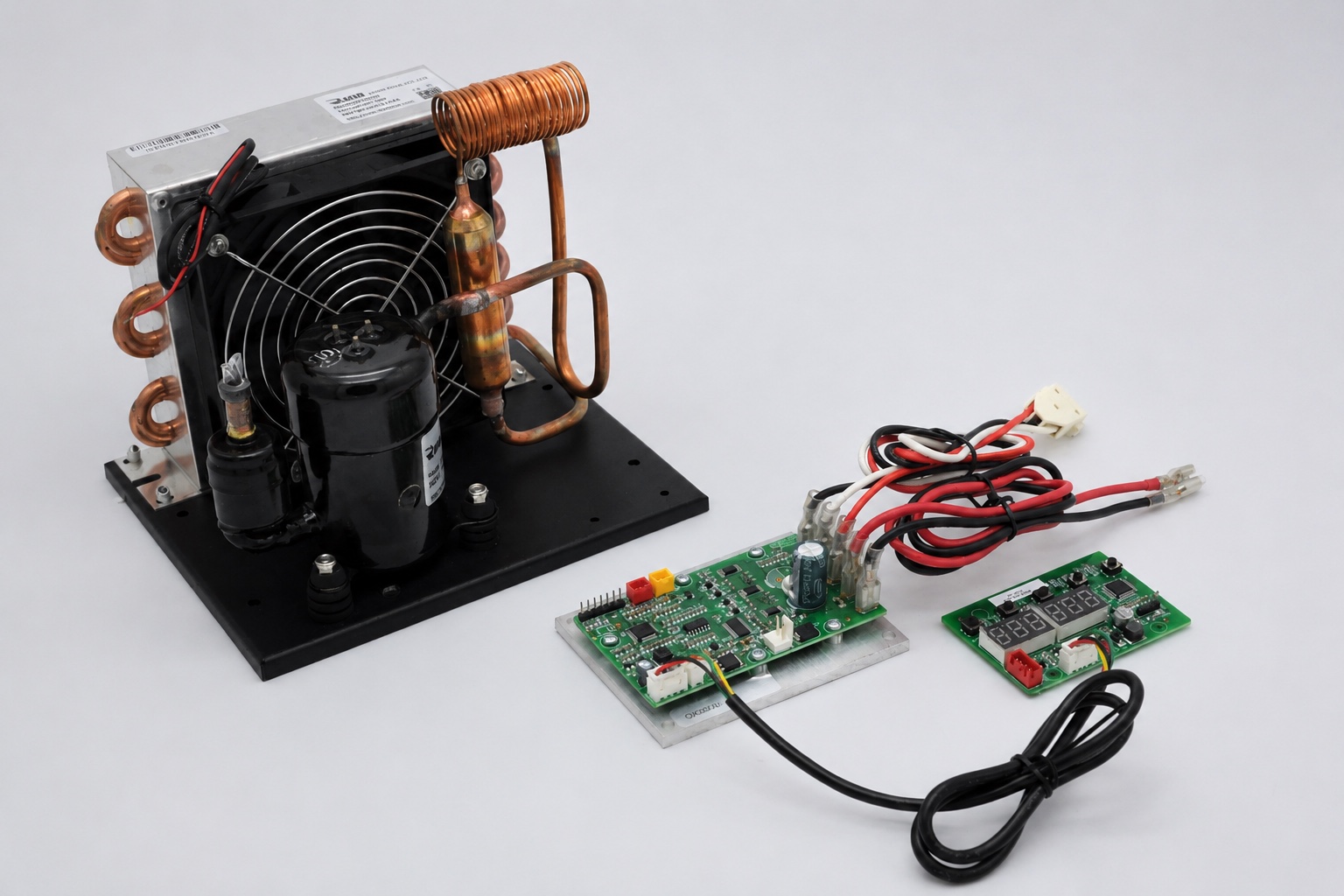
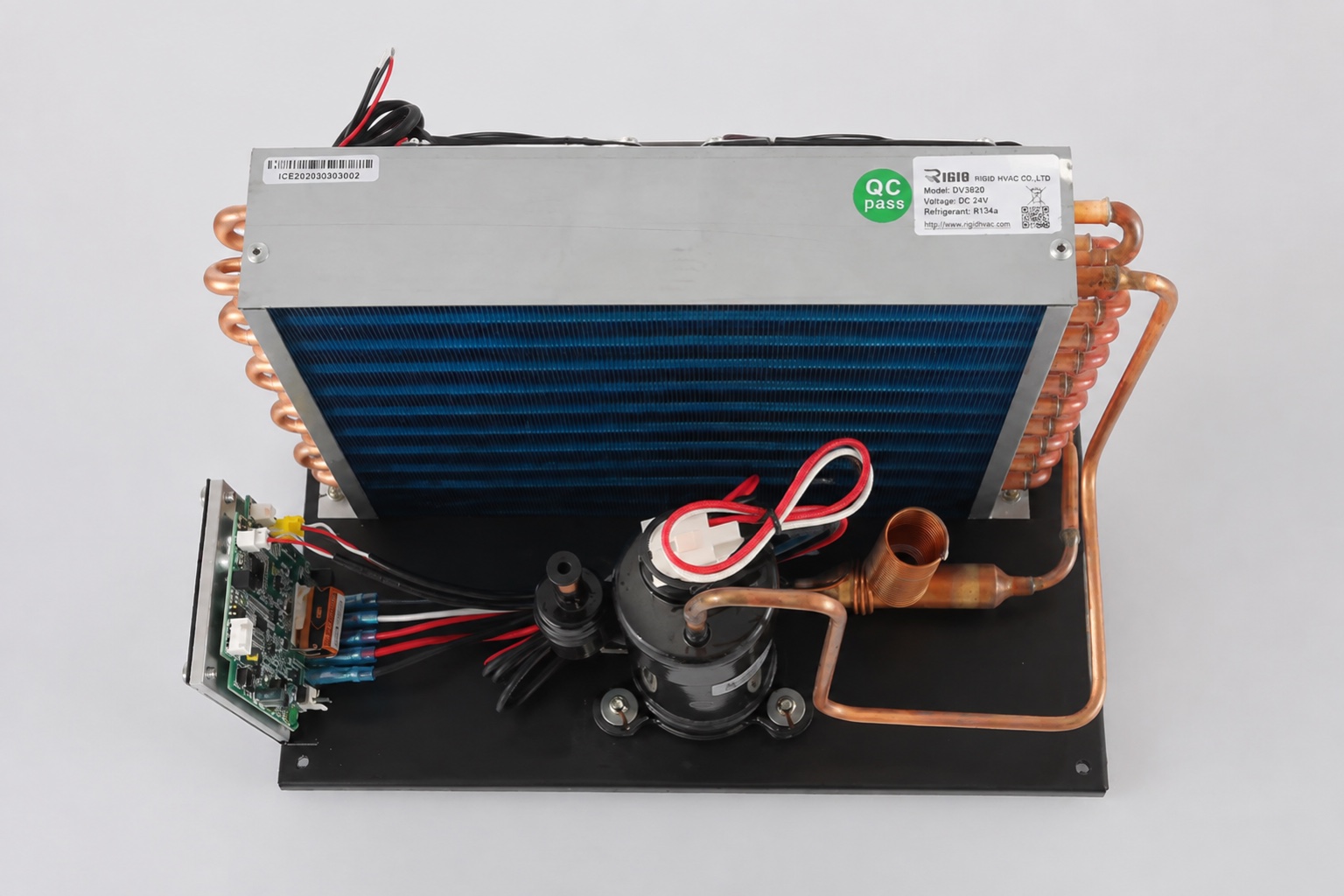 Where a small DC system differs is in every term of the risk equation:
| Factor | Large split system | Miniature DC condensing unit |
|---|---|---|
| Refrigerant charge | Kilograms available to migrate | Tens to a few hundred grams |
| Oil sump | Liters, deep crankcase | Small hermetic sump |
| Line lengths | Long suction runs storing charge | Short, compact circuits |
| Compressor | Semi-hermetic, valves and journals | Small hermetic rotary (QX class) |
| Start behavior | Line-start, full torque instantly | Inverter-driven soft ramp |
Three of those rows work in the small system’s favor. A charge measured in grams simply cannot deliver much liquid to the sump; short lines store little; and an inverter-driven rotary such as the QX1901VDL ramps up over seconds rather than slamming to speed, giving flashing refrigerant a gentler exit. This is why miniature DC units ship without a crankcase heater as standard and mostly live happily without one.
Mostly is not always. The exposure returns when the installation recreates the big-system geometry: the condensing unit mounted in an unheated shed with the cooled box indoors, long lines between them, and overnight off-cycles in winter. Cold shell, warmer coil, connected circuit — the migration gradient is back, scaled down but present. The scaled-down version also concentrates differently: with only a small oil charge in the sump, it takes proportionally less migrated refrigerant to dilute it badly, so “small charge, small problem” is only half true — the sump it dilutes is small too.
A Cold-Morning Diagnostic Sequence
Before attributing winter starting trouble to migration, walk the cheaper explanations in order:
- Supply voltage under load. Batteries sag in cold, and a DC compressor’s driver will refuse or retry below its cutoff. Measure at the unit’s terminals during the start attempt, not at the battery.
- Driver protection behavior. Inverter drivers retry rather than grind — a unit that attempts, pauses, and attempts again is protecting itself; note whether it eventually runs, and how the pattern maps to temperature.
- Oil viscosity in deep cold. Below the unit’s rated ambient, oil is thick regardless of migration; check the published operating range before expecting any start at all.
- Migration signature. Rattling or knocking in the first seconds, foam-related trips that clear on retry, symptoms only after long cold off-cycles, and a unit mounted colder than its evaporator — that cluster is the migration case.
Only the fourth case is a crankcase heater conversation. The first three are electrical and thermodynamic facts of cold weather, covered on the machine side by our guide to condensing unit derating — cold helps capacity but punishes everything else about starting.
Defenses in Order of Cost
- Geometry first, free. Mount the condensing unit no colder than the evaporator space where the installation allows it. Migration needs a gradient; deny it one and the problem never exists. A unit indoors with the lines running out beats the reverse arrangement.
- Off-cycle discipline, free. Where the controller allows, avoid long dead periods in deep cold — a brief periodic run keeps oil warm and redistributes charge. Even a daily cycle changes the accumulation arithmetic.
- Pre-start warm-up, cheap. Some inverter drivers can hold the motor with a small current without rotation, warming the shell electrically before the true start — the function of a crankcase heater without the part. Whether a given driver supports it is a datasheet question, not an assumption.
- An actual crankcase heater, last. For a permanently cold-mounted unit with long lines and long off-cycles, a small band heater on a timer or thermostat closes the case. Size it to hold the shell a few degrees above the line temperature; more is waste.
The ordering matters because the first two options are design decisions that cost nothing at installation time and everything to retrofit. The hardware answer is real but third in line — a crankcase heater cures a geometry that could usually have been avoided.
Fitting One on a DC System: Practical Notes
Where the case for a heater is made, the small-system version has its own practicalities, different enough from the mains-powered convention to list:
- Power source and budget. On a battery or solar installation, a heater drawing even 15 W (assumed) through every winter off-cycle is a real load — roughly a daily amp-hour bill that the energy budget must carry. A thermostat that energizes it only below a shell temperature threshold, rather than continuously, cuts the bill to the nights that need it.
- Band placement. A band element belongs low on the shell, around the sump where the oil sits, and under the insulation if the shell carries any. Heating the top of a shell warms vapor, not oil.
- Gentle is correct. The target is a shell a few degrees above the coldest connected point — enough to redirect migration, not enough to cook oil against the element. Oversized heaters create hot spots that age the oil they were fitted to protect.
- Wiring discipline. Fuse the heater circuit separately from the compressor driver, and route it so a failed element cannot take the refrigeration down with it. The heater is an accessory; it must never become a single point of failure for the system it protects.
- Verify it works. One winter-morning check with a thermometer — shell against suction line — confirms the gradient is pointing the right way. A heater that has quietly failed protects nothing, and nothing announces its failure.
None of this is exotic; it is the standard large-plant practice scaled to a system where every watt is accounted for. The engineering judgment is the same at every scale: identify the coldest point during the off-cycle, and make sure it is not the compressor.
The compressor family details — displacement, voltages, and the driver behavior that soft-starts through the risky seconds — are on the 12V compressor page, and the integrated units built on them on the DC condensing unit page. How the whole refrigeration circuit behaves from a cold start is walked through in our 12V compressor fridge guide.
If you want a cold-climate installation reviewed, send the following and our engineers will advise: unit model, mounting location and its winter temperature range, line lengths and routing, off-cycle pattern, supply voltage and source, and any cold-morning symptoms observed so far. Send your installation details to our engineering team.
Frequently Asked Questions
What does a crankcase heater do?
It keeps the compressor shell slightly warmer than the rest of the circuit during off-cycles, so migrating refrigerant vapor has no reason to condense there and dissolve into the oil. Warm oil also releases dissolved refrigerant rather than accumulating it. The result is a start on oil instead of foam after long cold shutdowns.
Do miniature DC condensing units need a crankcase heater?
Usually not. Charges measured in grams, short lines, small sumps and inverter soft-starts all shrink the migration problem that heaters exist to solve, which is why small hermetic units ship without one. The exception is a big-system geometry in miniature: unit mounted in an unheated space, warmer evaporator indoors, long lines, and overnight winter off-cycles.
Why does my compressor only struggle on cold mornings?
Either electrical or migration. Cold batteries sag under load and drivers refuse to start below their voltage cutoff — measure at the terminals during the attempt. If voltage holds and the unit rattles briefly after long cold off-cycles, then runs normally later in the day, refrigerant migrated into the oil overnight and the first seconds were spent boiling it back out.
Can refrigerant migration actually destroy a compressor?
Over time, yes. Each affected start foams the oil, momentarily starves the bearings, and can carry the oil charge out of the sump; a liquid slug reaching the cylinder is the acute version. One event is survivable — the damage model is cumulative wear from a winter’s worth of mornings, presenting eventually as a noisy or failed compressor with no single identifiable cause.
Is there an alternative to fitting a crankcase heater?
Three, all preferable where available: mount the unit no colder than the evaporator space so no gradient exists; avoid long dead off-cycles in deep cold with a brief periodic run; and use a driver’s pre-start winding-heat function where the datasheet offers one. The heater is the right answer for the installations that cannot use the first three.
How long before a cold start should a crankcase heater run?
Hours, not minutes — it has to warm the shell and drive dissolved refrigerant back out of the oil, and both are slow. Continuous energization during cold-season off-cycles on a thermostat is the standard arrangement; switching it on moments before a start achieves close to nothing.