
Condensing Unit Derating in Compact Fridge Designs: Why Mass Production Kills Prototype Performance
The prototype worked perfectly. Pull-down time met spec, steady-state temperature held within band, and the compressor cycled cleanly. Then the first production batch shipped, and the field reports started: units running warm, compressors cycling too frequently, and a handful of high-pressure shutdowns in hot climates. Nothing changed in the BOM. The compressor is the same. The refrigerant charge is the same. So what happened?
In most cases, the answer is condensing unit derating: a systematic loss of cooling capacity caused by differences between the prototype’s thermal boundary conditions and the production unit’s real-world operating environment. The prototype sat on an open bench with unrestricted airflow. The production unit lives inside a finished enclosure with tighter tolerances, smaller ventilation openings, and neighboring components that generate heat. The condensing unit is technically identical, but its effective capacity has dropped by fifteen to thirty percent because the environment around it changed.
This article maps the most common derating mechanisms in compact fridge and cooler designs, explains how to quantify them before production, and identifies the integration details that separate prototypes that scale from prototypes that fail.
Derating Mechanism One: Condenser Airflow Restriction
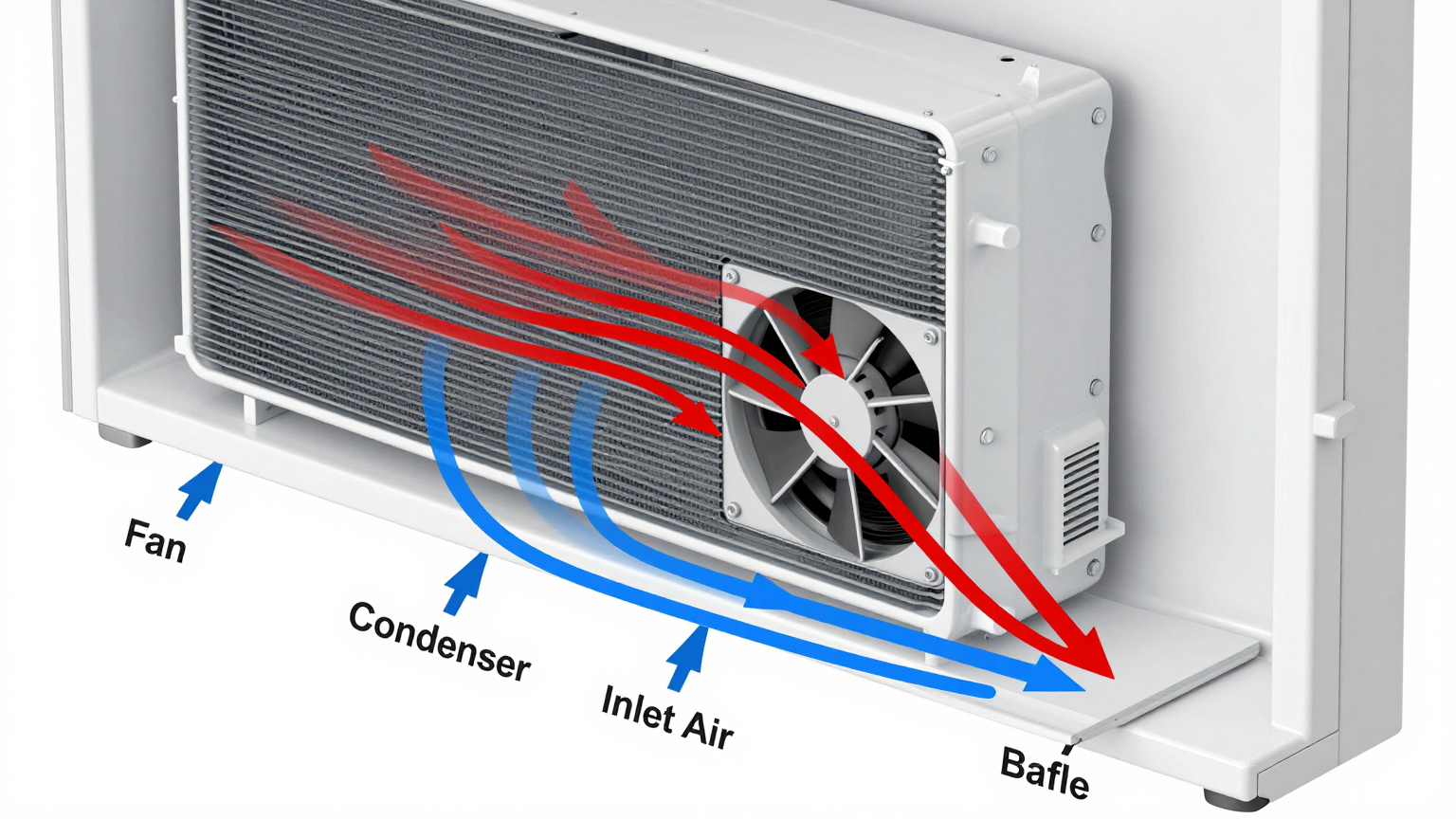
The condenser rejects heat from the refrigerant to the surrounding air. Its capacity depends directly on the volume of air flowing across the coil and the temperature of that air. On a prototype bench, the condenser has open access to room-temperature air on all sides. Inside a production enclosure, the air path is constrained by panels, wiring harnesses, structural ribs, and cosmetic grilles.
The effect is predictable but often underestimated. A condenser rated for 200 watts of heat rejection at 60 CFM airflow may deliver only 140 watts at 35 CFM. The compressor responds by running longer and harder, discharge pressure rises, and the system enters a degraded operating regime where it technically still cools but cannot reach the target temperature under peak ambient conditions.
The grille is usually the bottleneck. Industrial designers specify grille patterns for aesthetics, and the effective open area is often 30 to 50 percent of the gross panel area. A 100 cm² grille with a decorative mesh pattern may offer only 40 cm² of actual airflow area. If the condenser fan was selected based on the gross opening, the real airflow will be significantly below the design point.
Measuring the actual airflow in the production enclosure, not estimating it from the grille dimensions, is the single most valuable test an OEM can run before committing to production tooling. A simple anemometer traverse across the condenser face takes minutes and reveals whether the system has adequate margin or is already operating at the edge of its capacity.
Derating Mechanism Two: Hot Air Recirculation
The condenser heats the air that passes through it. If that heated air recirculates back to the condenser inlet instead of exhausting to the ambient environment, the effective inlet temperature rises and the condenser capacity drops. In compact enclosures, recirculation happens when the inlet and outlet openings are on the same face, when internal baffling is incomplete, or when the enclosure is installed against a wall that blocks the exhaust path.
A recirculation rate of just 20 percent can raise the effective condenser inlet temperature by 5 to 8 degrees above true ambient. For a system designed with 5 degrees of margin at peak ambient, this wipes out the entire safety factor. The unit runs continuously at maximum compressor speed and still cannot maintain setpoint on the hottest days.
The fix is airflow separation. The condenser compartment should have a defined inlet on one face and an outlet on a different face, with a physical barrier preventing short-circuiting. In compact designs where both openings must be on the same face, a divider panel between the inlet and outlet zones, even a simple sheet-metal baffle, reduces recirculation to acceptable levels.

Derating Mechanism Three: Ambient Heat Soak from Adjacent Components
In multi-function products, the condensing unit shares the enclosure with other heat-generating components: power supplies, motor drivers, LED lighting, and control electronics. Each of these raises the local air temperature in the condenser compartment. A power supply dissipating 15 watts in a poorly ventilated cavity can raise the local temperature by 8 to 12 degrees above ambient, effectively shifting the condensing unit’s operating point into a harsher thermal regime.
Prototype testing rarely captures this because the prototype either lacks the final electronics or has them mounted externally. The production unit integrates everything into the same enclosure, and the cumulative heat load from non-refrigeration components becomes a significant derating factor.
The mitigation is thermal zoning: physically separating the condenser air path from the electronics compartment so that waste heat from other components does not pre-heat the condenser inlet air. A partition wall with sealed cable pass-throughs is the most effective approach. Where space does not permit a full partition, directing the condenser fan to draw air from an external-facing grille rather than from the internal cavity achieves a similar result.
Derating Mechanism Four: Refrigerant Charge Sensitivity
Miniature refrigeration systems are sensitive to charge accuracy because the total system volume is small. A charge error of just a few grams, which would be insignificant in a household refrigerator, can shift the operating point of a compact system enough to cause measurable capacity loss.
In prototype builds, the charge is often optimized by a skilled technician who adjusts it while monitoring superheat and subcooling. In production, the charge is dispensed by a filling machine with a tolerance that may be plus or minus two to three grams. If the nominal charge was optimized on the prototype without accounting for this production tolerance, a fraction of production units will be slightly overcharged or undercharged.
An overcharged system floods the condenser with excess liquid, reducing the effective condensing area and raising discharge pressure. An undercharged system starves the evaporator, reducing cooling capacity and potentially overheating the compressor due to inadequate suction gas cooling. Both conditions manifest as derating relative to the prototype’s optimized performance.
Factory-sealed condensing units with pre-charged refrigerant circuits mitigate this risk by moving the charging step from the OEM’s production line to the compressor manufacturer’s controlled environment, where charge accuracy is tighter and leak testing is more rigorous.
Quantifying Derating Before Production
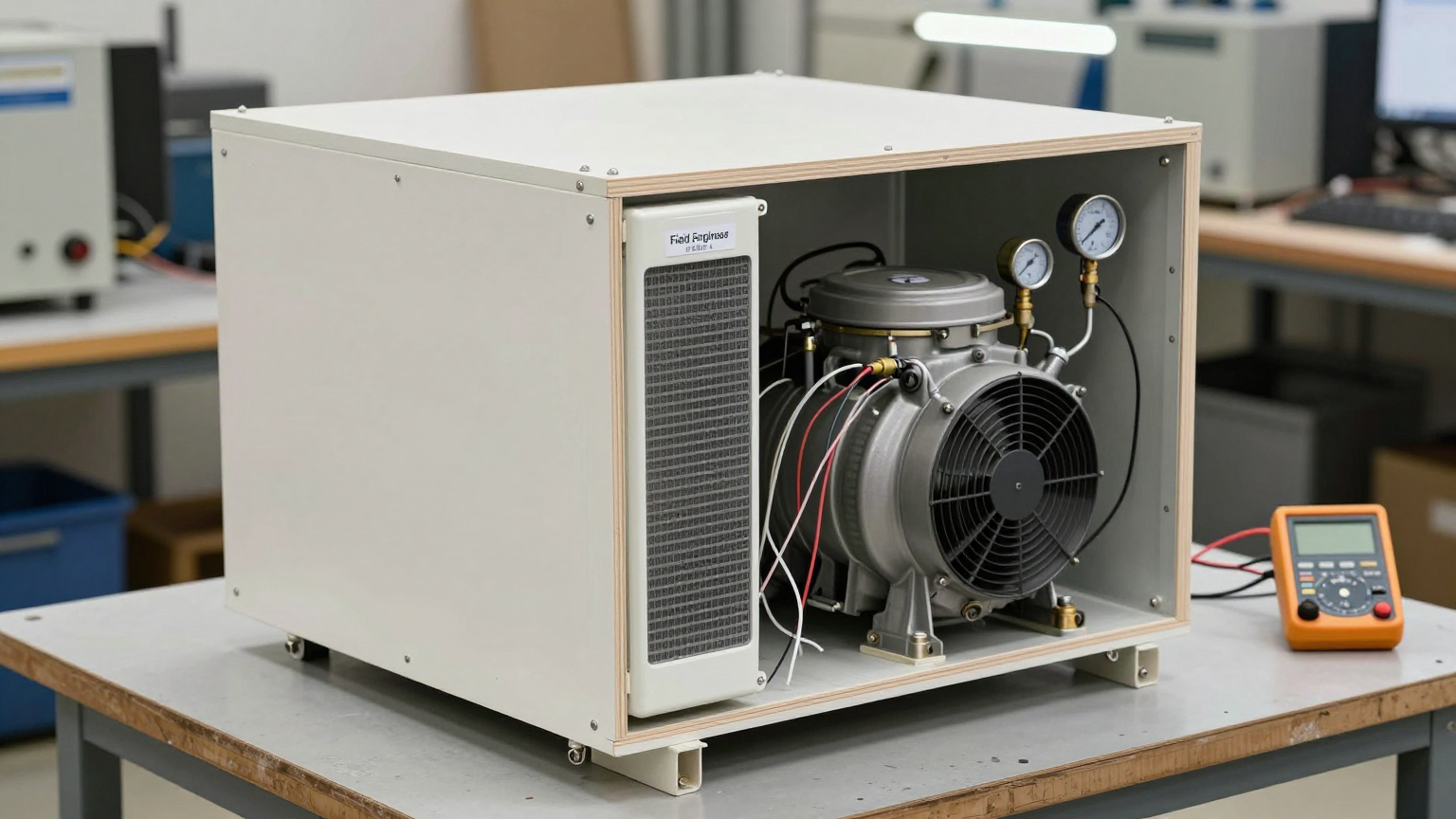
The goal is not to eliminate all derating factors but to quantify them early enough to adjust the system design or the condensing unit selection before tooling is committed. A practical pre-production validation sequence includes:
- Build a production-representative thermal mockup with final panel geometry, grille patterns, and internal component layout. It does not need to be cosmetically finished, but the airflow paths must match production intent.
- Instrument the condenser inlet and outlet air temperatures, compressor discharge and suction pressures, and evaporator air or surface temperature.
- Run the system at the maximum rated ambient temperature for a minimum of four hours and record steady-state performance.
- Compare the measured cooling capacity and pull-down time against the prototype baseline. Any shortfall is the cumulative derating from all mechanisms combined.
If the derating exceeds the design margin, the options are: improve the airflow path (larger grilles, better baffling, higher-flow fan), reduce the internal heat load (relocate electronics, improve power supply efficiency), or select a condensing unit with higher nominal capacity to absorb the derating and still meet the target.
Common Field Symptoms of Derating
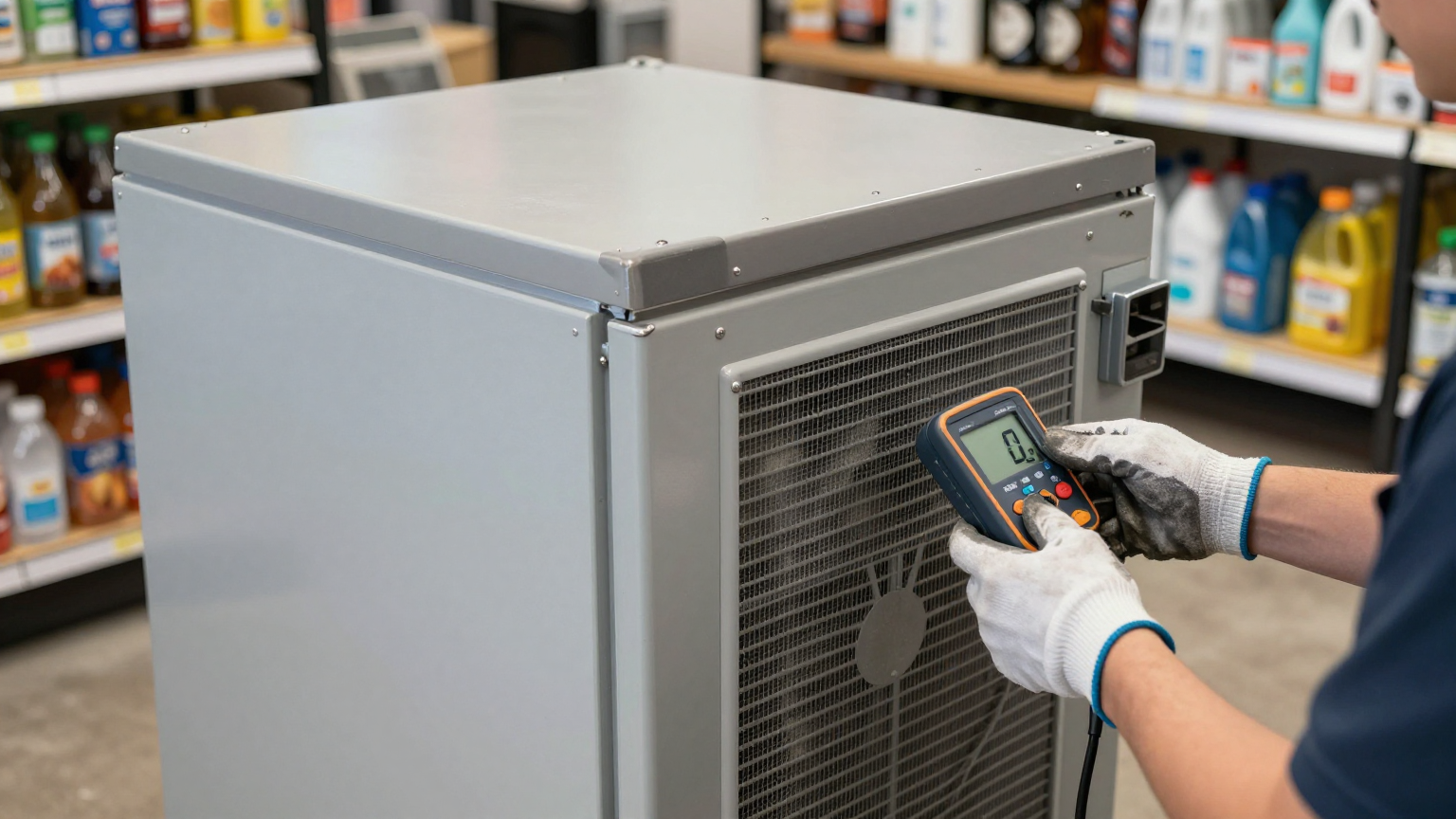
When derating is not caught before production, it surfaces as field complaints that are difficult to diagnose because the hardware is technically within spec. The condensing unit passes its standalone performance test. The refrigerant charge is correct. But the system underperforms in the enclosure. Recognizing the symptom pattern helps direct the investigation toward the root cause.
| Symptom | Likely Derating Mechanism | First Check |
|---|---|---|
| Unit holds temperature in winter but runs warm in summer | Condenser airflow restriction or recirculation | Measure condenser inlet air temperature vs. ambient |
| Compressor runs continuously but temperature slowly drifts up | Cumulative heat soak from adjacent components | Thermal image of condenser compartment during operation |
| Performance varies unit-to-unit in same batch | Refrigerant charge variation | Check superheat and subcooling across sample units |
| High-pressure shutdown in hot ambient only | Condenser capacity insufficient at peak conditions | Log discharge pressure over 24-hour cycle |
Designing for Production from the Start
The most effective way to avoid derating surprises is to design the enclosure thermal management concurrently with the product form factor, not sequentially. This means involving the condensing unit supplier early enough to influence the enclosure geometry, not just to fill the space left over after everything else is placed.
Practical guidelines that reduce derating risk:
- Allocate condenser airflow volume as a design constraint equal in priority to payload volume. A fridge that holds one more bottle but cannot cool them is not a better product.
- Specify grille open area based on the fan’s required airflow, not on aesthetic preference. If the designer insists on a restrictive pattern, compensate with a larger grille area or a higher-static-pressure fan.
- Separate the condenser air path from internal heat sources with physical barriers. Even a partial baffle is better than an open shared cavity.
- Test with production-representative enclosures at the earliest possible stage, ideally before committing to injection mold tooling.
- Select a condensing unit with at least 20 percent capacity margin above the calculated cooling load to absorb the inevitable derating from production realities.
The RIGID DC condensing unit range is designed for exactly this kind of OEM integration: compact form factors with flexible condenser configurations that adapt to the enclosure geometry rather than dictating it. If your enclosure constraints differ from standard configurations, the engineering team can review your layout and recommend a unit and airflow strategy that accounts for production derating from the start.
Frequently Asked Questions
How much derating should I expect in a typical compact fridge?
In a well-designed enclosure with adequate ventilation, derating is typically 10 to 15 percent relative to open-bench performance. In a tightly packaged enclosure with restrictive grilles and shared air paths, derating can reach 25 to 35 percent. The only way to know for certain is to measure performance in the production-representative enclosure.
Can I compensate for derating by increasing the refrigerant charge?
No. Adding refrigerant to compensate for airflow-related derating makes the problem worse. Excess charge floods the condenser, raises discharge pressure, and reduces efficiency. The correct response to airflow derating is to improve the airflow path, not to adjust the refrigerant charge.
Does a variable-speed compressor help with derating?
A variable-speed compressor can partially compensate by running at higher speed when conditions are demanding, but it cannot overcome a fundamental airflow limitation. If the condenser cannot reject the heat, running the compressor faster only raises the discharge pressure further. Variable speed helps with efficiency optimization across a range of conditions, not with recovering capacity lost to poor airflow design.
Should I test derating at room temperature or at maximum rated ambient?
Always test at maximum rated ambient. Derating effects are most severe at high ambient because the condenser is already working near its capacity limit. A system that shows acceptable performance at 25 degrees C may fail at 35 or 40 degrees C when the derating mechanisms consume the remaining margin.
How early should I involve the condensing unit supplier?
Ideally during the concept phase, before the enclosure geometry is frozen. The supplier can advise on minimum cavity dimensions, airflow requirements, and condenser orientation options that prevent derating issues from being designed into the product. Engaging after the tooling is committed limits the available solutions to fan upgrades and grille modifications, which may not be sufficient.