
Cool Suit Pump and Reservoir Sizing: Two Architectures, Not One
Driver cooling systems come in two forms that look similar from outside and work on completely opposite principles. Both circulate cold liquid through a garment. One stores cold in a large volume of ice and water and pumps it until it is exhausted; the other refrigerates continuously and circulates a small volume that never needs to store anything.
The reservoir tells you which one you are looking at. Ice-based systems are built around volumes measured in liters — a 17 liter box is a common size, and traditional cooler-based builds use 13 or 19 quart containers. An actively refrigerated unit such as the AlphaCooler carries a published reservoir of just 145 ml, with a pump flow rate of 7.5 L/min.
Those two numbers together are the whole design statement. At 7.5 L/min, a 145 ml reservoir turns over completely in about 1.2 seconds — so it stores essentially nothing and is not intended to. Cool suit pump and reservoir sizing therefore means something entirely different depending on which architecture you are specifying.
Stored Cold Against Continuous Cooling
| Ice-based storage | Active refrigeration | |
|---|---|---|
| Reservoir role | Holds the entire session’s cooling | Circulation volume only |
| Typical volume | 13–19 quarts, or around 17 liters | 145 ml on the AlphaCooler |
| Duration limit | Set by ice mass and load | Set by electrical supply |
| Between sessions | Must be refilled with ice | Nothing to do |
| Weight carried | Grows with required duration | Fixed — 6.8 kg for the 12 V unit |
| Cooling rate | Falls as ice depletes and water warms | Steady while power is available |
The last two rows are what decide most selections. A stored-cold system pays for duration in weight, and its performance declines through the session — often fastest at the end, when the driver is most heat-stressed. An active system carries a fixed mass regardless of session length and holds its output for as long as it has power.
Published capacity for the 12 V AlphaCooler is 100~450 W using R134a, and understanding what that means in this context requires knowing what the driver is producing.
Sizing Against the Actual Heat Load
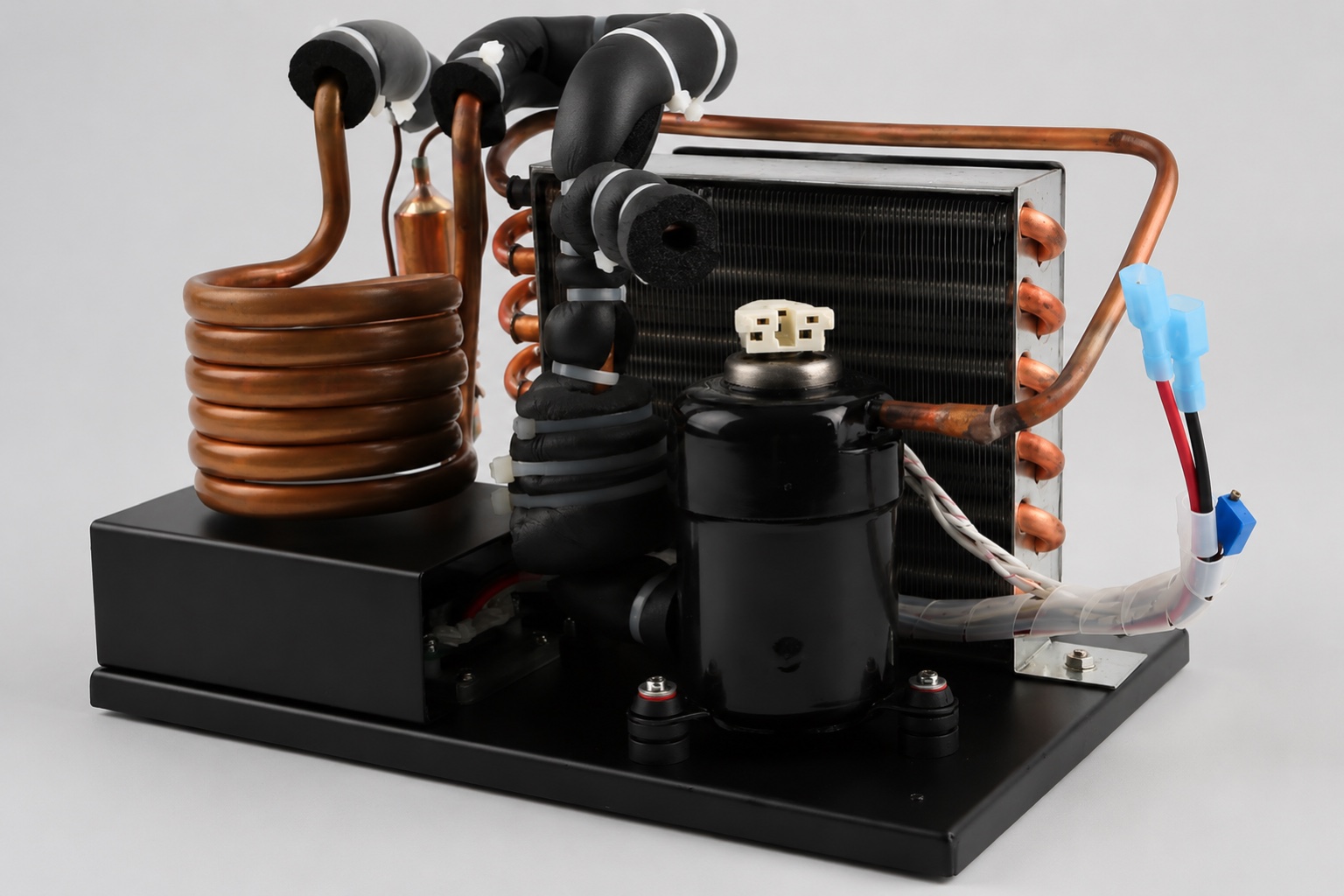 Cool suit pump and reservoir sizing starts from the load, and a driver in a hot cockpit is both a heat source and a heat recipient. The load the garment has to remove combines metabolic output with heat arriving from the environment, and the second term is the one that varies most between installations.
| Input | Value used | Basis |
|---|---|---|
| Metabolic heat output | 300–500 W | Assumed for sustained physical exertion |
| Fraction removable by a torso garment | Roughly a third | Assumed; garment covers part of the body |
| Environmental gain through the suit | 100 W | Assumed for a hot cockpit |
| Coolant supply temperature | Assumed low enough for a useful gradient | Set by the machine |
Taking the middle of the metabolic range, roughly a third of 400 W is around 130 W removed through the garment, plus a share of the environmental term — a total in the low hundreds of watts. That sits inside the published 100~450 W band, which is why an actively refrigerated unit in this class is a credible answer rather than a token one.
Two cautions on that arithmetic. The fraction a garment can remove depends heavily on coverage, contact and flow distribution, so it is a design variable rather than a constant. And the goal is rarely to remove all metabolic heat — it is to hold core temperature stable rather than to cool the driver down, which is a smaller requirement and a more achievable one.
What Flow Rate Actually Buys
The pump half of cool suit pump and reservoir sizing determines how much heat the coolant can carry for a given temperature rise. The relationship is the standard one: heat carried equals mass flow times specific heat times temperature rise across the garment.
At 7.5 L/min with water-based coolant, the flow is high enough that the temperature rise across the garment is small — which matters more than it first appears:
- Uniform garment temperature. A large rise means the tubing is noticeably colder at the inlet than the outlet, so cooling is uneven across the body and the driver feels it as a cold patch rather than as general relief.
- Higher effective heat transfer, because a smaller rise keeps the temperature difference between coolant and skin larger along the whole length of tubing.
- Tolerance of restriction. A garment with long, narrow capillary tubing presents real resistance, and a pump with margin can push through it where a marginal one cannot.
There is a limit in the other direction as well. Flow far above what the garment needs adds pressure drop and pump power without improving heat transfer meaningfully, because the temperature rise across the garment is already small and cannot usefully go lower. Beyond that point the extra flow is being spent on the pump rather than on the driver.
The trade is electrical draw and noise, both of which matter in a vehicle. A pump sized generously runs continuously alongside the compressor, and its consumption is part of the system’s total.
Why the Small Reservoir Is a Feature
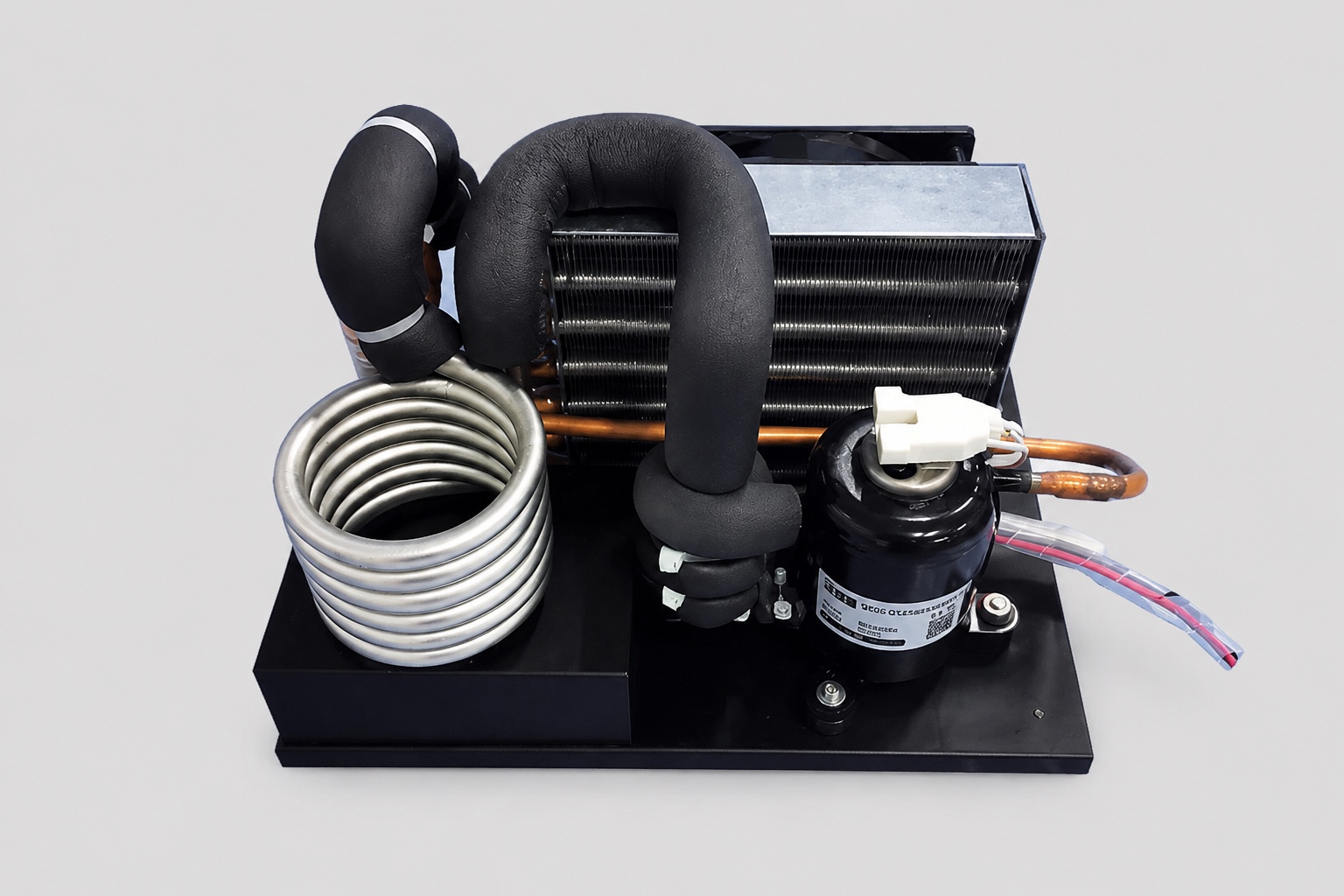 The reservoir half of cool suit pump and reservoir sizing looks like a limitation until the architecture is understood.
In a stored-cold system, reservoir volume is the cooling capacity — empty it and the system stops working. In an actively refrigerated system, the reservoir exists only to give the pump a supply and to accommodate thermal expansion. Its consequences:
- Almost no buffering. At 1.2 second turnover the reservoir cannot absorb a load spike, so the refrigeration has to respond directly. On a continuous load such as a driver, this is fine; on a system with sharp intermittent loads it would not be.
- Minimal weight and volume, which in a vehicle is the point.
- Fast response to a setpoint change, because there is no mass to move.
- Small coolant inventory to top up — the published requirement is around 145 ml of a four-to-one coolant mixture rather than liters of ice water.
The design conclusion is that reservoir sizing is not a free variable in an actively refrigerated system — it is set by pump supply and expansion, not by cooling requirement. Trying to size it as though it were a thermal store misunderstands the machine.
Where the Heat Actually Goes
An actively refrigerated personal cooling unit has to reject the heat it removes, plus its own electrical input, and in a vehicle that rejection happens inside the same enclosed space the occupant is in.
That produces a consequence worth stating plainly: the unit cools the person and warms the cabin. Net cabin heat rises by the electrical input, since the heat taken from the driver is returned along with the work done to move it. For an open cockpit or a well-ventilated space that is irrelevant; for a sealed cabin it is part of the thermal balance.
Practical consequences for installation:
- Give the condenser a clear discharge path, ideally to outside air rather than into the cabin.
- Keep the intake away from the discharge, since recirculation raises condensing temperature and reduces the capacity available to the garment.
- Account for the unit’s own heat in any cabin cooling calculation, rather than treating it as thermally neutral.
Where the heat has to be moved further than a short duct allows, the same principle applies as in any compact installation: liquid carries heat over distance far more compactly than air. The DV compact liquid chiller range at 100–550 W covers that role where the cooling has to be sited away from the person.
Selecting Between the Two
| Situation | Choose | Reason |
|---|---|---|
| Short sessions, ice readily available | Stored cold | Simple, no electrical load, adequate for the duration |
| Endurance running, hours at a time | Active refrigeration | Ice mass for that duration is impractical |
| Weight critical | Active refrigeration | Fixed mass rather than growing with duration |
| No reliable electrical capacity | Stored cold | An active unit needs continuous supply |
| Repeated sessions with short turnarounds | Active refrigeration | Nothing to refill between runs |
| Consistent output required to the end | Active refrigeration | Stored systems decline as ice depletes |
A hybrid exists and is sometimes overlooked: an actively refrigerated unit with a modest external buffer volume added to the loop. That keeps the fixed weight and continuous output of the active architecture while adding enough thermal mass to absorb a short peak — a driver returning to the car after standing in the sun, for instance. It costs a little weight and slows response slightly, and it is worth considering only where the load genuinely has sharp peaks rather than a steady profile.
The fourth row is the one that eliminates active systems in some categories, and it should be checked early. A unit drawing meaningful current alongside everything else in a vehicle needs that capacity to exist.
Full specifications for the 12 V and 24 V units, including the 330 × 170 × 204 mm envelope and 6.8 kg weight, are on the AlphaCooler product page. Broader cockpit heat management is covered in our racing driver cooling guide, and field maintenance practice in our cooling system maintenance guide.
If you want a system specified for a particular application, send the following and our engineers will advise: session duration and whether it is continuous, expected cockpit or working temperature, garment type and coverage, available electrical supply and voltage, acceptable weight and mounting envelope, and whether ice is practically available between sessions. Send your requirements to our engineering team.
Frequently Asked Questions
How big should a cool suit reservoir be?
It depends entirely on the architecture. In an ice-based system the reservoir holds the whole session’s cooling, so volume determines duration — liters, not milliliters. In an actively refrigerated system the reservoir only supplies the pump and accommodates expansion; the AlphaCooler’s published 145 ml is sized for that role. Cool suit pump and reservoir sizing means two different exercises depending on which you are building.
Is a 145 ml reservoir too small?
Not for an actively refrigerated system. At the published 7.5 L/min pump flow it turns over in roughly 1.2 seconds, which means it stores essentially no cold — and it is not meant to, because the refrigeration supplies cooling continuously rather than drawing on a store. A large reservoir on such a system would add weight and slow response for no benefit.
What flow rate does a cooling garment need?
Enough that the temperature rise across the garment stays small, which keeps cooling even across the body and maintains the temperature difference between coolant and skin along the whole tubing length. A published figure of 7.5 L/min sits comfortably above what a typical garment needs, which also gives margin against the restriction that long capillary tubing presents.
How much heat can a cooling garment actually remove?
A fraction of metabolic output, set by coverage, contact and flow distribution rather than by the machine alone. For sustained exertion producing 300 to 500 W, a torso garment removing roughly a third puts the requirement in the low hundreds of watts, which sits inside a published 100~450 W capacity band. The objective is usually to hold core temperature stable rather than to cool the person down.
Ice box or refrigerated unit?
Duration and weight usually decide it. Ice is simple and needs no electrical supply, but the mass required grows with session length and output declines as the ice depletes — often fastest at the end, when heat stress is highest. An active unit carries a fixed mass and holds output while powered, at the cost of needing that power to exist.
Does the coolant mixture matter?
Yes, for both freeze protection and heat transfer. The AlphaCooler’s published requirement is around 145 ml of a four-to-one coolant mixture, and departing from a specified ratio changes specific heat and viscosity together — which affects both how much heat the flow carries and how easily the pump moves it through the garment’s tubing.