
Coolant Freeze Point Margin: Why Setpoint Is the Wrong Reference
A glycol mixture is usually chosen against the setpoint. The loop runs at −20 °C, the chart says a given concentration protects to −20 °C, the mixture goes in, and the system works — until one morning the flow alarm trips and the evaporator has to be thawed before anything else can happen.
The error is not in the chart. It is in the reference. The coldest fluid in the system is not at the setpoint; it is at the evaporator surface, which runs several degrees below the coolant leaving the machine. Published guidance puts that offset in the region of 5 to 10 °C, and recommends protecting to roughly 10 °C below setpoint or, in another common formulation, 25 °F below the lowest required setpoint.
This is a walkthrough of a constructed scenario — values are assumed to illustrate the mechanism rather than describing a specific installation — showing how a coolant freeze point margin that looked adequate on paper produced a blocked heat exchanger.
What “Freeze Point” Actually Describes
Water freezes at a temperature. A glycol solution does not, and understanding the difference is what makes the coolant freeze point margin question tractable.
As a glycol mixture cools past its freeze point, it does not solidify. It separates: pure water ice crystals form and the remaining liquid becomes glycol-richer, and therefore has a lower freeze point than it started with. The result is a slush that still flows, up to a point.
Three consequences follow, and all of them matter:
- The onset is gradual and invisible. There is no moment when the loop stops; there is a progressive rise in viscosity and a progressive loss of flow.
- The remaining liquid gets stronger while the ice accumulates. The bulk fluid’s measured concentration rises even as ice builds on the coldest surface, so a concentration check taken from the reservoir can look correct while the evaporator is icing.
- The ice forms where it is coldest — on the evaporator plate — which is exactly where a blockage does the most damage.
This is why published guidance describes freeze point as slush formation rather than solidification, and why a margin of 3 to 5 °C from the measured freeze point is recommended even before the evaporator offset is considered.
The Scenario: A −25 °C Loop Protected to −25 °C
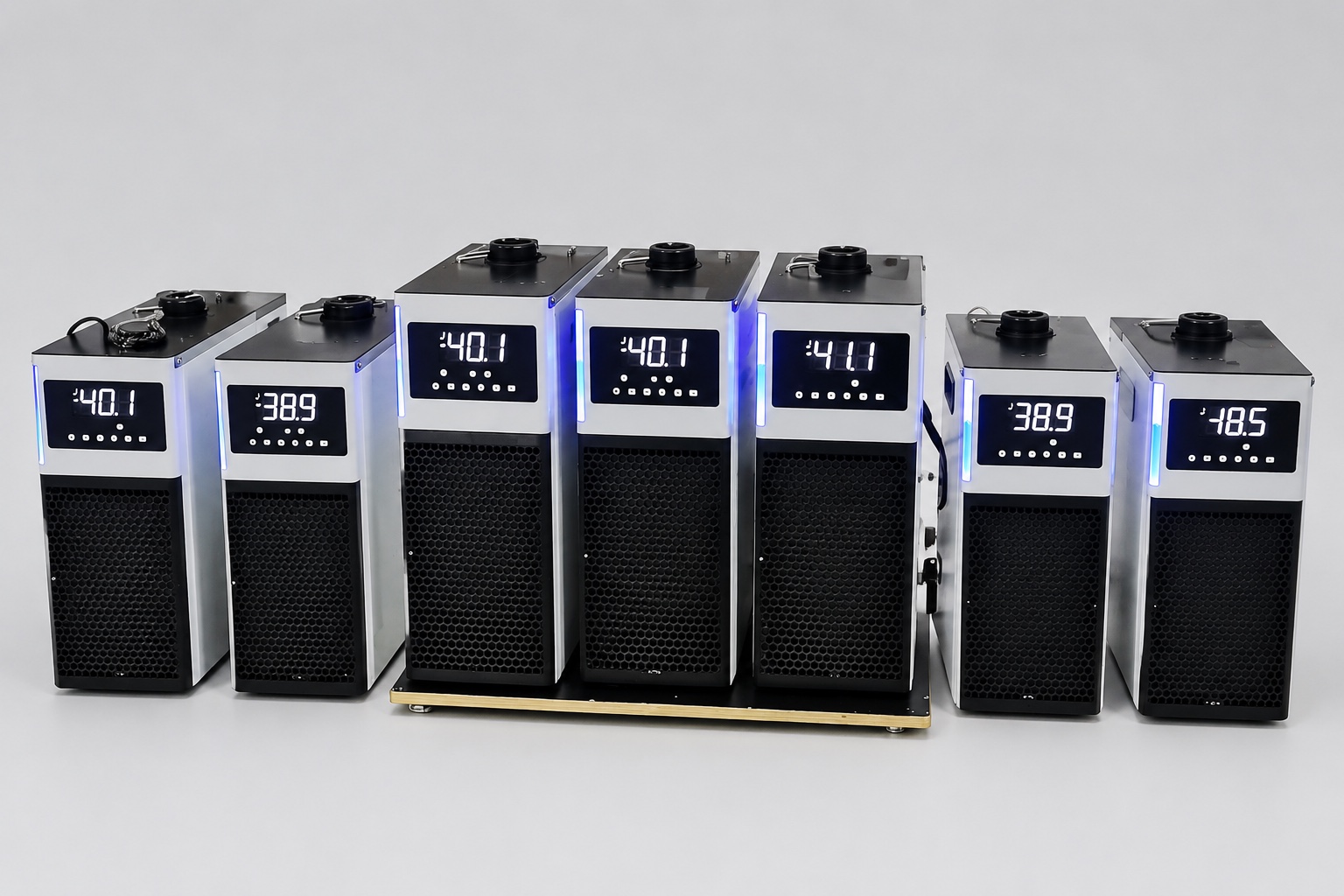 Consider a laboratory recirculating loop with the following configuration. All values are assumed for illustration.
| Parameter | Value | Basis |
|---|---|---|
| Chiller setpoint | −25 °C | Assumed process requirement |
| Coolant | Propylene glycol mixture | Assumed |
| Concentration chosen | Protects to −25 °C per chart | Assumed; selected against setpoint |
| Evaporator surface offset | 7 °C below coolant temperature | Assumed; published guidance suggests 5–10 °C |
| Actual coldest fluid temperature | −32 °C | Calculated |
| Process load | Light, well below chiller capacity | Assumed |
The mixture protects to −25 °C. The fluid touching the evaporator plate reaches −32 °C. There is no coolant freeze point margin at all at the only place it matters — there is a 7 °C deficit.
Note the last row. A light load makes this worse rather than better, because a lightly loaded evaporator runs colder: less heat is arriving to be absorbed, so the plate temperature falls closer to the refrigerant’s evaporating temperature. The condition that feels safest is the one that ices first.
What Happens Over the First Weeks
- Week 1. The loop performs correctly. Setpoint is reached, flow is normal, nothing is unusual. Ice begins forming as a thin film on the coldest part of the evaporator plate.
- Weeks 2–4. The film thickens. Flow through the plate falls slightly, which makes the fluid leaving colder, which accelerates the deposition. Bulk fluid concentration rises measurably as water leaves the solution — so a concentration check now reads higher than the original mixture, which reads as reassurance.
- Weeks 4–6. Pressure drop across the evaporator rises enough that flow falls noticeably. The process starts running warmer than setpoint despite the chiller reporting satisfaction — the classic flow-limited signature.
- Beyond. The flow alarm trips, or the loop stops circulating entirely. Recovery requires warming the machine to thaw the plate, which takes hours.
An installed system tells you about its coolant freeze point margin through pressure drop long before it trips an alarm, which is why the trend matters more than any single reading. The trap in step 2 is worth naming, because it inverts the most obvious diagnostic. Checking glycol concentration in the reservoir gives a number higher than the fill concentration, which suggests the fluid is more protected than it was — while the water that left the solution is sitting as ice on the plate.
Why It Passed Commissioning
Four ordinary circumstances hide a coolant freeze point margin error until it is expensive:
- Commissioning runs at a moderate setpoint, or at full load, both of which keep the evaporator warmer than steady-state light-load operation.
- The concentration was checked against the chart correctly. The arithmetic was right; the reference was wrong.
- Nothing measurable changes for weeks, and when it does, the first symptom looks like a flow restriction elsewhere in the loop.
- The failure arrives far enough from installation that it reads as fluid degradation or a strainer problem rather than as a specification error.
The third point sends most diagnoses in the wrong direction. A loop that is slowly icing its own heat exchanger presents identically to one with a loading strainer, and the two are investigated in completely different places.
Setting the Margin Correctly
Calculating the coolant freeze point margin is short once the reference is right:
- Start from the lowest setpoint the system will ever run at, not the normal one.
- Subtract the evaporator offset. Published guidance suggests 5 to 10 °C; use the larger figure unless you have measured your own.
- Subtract a safety margin of 3 to 5 °C from the measured freeze point, as recommended practice.
- Select concentration to protect to that combined temperature.
- Verify the resulting mixture still delivers adequate flow at the lowest setpoint, since the stronger solution is also the more viscous one. If it does not, change fluid family rather than weakening the mixture.
Applied to the scenario: lowest setpoint −25 °C, minus 10 °C offset, minus 5 °C margin gives −40 °C. The mixture should protect to −40 °C, not to −25 °C. That is a substantially stronger solution than the one chosen, and the difference is entirely a matter of which temperature was used as the reference.
A second formulation reaches a similar place: protect to 25 °F below the lowest required setpoint. Both are approximations of the same physical requirement, and either is far safer than protecting to the setpoint itself.
The Cost of Getting It Wrong the Other Way
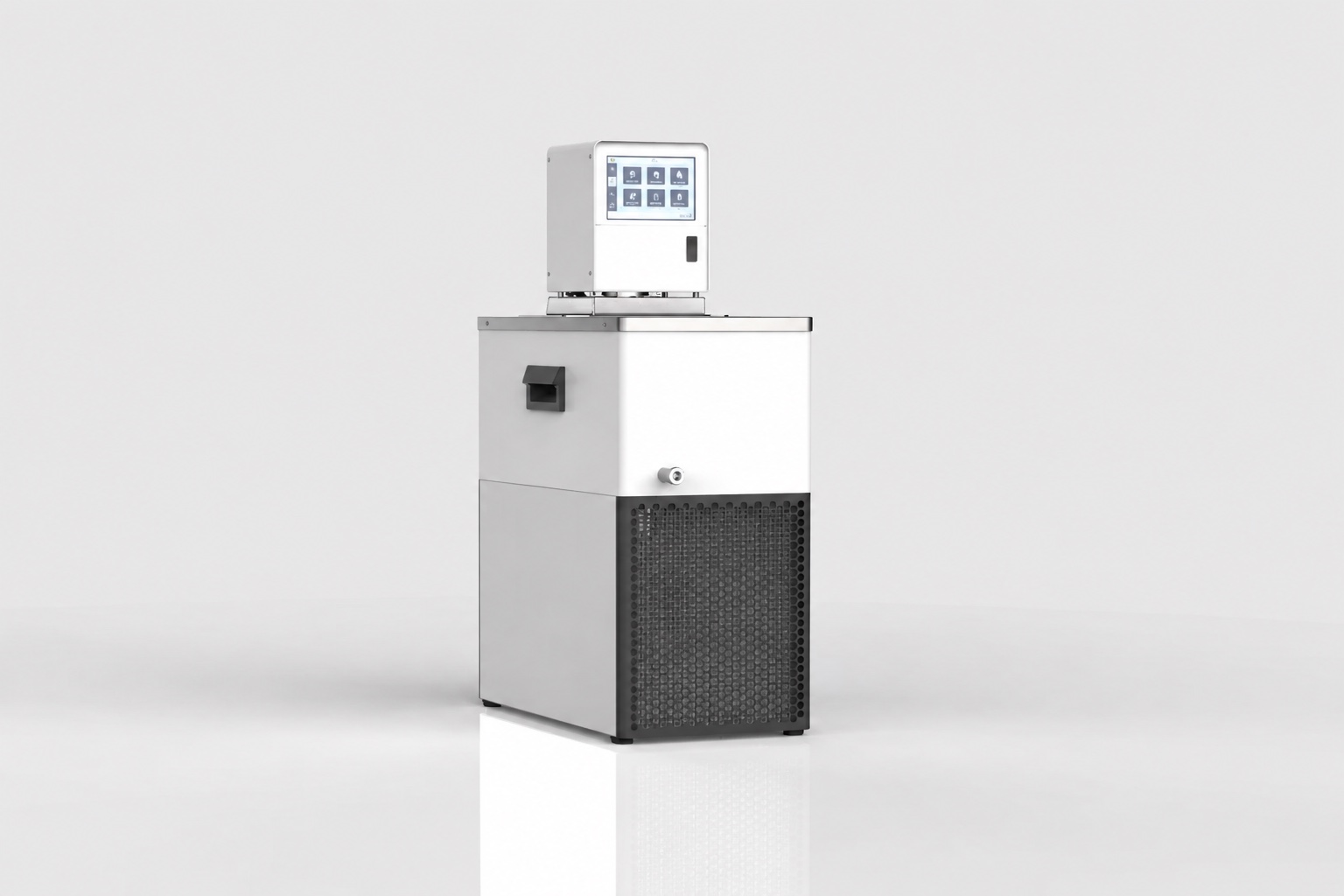 More glycol is not free, which is why the coolant freeze point margin should be calculated rather than maximized.
| Property | Effect of higher concentration | Consequence |
|---|---|---|
| Freeze point | Lower | The benefit being sought |
| Viscosity at low temperature | Substantially higher | More pressure drop, less flow, worse heat transfer |
| Specific heat | Lower | Larger temperature rise across the load for the same flow |
| Pump demand | Higher | May exceed available head on a small machine |
The second row is the one that bites on a benchtop system. A mixture strong enough to protect to −40 °C is considerably more viscous at −25 °C than one protecting to −25 °C, and the flow it can achieve through a restrictive application may fall below what the process needs. Since pump flow and head are not published for this range, a loop pushed toward high concentration is one where those figures are worth requesting.
The design conclusion is a balance rather than a maximum: protect against the coldest surface, then verify that the resulting fluid still flows adequately at that temperature. If it does not, the answer is usually a different fluid — a silicone-based heat transfer fluid, for instance — rather than a weaker glycol mixture.
Checking an Installed System
- Measure concentration with a refractometer rather than assuming the fill ratio survived. Top-ups with water, and evaporation from a vented reservoir, both move it.
- Compare the measured concentration against the original fill. A reading higher than the fill on a sub-zero loop is a warning sign, not reassurance — it can indicate water has left the solution as ice.
- Watch pressure drop or flow across the evaporator over time. A slow rise in resistance at unchanged conditions is the earliest measurable indicator.
- Note whether problems correlate with light load. An icing evaporator gets worse when the process is idle, which is the opposite of how a capacity problem behaves.
- If icing is suspected, warm the machine fully before investigating anything else. Diagnosing a partly frozen plate produces confusing readings.
Fluid selection and mixing ratios are covered in more depth in our glycol and water coolant ratio guide, and the viscosity consequences of strong mixtures at low temperature in our discussion of −40 °C circulator applications. Model data for the MiniCool 450, 800 and 850 across a published 0 °C to −40 °C range is on the MiniCool product page; positive-temperature loops are served by the DV compact liquid chiller range.
If you want a fluid specification checked against your operating conditions, send the following and our engineers will advise: lowest setpoint the system will run at, expected minimum process load, coolant fluid and current concentration, application internal geometry and hose sizing, acceptable temperature rise across the load, and whether the loop has ever shown a flow restriction. Send your loop details to our engineering team.
Frequently Asked Questions
How far below setpoint should coolant freeze protection go?
Not to the setpoint — to the evaporator surface temperature, which runs several degrees colder. Published guidance suggests an offset of 5 to 10 °C plus a safety margin of 3 to 5 °C from the measured freeze point, or equivalently protecting to about 25 °F below the lowest required setpoint. For a −25 °C loop that means a mixture protecting to roughly −40 °C, not −25 °C.
Why does a light load make icing more likely?
Because a lightly loaded evaporator runs colder. With less heat arriving to be absorbed, the plate temperature falls closer to the refrigerant’s evaporating temperature, increasing the gap between coolant temperature and the coldest surface. The condition that intuitively feels safest — an idle process — is the one where the coolant freeze point margin is smallest.
My glycol concentration reads higher than I filled. Is that good?
On a sub-zero loop it is a warning. When a mixture passes its freeze point, water separates out as ice and the remaining liquid becomes glycol-richer — so a reservoir reading above the fill concentration can mean water has left the solution and is sitting as ice on the evaporator. Check flow and pressure drop before concluding the fluid is fine.
What does a glycol mixture do when it freezes?
It does not solidify like water. Pure water ice crystals form while the remaining liquid becomes more concentrated, producing a slush that still flows until enough ice has accumulated to block the passage. That gradual onset is why the failure develops over weeks and why there is no obvious moment when something went wrong.
Is more glycol always safer?
No. Higher concentration lowers the freeze point but raises viscosity substantially at low temperature and lowers specific heat, so flow falls and the temperature rise across the load grows. On a small machine with limited pump head, an over-strong mixture can starve the application. Protect against the coldest surface, then confirm the fluid still flows adequately at that temperature.
How do I tell evaporator icing from a blocked strainer?
Both restrict flow, but icing correlates with load and temperature while a strainer does not. Icing worsens when the process is idle and at lower setpoints; a strainer behaves the same regardless. Icing also usually shows a bulk concentration reading above the fill value. If icing is suspected, warm the machine fully first — diagnosing a partly frozen plate produces readings that make sense of nothing.