
Jacketed Electrochemical Cell Cooling Starts With Two Separate Liquids
Jacketed electrochemical cell cooling uses an external heat-transfer fluid around the cell to influence the electrolyte temperature inside it. Keep those liquids separate. Select the external loop from the cell’s jacket limits, the required electrolyte temperature behavior, and the heat that must cross the cell wall. Do not send electrolyte through a standard chiller simply because both systems have liquid connections.
The immediate design question is whether the proposed loop can produce the required temperature history in the experiment without changing the experiment’s electrical, chemical, or mechanical conditions in an uncontrolled way. A stable reservoir display is only one part of that answer. The cell contents, electrodes, jacket, hoses, and room form the actual test environment.
Define the sample condition first, then qualify the cooling interface. This article covers the thermal integration of a jacketed laboratory cell. It does not prescribe an electrolyte formulation, electrode arrangement, electrochemical test method, or universal temperature for an experiment.
Choose the Type of Temperature-Control Supply
| Project requirement | Purchase route to evaluate | Information needed first |
|---|---|---|
| Cooling only; an OEM owns the external circulation and controls | A cooling module integrated into the equipment | Required supply temperature, fluid interface and integration responsibilities. |
| Heating and cooling, programmed temperature changes, or a complete ready-to-connect circulation package | A complete temperature-control circulator with the required functions | Actual temperature program and equipment interface; a cooling module alone does not establish these functions. |
| Jacket ports, electrolyte separation or allowed utility conditions are unclear | Resolve the cell interface before selecting the cooling supply | Cell documentation identifying the jacket and its permitted fluid conditions. |
Choose the route before comparing refrigeration capacity. A module can be a useful component in an OEM design while still leaving circulation, instrumentation or heating functions to that design. A laboratory purchasing a complete temperature-control utility needs those functions included in the quoted assembly.
Locate the Jacket Ports Before Planning the Circuit
A jacketed vessel has a thermal circuit outside the experimental liquid volume. Its connections must be distinguished from gas inlets, electrolyte ports, drains, and electrode openings. Make the distinction on the actual cell drawing rather than inferring it from hose size or connection position.
Record the exact cell designation, working sample volume, jacket connections, and permitted circulation arrangement from its own documentation. Confirm which fittings communicate with the jacket and which communicate with the experimental volume. Neither a small sample volume nor a familiar hose connection establishes an allowable jacket pressure or compatibility with a RIGID module.
Use the manufacturer’s connection instructions for flow direction, venting, support, and permitted fluid. A connection that fits mechanically still needs checks for material compatibility, temperature, retention, and pressure. Small glass fittings also need hose support so the plumbing does not become a lever on the vessel.
Mark supply and return outside the enclosure where they remain identifiable after installation. Include the intended disconnect and drain arrangement in the layout. Maintenance should not require guessing which hose communicates with the sample and which belongs to the external thermal circuit.
Keep the Electrolyte Specification Out of the Chiller Fluid List
| Liquid or material | Where it belongs | Whose compatibility information is needed? |
|---|---|---|
| Electrolyte | Experimental cell volume | Cell, seals, electrodes, and experiment owners |
| External heat-transfer fluid | Jacket, hoses, pump, and chiller liquid path | Every wetted component supplier in that loop |
| Cleaning fluid | Only the components and procedure approved for cleaning | The manufacturer of each exposed component |
| Reference electrode filling solution | Its designated electrode assembly | The electrode manufacturer and experiment method |
The jacket provides a thermal interface, not permission to mix circuits. A fluid acceptable inside the electrochemical cell may be unsuitable for pump seals or a chiller heat exchanger. Conversely, a coolant additive approved for an external loop may invalidate an experiment if a leak carries it into the sample.
For jacketed electrochemical cell cooling, record both fluid identities and the expected consequences of leakage across the wall. Use the cell manufacturer’s inspection and cleaning instructions. If unexplained liquid loss or cross-contamination is suspected, take the affected setup out of service for investigation rather than compensating by repeatedly topping up either circuit.
Do not prescribe high-purity water, glycol, a corrosion inhibitor, or a conductivity target solely from the phrase “electrochemical cell.” The external wetted materials and the cell’s instructions govern that choice. The experiment’s analytical purity requirement is a separate matter from the coolant supplier’s compatibility requirement.
Specify Electrolyte Temperature Separately From Supply Temperature
Heat crosses the jacket fluid, vessel wall, and liquid-side boundary before it reaches the experimental volume. The electrolyte can therefore remain warmer than the coolant under a heat load. During a temperature transition, it can also lag behind the jacket. The size and direction of the difference depend on the operating state.
Write at least three distinct requirements: the desired electrolyte temperature, the permitted coolant inlet range, and the time allowed to reach the experimental acceptance band. Include how long the sample must remain within that band before data collection. A single “set temperature” entry cannot communicate all three.
A cooling-only module is not automatically a heating-and-cooling circulator. If the experiment requires an elevated hold, an upward ramp, or recovery after a cold fluid change, define how heat will be added and controlled. A refrigerator’s ability to remove heat does not establish that it can execute a bidirectional temperature program.
When comparing equipment, distinguish stability at one sensor from spatial uniformity within the electrolyte. A probe can report a steady value while another region differs. Changing mixing or probe position can also change the experiment, so the thermal qualification must preserve the method’s approved configuration.
Do Not Use Potentiostat Power as the Entire Heat Load
Electrical power delivered to the cell is relevant, but a generic voltage-times-current calculation is not a complete calorimetric model for every electrochemical experiment. Energy can be associated with reaction processes as well as heat, and measured electrical quantities must refer to the correct boundary. Instrument input power also includes losses that may never enter the cell.
For jacketed electrochemical cell cooling, assemble an operating history: the experimental electrical state, ambient conditions, temperature drift, jacket flow, and any other heat sources. A temperature hold and a programmed transition are different duties. Include heat exchanged through the vessel, electrode assemblies, leads, and surrounding fixtures where it is material to the test.
A useful first comparison can be performed on an approved nonreactive thermal surrogate, where the experiment owner permits one. This can characterize the external loop without claiming to reproduce the chemical system. It cannot qualify electrolyte compatibility or prove the thermal behavior of a reaction that was absent from the test.
If a supplier requests a load estimate, label its basis: measured, calculated with stated assumptions, or not yet known. Do not convert an unknown into an arbitrary percentage of a power-supply rating. An honest uncertainty range is more useful than a precise number derived from the wrong measurement boundary.
A Small Sample Can Still Have a Slow Thermal Response
Begin the response estimate with the actual sample mass, its applicable heat capacity, and the required temperature change. Their product estimates the sample’s sensible energy change when the material properties and assumptions apply. Record the property source and any phase or reaction effects excluded from the calculation. Do not assign water properties to an electrolyte whose composition has not been characterized.
A sample-energy estimate is not a cell performance prediction. The glass vessel, electrodes, fittings, and jacket fluid also store heat. Thermal resistance changes the available heat transfer as the temperature difference shrinks. Heat gain from the room and the experiment’s own behavior can further extend the approach to the target. An energy-only time estimate also requires the net removal rate from the sample, not the refrigerator’s nominal rating.
Measure settling at the experimental location. Do not convert the sample-only calculation into a guaranteed equilibration time. Likewise, a much larger refrigeration rating does not proportionally shorten the response when the limiting resistance is between the jacket and the electrolyte.
The general laboratory reactor sizing discussion addresses the broader separation between heat load and equipment selection. Here the smaller electrochemical volume introduces a distinct acceptance problem: verifying the sample temperature without compromising electrode placement or the test method.
Build the Hydraulic and Measurement Interfaces Together
Establish the cell jacket’s permitted pressure, coolant, and connection arrangement before choosing a pump. Required circulation flow and maximum jacket pressure are independent constraints. If the pressure limit is not stated in the accessible cell information, request it; a hose-barb dimension cannot supply that missing value.
Route hoses so normal access to electrodes does not bend the glass connections or pull the cell off its support. Account for the filled hose weight and the motion involved in cleaning. Keep the pump and its mechanical vibration from changing the measurement fixture in a way the experiment has not evaluated.
For temperature instrumentation, specify sensor location, immersion, calibration status, and logging interval. If a probe contacts the electrolyte, its compatibility and electrical effects belong in the experiment review. Do not assume an ordinary metal probe can be added without affecting an electrochemical measurement.
A jacketed electrochemical cell cooling test should record the external coolant and sample channels on the same timeline. Use that record to identify whether a delayed response originates in the cooling loop or across the cell interface. Avoid retuning multiple controllers simultaneously; otherwise a changed result may be impossible to attribute.
Screen a DV Module Against the Actual External Loop
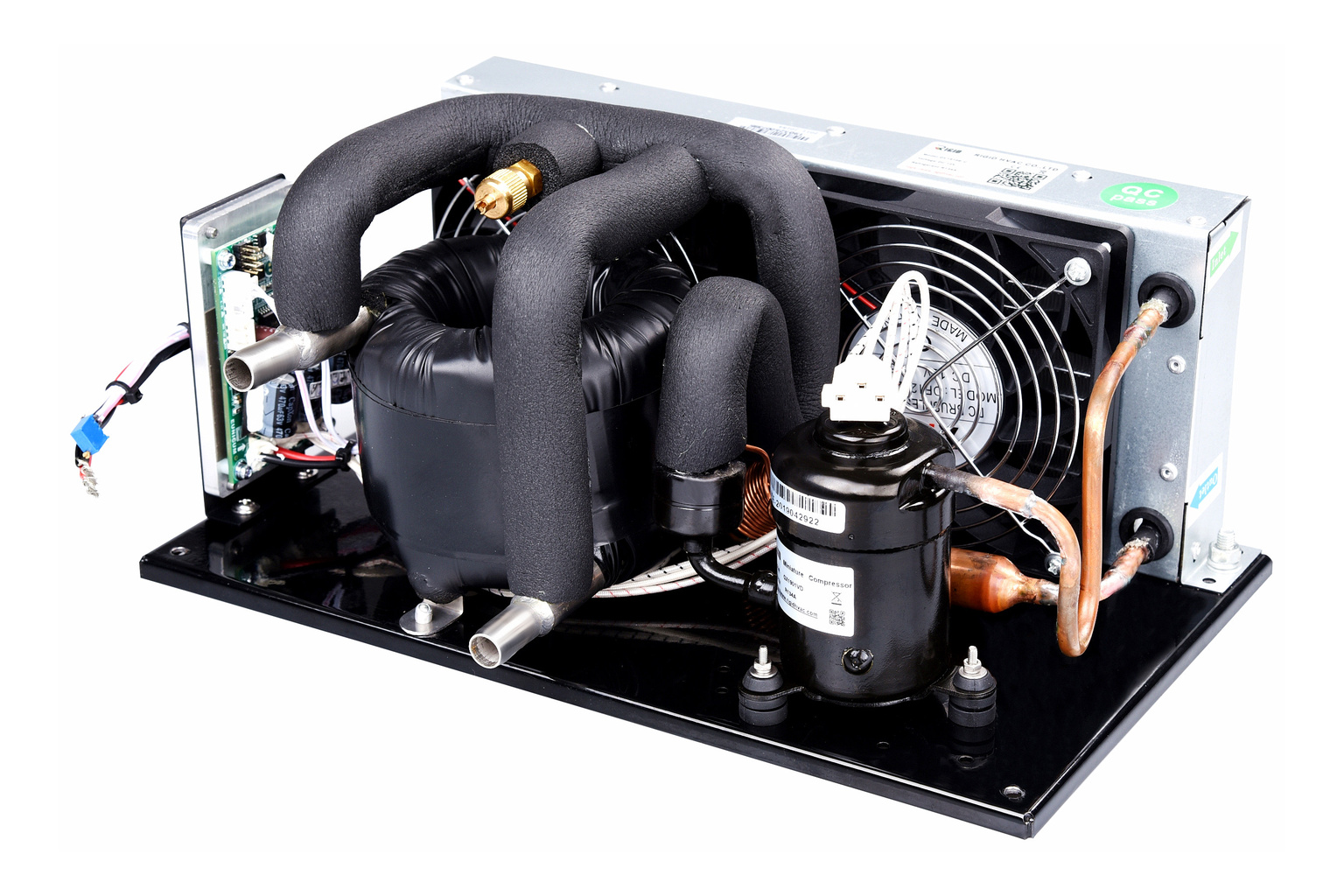
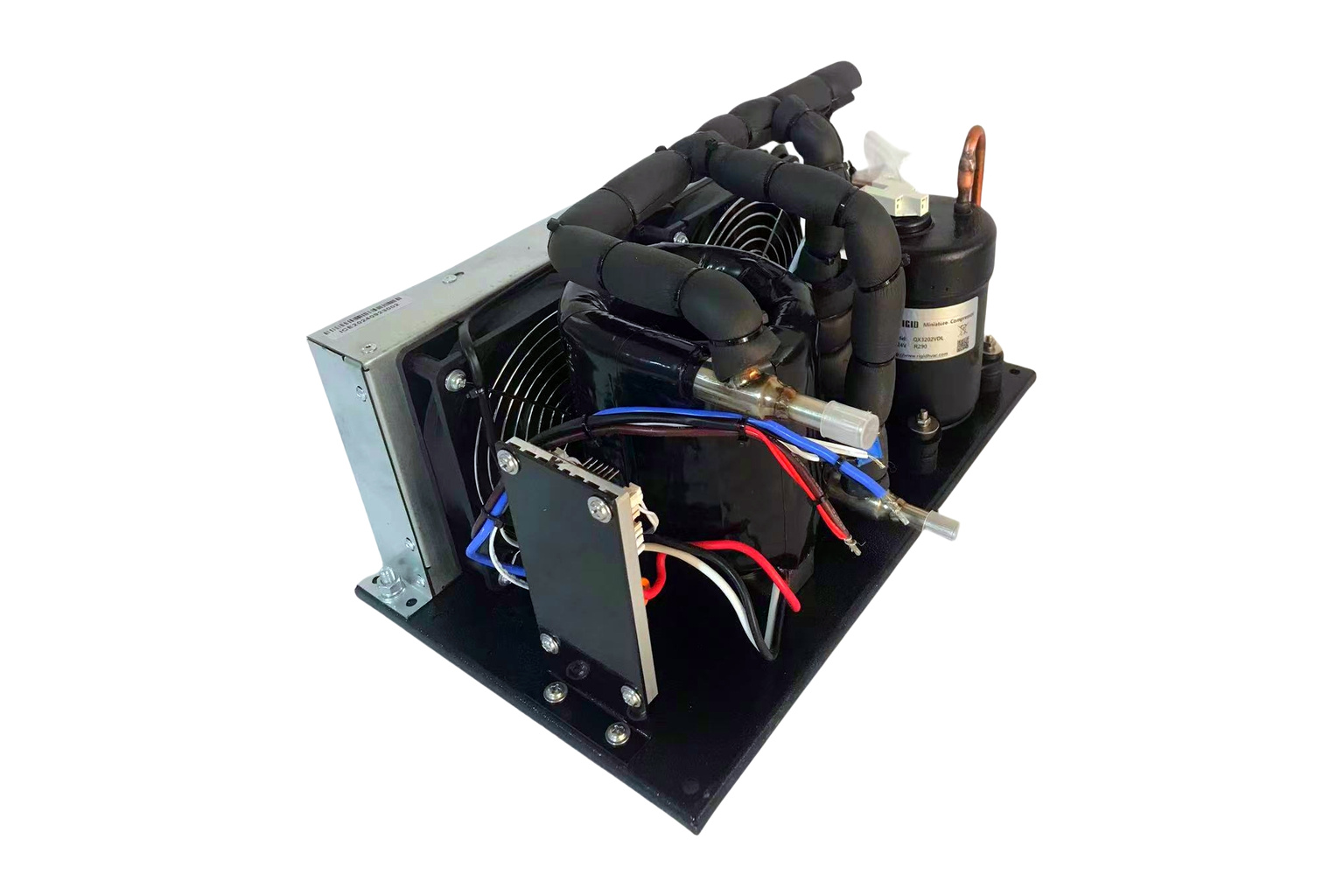
The RIGID DV compact liquid chiller range lists a −20 to +20°C operating range. Consider it only where the required external coolant condition falls within the documented envelope and the selected configuration can meet the actual duty. This is not a claim that the electrolyte itself must equal the chiller setpoint.
For jacketed electrochemical cell cooling, confirm the chosen exchanger’s wetted materials, approved fluid, installed flow, pressure protection, and temperature behavior. The reviewed series information does not provide a complete pump curve or establish compatibility with a particular cell. Integration may require a separately specified pump, reservoir, sensors, controls, and enclosure.
A compact module can be a candidate for an OEM-built external loop, while a finished laboratory circulator may better match a purchaser who needs an integrated heating program and sample-control interface. Make that decision from required functions. Do not treat a refrigeration assembly and a complete laboratory temperature-control instrument as equivalent deliveries.
Before procurement, write the acceptance result in measurable terms: the sample reaches its permitted band within the stated time, remains there through the defined experimental sequence, and the external loop respects every component limit. Include the worst intended room condition and the configured hoses. Repeat qualification after changes that materially alter thermal resistance or control behavior.
Identify the offered configuration by its complete model code, such as DV1920E-C, and the agreed component list. A family name alone cannot establish which heat exchanger, controls, or external circulation parts are included.
Send the Application Details for Review
Provide the cell drawing and jacket limits, both fluid identities, target sample-temperature history, measured or estimated load, and the intended plumbing. Request a review of the external cooling loop with the missing parameters clearly identified so the proposed scope can be evaluated.
Frequently Asked Questions
Can electrolyte circulate directly through the chiller?
Not as an assumption for this arrangement. Jacketed electrochemical cell cooling keeps the experimental liquid separate from the external heat-transfer circuit. Direct circulation would be a different design requiring explicit compatibility and contamination review of every exposed component.
Will the electrolyte equal the chiller display temperature?
Not necessarily. Heat transfer through the jacket and vessel creates offsets under load and delays during transitions. Verify the experimental temperature at an appropriate location using a measurement arrangement compatible with the cell and its method.
Does the smallest cell require the smallest chiller?
Not necessarily. Sample volume affects stored energy, but the vessel, fixtures, experiment, room heat gain, and required response also matter. The external loop’s flow and control behavior can be more important than a nominal capacity comparison between two small units.
Can a DV cooler perform an elevated-temperature program?
Do not infer that function from cooling capability. An elevated or bidirectional program requires a suitable heat source, control arrangement, and approved operating range. Confirm those functions explicitly rather than assuming the module supplies the same features as a heating circulator.
What information makes an engineering inquiry useful?
Send the application details listed in the review request above, including any unknown interface or operating requirement. The proposed module configuration must be checked against those conditions before selection.