
Crane Cab Cooling Begins with a Problem No Other Vehicle Has
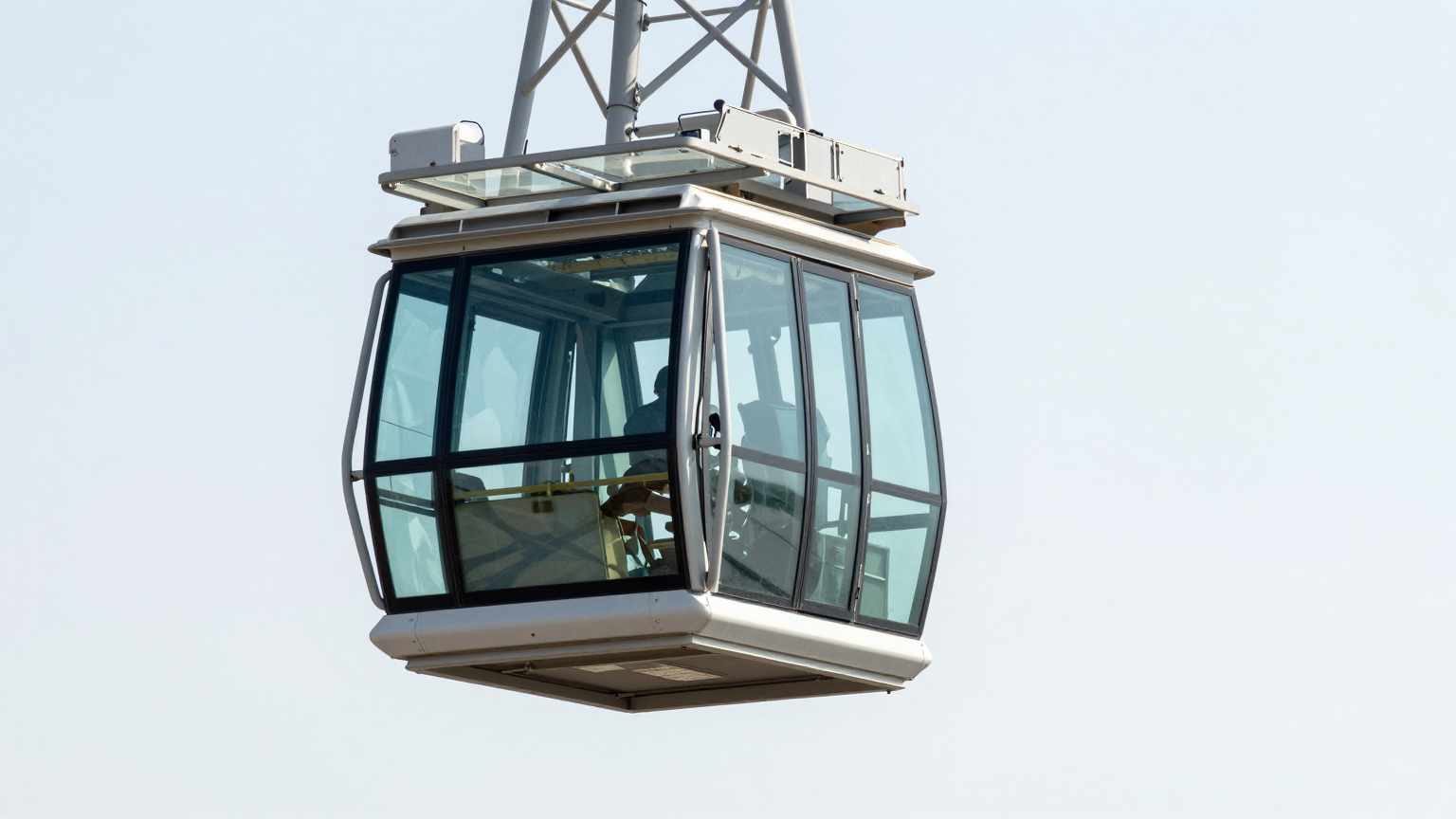
The crane operator’s cab is one of the most thermally extreme enclosed workspaces in heavy industry — and the reason has nothing to do with the engine. On a tower crane, the cab sits 30, 50, or 80 meters in the air, suspended in direct solar exposure from dawn to dusk with no shade from buildings, trees, or terrain. On a mobile crane or crawler crane, the cab may be closer to the ground but still features floor-to-ceiling glass on three or four sides for the visibility that load handling demands. In both cases, the cab is a glass box baking in the sun.
The physics are punishing. A crane cab with 3–5 square meters of glass area absorbs solar radiation from multiple angles simultaneously — including from above, since many crane cabs have transparent or translucent roof panels for boom visibility. Unlike a truck cab that moves through ambient air at highway speed (providing passive condenser cooling and wind-driven ventilation), a crane cab is essentially stationary in still air for the entire shift. There is no ram air. There is no shade cycle from passing under bridges or through tunnels. The thermal load is sustained, maximum, and relentless.
On a clear summer day with ambient temperature of 35 °C, cab interior temperatures commonly exceed 55–65 °C without mechanical cooling. At altitude on a tower crane, the lack of ground-level thermal mass and the exposure to wind-driven heat gain (warm air rising from pavement or steel structures below) can make conditions even worse than ground-level measurements suggest. This is not a comfort problem — it is a cognitive performance and safety problem for an operator controlling multi-ton suspended loads over populated work zones.
Why Crane Cabs Are the Hardest Vehicle to Cool
Every enclosed vehicle cab presents thermal challenges, but crane cabs combine several factors that other equipment types face individually — and add a few that are unique to the crane environment.
Solar Load from All Angles
A forklift cab has glass on the sides and front. A truck cab has a solid roof and opaque rear wall. A crane cab — particularly on tower cranes and overhead bridge cranes — often has glass or transparent panels on the floor, sides, front, and portions of the roof. The operator needs unobstructed sightlines in every direction for safe load spotting. This means there is no surface that reliably rejects solar radiation. The entire cab is a solar collector.
No Ambient Airflow for Condenser Cooling
An air conditioning system’s condenser must reject heat to the surrounding air. On a truck moving at speed, ram air provides substantial airflow across the condenser without any fan assistance. On a crane, the cab is stationary or moves slowly during slewing operations. The condenser depends entirely on its own fan for airflow, and that fan must overcome any dead-air zones created by the cab structure or mounting location. Under-sizing the condenser or restricting its airflow is one of the most common causes of crane cab AC underperformance.
Vibration from Load Dynamics
Crane cabs experience a vibration profile that differs fundamentally from ground vehicles. The dominant vibration sources are not road surface or engine firing — they are the dynamic loads from hoisting, lowering, slewing, and trolley travel. These generate low-frequency oscillations (often below 5 Hz) combined with sudden impulses when loads are engaged, released, or arrested. On lattice boom crawler cranes, boom luffing adds another axis of dynamic loading. AC system components — compressor mounts, refrigerant fittings, electrical connectors — must tolerate these low-frequency, high-amplitude motions without fatigue failure.
Height and Access Constraints
On a tower crane, any maintenance requires climbing to the cab. Replacing a filter, cleaning a condenser, or troubleshooting an electrical fault becomes a significant effort — not something a technician can do in a parking lot between shifts. The AC system must be as close to maintenance-free as practical, with long service intervals and robust components that tolerate the operating environment without frequent attention.
Mounting Approaches: Where Does the AC System Go?
The physical constraints of crane cabs limit mounting options more severely than on any other mobile equipment type. The dominant approaches each carry trade-offs.
Rooftop Monoblock
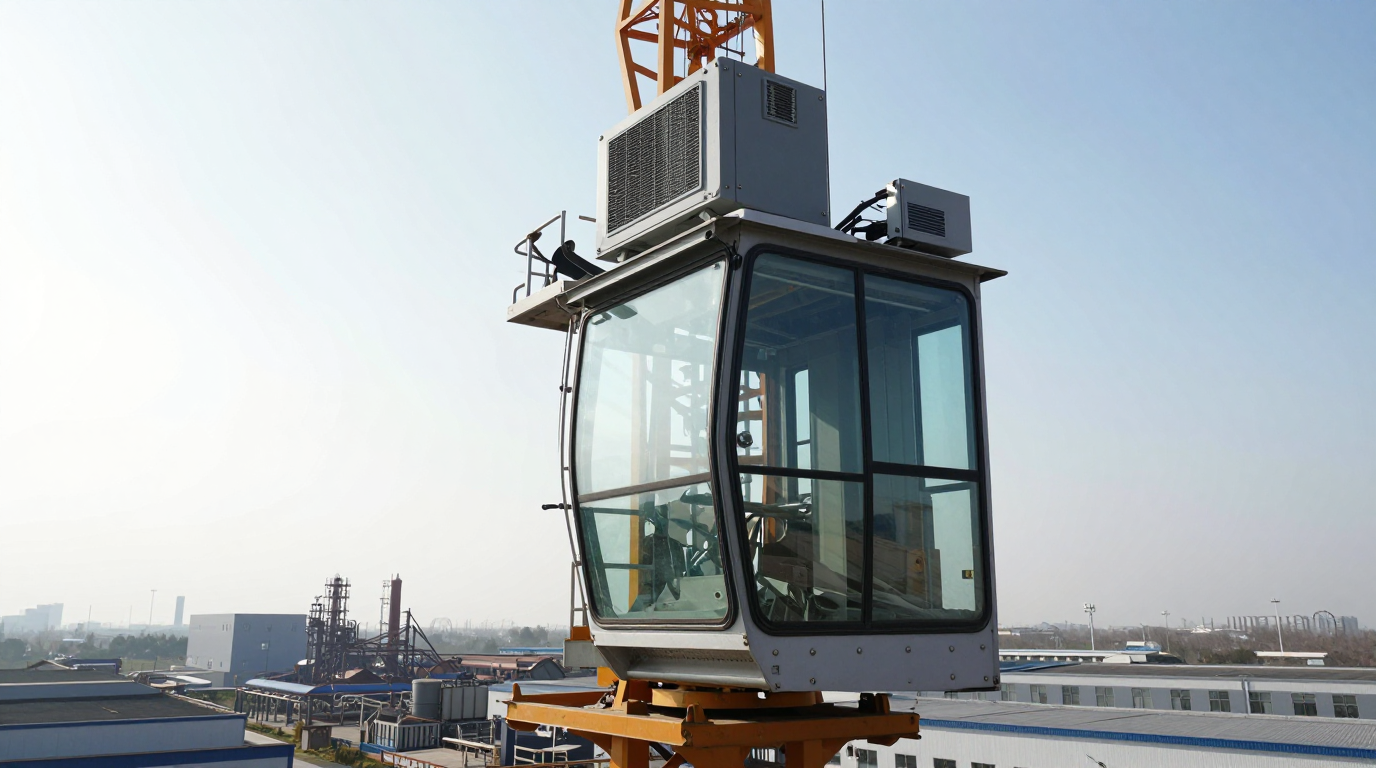
A monoblock (self-contained) unit places the compressor, condenser, and evaporator in a single enclosure mounted on or through the cab roof. This is the most common aftermarket approach for crane cabs because it avoids the challenge of routing refrigerant lines to a remote condenser location — which, on a tower crane, may not exist at all.
Advantages: single mounting point, no refrigerant line routing, simplified installation. Disadvantages: all weight concentrated on the roof (raising center of gravity), reduced headroom inside the cab, condenser airflow limited to what the unit’s built-in fans can provide, and servicing requires access to the cab roof — which on an elevated crane may require a person to climb onto the cab exterior.
Split-Type with Remote Condenser
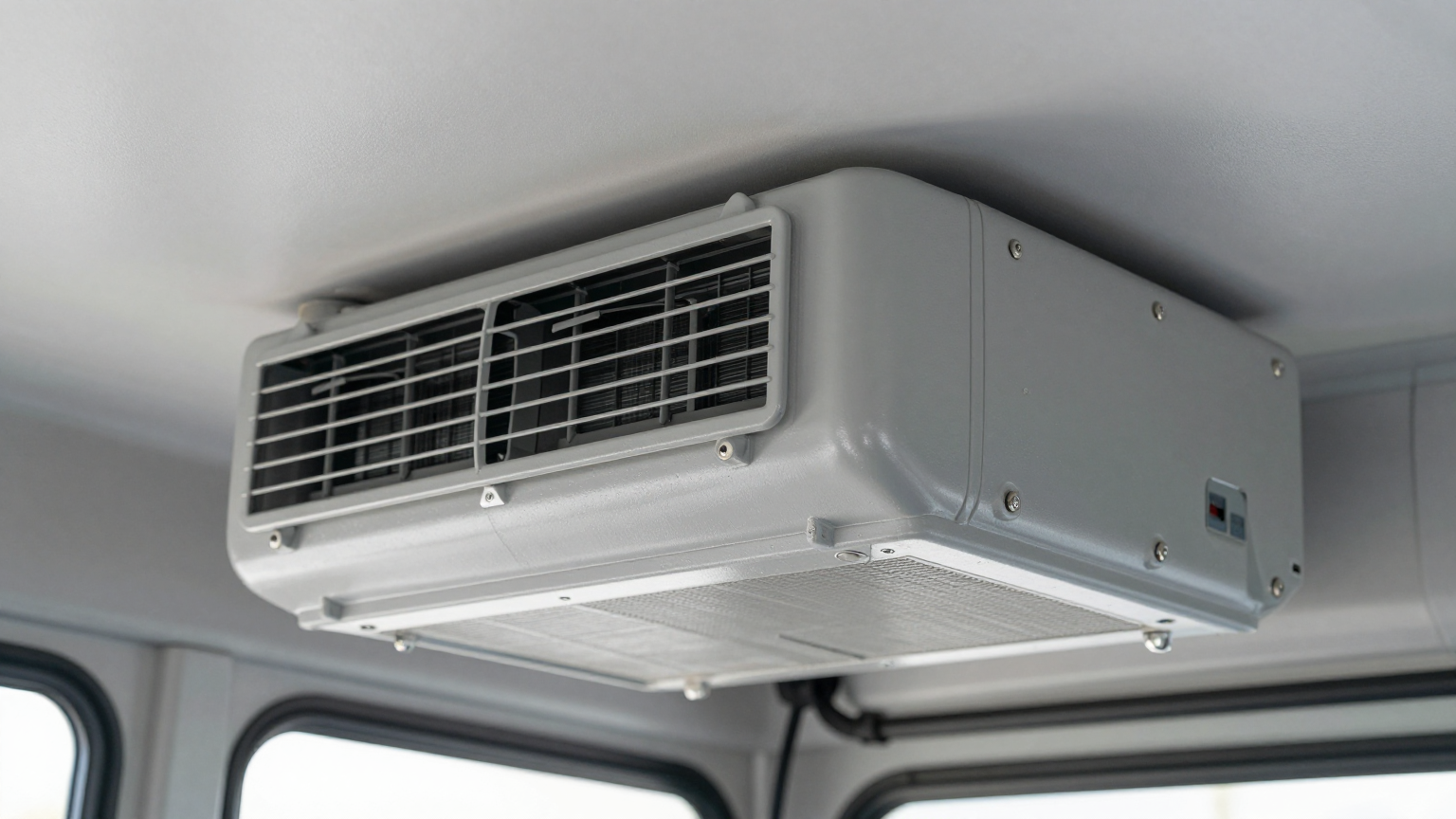
A split system places a compact evaporator inside the cab and the condenser/compressor assembly externally. On ground-level crane types — mobile cranes, truck cranes, crawler cranes — the condenser can mount on the vehicle frame, engine compartment area, or superstructure behind the cab, with refrigerant lines routed through the cab structure. This provides better condenser airflow, distributes weight, and keeps the indoor unit compact (typically 440 × 140 × 320 mm for the evaporator, fitting within the cab headliner zone).
On tower cranes, the split approach is more challenging — the condenser must mount somewhere on or near the cab structure at height, since there is no vehicle frame nearby. Some installations mount the condenser on the back wall of the cab exterior or on a bracket attached to the crane’s turntable structure. The key constraint is ensuring the refrigerant line length does not exceed the system’s rated maximum (typically 3–5 meters for pre-charged systems) and that the condenser location receives adequate airflow.
Decision Logic
| Crane Type | Recommended Approach | Key Constraint |
|---|---|---|
| Tower crane (cab at height) | Monoblock or split with condenser on cab exterior | No remote frame for condenser; access for maintenance |
| Overhead bridge crane | Monoblock or compact split | Limited cab size; vibration from trolley travel |
| Mobile / truck crane | Split-type with condenser on vehicle frame | Slewing motion stresses refrigerant lines at cab-to-frame transition |
| Crawler crane | Split-type with condenser on superstructure | Boom luffing vibration; dust from ground-level operation |
Sizing the Cooling Capacity for a Crane Cab
Crane cabs are small — typically 1.5 to 3.0 cubic meters of interior volume — but the cooling capacity required per unit volume is among the highest of any vehicle application. The reasons are the extreme glass area, the lack of insulation in many cab designs, and the sustained full-sun exposure without any shading cycle.
A rough sizing guideline for crane cabs under direct solar load:
- Small cab (overhead bridge crane, 1.5 m³): 1,500–2,000 W cooling capacity
- Medium cab (tower crane, mobile crane, 2.0–2.5 m³): 2,000–2,500 W
- Large cab (modern tower crane with full enclosure, 2.5–3.0 m³): 2,300–3,000 W
A system rated at 2,300 W (7,843 BTU) covers the majority of crane cab applications, providing adequate capacity for medium cabs and reasonable margin for smaller cabs in extreme ambient temperatures. Under-sizing is the more common and more costly error — a unit that runs continuously without reaching setpoint wears out faster, draws more power, and leaves the operator in a cab that is cooler than unconditioned but still uncomfortably warm.
Power Source Considerations for Crane AC
Cranes present a wider range of electrical system configurations than most vehicle categories, and matching the AC system to the available power is a critical specification step.
Electric Overhead Cranes
Overhead bridge cranes in factories and warehouses are typically powered by facility electrical supply through bus bars or festoon cables. The cab electrical system may be 24V DC, 48V DC, or powered through a small transformer from the crane’s AC supply. A DC air conditioning system that accepts 24V or 48V input can connect directly to the cab’s DC bus without additional conversion hardware.
Tower Cranes
Tower cranes run on site electrical supply (typically 3-phase AC), with the cab’s control and comfort systems running on a lower-voltage DC circuit — commonly 24V. The AC system’s power draw must be evaluated against the cab electrical circuit’s capacity, including other loads such as control electronics, lighting, radio, and anti-collision systems.
Mobile and Crawler Cranes
These machines have conventional diesel-electric systems with 24V or higher DC electrical buses. The considerations are similar to other heavy equipment: verify alternator capacity at operating RPM, ensure the electrical system can sustain the AC draw under full crane operation (when electrical demand from slewing motors, hydraulic pumps, and control systems is also high), and provide appropriate fusing and wiring gauge.
A DC air conditioning unit with multi-voltage input capability (24V, 48V, 60V, 72V) simplifies specification across diverse crane fleets and reduces the risk of voltage mismatch during procurement.
Installation Details That Determine Long-Term Reliability
Refrigerant Line Routing on Slewing Cranes
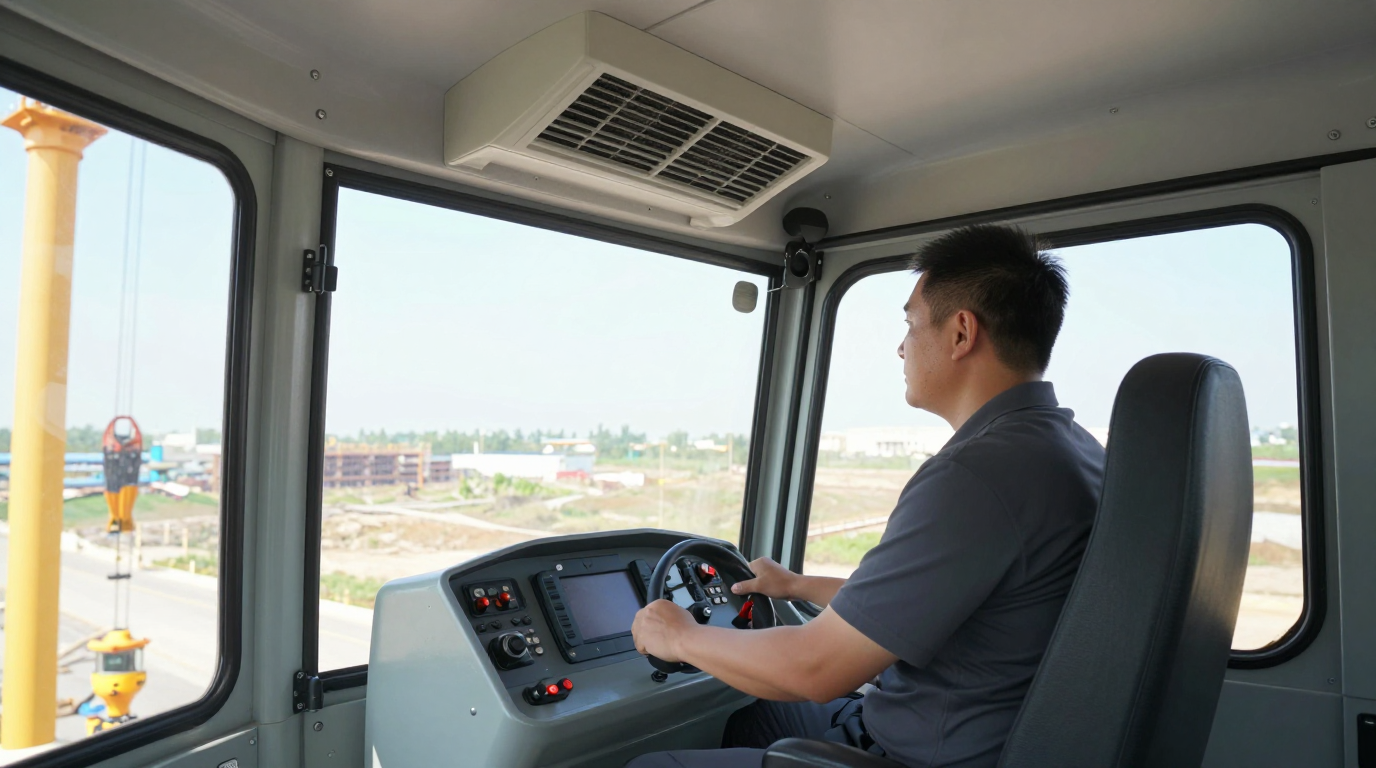
On cranes where the cab rotates relative to the lower structure (mobile cranes, crawler cranes, some tower cranes), the refrigerant lines of a split-type system must cross the slewing interface. This is the highest-risk point in the installation. The lines must accommodate 360° continuous rotation (on many mobile cranes) or limited-arc slewing without kinking, stretching, or fatigue cracking. Flexible high-pressure hose with a coiled service loop at the transition point — similar to the approach used for hydraulic lines crossing the same interface — is the standard solution. The loop must be sized for the full range of rotation plus a safety margin.
Condensate Management at Height
On ground-level equipment, condensate drains to the ground through a simple tube. On an elevated crane cab, condensate drainage must be managed more carefully. Dripping water from a tower crane cab onto workers or the public below is unacceptable on most job sites. The drain should route to a collection point or down a structural member where it can dissipate without creating a ground-level drip zone. In freezing conditions, condensate lines can ice up and block drainage — a heated drain or self-draining design may be necessary in cold-climate winter operations.
Cab Sealing and Insulation
Many crane cabs — especially on older equipment — have poor sealing around door frames, window gaskets, and cable pass-throughs. Air conditioning a leaky cab is like heating a house with the windows open. Before installing any cooling system, inspect and repair cab seals. Adding reflective film or tinted glazing to portions of the glass that are not critical for sightlines can also significantly reduce solar heat gain and lower the cooling system’s required capacity.
Weight and Balance
Crane cab structures are engineered for specific loads. Adding 48 kg of AC equipment — whether concentrated on the roof (monoblock) or distributed between indoor and outdoor units (split-type) — must be evaluated against the cab’s structural capacity and the crane’s overall balance. On tower cranes, the cab is typically a non-load-bearing structure, and additional weight on the cab roof should be reviewed with the crane manufacturer’s engineering specifications. The split-type approach, distributing approximately 48 kg across two mounting points, generally presents a more favorable load distribution than concentrating all weight overhead.
Common Field Questions
Can a standard truck AC kit work on a crane cab?
The cooling capacity may be adequate — crane cabs are typically smaller than truck sleepers. However, the mounting constraints, vibration profile, and condenser airflow conditions differ significantly. A truck AC kit’s condenser assumes ram air from vehicle movement; a crane condenser must work entirely on fan-driven airflow. If adapting a truck-rated system, verify that the condenser fan capacity is sufficient for the zero-airspeed condition of a stationary crane cab.
How do I service the AC system on a tower crane?
Design the installation with maintenance access in mind. Evaporator filters should be accessible from inside the cab without tools. The condenser — whether part of a rooftop monoblock or a separately mounted unit — should be positioned where it can be cleaned (compressed air blowdown) from a safe access point. Pre-charged systems with R134a refrigerant reduce the likelihood of field service requiring refrigerant handling at height.
Is the vibration from crane operations worse than from road vehicles?
Different, not necessarily worse. Crane vibration is lower-frequency and more oscillatory (pendulum-like motion from load dynamics) compared to the higher-frequency, road-surface-driven vibration of trucks. DC rotary compressors — such as the SANYO DC compressor — are well-suited to this profile because they have fewer reciprocating parts that are sensitive to low-frequency resonance. Proper vibration-isolating mounts are still essential.
What about cranes operating in extreme heat (Middle East, Southeast Asia)?
In ambient temperatures exceeding 45 °C, cooling demand increases substantially. Ensure the AC system is rated for high-ambient operation (condensing temperature rated for at least 55 °C ambient). A system with 2,300 W capacity provides reasonable coverage for most crane cabs at these temperatures, though cabs with unusually large glass areas may need the system to run at or near full capacity continuously. Verify that the condenser has adequate airflow margin — restricted airflow in high-ambient conditions is the primary cause of system underperformance.
Does the AC system affect the crane’s electrical safety systems?
The AC system should be wired on a separate circuit with its own fuse or breaker, independent of the crane’s safety-critical systems (load moment indicator, anti-collision, limit switches). The wiring should not share conduits with control wiring to avoid electromagnetic interference. On cranes with ATEX or explosion-proof requirements, verify that the AC system’s electrical components meet the applicable hazardous area classification.
Can the system pre-cool the cab before the operator climbs up?
Yes — a DC system running on battery or site power can be activated remotely or on a timer to pre-cool the cab before shift start. This eliminates the 15–20 minute heat soak that operators otherwise endure while the AC catches up with a cab that has been baking in the sun since sunrise. For tower cranes, this is a meaningful quality-of-life improvement that also reduces early-shift heat stress risk.
Integration Support
Every crane installation is unique — the cab geometry, the electrical system, the mounting options, and the operating environment all vary by crane type and manufacturer. If your crane fleet presents constraints beyond the standard scenarios described here, the Rigid engineering team can review your configuration and identify a viable cooling path. The HS23P split-type DC air conditioner offers the compact form factor, multi-voltage input, and pre-charged refrigerant circuit that address the core challenges of crane cab cooling — whether the cab sits at ground level or 80 meters in the air.
The crane operator has one of the most exposed workstations in any industry. Suspended in a glass enclosure with no shade, no breeze, and no option to step away from the controls during a critical lift, that operator depends on engineered cooling to maintain the focus that safe crane operation demands. Getting the AC system right is not a luxury — it is part of the safety infrastructure.