
What Is a Cryocooler and Why Does It Matter?
A cryocooler is a mechanical refrigeration device engineered to reach extremely low temperatures—typically below −40 °C and, in advanced units, down to −196 °C (77 K) or colder. Unlike conventional compressor-based refrigeration that bottoms out around −30 °C to −40 °C, a cryocooler uses specialized thermodynamic cycles to push heat away from a cold tip or cold head, achieving the cryogenic range that science, medicine, and defense systems increasingly demand.
If you are reading this, you likely need cryogenic cooling for a specific project—whether that is maintaining infrared sensors at operating temperature, preserving biological samples at ultra-low temperatures, or running analytical instruments in the field without liquid nitrogen. This guide walks through the real-world applications where cryocoolers deliver value, then provides a practical framework for choosing and purchasing the right unit for your requirements and budget.
Core Applications: Where Cryocoolers Are Used Today
Cryocoolers have moved well beyond pure research. They now sit at the heart of systems across multiple industries. Below are the six sectors where demand is growing fastest, along with the specific use cases that drive purchasing decisions.
Laboratory and Research
University physics departments, national laboratories, and corporate R&D centers represent the largest single market for cryocoolers. The core applications include:
- Mass spectrometry and cryogenic trapping. Gas-phase molecules are condensed onto a cold surface to concentrate trace analytes before analysis. A cryocooler replaces bulky liquid-nitrogen dewars, eliminating supply-chain dependence and reducing ongoing costs.
- Low-temperature physics experiments. Studies of superconductivity, quantum phenomena, and material science routinely require stable temperatures between −150 °C and −196 °C. Temperature stability of ±0.1 °C or better is critical to reproducible results, and modern free-piston Stirling cryocoolers deliver exactly that level of precision.
- Cryogenic sample preparation. Electron microscopy and X-ray crystallography benefit from cryogenic sample stages. A compact cryocooler mounted directly to the sample chamber eliminates liquid-cryogen handling risks.
- Detector cooling. Photon-counting detectors, bolometers, and charge-coupled devices (CCDs) used in spectroscopy and astronomy require operating temperatures well below ambient to reduce thermal noise.
Key selection criteria for laboratory use: temperature stability, vibration level (especially for microscopy), and cold-head mounting flexibility. Weight and portability are less critical when equipment stays on a bench.
Medical and Pharmaceutical
The medical sector’s relationship with cryocoolers is expanding rapidly, driven by the global push for cold-chain reliability and ultra-low-temperature storage.
- Vaccine storage and transport. mRNA vaccines require storage at −70 °C to −80 °C. Traditional ultra-low freezers weigh hundreds of kilograms, draw significant AC power, and cannot operate during transport. A DC-powered cryocooler-based vaccine freezer—weighing as little as 13.5 kg and drawing only 5 A at 12–24 V DC—enables true last-mile cold-chain coverage, including deployment from vehicle batteries or solar panels.
- Biological sample preservation. Tissue banks, stem cell repositories, and blood-product storage all require temperatures between −80 °C and −150 °C. Cryocooler-based systems offer oil-free, CFC-free operation that eliminates contamination risk in clean-room environments.
For medical and pharmaceutical buyers, the priority is regulatory compliance (temperature logging, alarm systems), DC power compatibility for mobile use, and noise level for patient-facing environments. Units operating at ≤38 dB are quiet enough for clinical settings.
Aerospace and Defense
Aerospace was the original driver of compact cryocooler development, and defense remains a major end market.
- Infrared detector cooling. Forward-looking infrared (FLIR) cameras, missile seekers, and surveillance systems all require their detector elements cooled to 77 K (−196 °C) or below. The detector’s signal-to-noise ratio improves dramatically at cryogenic temperatures, making the cryocooler a mission-critical component.
- Satellite sensor cooling. Space-based Earth-observation and weather satellites carry infrared and sub-millimeter sensors that must operate below 100 K. Cryocoolers designed for space must survive launch vibration, operate in vacuum, and deliver multi-year lifetimes exceeding 50,000 hours without maintenance.
- Man-portable systems. Handheld thermal imagers and night-vision devices need cryocoolers weighing under 5 kg that can run from battery packs. A unit weighing 4.0 kg and delivering >5 W of cooling at −196 °C meets this requirement.
Defense procurement focuses on reliability (mean time between failures), shock and vibration tolerance, low acoustic signature, and DC power compatibility with military vehicle and aircraft bus voltages (typically 24–28 V DC).
Food Science and Biotechnology
Deep-freeze applications in food technology and biotech are a growing market for cryocooler systems, particularly where traditional liquid-nitrogen infrastructure is unavailable or impractical.
- Flash freezing. Rapid freezing of food samples preserves cellular structure and prevents ice-crystal damage. A cryocooler reaching −100 °C to −150 °C can flash-freeze small batches without the safety hazards of liquid nitrogen.
- Biobank sample storage. Long-term storage of DNA, RNA, cell lines, and tissue samples at −80 °C or colder ensures viability for decades. Cryocooler-based storage cabinets offer continuous mechanical cooling with precise temperature control, avoiding the boil-off monitoring required with liquid-nitrogen dewars.
- Lyophilization (freeze-drying). Pharmaceutical and food freeze-dryers require a condenser cold enough to trap sublimated water vapor. A cryocooler-based condenser operating at −80 °C to −120 °C is more compact and energy-efficient than a cascade compressor system.
Petroleum and Chemical Analysis
The petroleum and petrochemical industry uses cryocoolers in analytical instrumentation where direct cooling of sensors and sample chambers is required.
- Cloud-point and pour-point testing. ASTM D2500 and D97 methods require controlled cooling of petroleum samples to observe crystallization behavior. A cryocooler provides programmable cooling ramps from ambient to −80 °C without external refrigerant baths.
- Gas chromatography cold trapping. Volatile organic compound (VOC) analysis captures trace gases on a cryogenically cooled trap before thermal desorption into the column. A cryocooler eliminates consumable liquid nitrogen and enables 24/7 unattended operation.
- Field-deployable analysis. Wellsite and pipeline monitoring instruments must operate from generator or vehicle power. A cryocooler drawing 6 A at 24 V DC fits this requirement, running from standard industrial DC supplies.
For chemical and petroleum applications, the main purchasing criteria are temperature range, cooling-rate programmability, and ability to operate continuously in industrial environments.
Portable and Off-Grid Deployment
Perhaps the fastest-growing segment for cryocooler sales is portable and off-grid applications, where conventional AC-powered laboratory freezers simply cannot go.
- Field research stations. Antarctic, Arctic, and high-altitude research stations may have limited or intermittent power. A cryocooler operating from 12–30 V DC can run from solar panels, wind turbines, or vehicle alternators, providing −86 °C storage for geological, biological, or atmospheric samples.
- Mobile medical clinics. Vaccination campaigns in remote regions need ultra-cold storage that travels in a pickup truck. A portable cryocooler freezer with 10–40 L capacity and a weight of 17 kg transforms any vehicle into a mobile cold-chain node.
- Disaster relief. After earthquakes, hurricanes, or floods, the electrical grid may be down for weeks. DC-powered cryocooler freezers maintain critical medical supplies—blood products, vaccines, tissue samples—from vehicle batteries or portable solar arrays.
- Military forward operating bases. Field medical units require ultra-cold storage for blood and biological samples. A 12 V DC cryocooler drawing 6 A can operate from standard military vehicle power without an inverter, reducing weight, complexity, and acoustic signature.
Off-grid buyers care most about three things: power consumption (watts per degree of cooling), total system weight, and the ability to run from DC sources without AC inverters. A cryocooler rated at 100 W input, 24 V DC, and 7 kg meets the benchmark for vehicle-portable deployment.
How to Choose the Right Cryocooler: A Buyer’s Framework
With dozens of cryocooler products on the market ranging from entry-level units to high-end space-qualified systems, selecting the right one requires a structured approach. Here are the five parameters that should drive your decision.
1. Target Temperature Range
This is the single most important specification. Different applications cluster at different temperature tiers:
- −40 °C to −80 °C: Vaccine storage, pharmaceutical preservation, food flash-freezing. Many applications here can be served by smaller cryocoolers in the 40–80 W range.
- −80 °C to −150 °C: Biobank storage, petroleum analysis, cryogrinding, cryosurgery. This mid-range requires 80–100 W cooling capacity and a system capable of reaching −120 °C to −150 °C.
- −150 °C to −196 °C (77 K): IR detector cooling, superconductor systems, low-temperature physics. Only certain cryocooler architectures reach this range. Free-piston Stirling coolers can deliver >5 W of useful cooling at 77 K, which is sufficient for many detector and sensor applications.
Always specify your required temperature at load, not the cooler’s no-load minimum. A cryocooler that reaches −196 °C at zero heat load may only sustain −170 °C under your actual thermal load. Ask for load curves.
2. Cooling Power (Watts at Temperature)
A cryocooler’s headline wattage is its electrical input power, not its cooling capacity at the cold tip. What matters is how many watts of heat the cooler can remove at your target temperature. For example:
- A 40 W input cryocooler may deliver 10–15 W of cooling at −80 °C—plenty for a 1-liter sample chamber.
- A 100 W input unit may deliver 20–30 W at −120 °C, or >5 W at −196 °C—enough for an IR detector or small biobank.
Match cooling power to your thermal load: the heat leak of your insulated chamber plus the heat content of any samples you are loading. Oversizing by 20–30 % is standard engineering practice to ensure the cooler reaches temperature even in warm ambient conditions.
3. Power Supply: DC vs. AC
This is where many buyers encounter a fork in the road:
- AC-powered cryocoolers are common in laboratory and industrial settings where wall power is available. They typically use 110 V or 220 V AC and may draw several hundred watts.
- DC-powered cryocoolers open up mobile, portable, and off-grid applications. Units operating from 12–30 V DC at 3–10 A can run from vehicle batteries, solar panels, or military power buses. DC input also eliminates the weight, heat, and failure risk of an AC inverter.
If there is any chance your cryocooler will need to operate outside a laboratory, choose a DC-compatible model from the start. Retrofitting AC-only systems for field use adds cost and complexity.
4. Size and Weight
Traditional cryocooler architectures (Gifford-McMahon and pulse-tube designs) can weigh 30–100 kg and occupy significant bench space. That is acceptable for fixed laboratory installations but prohibitive for portable, vehicle-mounted, or space-constrained applications.
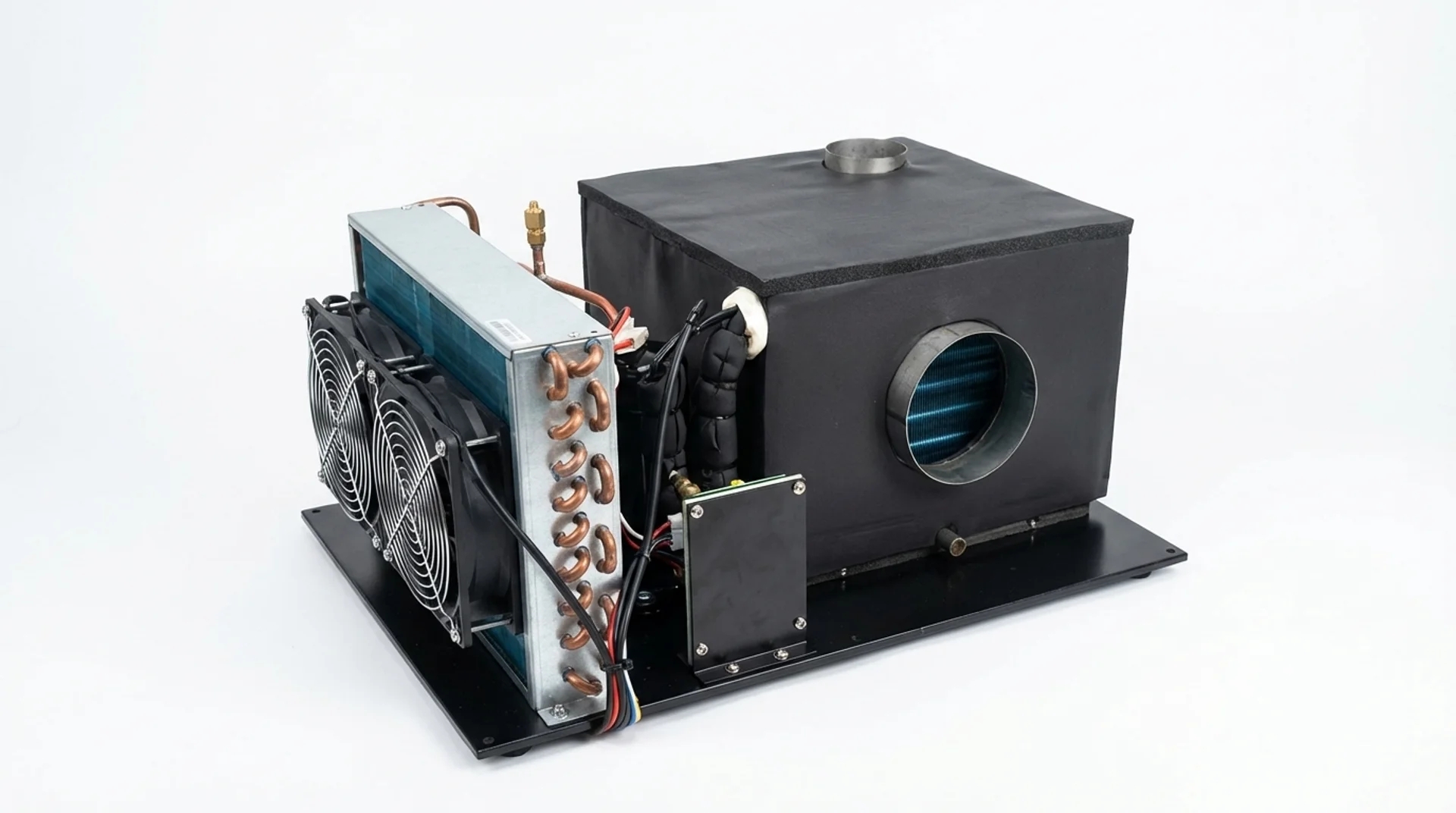
Modern free-piston Stirling cryocoolers (FPSC) have dramatically reduced the size-weight envelope. A unit delivering 100 W of input cooling in a package weighing 7 kg and operating at ≤48 dB represents a fundamentally different design point. For 77 K applications, units weighing just 4.0 kg are available. When you are evaluating a cryocooler for sale, always compare specific cooling power: watts of cooling per kilogram of cooler mass.
5. Budget Considerations
Cryocooler price varies enormously, from under $1,000 for small commercial coolers to $50,000 or more for space-qualified or custom units. The key cost drivers are:
- Temperature range. Reaching −80 °C costs less than reaching −196 °C. If your application only needs −80 °C, do not pay for −196 °C capability.
- Cooling power. Higher wattage at temperature costs more in materials and engineering.
- Certification. Medical-grade, MIL-spec, or space-qualified units carry certification costs that multiply the base price.
- Volume. Single-unit purchases carry higher per-unit costs than OEM volume orders. If you are integrating a cryocooler into a product, discuss volume pricing early.
- Total cost of ownership. A cryocooler that eliminates liquid-nitrogen consumption can save $3,000–$10,000 per year in consumables alone, paying for itself within 12–24 months.
When comparing cryocooler prices across suppliers, normalize to cost per watt of cooling at your target temperature. A cheaper unit that delivers less cooling at temperature may actually cost more per useful watt.
FPSC vs. Traditional Cryocooler Technologies
Buyers evaluating a cryocooler for sale will encounter three main technology families. Here is how they compare on the parameters that matter most for purchasing decisions:
| Parameter | Gifford-McMahon (GM) | Pulse Tube | Free-Piston Stirling (FPSC) |
|---|---|---|---|
| Typical weight | 30–100 kg | 15–50 kg | 4–7 kg |
| Power supply | AC only (typically) | AC only (typically) | 12–30 V DC |
| Moving parts | Motor + displacer + rotary valve | Motor + compressor (no cold moving parts) | Free piston + MagLev bearings (oil-free) |
| Noise level | 55–65 dB | 50–60 dB | ≤38–48 dB |
| Maintenance | Valve/seal replacement every 10,000–15,000 h | Low (no cold moving parts) | Minimal (no oil, no seals in contact) |
| Portability | Fixed installation | Semi-portable | Fully portable |
| Refrigerant | Helium (high-pressure system) | Helium | Helium (sealed, CFC-free) |
| Temperature range | 4 K to 80 K | 4 K to 80 K | 77 K to 273 K (0 °C) |
When to choose GM or Pulse Tube: If you need temperatures below 40 K (liquid-helium territory) for superconducting magnets, quantum computing dilution refrigerators, or particle physics detectors, GM and pulse-tube systems are currently the only mechanical options. These are large, AC-powered, laboratory-installed systems.
When to choose FPSC: If your application falls in the 77 K to 0 °C range—which covers the vast majority of medical, analytical, defense, food-science, and portable applications—a free-piston Stirling cryocooler offers decisive advantages in weight, power flexibility, noise, and total cost of ownership. The absence of oil eliminates contamination in clean environments. DC input enables vehicle, solar, and battery operation. And weights of 4–7 kg make true portability possible.
Matching Cryocooler Models to Application Requirements
To make the selection process concrete, here is how specific FPSC cryocooler configurations map to the application categories discussed above:
- Laboratory bench cooling (−40 °C to −100 °C): A 40 W, 12 V DC unit operating at ≤38 dB provides whisper-quiet cooling for sample preparation, detector stages, and small cryostats. The 12 V input allows operation from a benchtop power supply or even a laboratory UPS.
- Analytical instruments and biobank (−120 °C to −150 °C): An 80–100 W cryocooler at 24 V DC reaches the deep-cryogenic range needed for pharmaceutical storage, petroleum analysis, and cryogrinding. At ≤48 dB and 7 kg, it can be integrated directly into OEM instruments.
- Infrared detectors and defense sensors (77 K / −196 °C): A specialized 77 K module delivering >5 W of cooling at liquid-nitrogen temperature, weighing just 4.0 kg, replaces Joule-Thomson or Stirling-displacer coolers in thermal imagers and satellite sensors. The 12–30 V DC input range covers standard military and aerospace power buses.
- Vaccine cold chain (−86 °C to +4 °C): A purpose-built vaccine freezer with 1 L capacity, 100 W input, 12–24 V DC, and 13.5 kg total weight deploys in vehicles, boats, and aircraft for last-mile vaccine delivery. Temperature precision of ±0.1 °C satisfies WHO cold-chain requirements.
- Field and mobile deployment (−86 °C to 0 °C): A portable freezer with 10–40 L capacity, 100 W input at 12–30 V DC, and 17 kg total weight serves field research, disaster relief, and military medical units. The larger capacity handles batch sample storage while remaining vehicle-portable.
Every model listed above uses helium as the working gas, operates oil-free with magnetic-levitation (MagLev) bearings, and contains no CFCs or HFCs—making them compliant with Montreal Protocol and Kigali Amendment requirements without any refrigerant-management overhead.
Common Mistakes When Buying a Cryocooler
Having worked with customers across all six application sectors, we see the same purchasing mistakes repeatedly. Avoid these:
- Specifying no-load temperature instead of temperature at load. A cooler that reaches −196 °C at zero watts of heat input may only reach −160 °C under your 10 W thermal load. Always request performance curves showing temperature versus cooling power.
- Ignoring total cost of ownership. Liquid nitrogen costs $0.50–$2.00 per liter depending on location, and a typical lab dewar consumes 5–20 liters per day. Over five years, a mechanical cryocooler that eliminates LN₂ consumption saves $10,000–$50,000 in consumables alone—often more than the cryocooler price itself.
- Overspecifying temperature range. If you need −80 °C, buying a −196 °C system wastes money and may sacrifice cooling power at your actual operating temperature. Match the cooler to your requirement, not the most impressive spec sheet.
- Assuming AC-only is acceptable. Even if your primary installation has wall power, consider whether you might need field deployment, emergency backup, or vehicle transport in the future. Starting with a DC-compatible cryocooler keeps your options open at minimal additional cost.
Where to Find a Cryocooler for Sale
The cryocooler market includes large industrial manufacturers, specialty cryogenics companies, and direct-to-OEM suppliers. When evaluating where to buy, consider:
- Direct from manufacturer vs. distributor. Buying directly often provides better pricing, engineering support, and customization options. Distributors add convenience but may lack deep application knowledge.
- OEM vs. end-user pricing. If you are integrating cryocoolers into a product, negotiate OEM pricing based on annual volume commitments. Even modest volumes (10–50 units per year) can significantly reduce per-unit cost.
- Lead time. Standard cryocooler models may ship in 2–4 weeks. Custom configurations, especially those requiring specific cold-head geometries or specialized temperature controllers, may need 6–12 weeks.
- After-sales support. Confirm warranty terms, spare-parts availability, and whether the manufacturer provides application engineering support for integration. A cryocooler is a precision instrument—you want a supplier who can help you get the most out of it.
For FPSC-based cryocoolers covering the 77 K to 0 °C range with DC power input and compact form factors, explore the full product lineup including specifications, datasheets, and inquiry options. The range spans from 40 W single-cooler modules through 100 W high-capacity units to purpose-built vaccine and portable freezer systems.
Conclusion: Choosing the Right Cryocooler for Your Application
The cryocooler has evolved from a specialized laboratory curiosity into an enabling technology across medicine, defense, energy, food science, and field research. The shift from large, AC-powered GM and pulse-tube systems toward compact, DC-powered FPSC architectures has opened applications that were previously impractical—mobile vaccine cold chains, vehicle-mounted analytical instruments, battery-powered IR sensors, and solar-powered field stations.
The right purchasing decision comes down to five questions: What temperature do you need at load? How much cooling power does your thermal load require? Do you need DC power capability? How much weight and volume can you tolerate? And what is your total cost of ownership including consumables you can eliminate?
Answer those five questions, match them to the specifications of available models, and you will find the cryocooler that fits your application—whether it sits on a laboratory bench, flies on a satellite, or rides in the back of a truck delivering vaccines to a village clinic.