
Cryocooler Heat Rejection Decides How Cold the Cold End Gets
A Stirling cryocooler is usually selected on its cold-end specification — the temperature it reaches and the watts it lifts there. That is the right number to start from and the wrong number to stop at, because the cold end only performs as well as the warm end permits.
The relationship is arithmetic rather than approximate. A Stirling cooler rejects everything it removes from the cold tip plus everything it consumes electrically, and for these machines the electrical input is larger than the cooling capacity. Published guidance offers a concrete illustration: a 100 W cooler drawing 24 V at 6 A takes 144 W electrical, so the warm end has to dissipate roughly 244 W — around 2.4 times the cooling it produces.
Cryocooler heat rejection is therefore not a secondary consideration in the enclosure design. It is the constraint that determines whether the machine reaches its specified temperature at all, and this guide works through how to size it.
The Ratio That Surprises People
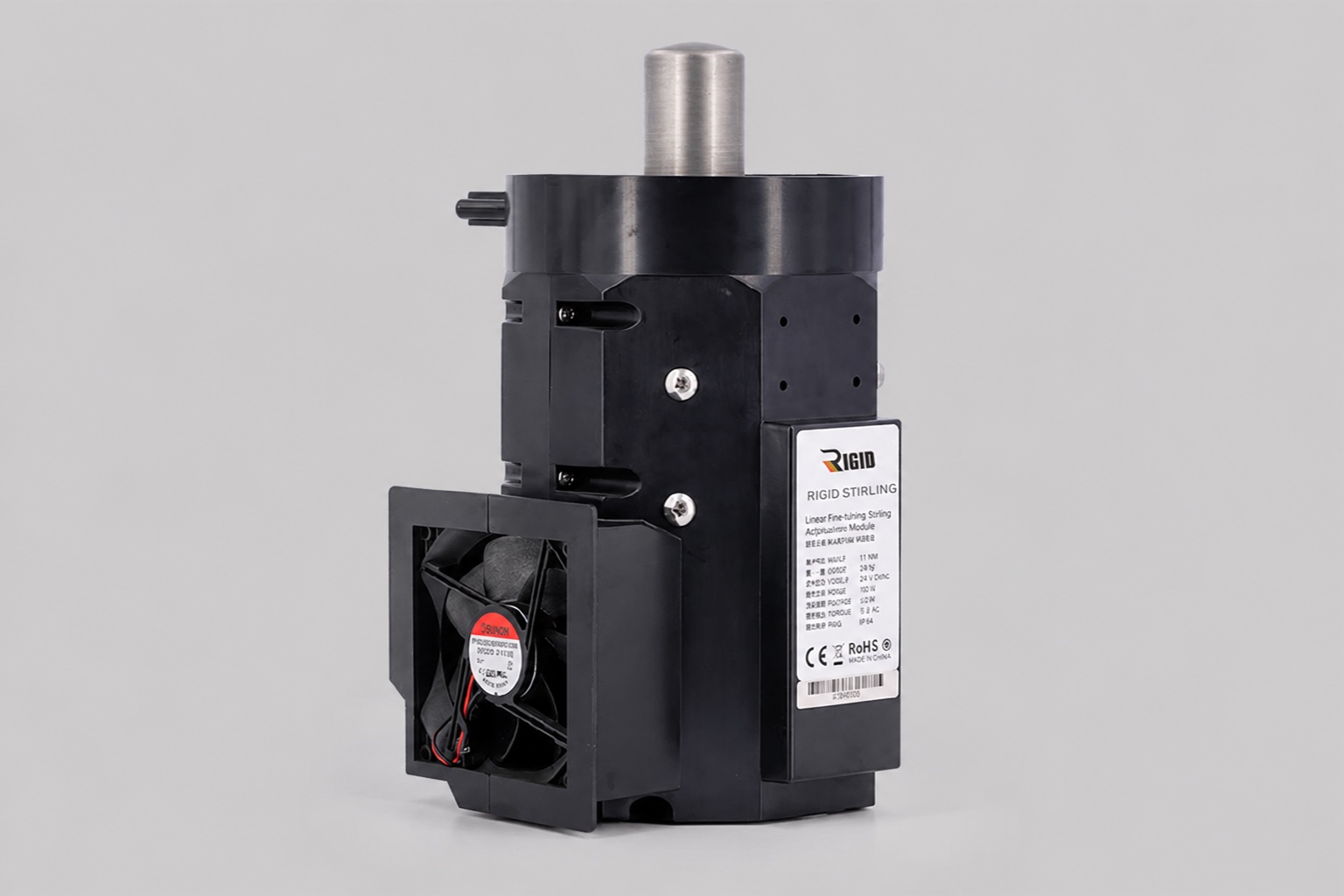 The cryocooler heat rejection ratio surprises people because vapor-compression engineers arrive with an intuition calibrated on a different ratio. A conventional refrigeration system with a coefficient of performance above 1 rejects less than twice what it removes. A Stirling cooler working at cryogenic temperatures operates far from that regime, and the rejection load is dominated by the electrical input rather than by the heat lifted.
| Quantity | Example figure | Where it comes from |
|---|---|---|
| Cooling capacity at the cold tip | 100 W | The specification being bought |
| Electrical input | 144 W (24 V × 6 A) | What the supply delivers |
| Total warm-end rejection | ≈ 244 W | Sum of the two |
| Design target for the rejection path | ≈ 293 W | 244 W plus 20 percent margin |
Put in airflow terms, that number becomes tangible. Carrying roughly 293 W on air at a 10 K temperature rise requires in the region of 25 liters per second of airflow — a real fan and a real path, not incidental ventilation. Halve the acceptable rise and the airflow doubles.
That final row follows established guidance to design the warm-end path with at least 20 percent margin above the calculated load. The practical consequence for an enclosure designer is direct: the thermal design problem is nearly 300 W of rejection, not the 100 W that appears on the datasheet. Enclosures sized against the cold-end number run hot and the machine underperforms.
How Reject Temperature Feeds Back to the Cold End
Cryocooler heat rejection is not merely a matter of getting rid of heat. The temperature at which it is rejected changes what the cold end can achieve.
Published guidance is explicit that a lower reject temperature improves performance, down to a point. The mechanism is straightforward: the machine works across the span between its warm and cold ends, and raising the warm end widens that span. Consequences:
- The achievable minimum cold-end temperature rises as the reject temperature rises.
- At a fixed cold-end temperature, the available cooling capacity falls.
- Electrical input for the same duty rises, which increases rejection further — a mild positive feedback.
So a poorly rejected machine does not simply run warm; it runs warm and demands more power and delivers less cooling. This is why a specification quoted at a favorable reject condition can be unreachable in a real enclosure.
Air or Liquid: What Each Path Delivers
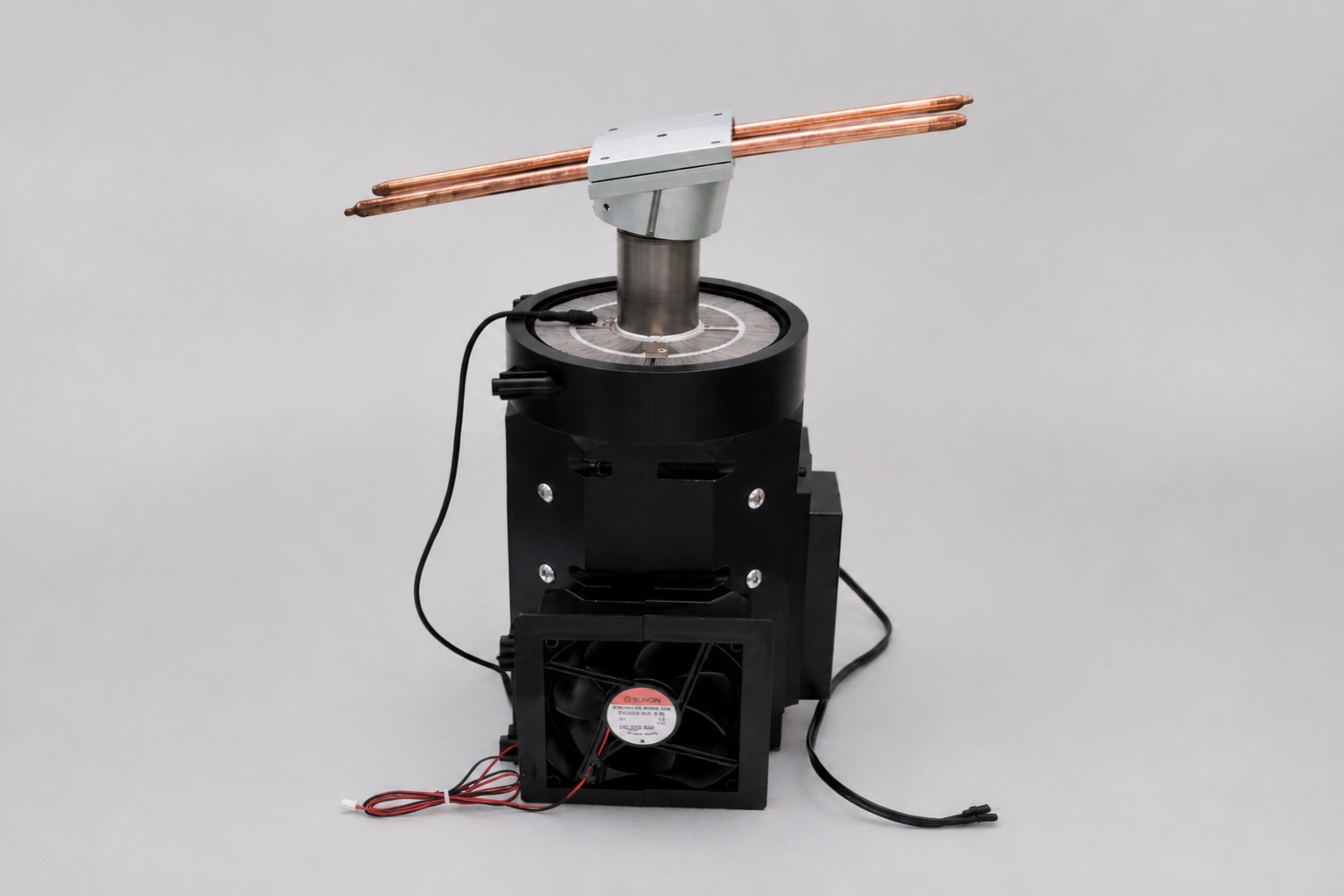 Cryocooler heat rejection can go to air or to liquid, and published figures give a useful sense of what each achieves. With an air fin rejecter in a 28 °C room, the rejecter itself sits around 35 °C — roughly 7 K above ambient. With a water jacket, the rejecter sits only 2 to 5 °C above the water temperature.
| Air fin | Water jacket | |
|---|---|---|
| Rejecter temperature | Roughly 7 K above ambient | 2–5 K above water temperature |
| Lowest achievable reject temperature | Limited by room ambient | Limited by the chiller supplying the water |
| Added components | Fan and ducting | Chiller, pump, hoses, coolant |
| Noise and vibration | Fan noise at the machine | Moved away from the instrument |
| Suits | Moderate ambient, moderate duty | Hot ambient, highest cold-end performance, sensitive instruments |
The second row is the decisive one. An air-rejected machine can never reject below room temperature, so in a 35 °C room its rejecter sits above 40 °C and the cold end pays for it. A water-jacketed machine can reject to whatever the supplying chiller holds — and if that is a sub-zero loop, the reject temperature can sit below ambient, which is the configuration that extracts the most from the cold end.
That combination is worth stating plainly: a recirculating chiller feeding a cryocooler’s water jacket is not redundant cooling. It is what allows the cryocooler to reach its specification.
Working the Rejection Design
Sizing cryocooler heat rejection follows a fixed order:
- Take the cold-end capacity you need at the temperature you need it.
- Add the electrical input at that operating point. This is the term most often omitted and it is usually the larger of the two.
- Add 20 percent margin, per established practice for the warm-end path.
- Decide air or liquid based on the reject temperature you need, not on convenience.
- For air, calculate the airflow required to carry that heat at an acceptable temperature rise, and confirm the enclosure can supply it without recirculation.
- For liquid, size the supplying chiller against the full rejection figure and confirm its capacity at the coolant temperature you intend to run.
- Verify by measuring the rejecter temperature in the installed enclosure at the worst realistic ambient, not on the bench.
Step 6 is where the FPSC range meets the rest of the product line. A cryocooler rejecting roughly 300 W into a water jacket needs a chiller sized for that load at the jacket temperature — which places it firmly in the range covered by a sub-zero recirculating machine rather than in the range of an incidental cooling loop.
Matching to the FPSC Range
| Model | Cooling capacity | Temperature range | Supply | Weight |
|---|---|---|---|---|
| FPSC-RS40 | 40 W | 0 °C to −100 °C | 12 V | 6 kg |
| FPSC-RS80 | 100 W | 0 °C to −120 °C | 24 V | not stated |
| FPSC-RS100 | 100 W | 0 °C to −150 °C | 24–30 V | 7 kg |
| FPSC-RS100 Plus | 100 W | 0 °C to −160 °C | 24–30 V | 7 kg |
| FPSC-RS100 Plus 77K | >5 W at −196 °C | −160 °C to −204 °C | 12–30 V | 4.0 kg |
| RG01L86 | 100 W | +4 °C to −86 °C | 12–24 V | not stated |
The published temperature ranges in that table are cold-end capabilities, and each was established at some reject condition. Where an application targets the bottom of a model’s range, the rejection path is not a detail — it is the difference between reaching that temperature and stopping several degrees short of it.
Two observations for rejection design. The 100 W models span very different minimum temperatures, which means the same rejection load is being asked to support different cold-end demands — and the colder the target, the more the reject temperature matters. And the 77 K model lifts only a few watts at its working temperature while still consuming electrical input, so its rejection load is dominated almost entirely by input power rather than by heat lifted.
Full model data is on the FPSC Stirling cooler product page. Where a water jacket is the chosen rejection path, the DV compact liquid chiller range at 100–550 W covers smaller duties, with sub-zero loops served by the MiniCool range at 450 W to 850 W across a published 0 °C to −40 °C range.
Where Rejection Design Goes Wrong
Sizing the enclosure on cold-end capacity
The commonest cryocooler heat rejection error is treating a 100 W machine as a 100 W thermal problem. The enclosure has to handle the sum of cooling and electrical input, which is well over twice that figure.
Assuming the datasheet reject condition
Cold-end specifications are quoted at some reject temperature. If the installation cannot achieve that temperature, the specification does not apply — and the shortfall appears as an instrument that never quite reaches its working point.
Air rejection in a hot or enclosed space
An air-rejected machine is bounded by ambient. In a sealed enclosure or a hot room, that bound may sit above what the application needs, and no amount of fan capacity moves it.
Ignoring the feedback
Poor rejection raises input power, which raises rejection load. Designs that are marginal degrade rather than settling, particularly as ambient rises.
Measuring on the bench and shipping the enclosure
An open machine on a bench rejects to an effectively unlimited room. The same machine in its production enclosure rejects into a confined volume that warms as it runs. Bench performance is not evidence about the installed condition, and the gap between them is entirely a rejection-path question.
Forgetting the margin
Established practice calls for at least 20 percent above the calculated load, and the calculated load itself contains assumptions. A rejection path designed exactly to the sum has no allowance for a dusty fin or a warm day.
Integration constraints in confined installations are covered in our guide to cryocooler integration in tight spaces, and selection across the range in our Stirling cryocooler selection guide.
If you want a rejection path checked, send the following and our engineers will advise: required cold-end temperature and capacity, expected electrical input at that point, maximum ambient, whether the machine is in a sealed enclosure, available airflow or water supply, acceptable noise and vibration at the instrument, and whether a recirculating chiller is already present. Send your installation details to our engineering team.
Frequently Asked Questions
How much heat does a Stirling cryocooler reject?
Cooling capacity plus electrical input. Published guidance illustrates this with a 100 W cooler drawing 24 V at 6 A: 144 W electrical plus 100 W lifted gives roughly 244 W at the warm end, and the rejection path should be designed with at least 20 percent margin above that. Cryocooler heat rejection is therefore around two and a half times the number on the cold-end specification.
Does reject temperature affect the cold end?
Directly. The machine works across the span between warm and cold ends, so raising the warm end raises the achievable minimum cold-end temperature and reduces capacity at any given cold temperature. Published guidance states that lower reject temperature improves performance, down to a point. A specification quoted at a favorable reject condition is not achievable in an installation that cannot reach that condition.
Air fin or water jacket?
Air is simpler and bounded by ambient — published figures put the rejecter around 7 K above room temperature. A water jacket sits only 2 to 5 K above the water temperature, so it can reject below ambient if the supplying loop is chilled. Choose water where the ambient is hot, where the cold end needs maximum performance, or where fan noise and vibration at the instrument are unacceptable.
Can I use a recirculating chiller to reject cryocooler heat?
Yes, and it is the configuration that extracts the most from the cold end. The chiller has to be sized for the full rejection load — cooling capacity plus electrical input plus margin — at the coolant temperature you intend to hold. For a machine rejecting around 300 W that is a real duty, not an incidental loop.
Why does my cryocooler not reach its rated temperature?
Rejection is the first thing to check, before suspecting the machine. Measure the rejecter temperature in the installed enclosure at the worst realistic ambient. If it sits well above the condition the specification was quoted at, the shortfall is explained. Poor rejection also raises input power, which increases the rejection load further, so marginal designs degrade rather than stabilize.
How much margin should the rejection path have?
At least 20 percent above the calculated load, per established practice — and remember the calculated load already contains assumptions about electrical input at the operating point. A path designed exactly to the sum has no allowance for a dust-loaded fin, a warmer than expected room, or an operating point that draws more than estimated.