
When an OEM thermal engineer specifies a DC air conditioner for an industrial product, the selection process looks nothing like shopping for a window unit. The engineer needs a cooling module that bolts into an existing chassis, runs on the same DC bus as the rest of the system, and maintains a target enclosure temperature without exceeding a strict power budget. Getting any of these wrong means a redesign cycle that costs months.
This guide walks through the selection process for DC air conditioner modules in industrial OEM applications—from matching cooling capacity to thermal load, through voltage and refrigerant selection, to the mechanical and electrical integration details that determine whether a module fits your product or forces a compromise.
DC Air Conditioner Module Selection Starts with Thermal Load
Every selection decision begins with the same question: how much heat does the enclosure generate? Not the ambient temperature, not the enclosure volume—the actual heat dissipation of the components inside. A telecom cabinet with 300W of active electronics needs a fundamentally different cooling module than an EV charging station dissipating 600W through its power conversion stage.
The calculation is straightforward in principle. Sum the power dissipation of every heat-generating component inside the enclosure. Add solar loading if the enclosure sits outdoors—typically 100-200W for a standard NEMA 4X cabinet in direct sunlight. Subtract any heat that escapes through the enclosure walls by conduction (usually negligible in well-insulated designs, significant in thin-wall sheet metal). The result is your required cooling capacity.
Where engineers get tripped up is the safety margin. A module rated at exactly the calculated thermal load will run at 100% duty cycle in worst-case conditions, which shortens compressor life and leaves zero headroom for component aging or unexpected heat sources. Standard practice is to specify 20-30% overcapacity. If your thermal load calculation shows 400W, select a module rated at 500-550W.
For Micro DC Aircon modules, the product line spans four cooling capacity tiers that map to common industrial thermal loads:
- 450W (1,535 BTU) — Entry tier. Covers enclosures with 300-350W internal heat load. Typical applications: small telecom cabinets, sensor housings, PLC enclosures.
- 550W (1,876 BTU) — Mid tier. Covers 380-430W heat loads. Typical applications: medium electronics cabinets, edge computing nodes, instrumentation enclosures.
- 700W (2,387 BTU) — High-performance tier. Covers 480-550W heat loads. Typical applications: EV charger cabinets, power conversion equipment, dense computing enclosures.
- 900W (3,069 BTU) — Flagship tier. Covers 620-700W heat loads. Typical applications: high-density server cabinets, multi-inverter enclosures, industrial automation panels with VFDs.
Voltage Matching: Why It Determines Your Module Choice
DC air conditioner modules run directly from the system DC bus. There is no inverter stage, no AC conversion—the compressor motor, fans, and control board all operate on the bus voltage. This eliminates 10-15% conversion loss compared to AC-powered alternatives, but it also means the module voltage must match your system exactly.
Three voltage platforms cover the vast majority of industrial DC systems:
12V systems are common in automotive-derived applications, small solar installations, and equipment designed around lead-acid or single-series lithium battery packs. The DV1910E-AC delivers 450W of cooling at 12V. The tradeoff at 12V is current—delivering 450W of cooling requires higher current draw than the same capacity at 24V or 48V, which means heavier wiring and more attention to voltage drop over cable runs.
24V systems represent the broadest application range. Most industrial equipment, telecom systems, and medium-duty mobile platforms operate on 24V DC buses. The full Micro DC Aircon lineup is available at 24V, from the 450W DV1920E-AC through the 550W DV3220E-AC, the 700W DV2820E-AC, and the 900W DV3820E-AC. For OEM integration, 24V is typically the default recommendation unless the system architecture dictates otherwise.
48V systems are increasingly common in telecom infrastructure, EV charging stations, and high-power battery storage systems. The DV1930E-AC (450W) and DV3830E-AC (900W) serve this voltage tier. The advantage of 48V is lower current for the same power, which simplifies wiring, reduces connector size, and minimizes resistive losses in long cable runs—a real benefit in telecom tower installations where the cooling module may sit meters away from the power source.
A critical integration note: these modules do not include voltage regulation. If your DC bus voltage fluctuates significantly (common in battery systems during charge/discharge cycles), verify that the module’s operating voltage range covers your bus voltage swing. Running a 24V module on a battery that sags to 20V under load or peaks at 28.8V during charging requires confirmation from the module specifications.
Refrigerant Selection: R134a vs R290 for Industrial Applications
Most Micro DC Aircon modules ship with R134a, a well-established HFC refrigerant with decades of field history in mobile and compact cooling systems. R134a offers predictable performance, wide component availability, and straightforward service procedures. For the majority of industrial OEM applications, R134a is the default choice.
The DV2820E-AC-T variant uses R290 (propane), a natural refrigerant with a Global Warming Potential of 3 compared to R134a’s GWP of 1,430. R290 also delivers slightly higher thermodynamic efficiency in the operating range typical of enclosure cooling (ambient 25-45°C, target 20-30°C internal). The tradeoff is that R290 is flammable (A3 classification), which introduces additional requirements for installation in some jurisdictions and applications.
For OEM engineers evaluating R290, the key considerations are:
- Charge quantity: Micro DC Aircon modules use small refrigerant charges. Regulations in many markets (including IEC 60335-2-40) permit A3 refrigerants below certain charge limits without requiring additional safety measures.
- Ventilation requirements: If the module is installed in a confined, unventilated space, local codes may require leak detection or mechanical ventilation.
- End-market regulations: Some industries (medical devices, certain military applications) have specific refrigerant restrictions. Verify before specifying R290.
- Sustainability mandates: If your product targets European markets or customers with corporate sustainability requirements, R290 may be preferred or required.
Both refrigerant options deliver the same 700W cooling capacity in the DV2820E-AC platform. The choice is driven by regulatory environment and end-market requirements, not by cooling performance.
Mechanical Integration: Fitting a Cooling Module into Your Product
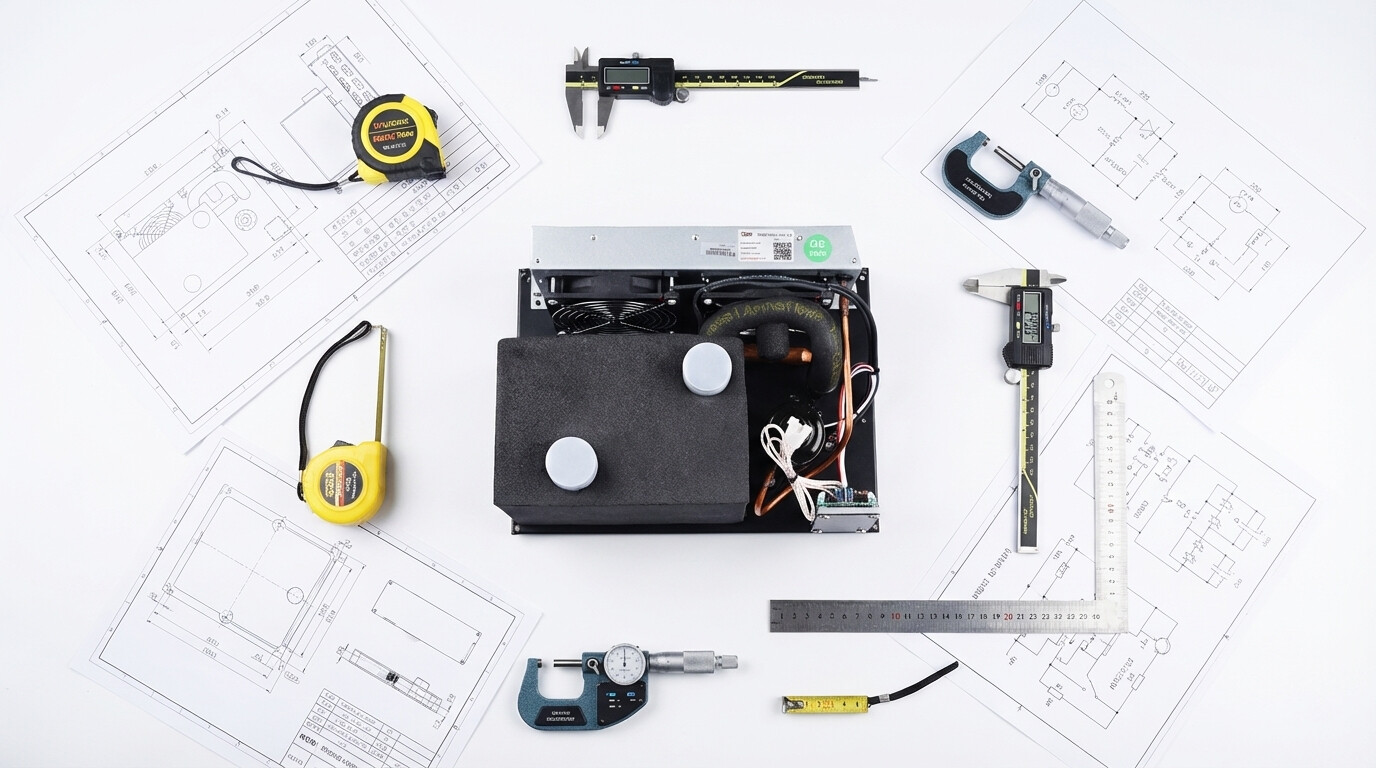
A DC air conditioner module is not a standalone appliance—it is a sub-assembly that must integrate into the OEM product’s mechanical envelope. The integration challenge has three dimensions: physical space, airflow path, and vibration management.
Physical space. Micro DC Aircon modules weigh approximately 11 pounds (5 kg) and are designed for confined-space installation. However, the module requires clearance on both the condenser side (outdoor/hot side) and the evaporator side (indoor/cold side) for adequate airflow. Blocking either side reduces cooling capacity and increases compressor cycling, which shortens component life. Minimum clearance recommendations vary by model—consult the engineering datasheet for your specific unit.
Airflow path. The module moves heat from the evaporator (inside the enclosure) to the condenser (outside). The condenser must reject heat to ambient air, which means it needs access to outside air that is not recirculated from the enclosure exhaust. In sealed enclosure designs, this is inherent—the condenser faces outward, the evaporator faces inward, and the enclosure wall provides the thermal boundary. In partially ventilated designs, ensure the condenser intake does not draw in heated exhaust air from the enclosure or adjacent equipment.
Vibration. The BLDC compressor generates vibration during operation, primarily at the compressor’s rotational frequency and its harmonics. In most stationary industrial applications, the module’s internal vibration isolation is sufficient. In mobile applications (vehicles, marine, field-deployed equipment), additional vibration isolation mounting may be required to prevent fatigue failures in refrigerant lines and electrical connections. RIGID provides vibration and shock mounting guidelines for mobile installations.
Electrical Integration: Power, Control, and Protection
Electrical integration involves three connections: power input, control interface, and protection circuits.
Power input is straightforward—connect the module to the DC bus through appropriately sized wiring and an overcurrent protection device (fuse or circuit breaker). Wire sizing depends on the module’s maximum current draw and the cable run length. For 24V systems, a 700W cooling module draws approximately 8A during normal operation, with brief inrush currents during compressor startup. Size the overcurrent protection for the inrush rating, not the steady-state draw.
Control interface. Micro DC Aircon modules include an onboard temperature controller that manages compressor speed based on the evaporator return air temperature. For OEM integration, the module can typically accept an external temperature setpoint signal or be configured to operate within a defined temperature band. Some models offer RS485 or dry contact interfaces for integration with building management systems or equipment controllers.
Protection circuits. The module includes built-in protection against high-pressure lockout, low-voltage cutoff, and compressor overtemperature. These protections are non-negotiable for reliability—do not bypass them. In OEM applications, the module’s fault output signal should be wired to the host system’s alarm or monitoring interface so that cooling failures are detected before thermal damage occurs.
When to Choose Micro DC Aircon Over Alternatives
DC air conditioner modules compete with several alternative cooling technologies. The selection depends on the application’s specific constraints:
Versus thermoelectric (Peltier) coolers: Peltier coolers are simpler and have no moving parts, but their efficiency is 3-5 times lower than vapor compression at the same cooling capacity. For heat loads above 100W, the power consumption penalty of Peltier cooling becomes prohibitive in battery-powered or power-constrained applications. Micro DC Aircon modules deliver 450-900W of cooling at efficiencies that Peltier technology cannot match at any scale.
Versus filtered fan ventilation: Fans are the lowest-cost cooling option, but they only work when ambient air is cooler than the target enclosure temperature. They also introduce dust, moisture, and contaminants into the enclosure. For sealed enclosures, outdoor installations, or any application where the enclosure must maintain a temperature below ambient, fans are not an option—active refrigeration is required.
Versus traditional AC-powered air conditioners: If grid power is available and the installation is stationary, a conventional AC air conditioner may be simpler. But in battery-powered, solar-powered, vehicle-mounted, or remote off-grid applications, the DC air conditioner eliminates the inverter, reduces system weight, and improves overall energy efficiency by 15-25%.
The decision framework is simple: if your application runs on DC power, operates in a sealed or contaminated environment, and generates more than 100W of heat, a DC air conditioner module is likely the most efficient and reliable cooling solution available.
For detailed specifications and OEM integration support, visit the Micro DC Aircon product page.
Real-World Deployment: What the Datasheet Does Not Tell You
Datasheets provide rated cooling capacity at standard test conditions—typically 35°C ambient and 55°C return air temperature. Real-world installations rarely match these conditions, and the performance gap catches engineers who design to datasheet numbers without applying derating factors.
High ambient temperature. When ambient temperature exceeds 35°C, condenser efficiency drops because the temperature differential between the refrigerant and ambient air decreases. At 50°C ambient—common in Middle Eastern telecom installations and sun-exposed outdoor cabinets—expect 15-25% capacity reduction from rated values. If your worst-case ambient is 50°C and your thermal load is 400W, you need a module rated at 550-600W, not 450W.
Altitude. Air density decreases with altitude, reducing both condenser and evaporator heat transfer. At 3,000 meters—common for telecom relay stations in mountainous regions—air density is approximately 70% of sea-level values. This does not reduce cooling capacity by 30%, because the compressor still moves the same mass of refrigerant, but it does reduce airside heat transfer, which can lower effective capacity by 8-12%.
Dust and contamination. Condenser coil fouling is the most common cause of gradual performance degradation in field-deployed DC air conditioner modules. In dusty environments—construction sites, mining operations, agricultural settings—condenser airflow restriction can reduce cooling capacity significantly within months if the coils are not cleaned. Sealed enclosure designs inherently protect the evaporator coil, but the condenser, which must exchange heat with ambient air, remains exposed. Specify modules with accessible condenser coils and establish a maintenance interval based on the deployment environment.
Continuous vs intermittent duty. Some applications require 24/7 cooling (telecom cabinets, battery storage systems), while others cycle with equipment operation (mobile test stations, field-deployed instruments). Continuous-duty applications stress the compressor more heavily and benefit from variable-speed operation, which reduces average compressor speed and extends bearing life. All Micro DC Aircon modules use variable-speed BLDC compressors that modulate capacity to match load, making them suitable for continuous-duty applications without the on-off cycling that shortens fixed-speed compressor life.
The selection process for a DC air conditioner module is methodical, not complicated. Start with the thermal load, match the voltage, choose the refrigerant based on regulatory requirements, verify the mechanical fit, and apply appropriate derating for your deployment environment. The result is a cooling solution that integrates cleanly into your product and operates reliably for the life of the equipment.