
DC Air Conditioner vs Evaporative Cooler: Engineering the Right Choice for Sealed Enclosures
When specifying a cooling solution for a vehicle cabin, telecom shelter, or equipment enclosure, the decision often comes down to two fundamentally different technologies: DC-powered vapor compression air conditioning and portable evaporative cooling. Both claim to solve the same thermal management problem. In practice, they operate on entirely different physical principles — and those differences determine whether your system actually maintains target temperatures or simply moves humid air around while heat loads continue to climb.
This comparison breaks down the thermodynamics, application boundaries, and real-world performance of each approach. If you’re designing cooling into a sealed or semi-sealed system running on DC power, the distinction matters more than most product spec sheets suggest.
How Each Technology Actually Works
Vapor Compression (DC Air Conditioning)
A DC air conditioner operates on the same refrigeration cycle used in residential and automotive HVAC — compressed refrigerant absorbs heat from indoor air through an evaporator coil, then rejects that heat to the outdoors through a condenser. The critical distinction: this is a heat pump. It physically moves thermal energy from inside to outside, achieving temperatures well below ambient regardless of humidity conditions.
Modern micro DC aircon units use brushless DC compressors that run directly from 12V or 24V battery systems without requiring AC inverters. The compressor, condenser, evaporator, and expansion device form a closed refrigerant loop. Refrigerant changes phase — liquid to gas at the evaporator (absorbing heat from enclosure air), gas to liquid at the condenser (releasing heat to the external environment). The net effect: the enclosed space gets progressively cooler while absorbed heat exits through the externally-mounted condenser.
The thermodynamic coefficient of performance (COP) for these systems typically ranges from 2.0 to 3.5, meaning each watt of electrical input moves 2 to 3.5 watts of thermal energy out of the enclosure. This energy multiplication is fundamental to why vapor compression dominates precision cooling applications.
Evaporative Cooling
An evaporative cooler passes air over a wet medium — typically a cellulose pad, aspen fiber, or similar wicking material. As water evaporates from the pad surface, it absorbs latent heat from the air stream, reducing the dry-bulb temperature of the air passing through. No refrigerant, no compressor, no mechanical phase-change cycle. The “cooling” comes entirely from the water’s phase change from liquid to vapor.
This process is adiabatic — the total heat content (enthalpy) of the air doesn’t decrease. The air gets cooler in terms of dry-bulb temperature but gains moisture content, increasing its wet-bulb temperature. You’re trading sensible heat for latent heat, not removing heat from the space. The air feels cooler on skin due to lower temperature, but the total thermal energy in the room remains unchanged.
Maximum theoretical cooling equals the wet-bulb depression multiplied by airflow mass. In practice, evaporative effectiveness ranges from 70-90% of the theoretical maximum, depending on pad design, airflow velocity, and water distribution uniformity.
The Sealed Enclosure Problem
Here’s where the engineering reality diverges sharply from marketing claims. In a sealed or semi-sealed enclosure — a vehicle cabin with windows closed, a telecom cabinet, an equipment housing, a medical device compartment, or a battery storage container — evaporative cooling faces three fundamental physical limitations that cannot be engineered around:
1. Humidity Saturation
Evaporative cooling adds moisture to the air with every pass through the wet media. In an open environment, humid exhaust air disperses into the atmosphere and is replaced by fresh, drier air. In a sealed space, relative humidity climbs rapidly toward saturation. Once the enclosed air reaches 80-90% RH, the vapor pressure differential between the wet pad and the air stream drops to near zero. Evaporation slows dramatically and cooling output collapses.
The result: you’re left with a warm, humid enclosure — objectively worse than where you started. For electronics, high humidity accelerates corrosion, promotes dendrite growth on circuit boards, and can cause condensation when temperatures fluctuate. For human occupants, high humidity impairs the body’s evaporative cooling mechanism (sweating), making the space feel hotter despite unchanged air temperature.
2. No Sub-Ambient Cooling Capability
An evaporative cooler cannot reduce air temperature below the wet-bulb temperature of the incoming air. This is a hard thermodynamic limit, not a design constraint that better engineering can overcome. In humid climates (Southeast Asia, coastal regions, tropical zones, monsoon seasons), the wet-bulb temperature may already be 26-28°C. If your equipment needs 25°C or your cabin target is 22°C, evaporative cooling physically cannot reach those temperatures regardless of unit size, pad area, or airflow rate.
Consider a typical scenario: ambient conditions of 35°C dry-bulb, 70% RH. The wet-bulb temperature is approximately 30.5°C. An evaporative cooler at 85% effectiveness can reduce supply air to about 31.2°C — barely perceptible cooling, and certainly not adequate for equipment protection or occupant comfort in a sealed space.
3. Climate and Seasonal Dependency
Evaporative cooling effectiveness is directly proportional to the wet-bulb depression — the gap between dry-bulb and wet-bulb temperatures. In arid climates (desert regions, dry continental interiors), this gap can be 15-20°C, providing substantial cooling potential. In humid climates, the gap shrinks to 2-4°C of available cooling capacity.
A system that delivers 12°C of temperature reduction in Phoenix (15% RH summer afternoon) provides only 3°C in Houston (75% RH summer afternoon). For equipment deployed across multiple climate zones — fleet vehicles, distributed telecom infrastructure, mobile medical units — this variability makes evaporative cooling impossible to specify with confidence.
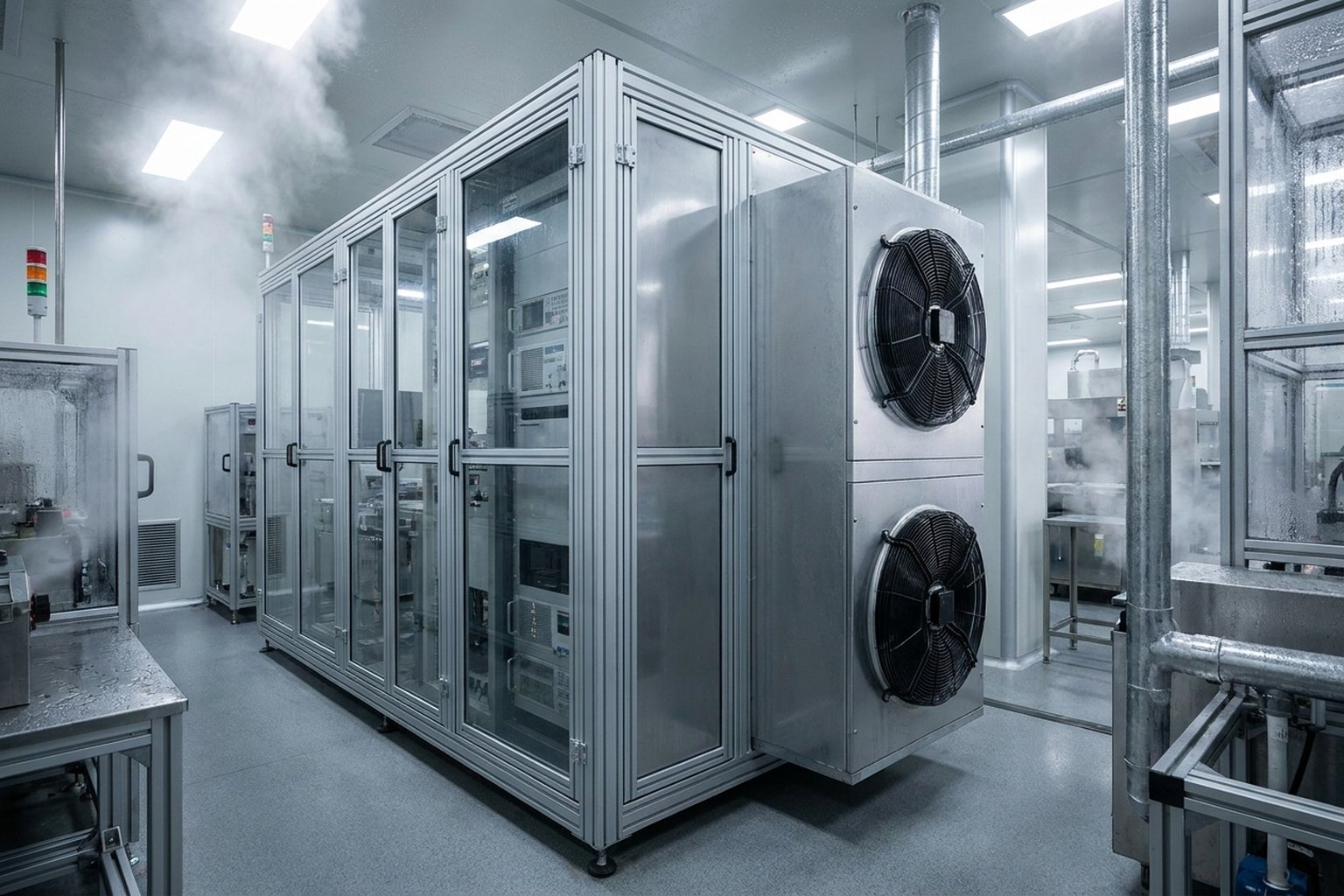
DC Air Conditioner Advantages in Enclosed Applications
Vapor compression addresses each of the above limitations directly through fundamentally different physics:
True Heat Removal
A DC air conditioner doesn’t redistribute energy within the space — it pumps heat out. The condenser rejects absorbed thermal energy to the external environment. Net thermal energy inside the enclosure decreases with every operating minute. This is actual cooling in the thermodynamic sense: reducing the total enthalpy of the enclosed air mass, not merely shifting energy between sensible and latent forms.
Sub-Ambient Temperature Control
Because the refrigeration cycle operates independently of ambient humidity, a DC aircon unit can maintain enclosure temperatures 15-20°C below ambient. Equipment that needs 25°C in a 45°C desert environment? Achievable with appropriate system sizing. A vehicle cabin at 22°C when it’s 38°C outside? Standard operating range for a properly specified unit. The cooling capacity is determined by compressor displacement and refrigerant charge, not by atmospheric moisture content.
Active Dehumidification
The evaporator coil operates below the dew point of incoming air. Moisture condenses on the coil surface and drains away as liquid water. The DC air conditioner simultaneously cools and dehumidifies — critical for electronics protection, corrosion prevention, optical instrument clarity, and human comfort. Evaporative coolers do the exact opposite, adding moisture that accelerates component degradation, promotes biological growth, and compromises enclosure integrity.
Climate Independence
Whether deployed in Saudi Arabia, Singapore, Norway, or Brazil, a vapor compression system delivers consistent cooling capacity. Performance varies with ambient temperature (higher ambient increases condenser pressure and reduces efficiency), but the system functions reliably across the full range of global climates. No seasonal performance cliffs, no geographic limitations, no dependency on local humidity conditions.
When Evaporative Cooling Is the Right Choice
Engineering honesty requires acknowledging where evaporative cooling genuinely excels. It’s not a bad technology — it’s a technology with specific, well-defined application boundaries:
- Open-air environments: Warehouses with open bay doors, outdoor patios, agricultural buildings, construction sites, and loading docks where humid exhaust air disperses freely into the atmosphere. No humidity buildup occurs because the space continuously exchanges air with the outdoors.
- Arid climates with adequate ventilation: In regions with consistent low humidity (below 30% RH) and sufficient exhaust ventilation to prevent moisture accumulation, evaporative coolers deliver meaningful temperature reduction at a fraction of the energy cost of vapor compression.
- Human comfort in open industrial spaces: Spot cooling for workers in large, ventilated facilities where the goal is perceived comfort improvement rather than precise temperature control. The combination of air movement and slight temperature reduction provides meaningful relief.
- Budget-constrained, non-critical applications: Where the cooling target is “better than nothing” rather than a specific temperature setpoint, where humidity increase is acceptable, and where equipment sensitivity to moisture is not a concern.
Evaporative coolers cost less upfront (typically 40-60% less than equivalent-capacity DC aircon), use no refrigerant, consume significantly less electrical power (often 75% less), and require simpler maintenance (periodic pad replacement and water system cleaning). These are genuine, meaningful advantages in appropriate applications. The failure mode isn’t the technology itself — it’s misapplication to sealed environments where the underlying physics don’t support the approach.
Micro DC Aircon: Purpose-Built for Enclosed DC-Powered Systems
For system integrators and equipment designers working with sealed or semi-sealed enclosures on DC power, the Micro DC Aircon product line addresses the specific constraints of battery-powered and vehicle-mounted cooling applications:
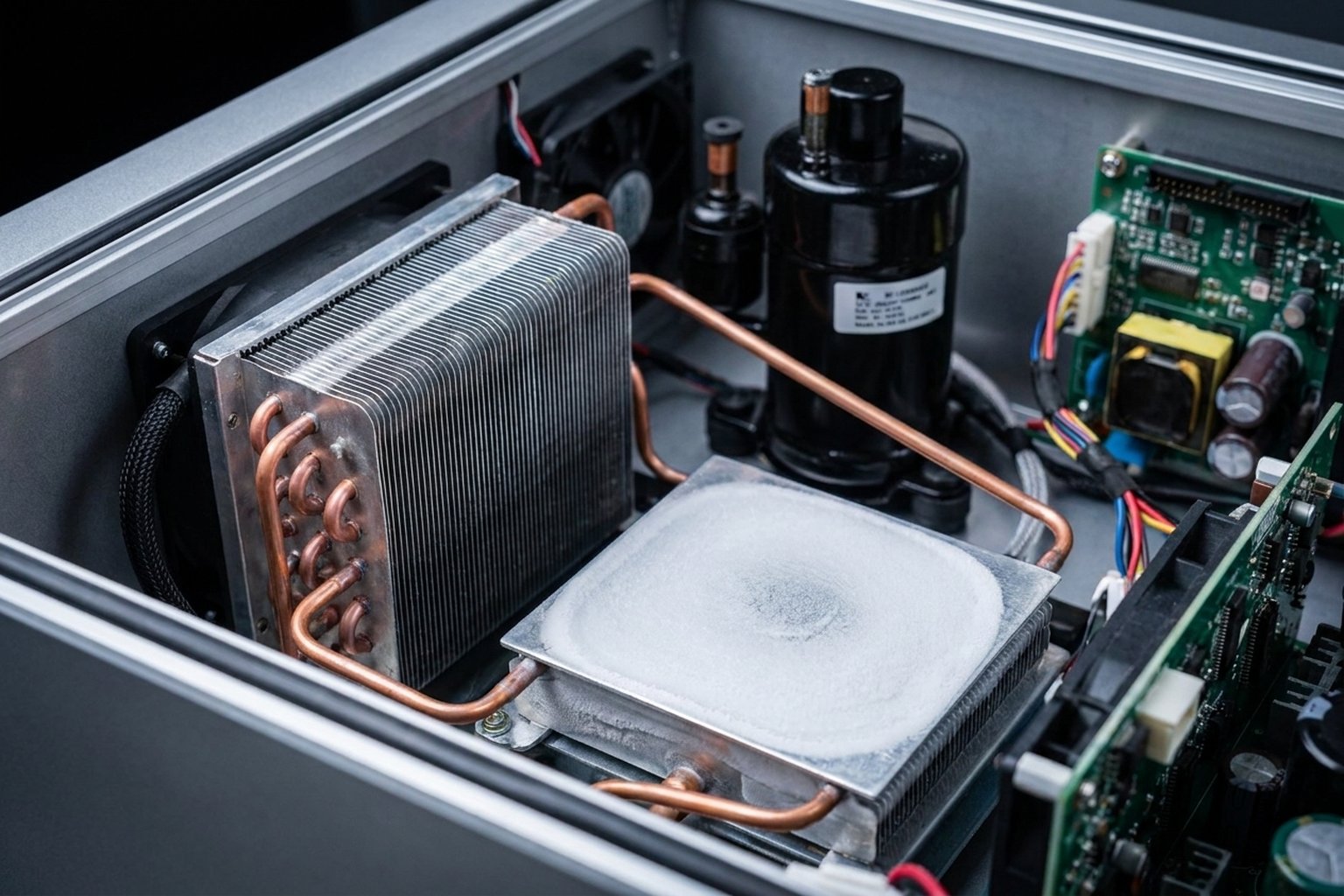
Available Configurations
| Model | Voltage | Power | Current Draw |
|---|---|---|---|
| DV1910E-AC | 12V DC | 450W | 16A |
| DV1920E-AC | 24V DC | 450W | 8A |
| DV2820E-AC | 24V DC | 700W | 8A |
| DV3820E-AC | 24V DC | 900W | — |
The range spans from compact 450W units suitable for small equipment enclosures and single-occupant vehicle cabins up to 900W systems capable of managing larger thermal loads in multi-equipment shelters or commercial vehicle applications. All models operate directly from DC bus voltage without intermediate power conversion.
Key Engineering Characteristics
- Direct DC operation: 12V and 24V models eliminate inverter requirements for battery-powered systems, reducing component count, conversion losses (typically 8-15% with inverters), and potential failure points in the power chain.
- Variable speed BLDC compressor: Brushless DC motor allows continuous capacity modulation to match instantaneous thermal load. This reduces cycling losses, extends compressor life, and maintains tighter temperature control compared to fixed-speed on/off operation.
- Compact packaging: Designed for integration into space-constrained enclosures — vehicle roof assemblies, equipment cabinet sidewalls, under-bench installations — rather than standalone floor placement that consumes usable interior volume.
- Sealed system compatibility: Split configuration with indoor evaporator unit and outdoor condenser unit maintains enclosure integrity. No ventilation openings required, preserving IP-rated dust and water protection.
- Active humidity management: Condensate removal at the evaporator actively dehumidifies the enclosed space, protecting sensitive equipment from moisture-related degradation.
Decision Framework: Selecting the Right Technology
Rather than a blanket recommendation, apply these decision criteria to your specific application requirements:
Specify DC Air Conditioning When:
- The enclosure is sealed or has minimal ventilation (IP-rated cabinets, closed vehicle cabins, weatherproof shelters)
- Target temperature must be maintained below ambient conditions
- Humidity control matters (electronics cooling, instrument protection, pharmaceutical storage, human comfort in closed spaces)
- The system operates across multiple climate zones or seasons with varying humidity
- Precise temperature setpoints are required for equipment reliability or process control
- The application involves moisture-sensitive equipment (PCBs, optical systems, battery packs, medical devices)
- Continuous, predictable cooling capacity is required regardless of weather conditions
Specify Evaporative Cooling When:
- The space is open or well-ventilated with free air exchange to outdoors
- Operating climate is consistently arid (below 30% RH) throughout the cooling season
- The cooling target is relative comfort improvement, not an absolute temperature setpoint
- Power budget is extremely limited and sub-ambient cooling isn’t required
- Initial cost is the primary constraint and performance requirements are flexible
- Humidity increase within the space is acceptable or even beneficial (some agricultural applications)
Total Cost of Ownership Analysis
The upfront cost comparison favors evaporative cooling — typically 40-60% less expensive for equivalent airflow ratings. However, total cost of ownership in sealed enclosure applications often reverses this equation when examined over a 5-year deployment horizon:
- Maintenance frequency: Evaporative coolers in sealed or poorly-ventilated spaces saturate quickly, leading to frequent pad replacements (monthly in humid climates vs. annually in arid ones), water system descaling, and biological growth management. DC aircon units with BLDC compressors typically operate 30,000+ hours before requiring major service intervention.
- Collateral damage costs: Humidity damage to electronics, corrosion of metal components, mold growth on surfaces, and condensation-related short circuits in sealed spaces create repair and replacement costs that can dwarf the cooling system’s initial price difference many times over.
- Effective energy consumption: While evaporative coolers use less power per unit of airflow, they may run continuously without reaching setpoint in humid conditions — consuming power without delivering useful cooling. A properly sized DC aircon cycles based on thermostat demand, with actual energy consumption proportional to thermal load rather than continuous maximum draw.
- System modification costs: Specifying evaporative cooling for a sealed enclosure often requires adding ventilation pathways — cutting openings, adding exhaust fans, installing louvers, and compromising the enclosure’s dust and water ingress protection rating. These modifications may cost more than the price difference between cooling technologies, while degrading the enclosure’s environmental protection.
Common Specification Errors to Avoid
From field deployment experience, these are the most frequent thermal management specification errors encountered in DC-powered enclosed systems:
Evaporative cooler in a vehicle cabin with windows closed: Humidity builds within 15-20 minutes of operation. Windshield fogs internally. Occupant comfort degrades rather than improves as skin moisture cannot evaporate. The cooler appears to work initially (first few minutes while air is still relatively dry) then fails progressively as the cabin air saturates.
Evaporative cooler in a telecom shelter: Equipment racks generate heat continuously (often 2-5 kW in a small shelter). The cooler adds moisture to already-warm air without removing heat. Condensation forms on cold surfaces (cable entries, structural members) when ambient temperature drops at night. Circuit board corrosion accelerates. Mean time between failures for rack equipment drops significantly.
Oversized DC aircon for intermittent loads: A 900W cooling unit serving a small enclosure with only a 200W steady-state heat load will short-cycle — compressor starts, rapidly cools the small air volume, shuts off, temperature rises, restarts. This cycling pattern reduces compressor life and wastes energy on repeated startups. Proper sizing — matching cooling capacity to actual thermal load with 20-30% safety margin — delivers better performance and longer equipment life than maximum oversizing.
Ignoring solar gain: Enclosures exposed to direct sunlight can absorb 200-500W of additional thermal load through their surfaces. A cooling system sized only for internal equipment heat loads will be undersized during peak solar exposure hours. Include solar gain calculations in your thermal load assessment.
Integration Guidance for System Designers
When specifying DC air conditioning for an enclosed system, address these integration factors during the design phase:
- Condenser placement and airflow: The condenser must reject absorbed heat to the external environment. Ensure adequate clearance and unobstructed airflow across condenser coils — restricted airflow reduces cooling capacity and increases compressor power consumption. Minimum 150mm clearance on the air intake side is typical.
- Condensate management: The evaporator produces liquid water proportional to the dehumidification load. Route condensate drain lines with appropriate slope — gravity drain where elevation permits, condensate pump where it doesn’t. In freezing environments, consider heated drain lines or internal evaporation trays.
- Electrical integration: DC systems eliminate inverter complexity but require appropriate wire gauge for the current draw at operating voltage. A 12V/16A unit (DV1910E-AC) needs significantly heavier wiring than a 24V/8A unit (DV1920E-AC) delivering equivalent power. Include voltage drop calculations for cable runs exceeding 2 meters.
- Thermal load calculation: Sum all heat sources within the enclosure — equipment waste heat, solar gain through enclosure walls, air infiltration loads through seals and cable entries, and occupant metabolic heat if applicable. Size the cooling system to exceed this total with 20-30% margin for degradation and extreme conditions.
- Control interface: Most micro DC aircon units accept thermostat input for automated temperature control. Verify control signal voltage and protocol compatibility with your system’s automation or BMS platform. Some applications benefit from remote monitoring of compressor status and temperature trends.
Conclusion: Let the Physics Guide Your Specification
The choice between DC air conditioning and evaporative cooling isn’t a matter of brand preference or marketing persuasion — it’s determined by thermodynamic principles that don’t bend to wishful thinking. Evaporative cooling works by adding moisture to air in exchange for sensible temperature reduction. In any application where that moisture cannot freely exhaust to the atmosphere, the technology reaches its physical limits within minutes of operation.
DC vapor compression works by pumping heat out of the enclosed space using a refrigerant cycle that operates independently of ambient humidity. In any application requiring sub-ambient temperatures, humidity control, or climate-independent performance in a sealed environment, it’s the only approach that functions as specified across all operating conditions.
For fleet managers evaluating cabin cooling options, equipment designers protecting sensitive electronics, or system integrators specifying thermal management for enclosed DC-powered systems: understand the thermodynamic boundaries of each technology, match the solution to your actual operating conditions and enclosure characteristics, and specify accordingly.
If your application involves a sealed or semi-sealed enclosure on DC power, request an engineering assessment with your specific thermal load data, enclosure dimensions, ambient temperature range, humidity conditions, and target temperature requirements. The right specification starts with the right physics — and the right physics start with honest assessment of your application’s actual constraints.