
Why Solar-Powered Sites Need Purpose-Built DC Air Conditioning
Remote installations that rely on solar power face a cooling challenge that conventional air conditioning simply cannot solve. Telecom shelters baking under desert sun, environmental monitoring stations in tropical forests, and off-grid cabins in arid regions all share the same problem: sensitive equipment and occupants need reliable cooling, but there is no utility grid to tap into.
Traditional AC-powered cooling systems require inverters to convert stored DC battery power into alternating current. Every conversion step bleeds energy. In a solar-powered system where every watt-hour is precious, that conversion loss can mean the difference between a system that runs through the night and one that shuts down at 2 AM when batteries dip below threshold.
DC air conditioning eliminates the inverter entirely. The compressor, fans, and control electronics all run directly from the DC bus that your solar panels and batteries already provide. No conversion. No wasted energy. No additional point of failure.
This article walks through the practical system design considerations for integrating dc air conditioning into solar-powered installations — from load calculation and battery architecture to mounting, ducting, and real-world deployment scenarios.
Understanding the DC Solar Cooling Architecture
A solar-powered dc air conditioning system consists of four core subsystems that must work together as a unified design:
Solar Array: Photovoltaic panels generate DC electricity. The output voltage and current vary with irradiance, temperature, and panel configuration. Panels can be wired in series or parallel to match the nominal system voltage — typically 12V, 24V, or 48V for small off-grid installations.
Charge Controller: An MPPT (Maximum Power Point Tracking) or PWM charge controller regulates the flow of energy from the panels to the battery bank. MPPT controllers are strongly preferred for cooling applications because they extract significantly more energy from the panels under partial shade and varying conditions.
Battery Bank: Lithium iron phosphate (LiFePO4) batteries have become the standard for off-grid solar systems due to their deep discharge tolerance, long cycle life, and stable voltage curves. Lead-acid batteries still work but require larger capacity to deliver the same usable energy because they should not be discharged below 50%.
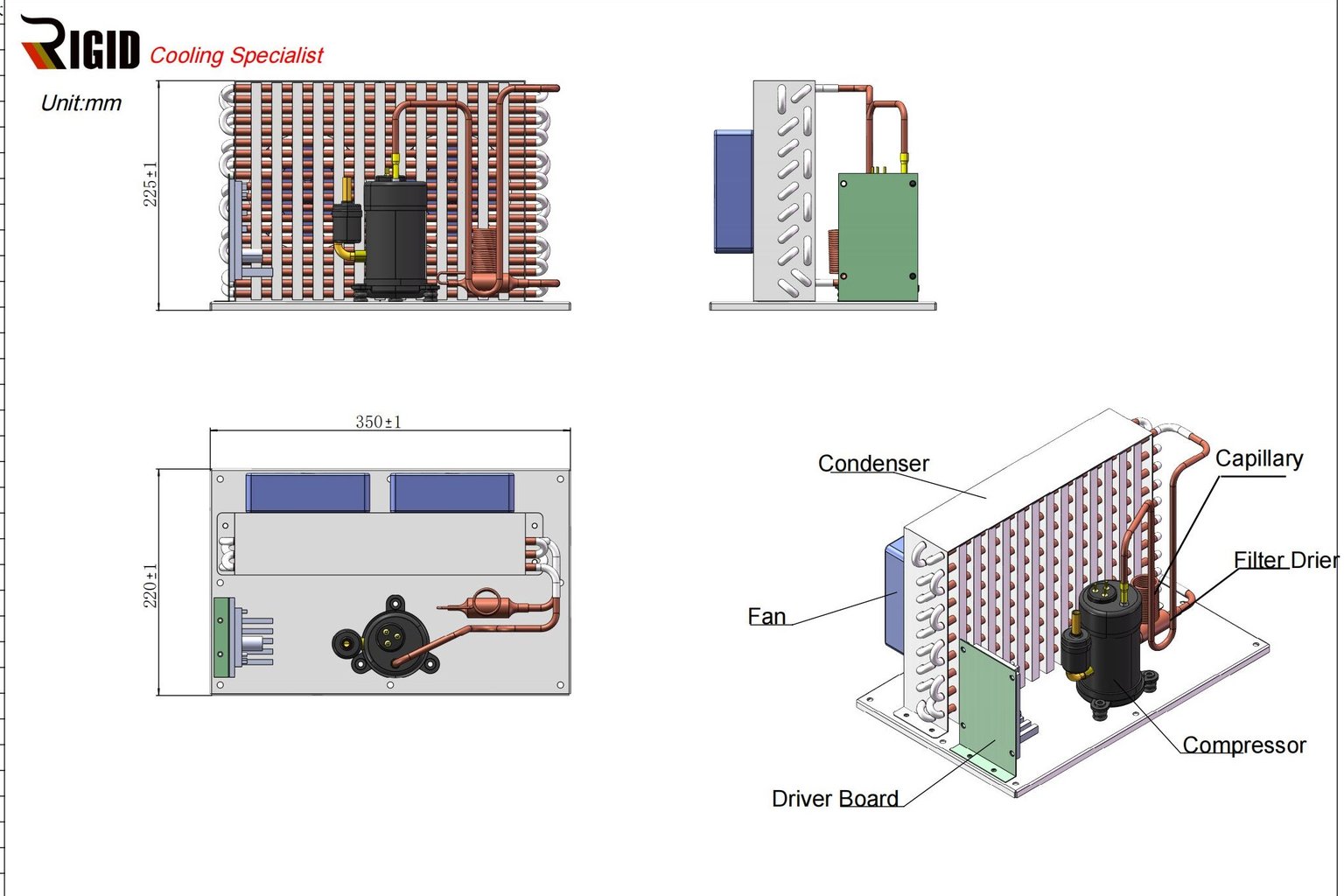
DC Air Conditioning Unit: The cooling system connects directly to the DC bus. A well-designed dc air conditioning unit uses a brushless DC (BLDC) variable-speed compressor that adjusts its speed based on thermal demand. When the space is near setpoint, the compressor slows down and draws less power. When the heat load spikes, it ramps up. This variable-speed behavior is inherently compatible with the fluctuating nature of solar energy availability.
Thermal Load Assessment for Off-Grid Sites
Before selecting any cooling hardware, you need to understand how much heat your installation actually generates and absorbs. Skipping this step is the single most common reason solar cooling systems underperform.
Heat enters an off-grid enclosure from three sources:
Internal heat generation: Every piece of electronic equipment inside the enclosure converts electricity into heat. Telecom radios, routers, battery chargers, monitoring computers, and power supplies all contribute. Add up the rated power consumption of every device — that total, in watts, is roughly equal to the internal heat load.
Solar heat gain: Direct sunlight striking the enclosure walls and roof transfers heat inward. The magnitude depends on wall material, insulation thickness, surface color, and geographic latitude. A white-painted, insulated telecom cabinet in Arizona will absorb far less solar heat than an uninsulated dark metal box in the same location.
Ambient conduction: When outside air temperature exceeds the desired interior temperature, heat conducts through the enclosure walls. Better insulation reduces this load, but it never eliminates it entirely.
For small off-grid sites — the kind where dc air conditioning makes the most sense — total cooling loads typically fall in the range of a few hundred watts to around 3,000 BTU. This is precisely the operating range where compact DC cooling units excel, and where oversized conventional systems would be wasteful and impractical.
Matching DC Air Conditioning to Your Solar Voltage Bus
One of the most important design decisions is matching the dc air conditioning unit’s input voltage to your solar system’s nominal bus voltage. Mismatches require DC-DC converters, which reintroduce the efficiency losses you were trying to avoid.
Common off-grid solar configurations and their implications for cooling:
12V Systems: Common in small mobile and marine applications. A 12V dc air conditioning unit connects directly. However, 12V systems carry high current for a given power level, which means heavier wiring and greater resistive losses over distance. Keep cable runs short and use appropriately sized conductors.
24V Systems: A popular middle ground for small cabins, telecom shelters, and remote monitoring stations. Current draw is halved compared to 12V for the same power, reducing wiring costs and losses. Many BLDC compressor-based cooling units operate natively at 24V.
48V Systems: Increasingly common for larger off-grid installations and telecom sites. Lower current means thinner cables and minimal voltage drop even over longer runs. A 48V dc air conditioning unit paired with a 48V battery bank and appropriately configured solar array represents the most electrically efficient configuration for fixed installations.
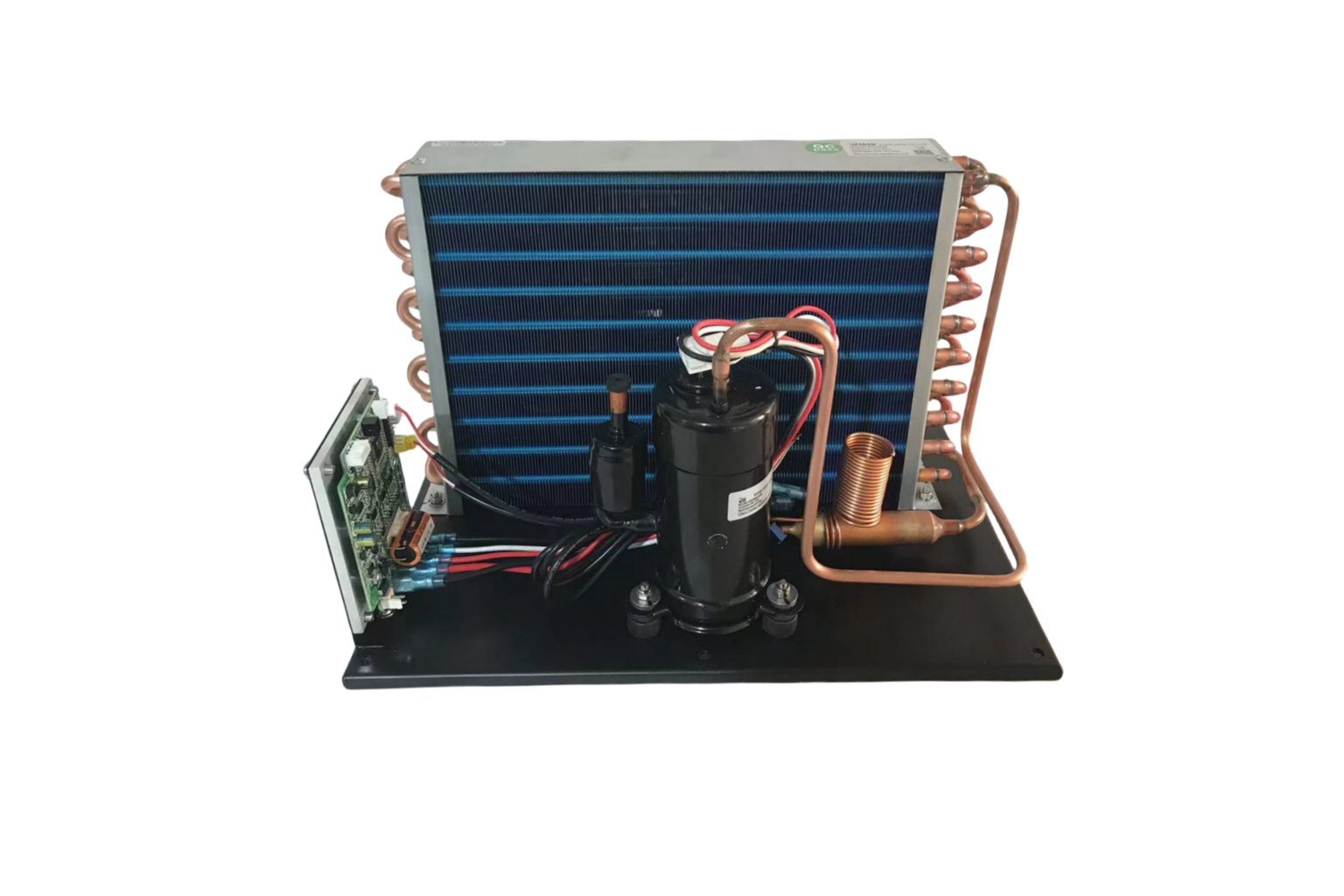
The RIGID Micro DC Aircon series, for example, is available in 12V, 24V, and 48V variants specifically to match standard off-grid bus voltages. With eight models spanning 450W to 900W cooling capacity and weighing approximately 5 kg (11 lbs), these units are designed to integrate directly into solar-powered systems without voltage conversion. They use BLDC variable-speed compressors and are available with either R134a or R290 refrigerant. You can explore the full Micro DC Aircon Cool lineup here.
Solar Array and Battery Sizing Framework
Sizing the solar array and battery bank for a dc air conditioning load is not a simple formula — it depends on geographic location, seasonal sun hours, panel orientation, shading, battery chemistry, depth of discharge limits, and how many hours per day the cooling system needs to run.
That said, here is a practical framework that solar installers and system designers can use as a starting point:
Step 1 — Determine daily cooling energy requirement. Estimate how many hours per day the dc air conditioning unit will run at various load levels. A variable-speed unit does not draw its maximum rated power continuously. In a well-insulated enclosure, the compressor may run at 40-60% capacity for much of the day, ramping to full power only during peak afternoon heat. Multiply the estimated average power draw by the number of operating hours to get daily watt-hours.
Step 2 — Add other loads. The cooling system is rarely the only load on the solar system. Include lighting, monitoring equipment, communication radios, and any other devices that share the battery bank.
Step 3 — Apply a safety margin. Add 20-30% to the total daily energy requirement to account for cloudy days, panel degradation, and system inefficiencies.
Step 4 — Size the battery bank for autonomy. Decide how many days of cloudy weather the system must survive without solar input. For critical telecom sites, two to three days of autonomy is common. For seasonal cabins, one day may suffice. Divide the total energy requirement (with safety margin) by the battery’s usable depth of discharge to determine the required battery capacity.
Step 5 — Size the solar array to replenish. Divide the daily energy requirement by the peak sun hours for your location (available from solar irradiance databases). This gives you the minimum array wattage. In practice, oversizing the array by 25-50% provides a buffer for seasonal variation and ensures the batteries reach full charge regularly, which extends their lifespan.
This framework is intentionally general because every site is different. A telecom shelter in northern Canada has vastly different solar availability than one in Saudi Arabia. The key principle is straightforward: a dc air conditioning unit with variable-speed operation makes the sizing exercise more forgiving because it naturally adapts its power draw to available energy.
System Integration and Wiring Best Practices
Clean wiring and proper integration are what separate a reliable solar cooling installation from one that trips breakers and corrodes connectors within a year.
Fusing and protection: Install a properly rated DC fuse or circuit breaker between the battery bank and the dc air conditioning unit. DC arcs are more dangerous than AC arcs because direct current does not cross zero, so use components specifically rated for DC service at your system voltage.
Cable sizing: Calculate the maximum current draw of the cooling unit and size cables according to the National Electrical Code (NEC) or your local equivalent. For DC systems, voltage drop over distance matters more than with AC. Keep the voltage drop below 3% on the run from battery to cooling unit. Use online voltage drop calculators or standard wire gauge tables.
Grounding: Ground the system frame and all metallic enclosure components to a common ground bus. Proper grounding protects against lightning-induced surges, which are a real concern for remote solar installations on exposed terrain.
Connector quality: Use marine-grade or industrial-grade DC connectors. Cheap automotive connectors corrode in outdoor environments. Crimped and heat-shrunk connections outperform soldered joints in applications subject to vibration and thermal cycling.
Thermostat and control integration: Many dc air conditioning units include built-in thermostatic control with a setpoint range — the RIGID Micro DC Aircon, for instance, supports a 5°C to 30°C setpoint range. For more sophisticated installations, you can integrate the cooling unit with a site monitoring system that adjusts the setpoint based on battery state of charge. When batteries are full and solar production is high, the system can pre-cool the enclosure. When batteries are low, the setpoint can be raised to reduce power draw.
Application Scenarios: Where Solar DC Cooling Delivers
Telecom Shelters and Cell Tower Equipment Cabinets
Telecom equipment generates constant heat and requires stable operating temperatures to maintain signal quality and component longevity. Remote cell towers and repeater stations are often powered entirely by solar panels and batteries. A compact dc air conditioning unit rated in the 450W to 900W cooling capacity range can maintain safe operating temperatures inside a standard outdoor telecom cabinet without any grid connection.
The variable-speed compressor is particularly valuable here. Telecom loads are relatively constant, but ambient temperatures swing dramatically between day and night. The cooling unit automatically adjusts its output — and its power consumption — to match the actual thermal demand at any given moment.
Remote Environmental Monitoring Stations
Weather stations, seismic monitors, water quality sensors, and wildlife tracking systems are often deployed in locations where grid power is impossible. The electronics inside these stations are sensitive to heat and humidity. A lightweight dc air conditioning unit weighing around 5 kg can be mounted directly on or inside the monitoring enclosure, drawing power from the same solar and battery system that runs the sensors.
Off-Grid Cabins and Small Shelters
Small cabins, hunting blinds, and emergency shelters in remote areas benefit from solar-powered cooling during hot months. The key constraint is that these structures typically have modest solar arrays and limited battery capacity. A dc air conditioning unit with variable-speed operation is well-suited because it can throttle down to minimal power draw when the space is near the desired temperature, preserving battery reserves for nighttime operation.
Agricultural and Livestock Monitoring Enclosures
Precision agriculture increasingly relies on electronic controllers, sensors, and communication equipment housed in field enclosures. These enclosures sit in direct sunlight and can reach extreme internal temperatures. Solar-powered dc air conditioning keeps the electronics within operating specifications without running power cables across fields.
What Solar DC Air Conditioning Is Not Designed For
Honesty about application boundaries builds trust and prevents costly mistakes. DC air conditioning units in the compact, solar-compatible class are not suitable for:
Large buildings or residential homes: The cooling capacity of compact DC units — typically up to around 3,000 BTU — is designed for small enclosures, not open floor plans or multi-room structures. Attempting to cool a full-sized building with these units will result in inadequate cooling and continuous full-load operation that drains batteries rapidly.
High-humidity industrial processes: Applications that require dehumidification of large air volumes or precise humidity control beyond what a small split-type or monoblock unit can provide are outside the scope of these systems.
Spaces with very high internal heat loads: Server rooms, industrial control panels with thousands of watts of heat dissipation, or any application where the cooling demand consistently exceeds the unit’s rated capacity will overwhelm a compact DC system.
The sweet spot is clear: small, enclosed spaces with moderate heat loads in locations where solar power is the primary or only energy source.
Maintenance Considerations for Long-Term Reliability
A solar-powered dc air conditioning installation in a remote location needs to run with minimal intervention. Design for low maintenance from the start:
Air filters: Dust accumulation on evaporator and condenser coils reduces cooling efficiency over time. Use washable filters and establish a cleaning schedule — quarterly for most environments, monthly in dusty or sandy locations.
Condenser airflow: Ensure the condenser has unobstructed airflow. In outdoor installations, check periodically for debris, bird nests, or vegetation growth that could block air circulation.
Electrical connections: Inspect DC connections annually for signs of corrosion, loosening, or heat damage. Thermal cycling in outdoor environments can loosen crimped connections over time.
Battery health monitoring: The battery bank is typically the most maintenance-intensive component in the system. Monitor cell voltages, state of charge, and cycle count. Replace batteries before they degrade to the point where they cannot support overnight cooling.
Refrigerant integrity: Sealed dc air conditioning units like the RIGID Micro DC Aircon come factory-charged with refrigerant (R134a or R290) and should not require recharging under normal conditions. If cooling performance degrades and filters are clean, a refrigerant leak may be the cause — this requires professional service.
Design Checklist for Solar DC Air Conditioning Installations
Use this checklist as a starting point when designing a solar-powered cooling system for a remote site:
1. Calculate the total thermal load of the enclosure (internal heat generation + solar gain + ambient conduction).
2. Select a dc air conditioning unit with cooling capacity that meets or slightly exceeds the calculated load.
3. Match the unit’s input voltage (12V, 24V, or 48V) to the solar system’s nominal bus voltage.
4. Size the battery bank for the desired days of autonomy, accounting for the cooling load plus all other electrical loads.
5. Size the solar array to replenish daily energy consumption with appropriate margin for your geographic location.
6. Specify DC-rated fuses, breakers, and wiring sized for maximum current draw with less than 3% voltage drop.
7. Plan condenser placement for adequate airflow and protection from direct weather exposure.
8. Integrate thermostat control with battery management for intelligent load shedding during low-charge conditions.
9. Document the installation for future maintenance personnel who may not have been involved in the original design.
Moving Forward with Solar-Powered DC Cooling
The convergence of affordable solar panels, high-density lithium batteries, and efficient BLDC compressor technology has made dc air conditioning a practical reality for off-grid installations. What was once a compromise — accepting heat or burning diesel for generator-powered cooling — is now a clean, reliable, and maintainable system architecture.
For solar installers and off-grid system designers, the key takeaway is this: treat the cooling system as an integral part of the energy system design, not an afterthought. Match voltages. Size batteries with cooling loads included from day one. Choose variable-speed units that adapt to both thermal demand and available solar energy. And select hardware built specifically for DC operation — not AC units bolted to inverters.
Small off-grid sites around the world — from telecom towers in sub-Saharan Africa to monitoring stations in the Australian outback to mountain cabins in the Rockies — are already running on solar-powered dc air conditioning. The technology is proven. The design principles are straightforward. The grid dependency is zero.