
DC Aircon vs AC Aircon: The Engineering Difference That Matters for Battery-Powered Systems
Every air conditioning system runs on electricity. But the type of electricity — alternating current (AC) or direct current (DC) — determines the system architecture, efficiency, failure modes, and suitability for off-grid and mobile applications. For engineers designing cooling into battery-powered systems, this distinction is not academic. It is the difference between a reliable thermal solution and a system that fails in the field because of a component that should never have been there in the first place.
This article compares DC aircon and AC aircon systems from an engineering perspective. Not marketing claims — measurable differences in efficiency, reliability, and integration complexity that affect total cost of ownership and system uptime.
How an AC Aircon System Works on Battery Power
A conventional AC aircon system is designed for mains power: 120V or 240V alternating current at 50/60 Hz. The compressor motor, fan motors, and control electronics all expect AC input. When you need to run this system on a battery — which stores energy as DC — you must add an inverter between the battery and the air conditioner.
The inverter converts DC battery voltage (typically 12V, 24V, or 48V) to AC mains voltage. This conversion introduces three engineering problems that do not exist in a native DC system.
Problem 1: Conversion Losses
No inverter is 100% efficient. Practical inverter efficiency ranges from 85% to 93%, depending on the load level, ambient temperature, and inverter quality. At 90% efficiency, a 500W air conditioner actually draws 556W from the battery. That 56W of waste heat must go somewhere — usually it heats up the inverter itself, which requires its own cooling and reduces the overall system efficiency further.
Over an 8-hour operating cycle, the inverter losses on a 500W system consume approximately 450Wh of battery energy — enough to run the air conditioner itself for almost another hour. In solar-powered or battery-backed installations where every watt-hour matters, this is not a rounding error.
Problem 2: Inverter Failure Modes
Inverters contain power semiconductors (MOSFETs or IGBTs), capacitors, transformers, and control circuits that are all subject to thermal stress, voltage transients, and mechanical vibration. In mobile and outdoor applications, these stress factors are amplified.
Common inverter failure modes include:
- Electrolytic capacitor degradation: The DC bus capacitors in an inverter have a finite lifespan that decreases exponentially with temperature. Every 10°C increase above the rated temperature halves the capacitor’s expected life. In an enclosure that is already generating heat, the inverter becomes a secondary heat source that accelerates its own degradation.
- Startup surge failures: AC compressors draw 5-8 times their running current during startup. The inverter must handle this surge without tripping its overcurrent protection. Undersized inverters fail during compressor startup, especially as battery voltage drops under load.
- Modified sine wave distortion: Lower-cost inverters produce modified sine wave output rather than pure sine wave. AC compressor motors running on modified sine wave power overheat, vibrate excessively, and fail prematurely because the harmonic distortion creates eddy current losses in the motor windings.
Problem 3: System Complexity
Adding an inverter means adding another component that must be sized, mounted, wired, fused, ventilated, and maintained. The inverter needs its own overcurrent protection, its own thermal management, and its own failure diagnostics. Every additional component in a system is another potential failure point and another item on the maintenance checklist.
How a Native DC Aircon System Works
A native DC aircon system eliminates the inverter entirely. The compressor, fan motors, and control electronics are all designed to operate directly on DC power at the battery’s native voltage — 12V, 24V, or 48V.
The key enabling technology is the BLDC (brushless direct current) compressor. Unlike an AC induction motor that requires alternating current to create a rotating magnetic field, a BLDC motor uses permanent magnets on the rotor and electronically commutated stator coils driven by a compact driver board. The driver board takes DC input and switches the stator coils in the correct sequence to spin the rotor — no inverter needed.
Efficiency Advantage
By eliminating the DC-to-AC conversion step, a DC aircon system captures the 7-15% efficiency loss that an inverter would impose. But the efficiency advantage goes beyond just eliminating conversion losses.
BLDC compressors support variable speed operation through PWM (pulse width modulation) control of the driver board. Instead of cycling the compressor fully on and off like a conventional AC system, the BLDC compressor modulates its speed to match the actual cooling demand. At partial load — which is where cooling systems operate most of the time — a variable-speed BLDC compressor is significantly more efficient than a fixed-speed AC compressor that cycles on and off.
The combined effect of eliminating inverter losses and enabling variable-speed operation means a DC aircon system typically delivers 20-35% more cooling per watt-hour of battery energy compared to an equivalent AC system running through an inverter.
Reliability Advantage
Fewer components mean fewer failure points. A DC aircon system has no inverter to fail, no AC compressor startup surge to manage, and no sine wave quality to worry about. The BLDC driver board is a fraction of the size and complexity of an inverter, operates at much lower voltages, and generates significantly less heat.
In vibration-heavy environments — vehicles, construction equipment, marine vessels — the absence of an inverter eliminates a major source of vibration-induced solder joint failures and connector loosening. The BLDC compressor itself is inherently smoother than a reciprocating AC compressor because the rotary mechanism produces less mechanical shock per revolution.
Real-World Performance Comparison
Consider a sealed enclosure with a 400W internal heat load in 40°C ambient. Both a DC aircon and an AC-with-inverter system are sized to deliver 450W of cooling capacity.
The AC system draws 250W at the compressor, but the inverter adds 10% overhead: total battery draw is 275W. The inverter itself generates 25W of heat inside or near the enclosure, effectively increasing the thermal load to 425W. The system runs at 94% of its rated capacity — leaving minimal margin for ambient temperature spikes.
The DC system draws the same 250W at the compressor, but directly from the battery with no conversion loss. No additional heat from an inverter. The system runs at 89% of its rated capacity — providing comfortable margin for temperature variations.
Over a 24-hour period, the DC system saves approximately 600Wh of battery energy. On a 48V/100Ah battery pack (4.8 kWh), that is 12.5% of the total energy — the difference between the system lasting through the night or shutting down at 3 AM.
When an AC Aircon System Still Makes Sense
DC aircon systems are not universally superior. There are legitimate scenarios where an AC system with an inverter is the practical choice:
- Existing AC infrastructure: If the facility already has AC power distribution and the cooling load requires high-capacity split systems (5 kW and above), retrofitting to DC is rarely cost-effective.
- High cooling capacity requirements: DC aircon units currently top out at approximately 900W (3,069 BTU) of cooling capacity per module. Applications requiring multi-kilowatt cooling are better served by AC systems or by multiple DC modules operating in parallel.
- Grid-connected installations: If reliable grid power is available and battery backup is not required, the efficiency advantage of DC operation does not justify the cost of replacing existing AC equipment.
The sweet spot for DC aircon systems is applications where battery power is the primary or sole energy source, where the cooling load is under 1 kW, where system reliability in harsh environments is critical, and where every watt-hour of energy efficiency extends operational capability.
Selecting the Right DC Aircon for Your Application
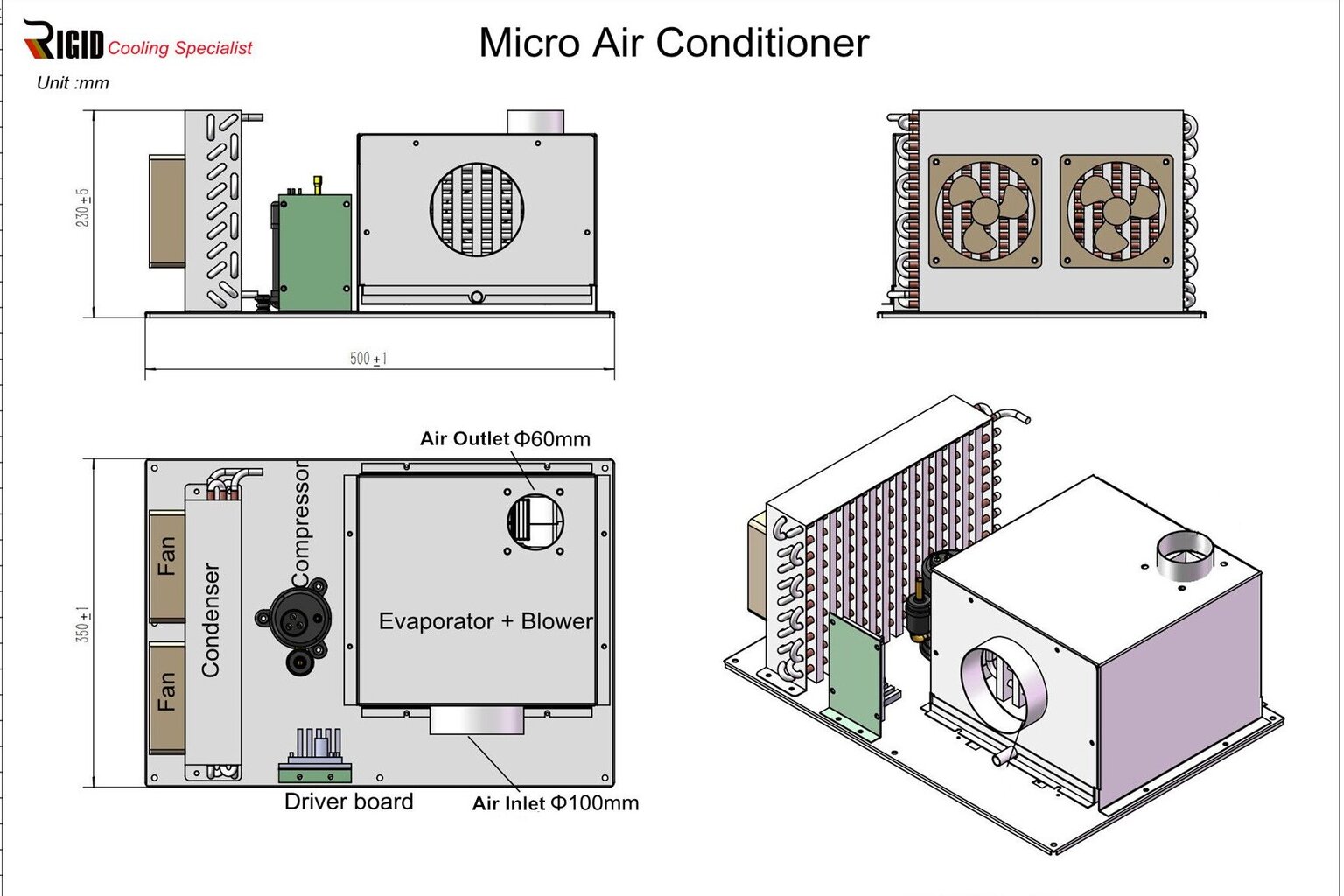
The RIGID Micro DC Aircon product line offers DC aircon units across four cooling tiers, all operating natively on DC power without inverters:
- 450W (1,535 BTU): DV1910E-AC (12V), DV1920E-AC (24V), DV1930E-AC (48V). Ideal for telecom cabinets, sensor enclosures, and small control panels with heat loads under 400W.
- 550W (1,876 BTU): DV3220E-AC (24V). Mid-range option for moderate heat loads in medium enclosures and small battery compartments.
- 700W (2,387 BTU): DV2820E-AC (24V, R134a) and DV2820E-AC-T (24V, R290). Higher capacity for larger enclosures, medical devices, and industrial panels with multiple heat-generating components.
- 900W (3,069 BTU): DV3820E-AC (24V) and DV3830E-AC (48V). Maximum single-module capacity for demanding applications.
All models use pre-charged refrigerant (R134a or R290), BLDC variable-speed compressors, and weigh approximately 5 kg — compact enough to integrate into the enclosure wall or mount directly adjacent to the cooling target.
Integration Considerations
Switching from an AC-with-inverter system to a native DC aircon requires rethinking the power architecture. The inverter is removed from the circuit, and the DC aircon connects directly to the battery bus through appropriately sized wiring and overcurrent protection.
Key integration points:
- Wire sizing: DC systems operate at lower voltage than AC, which means higher current for the same power. A 450W unit on 12V draws approximately 37A — requiring 8 AWG or larger wiring for runs over 2 meters. On 24V, the same unit draws approximately 19A, allowing 12 AWG wiring. On 48V, current drops to approximately 9A. Higher bus voltages simplify wiring.
- Fusing: Use slow-blow DC-rated fuses sized at 1.5-2 times the running current. Standard AC fuses must not be used in DC circuits — they may not interrupt a DC arc reliably.
- Voltage matching: Select the DC aircon voltage that matches the battery bus. Running a 24V unit on a 12V battery through a boost converter reintroduces conversion losses — defeating the purpose of going DC.
The engineering case for DC aircon in battery-powered applications is straightforward: eliminate the inverter, capture the efficiency gain, reduce the failure modes, and simplify the system. For applications under 1 kW of cooling where battery energy is the limiting resource, there is no technical argument for adding an inverter that does not need to be there.
Voltage Selection and Its Impact on System Design
The choice between 12V, 24V, and 48V DC aircon modules affects more than just wire sizing. It fundamentally shapes the system architecture and determines which applications are practical.
At 12V, current draw is highest for a given power level. A 450W module on 12V draws approximately 37A — requiring heavy gauge wiring, large fuses, and robust connectors. The 12V option exists primarily for compatibility with automotive electrical systems where 12V is the standard bus voltage. For new designs where the engineer can choose the voltage, 12V is rarely the optimal choice for cooling loads above 300W.
At 24V, current draw drops by half compared to 12V. A 450W module draws approximately 19A, and even the 900W flagship model draws approximately 38A — manageable with standard industrial wiring and connectors. The 24V bus is the most common choice for telecom, marine, and industrial battery systems, making 24V DC aircon modules the most widely deployed variant.
At 48V, current draw drops to approximately 9A for a 450W module. This enables longer wire runs with thinner gauge wiring and smaller connectors. The 48V bus is increasingly common in EV battery systems, telecom power plants, and solar installations with 48V battery banks. For new installations where the battery architecture is not yet fixed, 48V offers the most flexible and efficient wiring solution.
The key rule: match the DC aircon module voltage to the existing battery bus voltage. Introducing a DC-DC converter between the battery and the aircon module reintroduces the conversion losses that going native DC was supposed to eliminate. If the battery is 24V, use a 24V module. If the battery is 48V, use a 48V module. The engineering is that simple.
Maintenance Comparison
A DC aircon system with no inverter requires less maintenance than its AC-with-inverter equivalent. The inverter’s electrolytic capacitors, cooling fans, and power connections all require periodic inspection and eventual replacement. Removing the inverter from the system removes these maintenance items entirely.
The DC aircon module itself requires minimal maintenance: periodic condenser fin cleaning (quarterly in dusty environments, annually in clean environments), condensate drain verification, and electrical connection torque checks. The BLDC compressor has no brushes to wear, no starter capacitor to fail, and no centrifugal switch to malfunction — common failure points in AC compressor motors that simply do not exist in a BLDC design.