
DC Condensing Unit Cold Room Sizing: How to Match Capacity to Your Walk-In Cooler
Small cold rooms — walk-in coolers between 1 and 10 cubic meters — serve a critical role in restaurants, convenience stores, farms, and mobile food operations. They keep perishable goods at safe temperatures without the footprint or cost of full commercial refrigeration systems. But powering these cold rooms in off-grid locations, solar-powered facilities, or battery-backed setups introduces a challenge: traditional AC-powered condensing units require inverters, which add cost, complexity, and energy losses.
A DC condensing unit solves this problem directly. Running on 12V, 24V, or 48V DC power, these units connect straight to solar panels, battery banks, or vehicle electrical systems without conversion losses. For operators managing small cold rooms in remote locations or seeking energy independence, this approach eliminates an entire layer of infrastructure while delivering reliable cooling performance.
Understanding DC Condensing Units for Cold Room Applications
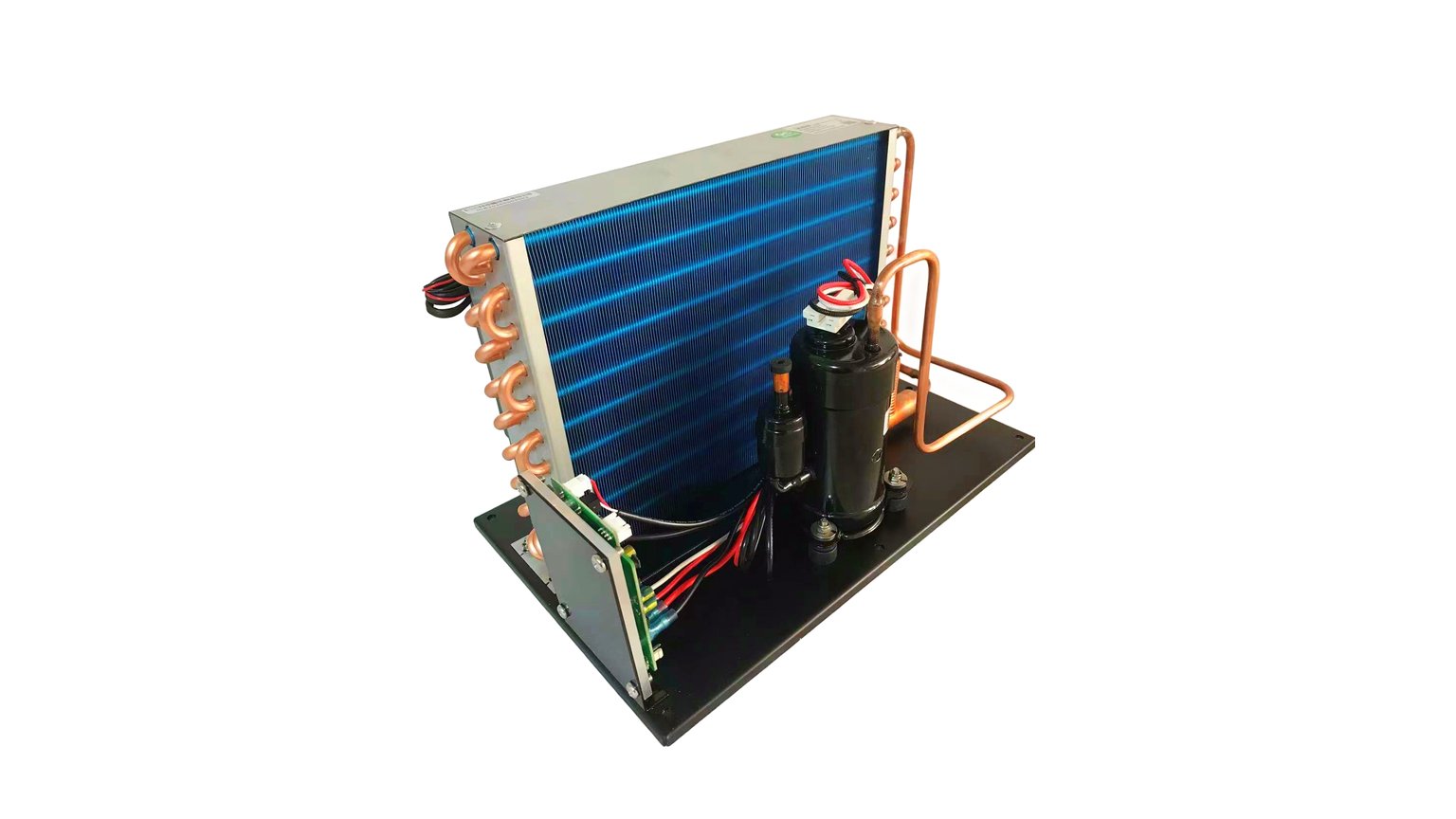
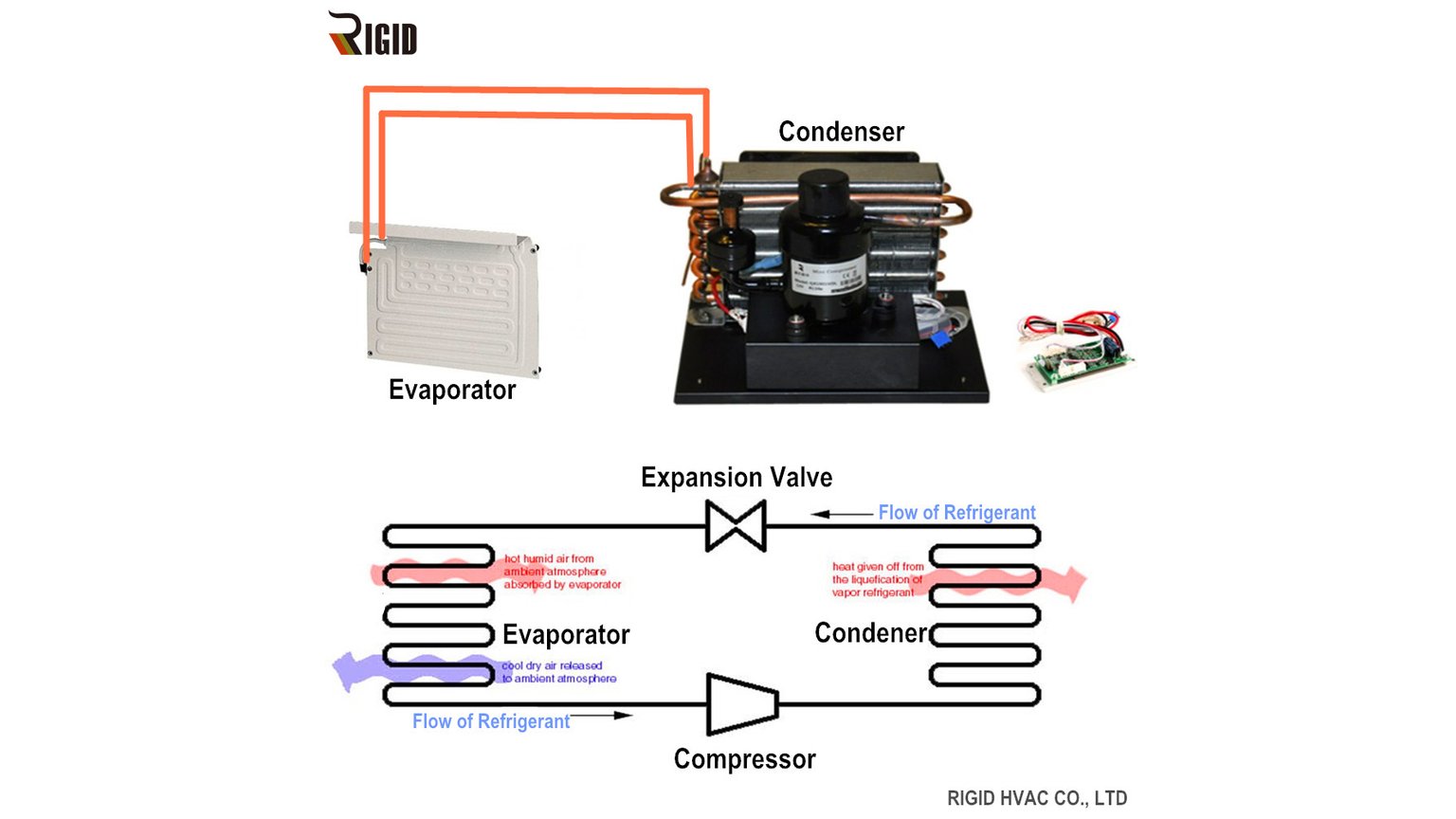
A condensing unit is the outdoor half of a refrigeration system — it contains the compressor, condenser coil, and fan that reject heat from the refrigeration cycle. Inside the cold room, an evaporator coil absorbs heat from the stored products. Together, they form a complete refrigeration loop.
What distinguishes a DC condensing unit from its AC counterpart is the power supply architecture. DC units use brushless DC compressors with variable-speed drives, meaning they can modulate their output to match the actual cooling load. This contrasts with traditional fixed-speed AC compressors that cycle on and off, creating temperature fluctuations and wasting energy during startup surges.
The variable-speed operation delivers several practical benefits for cold room operators:
- Steady temperature control — The compressor ramps up or down smoothly rather than cycling between full power and off, maintaining tighter temperature bands that protect food quality.
- Lower energy consumption — Running at partial load most of the time uses significantly less energy than repeated full-power startups.
- Reduced mechanical stress — Fewer start-stop cycles mean less wear on compressor components and longer service life.
- Soft-start capability — No high inrush currents, which matters enormously for battery and solar systems with limited instantaneous power delivery.
Sizing a DC Condensing Unit for Your Cold Room
Proper sizing ensures your cold room reaches and maintains target temperature without overworking the compressor or wasting energy on oversized equipment. The calculation involves several factors working together.
Volume and Insulation
The starting point is your cold room’s internal volume. A well-insulated 1 m³ cold room targeting 5°C in a 35°C ambient environment needs approximately 100-150W of cooling capacity. Scale that up proportionally: a 5 m³ cold room under the same conditions requires roughly 500-750W of cooling capacity.
Insulation quality dramatically affects this calculation. A cold room built with 100mm polyurethane panels performs very differently from one using 50mm polystyrene. Better insulation means less heat infiltration, which means a smaller condensing unit can maintain temperature — saving both upfront cost and ongoing energy consumption.
Temperature Requirements
Fresh food storage typically requires 2-8°C, while some applications need temperatures down to -5°C. The greater the difference between ambient temperature and target temperature (called temperature pull-down), the more cooling capacity you need. A cold room in a tropical climate with 40°C ambient temperatures needs substantially more cooling power than one in a temperate 25°C environment.
Operational Factors
Beyond the static heat load, consider dynamic factors that add to cooling demand:
- Door openings — Each time the door opens, warm ambient air rushes in. Frequent access (common in restaurant service) adds significant load.
- Product loading — Placing warm products into the cold room creates a temporary spike in cooling demand as the unit pulls down their temperature.
- Defrost cycles — The evaporator periodically needs defrosting, during which cooling stops temporarily and the unit must recover afterward.
- Lighting and fan motors — Internal heat sources from evaporator fans and lighting add small but constant loads.
Matching to Available Units
For small cold rooms in the 1-10 m³ range, the DC condensing unit series from Rigid HVAC offers two primary options:
- DV2820 series — Operating at 24V DC with approximately 700W cooling capacity, suitable for cold rooms up to about 5 m³ with moderate ambient temperatures and good insulation.
- DV3820 series — Also 24V DC with approximately 900W cooling capacity, handling larger volumes up to 8-10 m³ or higher ambient temperature conditions.
Both units can maintain cold room temperatures in the 2-8°C range for fresh food storage, with capability down to -5°C depending on insulation quality and ambient conditions. They pair with an evaporator coil — either a cold plate or finned evaporator — mounted inside the cold room.
Installation Advantages for Small Cold Rooms
One of the most significant practical advantages of DC condensing units for small cold rooms is simplified installation. These units come pre-charged with refrigerant, meaning the refrigeration circuit is sealed and ready at the factory. For operators in remote locations or areas where HVAC technicians are scarce and expensive, this eliminates a major barrier.
The installation process for a pre-charged DC condensing unit typically involves:
- Mounting the condensing unit — Position outside the cold room with adequate airflow around the condenser coil for heat rejection.
- Installing the evaporator — Mount inside the cold room at the appropriate height for air circulation.
- Connecting refrigerant lines — Pre-charged quick-connect fittings simplify this step compared to traditional brazing and vacuum procedures.
- Wiring the DC power supply — Connect directly to your battery bank, solar charge controller output, or DC bus.
- Setting the temperature controller — Configure target temperature and operating parameters.
Compare this to a traditional AC system installation that requires a certified HVAC technician to braze copper lines, pull vacuum on the system, charge refrigerant by weight, and verify subcooling and superheat values. The DC unit approach reduces installation time from a full day to a few hours and eliminates the need for specialized tools and certifications.
Power System Integration
The DC architecture opens up power system configurations that simply are not practical with AC condensing units.
Solar Direct
In locations with reliable solar resources, a DC condensing unit can run from solar panels through a charge controller and battery bank. The variable-speed compressor naturally adapts to available power — running faster during peak solar hours when energy is abundant and slowing down during cloudy periods or evening hours when drawing from batteries.
A typical solar-powered cold room system includes:
- Solar panel array sized to the daily cooling energy requirement plus battery charging
- MPPT charge controller to optimize solar harvest
- 24V battery bank (lithium iron phosphate preferred for cycle life and temperature tolerance)
- DC condensing unit connected directly to the battery bus
The elimination of an inverter removes 10-15% conversion losses, meaning your solar panels and batteries work more efficiently. For a system running 8-12 hours daily, those losses add up to meaningful energy savings over the system lifetime.
Vehicle and Mobile Applications
Mobile cold storage — whether on delivery vehicles, food trucks, or portable cold rooms for farmers markets — benefits enormously from DC operation. The condensing unit connects directly to the vehicle’s electrical system or a dedicated auxiliary battery, avoiding the noise, fuel consumption, and maintenance of a generator or the inefficiency of a large inverter.
Hybrid and Backup Systems
Many operators use DC condensing units in hybrid configurations — solar primary with grid-charged batteries as backup, or vehicle alternator charging while driving with battery sustaining while parked. The DC unit does not care where its electrons come from, as long as the voltage stays within its operating range.
Application Boundaries: Where DC Condensing Units Excel and Where They Do Not
Understanding the appropriate application range prevents disappointment and ensures you select the right technology for your specific situation.
Ideal Applications
- Small walk-in coolers (1-10 m³) — Restaurants, convenience stores, and small food processors with modest cold storage needs.
- Off-grid fresh food preservation — Farms, rural stores, and remote communities without reliable grid power.
- Mobile cold storage — Delivery vehicles, food trucks, and portable cold rooms for events or seasonal use.
- Solar-powered cold chains — Last-mile cold storage in developing regions where solar is the most practical power source.
- Backup cold storage — Secondary cold rooms that need to operate during grid outages from battery backup.
Applications That Require Different Solutions
- Large commercial cold rooms (>20 m³) — The cooling capacity of DC units in this class is insufficient for large volumes. These applications need larger AC systems or multiple units.
- Blast freezing (-30°C and below) — The temperature range of these DC condensing units does not extend to blast freezing requirements. Specialized low-temperature systems are needed.
- High-traffic commercial kitchens — Environments with very frequent door openings (dozens per hour during service) create heat loads that may exceed the capacity of a single small DC unit.
Energy Consumption and Operating Costs
The variable-speed operation of DC condensing units translates directly to lower energy consumption compared to fixed-speed alternatives of similar capacity. In a well-insulated cold room that has reached its target temperature, the compressor may run at only 30-50% of its maximum speed most of the time, consuming proportionally less power.
For solar-powered installations, this efficiency has a compounding effect: lower energy consumption means fewer solar panels and smaller battery banks, reducing the total system cost significantly. A cold room that needs 2 kWh per day instead of 3 kWh per day requires roughly one-third less solar and battery infrastructure — savings that often exceed the cost difference between DC and AC condensing units.
Operating costs also benefit from reduced maintenance. The variable-speed compressor experiences less mechanical stress than a cycling fixed-speed unit, and the simplified DC electrical system has fewer components that can fail. No inverter means no inverter failures, no fan replacements on inverter cooling systems, and no efficiency degradation from inverter aging.
Cold Room Construction Considerations
The condensing unit is only one part of a functioning cold room. The room itself must be properly constructed to achieve and maintain target temperatures efficiently.
Insulation
For small cold rooms paired with DC condensing units, insulation thickness and quality directly determine whether the unit can maintain temperature. Minimum recommended insulation for fresh food storage (2-8°C target) is 75mm polyurethane panels, with 100mm preferred for hot climates or sub-zero applications. Every millimeter of additional insulation reduces the steady-state cooling load.
Vapor Barrier
Moisture migration through cold room walls causes insulation degradation over time. A continuous vapor barrier on the warm side of the insulation prevents moisture from condensing within the panel and reducing its thermal performance.
Door Design
The door is typically the weakest point in cold room insulation. Strip curtains, self-closing mechanisms, and proper gasket seals minimize warm air infiltration during access. For cold rooms with frequent access, consider a small vestibule or air curtain to reduce thermal shock when the door opens.
Floor Insulation
Often overlooked, floor insulation prevents heat gain from the ground (or vehicle floor in mobile applications). Insulated floor panels with appropriate load-bearing capacity protect both thermal performance and structural integrity.
Getting Started: Engineering Assessment
Every cold room application has unique requirements based on location, climate, stored products, access patterns, and available power infrastructure. While the general sizing guidelines above provide a starting framework, an engineering assessment ensures your system is properly matched to your specific conditions.
Key information to prepare for an assessment includes:
- Cold room dimensions (or planned dimensions if building new)
- Target storage temperature and products to be stored
- Local ambient temperature range (summer peak is most critical)
- Expected door opening frequency and duration
- Available power source (solar capacity, battery bank size, vehicle electrical system specs)
- Installation location constraints (space for condensing unit airflow, refrigerant line routing)
With these details, an engineering team can recommend the appropriate condensing unit model, evaporator configuration, and power system sizing to deliver reliable cold storage performance for your specific application. Contact Rigid HVAC for a technical consultation tailored to your cold room project.