
Quick Answer: A DC condensing unit rated between 130W and 800W can maintain temperatures from +2°C down to -25°C in small cold rooms under 3 cubic meters. Sizing depends on insulation thickness, target temperature, ambient conditions, and door-opening frequency. RIGID DV-series units run on 12V–48V DC power, ship pre-charged with R134a or R290 refrigerant, and connect directly to a matched evaporator coil inside the cold room.
DC Condensing Unit Selection for Small Cold Rooms
Choosing the right DC condensing unit starts with understanding your cold room requirements. These compact refrigeration modules eliminate the need for grid power and inverters, making them the go-to solution for off-grid food storage, mobile refrigeration, and remote cold chain applications. The direct DC operation means higher efficiency — no energy lost in AC-to-DC conversion — and simpler wiring that connects straight to solar panels or battery banks.
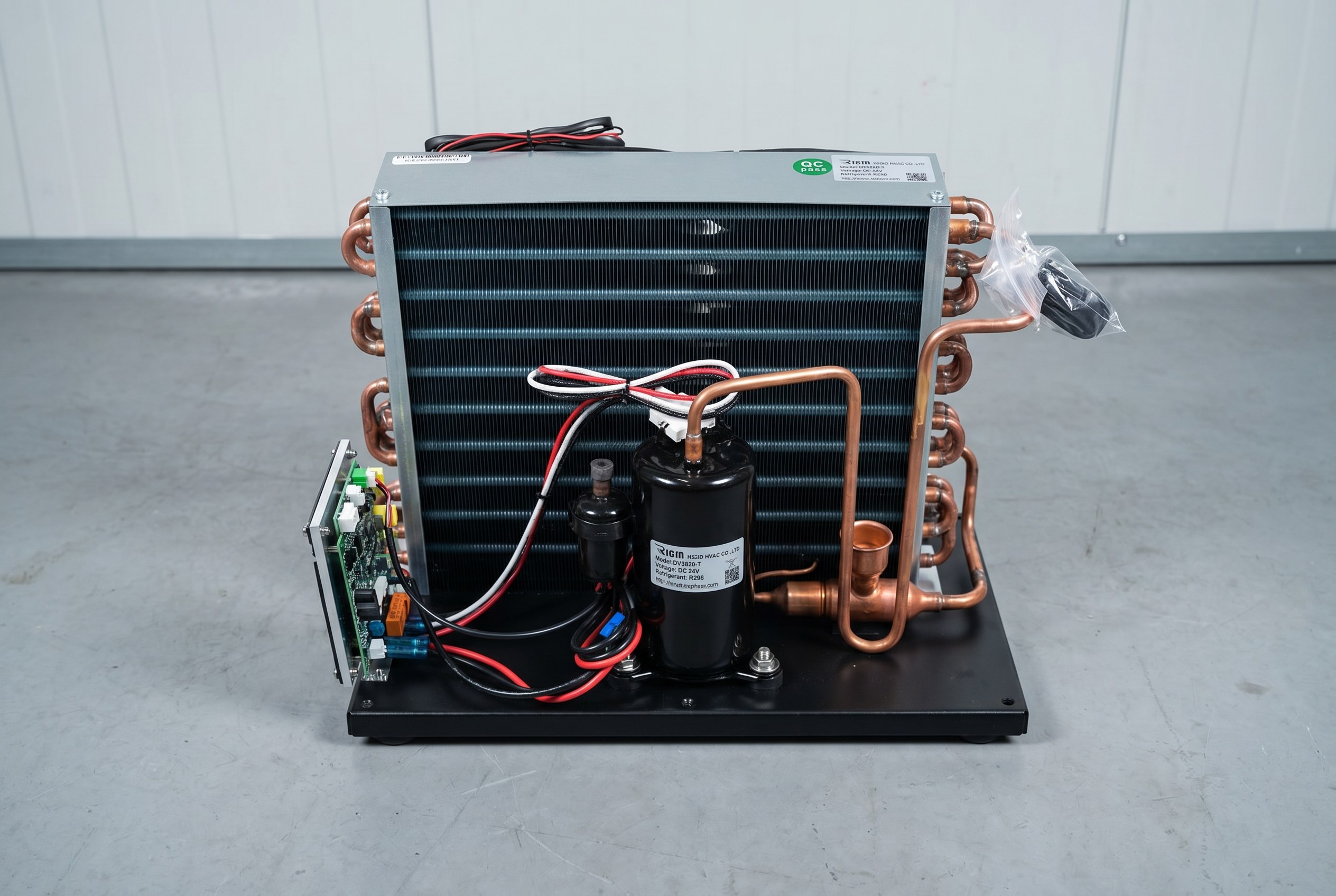
RIGID manufactures five DC condensing unit models spanning 130W to 800W cooling capacity. Each model targets a specific combination of room volume, temperature requirement, and power source. The sections below walk you through selecting the right model, sizing it correctly, and installing it for long-term reliable operation.
Who This Guide Is For
This guide is written for small business owners running restaurants, farms, or mobile food operations who need reliable cold storage without grid power. It also serves cold storage builders designing compact walk-in coolers and anyone pursuing off-grid food preservation with solar or battery systems. If you need to keep perishable goods between +2°C and -25°C in a space under 3 cubic meters, this sizing and installation guide will help you choose the right DC condensing unit and install it correctly.
Key Decision Framework
Before diving into specifications, answer these four questions to narrow your choice:
- What temperature do you need? Fresh produce storage (+2°C to +8°C) requires less cooling capacity than frozen goods (-18°C to -25°C). The temperature gap between ambient and target directly determines how hard the compressor works.
- How large is the insulated space? Volume in cubic meters determines the thermal load your unit must overcome. A 0.5 m³ medicine fridge has vastly different needs than a 2.5 m³ walk-in cooler.
- What is your power source? Solar panels, vehicle batteries, or battery banks dictate whether you need a 12V, 24V, or 48V unit. Matching voltage eliminates the need for DC-DC converters.
- How often will the door open? Frequent access adds heat load through air infiltration and may push you toward a higher-capacity model to maintain stable temperatures.
Getting these answers right prevents oversizing (wasted energy, higher cost) and undersizing (warm product, spoilage risk, compressor overwork).
DC Condensing Unit Selection Matrix

| Application | Room Volume | Target Temp | Model | Cooling Capacity | Voltage | Why This Model |
|---|---|---|---|---|---|---|
| Wine cellar / medicine fridge | 0.3–0.8 m³ | +5°C to +12°C | DV1910 | 130W | 12V | Low power draw suits small solar setups; gentle cooling preserves wine quality |
| Farm produce cooler | 0.5–1.2 m³ | +2°C to +8°C | DV3220 | 220W | 24V | Moderate capacity handles daily harvest intake without oversizing |
| Mobile food truck refrigerator | 0.8–1.5 m³ | 0°C to +4°C | DV2820 | 280W | 24V | Handles frequent door openings during service; runs from vehicle battery bank |
| Small restaurant walk-in cooler | 1.0–2.0 m³ | -5°C to +2°C | DV3820 | 380W | 24V | Higher capacity compensates for staff access cycles and mixed product loads |
| Off-grid frozen storage | 1.5–3.0 m³ | -18°C to -25°C | DV8020 | 800W | 24V/48V | Strongest unit in the range; reaches deep-freeze temperatures for meat and seafood |
How to Size a DC Condensing Unit for Your Cold Room
Step 1: Calculate Thermal Load
Thermal load is the total heat your condensing unit must remove per hour. It comes from three sources:
- Transmission load — heat leaking through walls, floor, and ceiling. Thicker insulation (80–100mm polyurethane panels) reduces this significantly. For a 1.5 m³ room with 80mm PU panels in 35°C ambient targeting +2°C, transmission load is approximately 120–160W.
- Product load — heat released by warm goods placed inside. A 20 kg batch of vegetables at 25°C entering a 4°C room adds roughly 40–60W of temporary load over 2–4 hours as the product cools down.
- Infiltration load — warm air entering when the door opens. Each door opening exchanges 30–50% of the room air volume. Strip curtains or rapid-close doors cut infiltration by 60–80%.
For a well-insulated 1.5 m³ cold room targeting +2°C in a 35°C ambient environment with moderate door openings, expect a total thermal load around 250–350W. A DV3820 (380W capacity) provides adequate headroom for peak loads without running the compressor at maximum speed continuously.
Step 2: Match Voltage to Power Source
RIGID DC condensing units operate on true DC power — no inverter needed. This eliminates conversion losses (typically 10–15% with inverters) and simplifies wiring:
- 12V systems — single vehicle battery or small solar setup. The DV1910 draws approximately 11A at full load, manageable for a 100Ah battery.
- 24V systems — two batteries in series or standard solar array. The DV2820, DV3220, and DV3820 all operate at 24V, drawing 8–16A depending on model and load.
- 48V systems — larger battery banks or direct solar string. The DV8020 at 48V draws approximately 17A at full capacity, compatible with standard 48V off-grid systems.
Running directly from DC also means the brushless compressor starts smoothly with variable-speed control, reducing inrush current that can trip breakers or damage batteries. No start capacitors or relay switches are needed.
Step 3: Factor in Ambient Temperature
Condenser performance drops as ambient temperature rises because the temperature difference available for heat rejection decreases. In environments above 40°C, derate cooling capacity by 15–20%. For hot climates, either choose one model size up or ensure the condenser has adequate airflow clearance (minimum 150mm on all sides) and consider adding a shade structure to keep direct sun off the condenser.
Need help sizing? Send us your cold room dimensions, target temperature, ambient conditions, and power source details, and our engineering team can recommend the right DC condensing unit model for your application.
Installation Guide: Mounting and Connecting Your DC Condensing Unit
Placement Requirements
Mount the condensing unit outside the insulated cold room. The condenser needs ambient air to reject heat — placing it inside the cold room defeats its purpose and adds heat load. Choose a location that provides:
- Minimum 150mm clearance around the condenser coil for unrestricted airflow
- Protection from direct rain and sun (a simple overhang or shade structure works)
- Vibration-dampening rubber mounts to reduce noise transmission to the structure
- Easy access for periodic maintenance and cleaning the condenser fins
- Proximity to the cold room wall penetration to keep refrigerant lines short
Refrigerant Line Routing
RIGID DC condensing units ship pre-charged with refrigerant (R134a or R290). Connection to the evaporator inside the cold room requires:
- Copper tubing sized to the unit specifications (typically 1/4″ liquid line, 3/8″ suction line for models up to 380W)
- Flare fittings or brazed connections — flare fittings allow easier service access without brazing equipment
- Closed-cell foam insulation on the suction line to prevent condensation and maintain system efficiency
- Routing through the insulated wall using a sealed penetration sleeve filled with expanding foam to prevent thermal bridging
Keep refrigerant lines as short as possible. Every additional meter adds pressure drop and reduces system efficiency by 3–5%. Ideal total line length is under 3 meters between condensing unit and evaporator.
Evaporator Placement Inside the Cold Room
Position the evaporator coil near the top of the cold room where warm air naturally rises. The fan should blow cold air downward and across stored products for even temperature distribution. Leave at least 100mm between stored goods and the evaporator to allow proper air circulation. Avoid placing product directly against the evaporator coil — this blocks airflow and creates warm spots elsewhere in the room.
Electrical Connections
Wire the condensing unit directly to your DC power source using appropriately sized cable to minimize voltage drop:
- DV1910 (12V, 130W): minimum 4 mm² cable for runs under 5 meters
- DV2820/DV3220 (24V, 220–280W): minimum 4 mm² cable for runs under 8 meters
- DV3820 (24V, 380W): minimum 4 mm² cable for runs under 6 meters, 6 mm² for longer runs
- DV8020 (48V, 800W): minimum 6 mm² cable for runs under 10 meters
Install a fuse or circuit breaker rated at 125% of the unit maximum current draw. Connect the controller temperature sensor inside the cold room at product height — not near the evaporator where readings will be artificially low and cause the compressor to cycle off prematurely.
Temperature Range and Performance Expectations
RIGID DC condensing units achieve evaporator temperatures between -20°C and -30°C depending on the model and operating conditions. However, the actual cold room temperature will be warmer than the evaporator temperature due to the temperature difference (TD) needed to drive heat transfer:
| Cold Room Target | Required Evaporator Temp | Typical TD | Suitable Models |
|---|---|---|---|
| +2°C to +8°C (fresh storage) | -8°C to -5°C | 8–10K | DV1910, DV2820, DV3220, DV3820 |
| -5°C to 0°C (near-freeze) | -15°C to -10°C | 8–10K | DV2820, DV3220, DV3820, DV8020 |
| -18°C to -25°C (frozen storage) | -28°C to -30°C | 8–10K | DV3820, DV8020 |
TD between evaporator surface and room air is typically 8–10K for forced-air evaporators. This means reaching -20°C room temperature requires an evaporator running at approximately -28°C to -30°C. For high-humidity applications like fresh produce storage, a smaller TD (5–7K) with a larger evaporator reduces moisture removal and keeps produce fresher longer.
What a DC Condensing Unit Cannot Do
Setting clear boundaries prevents costly mistakes and wasted time:
- Large cold rooms over 5 cubic meters — thermal load exceeds the capacity of these compact units even with heavy insulation. Use commercial condensing units with AC compressors instead.
- Blast freezing — rapid pull-down from ambient to -30°C requires 3–5× the steady-state maintenance capacity. These units are designed for maintaining temperature, not rapid pull-down of large product loads.
- High-ambient industrial environments — sustained operation above 45°C ambient degrades performance and shortens compressor life. The condenser cannot reject heat effectively when ambient approaches condensing temperature.
- AC power without a rectifier — these units require DC input. Running from mains power requires a quality DC power supply rated for the unit current draw.
If your application falls outside these boundaries, explore RIGID micro DC air conditioning solutions for climate control applications, or contact the team for guidance on larger refrigeration systems.
Cost Considerations for DC Cold Room Systems
Budget planning for a complete DC cold room system involves more than the condensing unit itself. Here is a breakdown of typical component costs:
| Component | Typical Cost Range | Notes |
|---|---|---|
| DC condensing unit | $300–$900 | Varies by model and cooling capacity |
| Evaporator coil with fan | $80–$250 | Must match condensing unit capacity and refrigerant type |
| Insulated panels (per m²) | $40–$80 | 80–100mm polyurethane recommended for frozen applications |
| Copper tubing and fittings | $50–$120 | Depends on line length and diameter |
| Temperature controller (if separate) | $30–$60 | RIGID units include integrated controller |
| Solar panels + battery (if off-grid) | $400–$1,500 | Sized to unit power consumption and daily run hours |
A complete 1.5 m³ off-grid cold room with solar power typically costs between $1,200 and $2,800 depending on insulation quality, battery capacity, and whether you are building the insulated structure yourself or purchasing prefabricated panels.
Want a cost estimate for your project? Send us your cold room size, target temperature, and location details, and our team can provide a component recommendation with approximate pricing for your specific situation.
Maintenance and Longevity
DC condensing units have fewer moving parts than traditional AC refrigeration systems, which translates to simpler maintenance routines and longer service life:
- Monthly: Clean condenser fins with compressed air or soft brush. Dust and debris buildup reduces heat rejection capacity and forces the compressor to work harder.
- Quarterly: Check refrigerant line insulation for damage or deterioration. Inspect electrical connections for corrosion, especially in humid or coastal environments. Verify drain line is clear.
- Bi-annually: Check evaporator for excessive frost buildup between defrost cycles, which indicates airflow issues or a failing defrost system. Verify fan motors spin freely.
- Annually: Verify temperature controller calibration against a reference thermometer. Check compressor current draw against nameplate — rising current over time may indicate refrigerant issues.
With proper maintenance, expect 8–12 years of service life from the brushless DC compressor. The absence of start capacitors, relay switches, and run capacitors (common failure points in AC compressors) contributes to this extended longevity. The electronic controller and variable-speed drive also reduce mechanical stress by eliminating hard starts.
Frequently Asked Questions
How many solar panels do I need to run a DC condensing unit?
For a DV3820 (380W cooling capacity) running in a tropical climate, plan for 600–800W of solar panels and a 200Ah 24V battery bank. The compressor draws approximately 8–12A at 24V during operation but cycles on and off based on temperature demand, averaging 40–60% duty cycle. This means daily energy consumption is roughly 2.5–4.5 kWh.
Can I use a DC condensing unit in a vehicle-mounted cold room?
Yes. The DV2820 and DV3820 are commonly used in food trucks, delivery vans, and mobile veterinary units. Their variable-speed brushless compressors handle vibration well, and the 24V operating voltage matches standard commercial vehicle electrical systems. Use vibration-dampening mounts and secure all refrigerant connections with proper support brackets.
What is the difference between R134a and R290 refrigerant in these units?
R134a is a synthetic refrigerant with zero ozone depletion but moderate global warming potential (GWP 1430). R290 (propane) is a natural refrigerant with near-zero GWP (3) and slightly higher energy efficiency due to better thermodynamic properties. However, R290 is flammable and requires careful handling and charge limits per safety standards. Both options are available in RIGID DC condensing units.
How long does it take to pull down a small cold room from ambient to target temperature?
A well-insulated 1.5 m³ room cooling from 30°C to +2°C with a DV3820 typically takes 2–4 hours with no product inside. Pulling down to -20°C with a DV8020 takes 4–8 hours depending on insulation quality. Adding product load extends these times — pre-cool product before loading when possible.
Do I need a thermostat or does the unit have built-in temperature control?
RIGID DC condensing units include an integrated electronic controller with temperature sensor. You set the target temperature and the controller modulates compressor speed accordingly. No external thermostat is required, though you can add one for redundancy in critical applications like medical or pharmaceutical storage.
Can I connect multiple DC condensing units to one cold room?
Yes, for redundancy or increased capacity. Two DV3820 units on a 3 m³ frozen storage room provide backup if one unit fails and faster pull-down times when both run. Each unit operates independently with its own evaporator section and controller, so failure of one does not affect the other.
What happens if the power source voltage drops below rated input?
The integrated controller includes under-voltage protection. If battery voltage drops below the minimum threshold (typically 10.5V for 12V systems, 21V for 24V systems), the unit shuts down gracefully to protect the compressor motor and prevent deep battery discharge that could damage your batteries.
Is the refrigerant pre-charged or do I need a technician to charge it?
All RIGID DC condensing units ship pre-charged with the correct refrigerant amount for standard installations. You connect the unit to the evaporator using flare fittings, purge the connecting lines with nitrogen, then open the service valves. No vacuum pump or charging equipment is needed for installations with line lengths under 3 meters.
What insulation thickness do you recommend for a DC-powered cold room?
For fresh storage (+2°C to +8°C), 60–80mm polyurethane panels are adequate in moderate climates. For frozen storage (-18°C to -25°C), use 100–120mm panels. Thicker insulation reduces thermal load, allowing a smaller condensing unit and lower energy consumption — critical for off-grid systems where every watt counts toward battery sizing and solar panel cost.
Can these units operate in humid tropical environments?
Yes. The brushless DC compressor and electronic controller are designed for humid conditions. However, ensure the condenser has adequate airflow to prevent moisture-related corrosion on the aluminum fins. Epoxy-coated or hydrophilic-coated condenser coils are available for coastal or high-humidity installations where salt air accelerates corrosion.
Start Your Cold Room Project
A properly sized DC condensing unit turns any insulated space into reliable cold storage — whether you are preserving farm produce, storing restaurant inventory, or building mobile refrigeration for remote locations. The key is matching cooling capacity to your specific thermal load and power source, then following proper installation practices for long service life.
Ready to move forward? Send us your cold room dimensions, target temperature, ambient conditions, and available power source, and our team can recommend the right DC condensing unit configuration and provide a detailed quotation for your project.