
Why Your DC Air Conditioner Datasheet Demands a Deeper Look
At first glance, a technical datasheet seems straightforward—a collection of figures, ratings, and dimensions. For busy engineers and system integrators, it’s tempting to find the primary cooling capacity number, match it to a heat load calculation, and move on. However, this approach often leads to costly, field-level failures. An underperforming thermal management system can cause everything from intermittent processor throttling to catastrophic equipment shutdown, jeopardizing project timelines and brand reputation. The numbers on a dc air conditioner datasheet are not just specifications; they are the boundary conditions for your system’s reliability.
Misinterpreting a single value—like assuming a nominal cooling capacity holds true in a high-temperature environment—is a common and critical error. This guide is written for the practicing engineer who needs to move beyond the surface-level data. We will break down the key parameters, explain the underlying engineering principles, and provide a clear framework for evaluation. By the end of this article, you will be able to confidently dissect any datasheet for a compact DC air conditioner, ensuring you select a unit that performs not just in the lab, but in the demanding reality of your deployment environment.
Get A Sample Online
Product link: https://rigidchill.com/micro-dc-aircon/


Context: Where Datasheet Misinterpretation Leads to Failure
Theoretical knowledge becomes practical wisdom when applied to real-world scenarios. Let’s examine two common situations where a superficial reading of a datasheet can result in significant operational problems.
Scenario 1: The Overheated Roadside Telecom Cabinet
An engineering team is tasked with designing a sealed NEMA-4 enclosure for 5G networking equipment. The cabinet will be deployed in a region where summer temperatures regularly exceed 40°C (104°F). The internal electronics generate a constant heat load of 350 watts. The lead engineer selects a 48V DC air conditioner with a nominal rating of 450 watts from a datasheet. On paper, this provides a 100-watt safety margin. However, after three months in the field, the equipment begins to experience intermittent connectivity drops during the hottest part of the day. A site visit reveals the internal cabinet temperature is spiking to 75°C, forcing the networking gear into thermal shutdown. The mistake? The 450-watt rating was a nominal value tested at a standard ambient temperature of 35°C. The datasheet’s performance curve, which was overlooked, showed that at 45°C ambient, the unit’s actual cooling capacity dropped to just 330 watts—below the equipment’s heat load.
Scenario 2: The Unstable Autonomous Mobile Robot (AMR)
A system integrator is building an AMR for warehouse logistics. The robot’s payload includes sensitive LiDAR sensors and a powerful processing unit housed in a compact, sealed compartment. To save weight and complexity, the system is powered by a 24V battery pack. The integrator chooses a compact DC air conditioner based on its average power consumption listed on the datasheet. During testing, the AMR operates perfectly for long stretches but occasionally freezes, requiring a full system reboot. The root cause is traced to the power system. While the air conditioner’s *average* power draw was low, the datasheet also specified a high inrush current during compressor startup. This momentary current spike caused a sufficient voltage drop across the battery management system to fault the sensitive onboard processor. The integrator had to redesign the power distribution circuit, causing project delays.
Common Failure Modes and Design Constraints
These scenarios highlight that a datasheet is a guide to avoiding failure. When selecting a compact DC air conditioner, engineers must design against several potential failure modes and constraints, all of which are informed by the datasheet.
- Thermal Overload: The most common failure. This occurs when the real-world heat load (internal electronics + solar gain) exceeds the air conditioner’s derated cooling capacity at the maximum operating temperature.
- Condensation and Moisture Ingress: In humid environments, if the enclosure is not properly sealed, the air conditioner’s cold evaporator coils can cause ambient air moisture to condense inside the cabinet, leading to short circuits and corrosion.
- Power System Instability: Failing to account for peak power draw, inrush current, and voltage drop can lead to brownouts that affect all electronics connected to the same power source.
- Mechanical and Vibration Fatigue: Every compressor-based system has vibration characteristics and mounting orientation limits. Ignoring these can lead to premature failure of the compressor bearings or refrigerant lines.
- Blocked Airflow and Recirculation: The datasheet specifies dimensions and implies clearance requirements. Installing a unit without adequate space for air intake and exhaust on both the internal and external loops will severely degrade performance.
- Accelerated Component Aging: Even if the system doesn’t fail catastrophically, operating electronics consistently at the high end of their temperature range will reduce their overall lifespan and reliability.
Engineering Fundamentals: The Principles Behind the Numbers
To properly interpret a datasheet, it’s essential to understand the fundamental principles of how these systems work. A miniature DC air conditioner isn’t just a fan; it’s a complete thermal engine operating on a closed-loop vapor-compression cycle.
The Critical Role of Closed-Loop Airflow
Unlike simple fans or thermoelectric coolers, a compressor-based cabinet cooler creates two completely separate air paths. The internal loop draws warm air from inside the electronics enclosure, passes it over the cold evaporator coil to remove heat, and returns chilled, dehumidified air back into the enclosure. The external loop pulls in ambient air from outside, passes it over the hot condenser coil to dissipate the collected heat, and exhausts it back to the environment. This separation is crucial. It ensures that dust, humidity, salt fog, and other contaminants from the outside world never enter the sealed enclosure, protecting the sensitive electronics within. This is the primary reason for choosing a DC air conditioner over a simple ventilation fan for sealed enclosures.
Nominal vs. Real-World: The Truth About Cooling Capacity
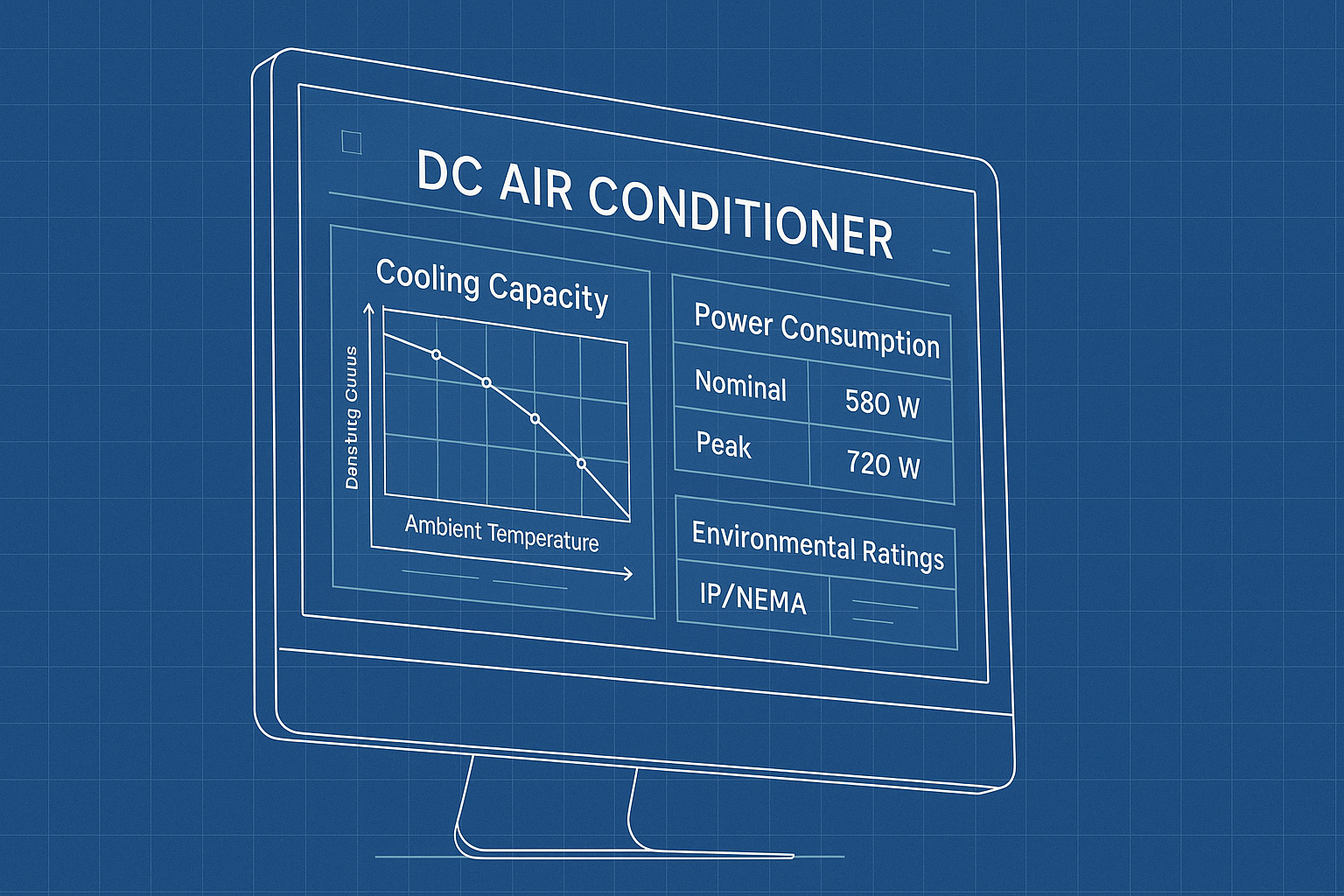
The most important—and most frequently misunderstood—specification is the cooling capacity rating dc aircon. The prominent number on the front page of a datasheet (e.g., 450W) is a *nominal* rating. This value is determined under standardized laboratory conditions, typically L35/L35, which means an internal enclosure temperature of 35°C and an external ambient temperature of 35°C.
However, the laws of thermodynamics dictate that the efficiency of a heat pump decreases as the temperature difference between the inside and outside increases. As the external ambient temperature rises, the air conditioner has to work harder to dump heat into the environment, and its effective cooling capacity decreases. This phenomenon is known as derating. A quality datasheet will include performance curves or a table showing the actual cooling capacity at various ambient temperatures. A core rule of thermal design is to size your cooling solution based on its derated capacity at your worst-case ambient temperature, not its nominal rating.
Power Input vs. Cooling Output (COP)
Engineers new to thermal systems sometimes confuse power input with cooling capacity. These are two different metrics. Cooling Capacity (in Watts or BTU/hr) is the amount of thermal energy the unit can remove from the enclosure. Power Input (in Watts) is the amount of electrical energy the unit consumes to perform that work. The ratio between these two is the Coefficient of Performance (COP). For example, a unit with a 450W cooling capacity might only consume 180W of electrical power. This would give it a COP of 2.5 (450 / 180). A higher COP indicates greater efficiency, which is especially critical in battery-powered applications.
Example Specifications from the Micro DC Aircon Series
A datasheet provides the raw data for your analysis. While formats vary, they will all contain a core set of specifications. The table below shows example parameters for several models within the Rigid Chill Micro DC Aircon series to illustrate what you should look for. These are provided as examples to contextualize the selection process.
| Model Example | Input Voltage (VDC) | Nominal Cooling Capacity (W) | Refrigerant |
|---|---|---|---|
| DV1910E-AC (Pro) | 12V | 450W | R134a |
| DV1920E-AC (Pro) | 24V | 450W | R134a |
| DV1930E-AC (Pro) | 48V | 450W | R134a |
| DV3220E-AC (Pro) | 24V | 550W | R134a |
Note: The values above are nominal and for illustrative purposes. Always refer to the official manufacturer datasheet for performance curves and detailed specifications.
A Step-by-Step Framework for Datasheet-Driven Selection
Use this structured approach to translate datasheet information into a reliable cooling solution.
- Define Your Thermal and Environmental Inputs
Before you even look at a datasheet, you must quantify your problem. This includes calculating the total internal heat load from all electronics, determining the maximum potential solar radiation load if the enclosure is outdoors, defining the highest possible ambient operating temperature, and setting the maximum allowable temperature inside the enclosure to keep components within their safe operating limits. - Filter by Primary Electrical and Mechanical Constraints
Use the datasheet to perform a first-pass filter. The most basic constraint is the available DC voltage (e.g., 12V, 24V, or 48V). Next, check the physical dimensions and weight to ensure the unit can be integrated into your design. Finally, verify the allowable mounting orientation. Some units are designed for vertical mounting only, and operating them horizontally can cause compressor lubrication failure. - Size for Cooling Capacity with Derating
This is the most critical step. Find the performance chart on the dc air conditioner datasheet. Locate your maximum expected ambient temperature on one axis and find the corresponding actual cooling capacity on the other. This derated capacity must be greater than your total heat load, with a recommended safety margin of 15-20% to account for unforeseen variables and component aging. Do not use the nominal rating for this calculation. - Validate Environmental Sealing and Control Features
If your application requires protection against dust or moisture, you need to understand the unit’s sealing capabilities. While datasheets may not always list a formal IP (Ingress Protection) or NEMA rating for the component itself, the design (e.g., flange, gasket) will be intended to help an integrator achieve a specific enclosure rating. Discuss your required IP/NEMA rating with the manufacturer. Also, review the control system. Does the unit offer variable fan speed via PWM? Are there alarm outputs for over-temperature or component failure conditions?

Implementation Checklist: From Datasheet to Deployment
Proper selection is only half the battle. Correct installation, guided by the datasheet and manual, is essential for long-term reliability.
- Mechanical Installation
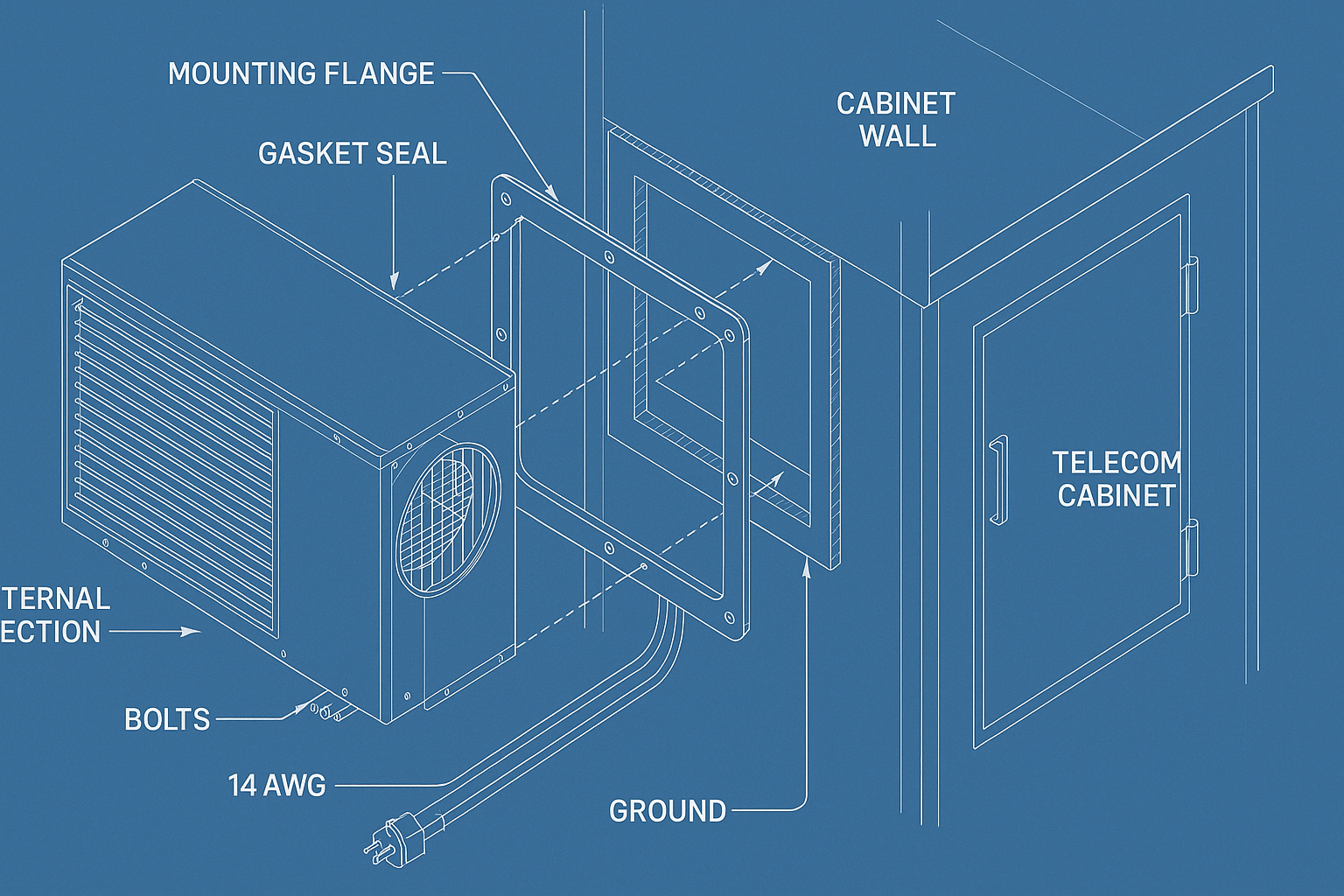
- Surface Integrity: Ensure the mounting surface of the enclosure is flat and rigid enough to support the unit without flexing.
- Secure Mounting: Use all provided mounting points with the specified hardware and torque values to prevent vibration-related failures.
- Airflow Clearance: Strictly observe the minimum clearance distances specified in the manual for both the condenser (external) and evaporator (internal) airflows. Obstructed airflow is a leading cause of poor performance.
- Electrical Connection
- Wire Gauge: Use wire of the appropriate gauge to handle the maximum current draw listed on the datasheet, factoring in the length of the wire run to minimize voltage drop.
- Power Supply: The DC power supply must be rated to handle not just the steady-state current but also the momentary inrush current at compressor startup.
- Grounding: Ensure the unit’s chassis is properly grounded according to the installation manual for safety and electrical noise reduction.
- Thermal Sealing
- Gasket Seal: Verify that the mounting gasket creates a continuous, airtight seal between the air conditioner and the enclosure wall. This is critical to maintaining the closed-loop system.
- Enclosure Integrity: Seal all other potential air leaks in the enclosure, such as cable glands and door seals, to prevent infiltration of ambient air.
- Commissioning and Maintenance
- System Check: After installation, power on the unit and listen for any abnormal noises or vibrations. Verify that both internal and external fans are operating correctly.
- Periodic Cleaning: The external condenser coils are the system’s radiator. In dusty environments, they must be periodically inspected and cleaned to maintain heat transfer efficiency. A clogged condenser is a slow death for a cooling unit.
Frequently Asked Questions (FAQ)
- 1. What’s the difference between cooling capacity in Watts and BTU/hr?
- They are just different units for measuring the same thing: a rate of heat removal. One Watt is equivalent to approximately 3.41 BTU/hr. Datasheets for the global market often list both.
- 2. Why does my dc air conditioner datasheet show a range for power consumption?
- Power consumption varies based on operating conditions. The unit will draw more power when working hard in high ambient temperatures. Modern units with variable-speed compressors and fans, like the Micro DC Aircon series, will also modulate their power draw to precisely match the cooling demand, increasing efficiency.
- 3. Can I mount a DC air conditioner horizontally?
- This depends entirely on the model. The compressor’s lubrication system is often designed for a specific orientation. Mounting a unit incorrectly can cause the oil to pool away from the compressor, leading to rapid failure. Always adhere to the mounting orientation specified on the datasheet.
- 4. What does an IP rating like IP55 actually mean for my enclosure?
- An IP rating defines the level of protection against the ingress of solids and liquids. The first digit (5) indicates protection against dust, and the second digit (5) indicates protection against low-pressure water jets from any direction. The air conditioner is a component that helps you achieve a system-level rating for your sealed enclosure.
- 5. How do I calculate the total heat load for my cabinet?
- The total heat load is the sum of all heat sources. The primary source is typically the power consumption of the internal electronics (P_internal). If the cabinet is exposed to sunlight, you must also add the solar heat gain (P_solar), which depends on the surface area, color, and location. The formula is: Heat Load = P_internal + P_solar.
- 6. The datasheet lists different refrigerant options. Which one should I choose?
- Refrigerant choice depends on application requirements and regional regulations. R134a is a widely used, effective HFC. R290 (propane) is a natural refrigerant with a very low Global Warming Potential (GWP) but is flammable, requiring specific safety considerations in the end-product design. R1234yf is a low-GWP alternative to R134a. The choice should be discussed with the manufacturer based on your product’s safety and compliance needs.
- 7. What is the expected service life of a miniature DC compressor?
- Service life depends on the application and operating conditions, but robust BLDC miniature rotary compressors are designed for longevity. The lifespan is often measured in tens of thousands of hours. The key to maximizing life is proper system integration: ensuring stable power, clean airflow, and operating within the specified temperature ranges.
- 8. What happens if I choose a unit with too much cooling capacity?
- Oversizing can lead to rapid cycling, where the compressor frequently turns on and off. This can cause premature wear on mechanical components and be electrically inefficient. It can also lead to excessive dehumidification inside the cabinet. It is better to size the unit correctly, with a reasonable safety margin, than to grossly oversize it.
Conclusion: From Data to Design Reliability
A dc air conditioner datasheet is far more than a simple catalog of features. It is an essential engineering document that provides the necessary data to design a reliable system. The difference between a successful deployment and a problematic one often comes down to the discipline of looking beyond the headline numbers. By understanding the principles of closed-loop cooling, accounting for thermal derating, and following a structured selection and implementation process, you can mitigate risks effectively.
The most reliable thermal solutions are born from a careful analysis of both the application requirements and the performance data of the cooling unit. For any project involving complex thermal challenges or unique environmental constraints, the datasheet is the starting point of a conversation. We encourage you to use this guide to inform your initial selection and to consult with experienced application engineers to validate your choice for your specific context. Explore our range of air conditioning solutions for more information.
Customization for Unique Applications
Standard datasheets define standard products. However, many advanced applications have requirements that fall outside of these specifications. Whether you need a unique voltage input, a modified footprint for tight integration, or enhanced performance for extreme temperature environments, a partnership with a flexible manufacturer is key. Rigid Chill specializes in developing customized and semi-customized Micro DC Aircon solutions. If your project demands more than an off-the-shelf product, contact our engineering team to discuss a purpose-built cooling solution tailored to your exact needs.