
Diffusion Pump Baffle Cooling Water Starts With Its Own Branch
Select diffusion pump baffle cooling water from the requirements of the actual water-cooled accessory: approved inlet temperature, branch flow, pressure limits, coolant quality, heat load, and cooling during shutdown. Identify the pump and baffle part numbers before comparing chillers. A baffle branch is a separate cooling duty, even when it shares a water source with the pump body. A compact refrigeration module can enter the review only when that duty falls within its documented operating conditions. It does not automatically replace the cooling supply for the whole diffusion pump, and it does not convert a water-cooled baffle into a cryogenic cold trap.
For a laboratory buying a small independent coolant source, the useful starting point is an interface record. It should show what the installed accessory needs, what the proposed supply can deliver, and which responsibilities remain with the vacuum-system provider. That record makes a quotation more meaningful than matching the pump’s name to a nominal cooling-capacity number.
Identify the Accessory Before Naming the Chiller
Water-cooled diffusion-pump baffles are real manufacturer accessories. Agilent lists water-cooled Halo Baffles separately from extended cold caps. That distinction matters during procurement: an accessory name, a pump-body cooling connection, and an inlet cold trap are not interchangeable descriptions. Obtain the assembly drawing or accessory manual for the installed part, rather than assuming that every item near the pump inlet has the same coolant connection or operating requirements.
Record the pump model, baffle part number, installed position, and accessory revision. Confirm whether the proposed water supply serves a dedicated passage in the accessory or enters a circuit shared with other components. Photographs can help identify connections, but they cannot establish internal routing or an approved operating limit. Keep an unresolved connection in the inquiry as a question. Do not turn a plausible hose route into a confirmed circuit diagram.
Separate the Baffle, Main Cooling Circuit, and Cold Trap
The diffusion pump baffle cooling water review should distinguish the accessory from the pump’s main cooling circuit. If both receive water from one source, their individual requirements still need to be available. A specification for the whole pump is not automatically a specification for a separately supplied baffle, and an accessory’s requirement does not establish the heat rejected by the pump body.
A refrigerated inlet cold trap introduces another duty. It may have a different temperature target, fluid requirement, collection mechanism, and service procedure. The separate vacuum cold-trap sizing guide addresses that selection boundary. Here, keep the inquiry centered on the water-cooled baffle. Combining several duties on a single chiller is a system-design decision that needs all of their operating conditions, rather than an assumption based on physical proximity.
Obtain a Temperature Requirement With a Measurement Location
Ask the accessory provider for the permitted supply-temperature range and where it applies. Is the limit measured at the baffle inlet, at a utility connection, or somewhere else? A refrigeration controller’s display is not proof of the liquid temperature entering the accessory. Hose routing, environmental exposure, and other branches can separate those readings. Include the measurement location in the requirements sheet so that the installed result can be compared against the correct boundary.
Use the approved accessory temperature requirement instead of choosing the lowest chiller setpoint. Do not import a temperature from another pump, a laboratory cold trap, or a refrigeration evaporator specification. When a baffle manual leaves the requirement unclear, request clarification for the actual accessory. A missing value should remain missing in the selection record; filling the gap with a familiar laboratory setpoint makes the quotation appear more complete while weakening its basis.
Check Flow and Pressure at the Baffle Connection
Define the required flow through the baffle branch and the allowable inlet, outlet, and differential pressures. These are separate quantities. A circulation pump can have an advertised flow that it cannot deliver through the installed accessory, hoses, fittings, and valves. Likewise, a maximum-pressure statement does not describe the pressure drop needed to obtain the required branch flow.
For diffusion pump baffle cooling water, request the hydraulic information using the intended liquid and operating temperature. Document hose lengths, connection sizes, service couplings, and the intended valve positions. If a pump curve or an accessory pressure-loss curve is unavailable, record the missing evidence and agree how the branch will be verified. The liquid-loop flow and pressure-drop guide explains the surrounding circuit issues; it does not supply an undocumented rating for the baffle or the proposed RIGID module.
Keep the Thermal Load Separate From Pump Electrical Power
A pump heater’s electrical rating does not identify the heat entering a separately cooled baffle. Nor does a vacuum pumping-speed figure establish a liquid-side cooling duty. Ask the vacuum-equipment provider for an accessory load estimate or an approved method of determining it under the intended operating program. Record which configuration and operating state the estimate covers.
If measured coolant data will support the estimate, agree the procedure before treating a return-temperature rise as a capacity specification. The record should identify the liquid, branch flow measurement, inlet and outlet temperature locations, and measurement uncertainty. A small difference between two probe readings deserves a different confidence assessment from a well-characterized result. Keep the capacity basis traceable and distinguish an observed branch load from a required design allowance. The allowance is a review decision, not a performance number that the chiller supplier has already guaranteed.
Decide Whether the Cooling Source Is Dedicated or Shared
A dedicated source makes the baffle duty easier to identify, but it does not remove the accessory’s requirements. Confirm how the proposed circuit will maintain the approved inlet condition and how the accessory can be serviced without interrupting another required cooling branch. Include any external circulation pump, reservoir, monitoring devices, and connections in the integration scope.
For a shared source, prepare a branch-by-branch record. List which consumers operate together and which must continue receiving cooling after another load stops. Specify how flow will be measured or confirmed in each branch. One satisfactory total-flow reading cannot establish that every branch has the required flow. Avoid choosing a shared arrangement merely because the connections fit; the supplier review needs both the simultaneous thermal duties and the installed hydraulic conditions.
Define Cooling Through Shutdown and Supply Interruptions
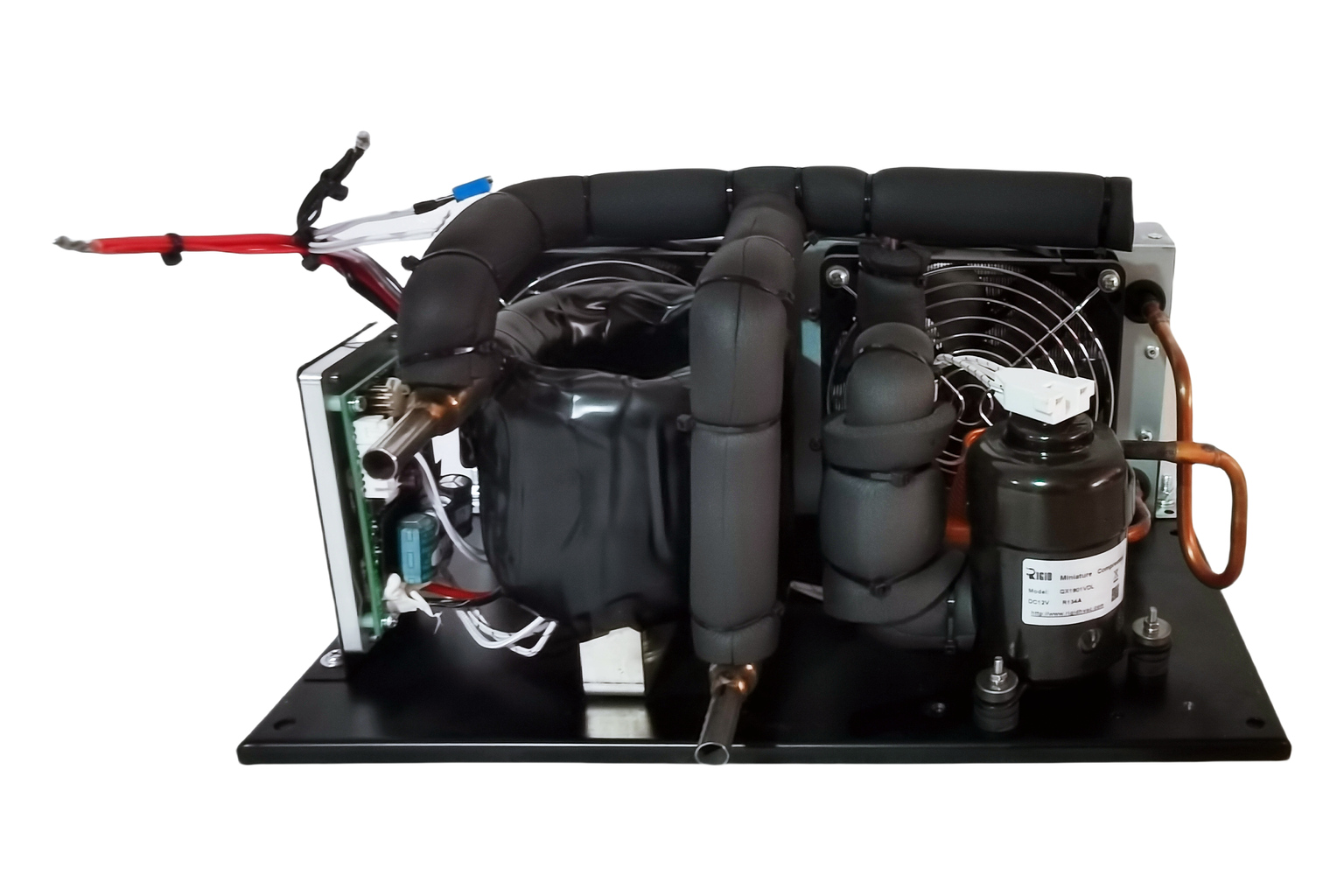
Cooling obligations can continue after a diffusion-pump heater is switched off. Agilent’s high-throughput pump manual explicitly requires cooling water during operation and continued cooling through the specified shutdown procedure. This is evidence that cooling has an operating sequence, not a universal timing specification for every pump or baffle. Use the current instructions for the installed equipment to define the accessory’s own requirements.
For diffusion pump baffle cooling water, ask what should happen following insufficient flow, an out-of-range supply temperature, a refrigeration fault, or loss of electrical power. Preserve the approved cooling sequence and identify who specifies the resulting vacuum-system response. This article does not define a heater interlock, venting sequence, emergency bypass, or safe interruption duration. A compressor stopping, a circulation pump stopping, and cooling water disappearing are different events; the integration review should distinguish them rather than assign all three the same assumed response.
Record Coolant Quality and Every Wetted Material
Use the accessory supplier’s coolant-quality instructions to assess the proposed closed loop. Confirm allowable additives and the materials exposed to the liquid, including the accessory, heat exchanger, circulation pump, tubing, seals, and couplings. Choosing a stainless steel heat exchanger does not establish compatibility for every other component in the circuit.
Do not introduce glycol, a biocide, or a corrosion inhibitor solely because it is common in another laboratory loop. Each change affects the fluid definition submitted for review. Record the formulation or supplier-approved specification and its maintenance requirements. A closed loop is still a maintained system: sampling, replacement, flushing, and refill responsibilities should be clear. Keep water-side contamination and the vacuum pump’s working fluid in separate records so that a maintenance discussion does not confuse two unrelated fluids.
Review the Compact DV Coaxial Module Within Its Boundary
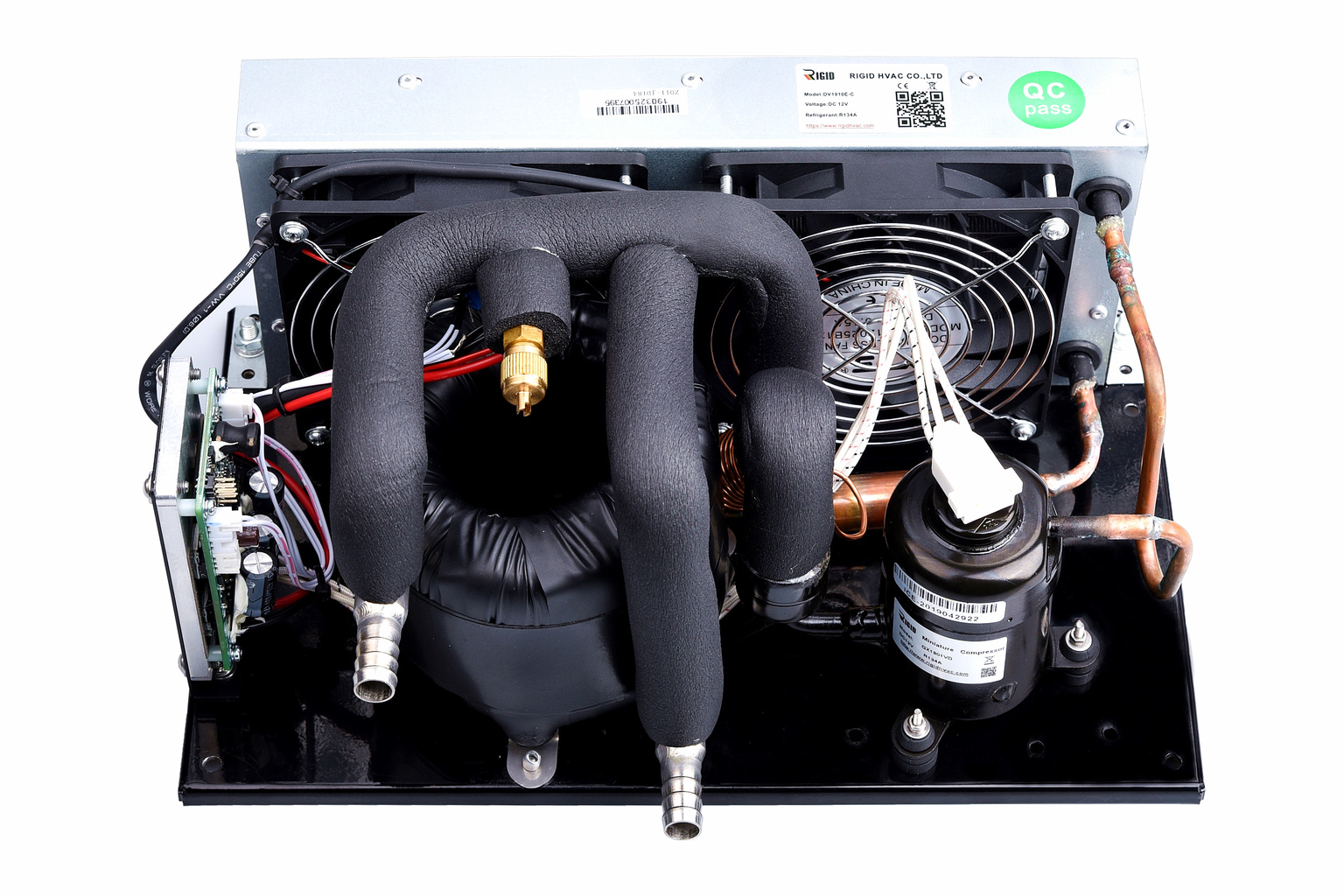
The RIGID compact liquid-chiller range includes a coaxial configuration. Its published liquid-temperature range is −20 to +20°C, and the series page lists cooling capacities of 100–550 W. Those catalog statements provide a screening boundary, not evidence that a particular module will satisfy every baffle duty. The published capacity figures do not state all test conditions needed to compare an actual application load.
DV1920E-C is one documented coaxial-series model that can be discussed with RIGID for a configuration-specific evaluation. Request capacity at the required coolant and ambient conditions, together with the electrical and integration information for the current delivered version. Pump flow, pump head, reservoir volume, and capacity test conditions are not stated in the referenced series facts. Evaluate the complete cooling arrangement, including any external circulation equipment, instead of treating a refrigeration module photograph as a finished baffle-cooling package.
Reject Requirements Outside the Documented Overlap
An acceptable accessory supply-temperature range and a catalog chiller range need an actual overlap at the intended operating condition. If the required supply is above +20°C, the published DV liquid-chiller range does not establish suitability. If the accessory requires a lower condition than −20°C, this product range likewise does not document coverage. Request an engineering determination or consider another appropriate cooling arrangement rather than quietly extending the published range.
The same discipline applies when the temperature overlaps but the available capacity evidence is inadequate. Do not interpret a suitable setpoint as proof of sufficient cooling. Also avoid claiming that a compact module covers an entire diffusion-pump installation when only a small accessory branch was evaluated. A useful rejection record names the unsupported requirement and the evidence still needed; it keeps procurement from losing the reason a candidate was set aside.
Build a Two-Duty Cooling Interface Record
Use a separate column for the baffle and the pump’s main cooling circuit, even when only the baffle is included in the current quotation. The second column makes the excluded duty visible and prevents an accessory inquiry from becoming an unreviewed whole-pump replacement. Add another consumer explicitly if the proposed source will also serve it.
| Review field | Baffle branch | Main pump cooling circuit |
|---|---|---|
| Equipment identity | Accessory part number and revision | Pump model and current manual |
| Supply temperature | Approved range and measurement location | Separate manufacturer requirement |
| Flow and pressure | Branch flow and hydraulic limits | Independent flow and connection limits |
| Thermal duty | Evidence for the accessory operating states | Evidence for the main cooling duty |
| Liquid definition | Approved formulation and wetted materials | Confirm compatibility separately |
| Operating sequence | Required cooling and interruption response | Manufacturer operation and shutdown procedure |
| Cooling supply scope | Proposed dedicated or shared branch | Included in quotation or explicitly excluded |
| Verification | Agreed branch measurements and acceptance | Independent operating verification |
Mark an unknown entry as not stated or awaiting supplier confirmation. That is more useful than merging the two columns into a single approximate requirement. The diffusion pump baffle cooling water record should allow another engineer to identify exactly what was evaluated and what remains outside the selection.
Verify the Installed Branch Before Acceptance
Agree an acceptance procedure with the equipment and cooling-system providers. It should specify the configuration, liquid, measurement locations, operating states, and acceptance limits to be used. Check that the actual branch reaches its required flow and inlet condition, with the installed hoses and intended valves. Record the condition of the refrigeration module’s environment as part of the verification rather than comparing an enclosed installation with an unrelated catalog photograph.
Acceptance should demonstrate the agreed branch duty. A cold supply hose, a stable controller display, or a pump that appears to run normally is not a substitute for the required measurements. Any response check must follow the providers’ approved procedure; do not deliberately remove required cooling from a hot operating pump to create an informal test. After maintenance changes the branch routing, liquid, or components, identify which acceptance evidence needs to be repeated.
Submit a Baffle-Specific Inquiry
Send the baffle and pump identities, the current cooling requirements, the defined liquid, the thermal-load evidence, and the proposed branch arrangement. Describe the ambient environment and available electrical supply without inferring whole-system consumption from a compressor current entry. State whether the quotation covers the baffle alone or additional consumers, and list the external pump, reservoir, controls, and mounting responsibilities that still need agreement.
For a diffusion pump baffle cooling water evaluation, contact RIGID with the accessory requirements. A complete inquiry lets the supplier assess the documented duty and flag missing conditions. It does not establish compatibility before that review. Preserve the resulting requirements and any supplier qualifications alongside the installed configuration so that a later service change can be assessed against the same selection basis.
Frequently Asked Questions
Can a compact chiller cool the entire diffusion pump?
That cannot be established from a baffle inquiry alone. The baffle branch and the pump’s main cooling circuit need separate temperature, flow, pressure, load, and operating-sequence records. If both will share one cooling source, the equipment and cooling-system providers must review the combined arrangement. A compact module that is suitable for a small accessory duty is not automatically suitable for the whole pump.
Is a water-cooled baffle the same as a refrigerated cold trap?
No. Identify the accessory by its drawing and manufacturer instructions. A water-cooled baffle, an internal cold cap, and a separately refrigerated cold trap can have different cooling interfaces and operating requirements. Do not transfer a cold-trap setpoint, collected-material assumption, or service procedure to the baffle branch merely because both components are located near the pump inlet.
What temperature should diffusion pump baffle cooling water use?
Use the approved range for the actual accessory and specify its measurement location. This guide does not assign a universal baffle setpoint. Compare that requirement with the proposed chiller’s documented range, then obtain performance evidence at the selected condition. The DV compact liquid-chiller range is −20 to +20°C; that statement does not extend to every cooling product or prove accessory compatibility.
Can cooling stop as soon as the pump heater turns off?
Do not assume that heater shutdown ends the cooling requirement. The installed pump and accessory instructions determine the required cooling sequence and permitted interruption response. Manufacturer pump manuals can require continued cooling after heater shutdown. Define the actual branch obligation with the vacuum-equipment provider; neither a generic delay nor an assumed chiller alarm interface supplies that missing requirement.
What information is needed to evaluate a DV coaxial module?
Provide the pump and baffle identities, approved inlet temperature and branch flow, hydraulic limits, coolant definition, thermal-load evidence, ambient conditions, available power, and operating sequence. State which additional loads and external circulation components are included. Request the current module’s performance at those conditions and keep unpublished specifications explicitly unresolved until RIGID supplies configuration-specific information.