
What a Direct Expansion Evaporator Is
A direct expansion evaporator is a heat exchanger in which refrigerant fed through a metering device boils completely inside the tubes or channels in contact with whatever is being cooled. The refrigerant enters as a cold liquid-vapor mixture, absorbs heat from the air, plate, product or liquid on the other side, and leaves as vapor on its way back to the compressor.
That definition sounds simple, but it has practical consequences. In a direct expansion system the evaporator, the metering device and the condensing unit form one sealed refrigerant circuit, so the evaporator cannot be chosen in isolation. Its size and form decide the evaporating temperature the compressor actually runs at, and that in turn decides capacity, efficiency and frost.
This guide explains how a direct expansion evaporator compares with other arrangements, what happens to the refrigerant along its length, and how to match one to a small DC condensing unit, with a worked balance-point example.
Feed Method and System Architecture: Two Separate Choices
Two different questions often get mixed together. The first is how refrigerant is fed to the evaporator: direct expansion or flooded. The second is what the evaporator cools: the load itself, or a secondary liquid that is then pumped to the load. A direct expansion evaporator can do either job, so the two comparisons are best kept apart.
| Feed method | How it works | Typical strengths | Typical limits |
|---|---|---|---|
| Direct expansion (DX) | Metered refrigerant boils completely inside the evaporator; vapor leaves slightly superheated | Small charge, few parts, suits compact systems | Evaporator, metering device and condensing unit must be matched |
| Flooded | Evaporator runs full of liquid fed from a separator or surge vessel; vapor returns through the vessel | High heat transfer across the whole surface, common in large industrial plants | Larger charge and vessels; rarely practical in compact systems |
| System architecture | How it works | Typical strengths | Typical limits |
|---|---|---|---|
| Direct cooling | The evaporator sits at the load and cools air, a plate or product directly | Lowest temperature difference to the load; no pump or coolant | Refrigerant circuit must reach the load |
| Secondary loop | An evaporator chills water or glycol, which is pumped to the load | Refrigerant stays in one compact unit; coolant can be piped anywhere | Extra temperature step, pump energy and coolant to manage |
For compact DC refrigeration the feed is almost always direct expansion, so the practical choice is the architecture. A direct expansion evaporator placed at the load wins when the load is close to the condensing unit and every kelvin of temperature difference counts. A secondary loop, as in a compact liquid chiller where a plate, coaxial or coil evaporator chills the liquid, wins when the cold has to travel to several places or the refrigerant circuit cannot be opened on site.
What Happens Along the Coil
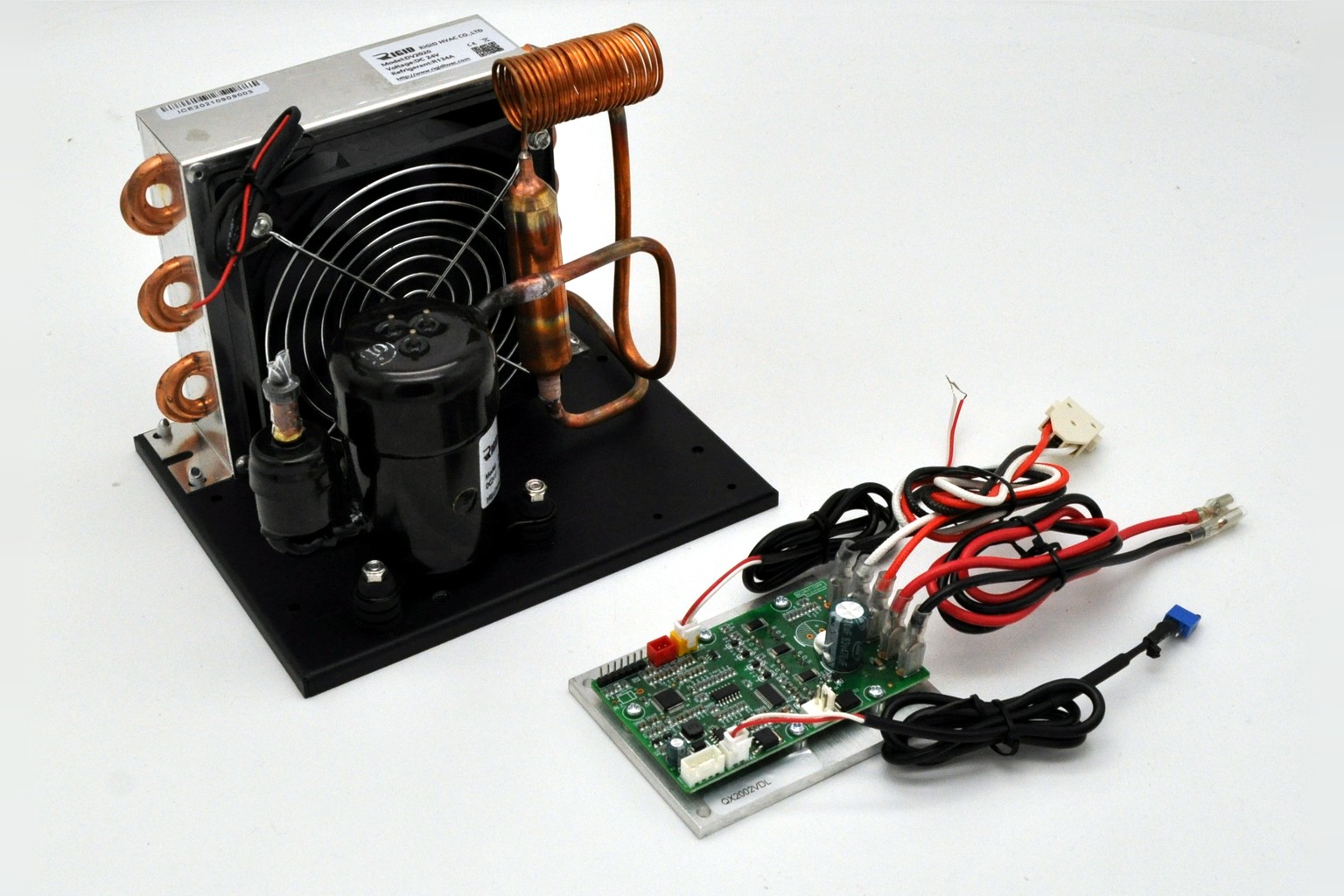 Every direct expansion evaporator has two zones. In the first and largest, the refrigerant is a boiling mixture at a nearly constant saturation temperature, and heat transfer is strong. In the last part of the circuit, the remaining liquid has boiled away and the vapor warms a few kelvin above saturation. That temperature rise is the superheat.
Superheat is not waste; it is insurance. It confirms that no liquid is returning to the compressor, where it could dilute oil or damage valves. Too much superheat, however, means a large share of the evaporator is warming vapor instead of boiling liquid, so the effective surface shrinks and capacity falls. Too little risks liquid return. Typical settings are a few kelvin, but the right figure depends on the metering device and the compressor maker’s guidance, as our guide to evaporator superheat in capillary DC systems explains.
Pressure drop along the circuit also matters. Refrigerant loses pressure as it flows, so its saturation temperature falls slightly from inlet to outlet. Long single circuits with small tubes can drop enough pressure to distort the superheat reading and waste surface. Larger coils are therefore split into parallel circuits fed by a distributor.
Metering Devices and How They Shape the Evaporator
The metering device sets how much liquid enters the direct expansion evaporator. Each type suits a different load pattern.
| Metering device | Control principle | Suits | Watch for |
|---|---|---|---|
| Capillary tube | Fixed restriction sized for one design condition | Small, steady loads; low cost; no moving parts | Charge-critical; superheat drifts as load and ambient change |
| Thermostatic expansion valve | Bulb at evaporator outlet holds superheat roughly constant | Loads that vary; multi-circuit coils | Bulb placement and insulation; hunting at very low flow |
| Electronic expansion valve | Controller drives valve from pressure and temperature sensors | Variable-speed compressors; wide operating ranges | Needs sensors, controller and tuning |
A variable-speed DC compressor changes mass flow continuously, which a fixed capillary cannot follow perfectly. Capillary systems still work well when the speed range used in practice is narrow and the charge is set carefully. Where the compressor spends long periods at very different speeds, a valve that holds superheat tends to use the evaporator surface more consistently.
The Balance Point: Where Evaporator and Condensing Unit Meet
A condensing unit’s capacity rises as the evaporating temperature rises, because the vapor it draws in is denser. An evaporator’s capacity does the opposite: it rises as the evaporating temperature falls, because the temperature difference to the load grows. The system settles where the two curves cross. That crossing is the balance point.
The example below uses assumed values for illustration only. The condensing unit figures are a generic curve, not a rating for any RIGID model.
| Evaporating temperature | Condensing unit capacity (assumed) | Small evaporator, 12 W/K, air at 4 °C | Large evaporator, 24 W/K, air at 4 °C |
|---|---|---|---|
| 0 °C | 265 W | 48 W | 96 W |
| −5 °C | 220 W | 108 W | 216 W, balance about here |
| −10 °C | 180 W | 168 W | 336 W |
| −12 °C | 165 W | 192 W, balance near −11 °C | 384 W |
With the small evaporator, the system balances near −11 °C at roughly 175 W. Doubling the evaporator’s heat transfer moves the balance to about −5 °C at roughly 218 W. The same condensing unit delivers more cooling, at a higher evaporating temperature, with a lower compression ratio and therefore better efficiency.
The warmer coil has a second benefit: it removes less moisture from the air and builds frost more slowly. The trade-off is size and cost. An undersized direct expansion evaporator is one of the most common reasons a correctly rated condensing unit appears to underperform.
Evaporator Forms in Small DC Systems
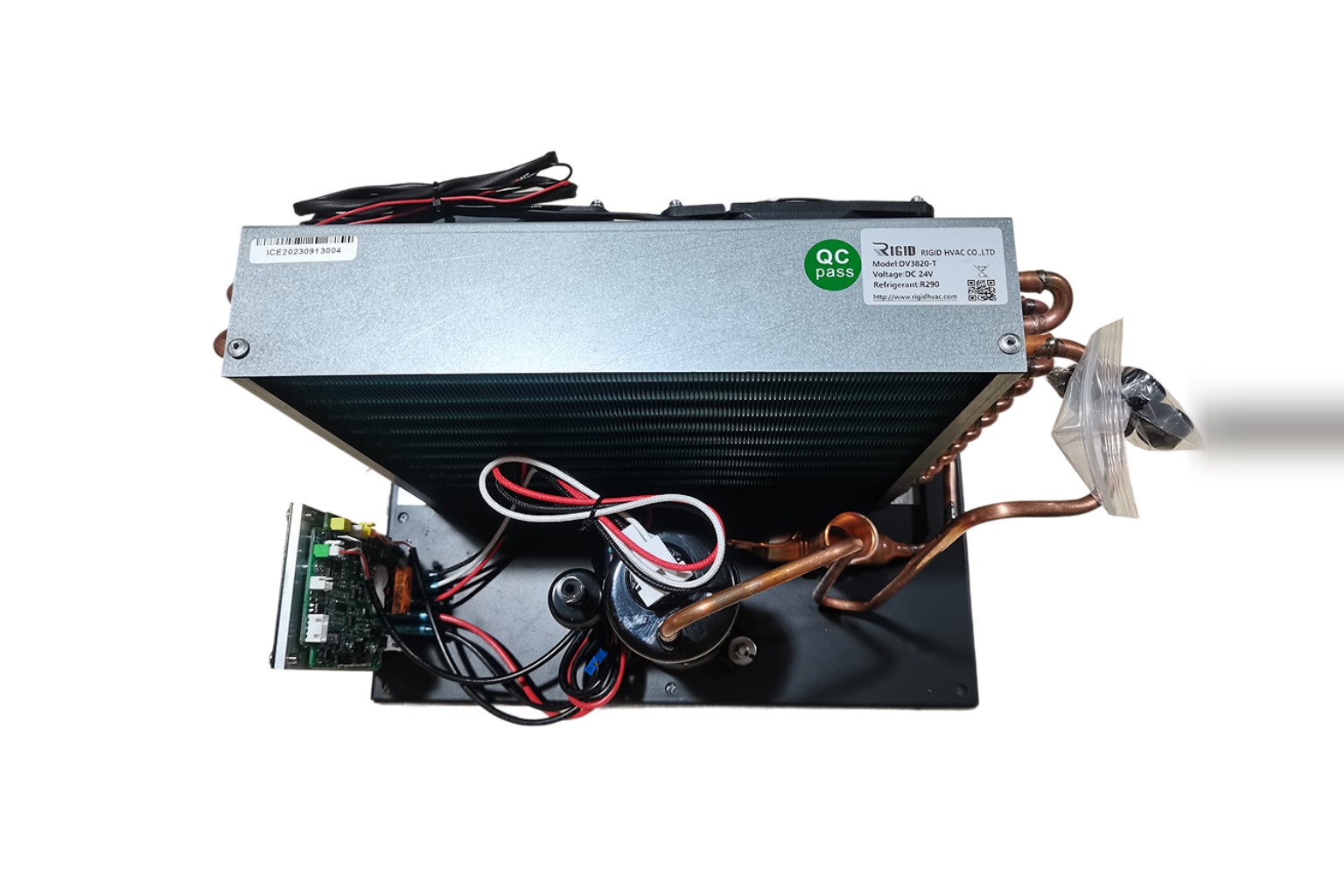 Small DC systems use several evaporator forms, chosen by what has to be cooled and how.
- Finned-tube coil with fan for cooling air in boxes, cabinets and small rooms. Fin spacing trades surface area against frost tolerance.
- Cold plate, with refrigerant channels bonded to or machined into a metal plate, for conducting heat directly from electronics, samples or a payload.
- Roll-bond or plate evaporator, common in refrigerator and freezer liners, where the plate forms part of the cabinet wall.
- Tube-on-tank wrapping, where tubing is bonded around a vessel to cool its contents.
- Coaxial or tube-in-tube exchanger, where refrigerant cools a flowing liquid, which is effectively the heart of a secondary-loop chiller.
Each form has a very different heat transfer coefficient per unit area. A cold plate in good contact with a solid load can run a small temperature difference, while a coil cooling still air needs much more surface for the same heat. Size from the load side first, then check where the balance point lands.
Matching a Direct Expansion Evaporator to a DC Condensing Unit
RIGID’s DC condensing unit range is listed at 100 to 550 W of cooling capacity, an evaporating temperature range of ±20 °C, 12V, 24V and 48V supplies, R134a or R290 refrigerant, and variable compressor speed from 2,000 to 6,500 rpm. Individual models are listed at low back-pressure capacities, for example 100 to 130 W for the 12V DV1910 and 100 to 250 W for the R290 DV2820-T. The page describes these units as cooling the payload directly via a cold plate or evaporator, which is exactly the direct expansion arrangement.
Work through the match in this order:
- Define the load and target temperature, including pull-down, door openings and the hottest ambient the condenser will see.
- Choose the evaporating temperature the design can tolerate. Check it sits inside the unit’s listed evaporating range; a design that needs evaporating below −20 °C is outside the listed range and should be discussed with the manufacturer first.
- Size the evaporator’s heat transfer so that the balance point lands at or above that evaporating temperature with the required capacity.
- Select the metering device for the load pattern and the compressor’s speed range.
- Plan tube sizes and routing for oil return at minimum speed, especially on vertical suction risers.
- Set the refrigerant charge and superheat on the real system, not from a drawing.
For a room-scale example of this process, see our guide to sizing a DC condensing unit for small cold rooms.
Frost, Oil Return and Charge
Three field issues account for most direct expansion evaporator complaints in small systems.
Frost forms whenever the coil surface is below 0 °C and the air holds moisture. Frost insulates the surface and blocks fin passages, which lowers the evaporator’s heat transfer and pushes the balance point colder, which grows more frost. A generously sized coil running warmer slows this spiral, and a defrost strategy removes what does form.
Oil return is the second. Small compressors carry oil with the refrigerant, and it must be swept back through the evaporator and suction line. Oversized tubes or long upward runs at low compressor speed let oil settle where it both starves the compressor and coats the evaporator surface.
Charge is the third, particularly with capillary tubes. Too little refrigerant starves the evaporator, raises superheat and cuts capacity. Too much floods it and risks liquid return. With R290, charge limits for the application also apply, so the evaporator’s internal volume matters at the design stage. The basics of how the whole circuit fits together are covered in our explainer on how a 12V compressor fridge works.
Common Mistakes
- Choosing a condensing unit by nominal capacity without checking capacity at the real evaporating temperature.
- Undersizing the evaporator, which drags the evaporating temperature down, reduces capacity and accelerates frost.
- Using a capillary sized for one condition on a system whose compressor speed and load vary widely.
- Reading superheat with a poorly attached or uninsulated sensor.
- Ignoring oil return at minimum compressor speed.
- Assuming a direct expansion evaporator can simply be swapped for a larger one without revisiting charge and metering.
If you are designing a direct expansion system around a compact DC condensing unit, share the load, target temperature, ambient range, supply voltage, evaporator form and available space, and our engineers will help check the match. Send your direct expansion system details to our engineering team.
Frequently Asked Questions
What is a direct expansion evaporator?
It is an evaporator in which refrigerant boils directly inside the tubes or channels in contact with the air, plate, product or liquid being cooled. The refrigerant enters as a liquid-vapor mixture, evaporates completely, and leaves as slightly superheated vapor. It can cool a load directly or chill a secondary liquid.
What is the difference between a DX evaporator and a flooded evaporator?
A DX evaporator is fed only as much liquid as it can fully evaporate, controlled by a metering device, so vapor leaves with some superheat. A flooded evaporator runs full of liquid supplied from a separator or surge vessel, and vapor returns through that vessel. Flooded designs are mainly used in large industrial systems.
Is cooling directly with a DX evaporator better than a chiller loop?
Neither is better in general. A direct expansion evaporator at the load has a smaller temperature difference to the load and fewer parts. A secondary loop, in which an evaporator chills water or glycol that is pumped to the load, keeps refrigerant in one unit and lets coolant travel to distant or multiple loads, at the cost of an extra temperature step and a pump.
Why does my condensing unit deliver less cooling than its rating?
A common reason is that the evaporator is too small or frosted, which pulls the evaporating temperature below the rating point. The compressor then pumps less refrigerant mass and delivers less capacity. Incorrect charge, high superheat and a hot condenser environment are the other usual causes.
What superheat should a direct expansion evaporator run?
Typical settings are a few kelvin, enough to guarantee no liquid reaches the compressor without wasting evaporator surface. The correct value depends on the metering device, the refrigerant and the compressor maker’s guidance, so confirm it on the operating system.
Can one DC condensing unit serve two evaporators?
It is possible but adds complexity. Two evaporators at different temperatures need separate metering and usually pressure or flow control so that the colder one does not starve the warmer one or vice versa. For multiple loads at similar temperatures, a secondary coolant loop is often simpler.