
Heat kills pets. Every summer, animals die in vehicles and crates because passive cooling solutions cannot overcome ambient temperatures above 28-30°C. Your dog overheats in a vehicle crate during summer shows. A proper dog crate air conditioner solves this — not a fan, not an ice pack, but genuine vapor compression cooling. Your breeding kennel cannot maintain safe temperatures during heat waves. Your service dog needs a cooled crate for transport between buildings. Air conditioning a small enclosed space for an animal raises specific safety questions that general HVAC advice does not address.
This guide covers whether a micro DC aircon is appropriate for pet cooling applications, what safety features matter, and how to size the system correctly for an animal crate environment.
Why a Dog Crate Air Conditioner Beats Standard Pet Cooling
Current approaches to pet cooling have significant limitations:
Ice packs and cooling mats: Provide 30-60 minutes of modest temperature reduction, then become warm dead weight. Cannot maintain a specific target temperature. Require constant replacement during long events. Not a solution for extended transport or kennel cooling.
Battery fans: Move air but cannot cool below ambient temperature. When ambient is 35°C, a fan blowing 35°C air does not prevent heat stress in a brachycephalic breed that struggles above 26°C. Air movement helps with evaporative cooling from panting but cannot overcome a hot environment.
Vehicle AC left running: Works but wastes fuel, generates emissions, and requires the vehicle engine running (or a hybrid/EV system). For shows, training events, or emergency service staging areas, leaving vehicles running creates noise, pollution, and safety concerns.
Thermoelectric coolers: Small Peltier-based units marketed as “pet coolers” typically produce 20-50W of cooling. For a well-insulated crate in 35°C ambient, you need 150-300W of cooling capacity to maintain safe interior temperatures. These units cannot deliver that. They create a slightly cool spot directly in front of the unit but cannot lower overall crate temperature meaningfully.
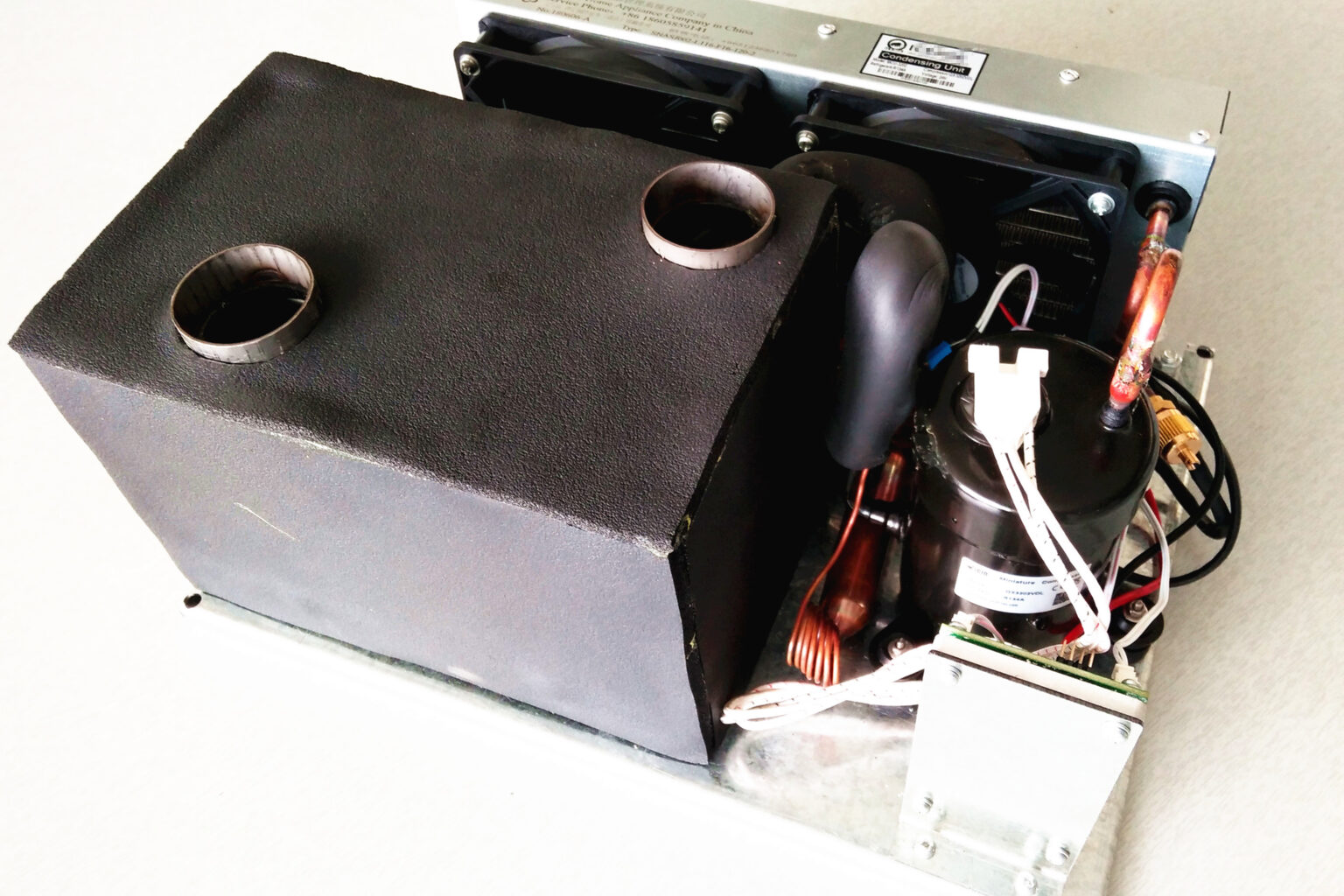
A micro DC air conditioner using vapor compression (the same technology in your home AC, miniaturized) provides the cooling capacity, temperature precision, and sustained operation that animal safety requires.
Pet Chiller Safety: What Makes a DC Aircon Safe for Animals
Animals cannot adjust thermostat settings, report discomfort, or escape if the system malfunctions. Safety features that matter specifically for pet applications:
Temperature limiting: The system must prevent over-cooling. A dog crate should not drop below 15-18°C even if the controller malfunctions. Hardware temperature limits (independent of software control) provide this protection. Most micro DC aircon controllers include a minimum temperature cutoff that prevents the compressor from running when discharge air temperature drops below a safe threshold.
No exposed hot surfaces: The condenser (hot side) and discharge line can reach 50-70°C during operation. These components must be located outside the animal space or protected by guards. A properly installed system routes all hot-side components externally, with only the cooled air output entering the crate.
Quiet operation: Animals have more sensitive hearing than humans. A compressor cycling on and off (as fixed-speed units do) creates startling noise events that stress anxious animals. Variable-speed BLDC compressors running continuously at partial load produce steady, low-level white noise (35-40 dB) that most animals habituate to quickly. No sudden startups or shutdowns.
No refrigerant risk to animals: The refrigerant circuit is permanently sealed. R134a (the standard refrigerant in micro DC aircon systems) is non-toxic and non-flammable at room temperature. Even in the unlikely event of a leak, the small charge amount (typically 50-100g) in a micro unit dissipates rapidly without creating hazardous concentrations in a ventilated space.
Fail-safe behavior: If power is lost or the compressor fails, the system must not create a worse condition than having no cooling at all. This means: no blocked airflow paths that trap heat, no sealed spaces that prevent natural ventilation, no stored cold that reverses into heat. A well-designed installation allows passive airflow when the system is off.
Sizing a Micro DC Aircon for a Dog Crate
Thermal load calculation for an animal crate differs from equipment cooling because the animal itself is a significant heat source:
 Animal metabolic heat: A medium dog (20-30 kg) at rest generates 40-80W of metabolic heat. Under mild stress (panting, elevated heart rate from heat or anxiety), this rises to 100-150W. Large breeds and working dogs can generate 150-250W under exertion.
Solar heat gain through crate walls: A crate in direct sunlight can absorb 200-500W of solar radiation depending on color and material. Dark-colored crates in full sun represent the worst case. This is often the largest heat load component — more than the animal itself.
Ambient heat transfer: Heat flowing through crate walls from hot ambient air. For a standard large dog crate (roughly 1m × 0.7m × 0.8m) with typical plastic/wire construction, heat gain at 35°C ambient with 22°C interior target: approximately 80-150W depending on insulation quality.
Total cooling requirement: Animal heat (100W) + solar gain (0-300W depending on shade) + ambient conduction (100W) = 200-500W for a large crate in summer conditions. With shade and insulation, the lower end (200-250W) is sufficient. In direct sun, you need the full 400-500W range.
This sizing tells you which micro DC aircon unit to select:
- DV1910E-AC (12V, 450W cooling): Suitable for most pet crate applications, especially when shade or insulation reduces solar load. Runs from vehicle 12V battery directly.
- DV1920E-AC (24V, 450W cooling): Same capacity, 24V operation for dedicated battery setups or dual-battery vehicle systems.
- DV3220E-AC (24V, 550W cooling): For large crates in high-ambient conditions or multiple-animal enclosures.
Dog Crate Air Conditioner Installation Approaches
Installation must balance cooling performance with animal safety and practical portability:
External condenser mounting: The condenser (heat rejection side) mounts outside the crate — typically on the roof, rear wall exterior, or on a separate platform beside the crate. This keeps all hot components away from the animal and rejects heat to ambient without warming the crate interior.
Cool air delivery: A short insulated duct from the evaporator output enters the crate through a wall or ceiling penetration. Direct the airflow along the crate ceiling (not directly at the animal’s face) to provide distributed cooling without draft stress. Some installations use a diffuser plate to spread airflow evenly.
Condensate management: Cooling dehumidifies air, producing condensate water. Route the condensate drain to the outside of the crate via a small tube. Do not allow water to drip inside the animal space — it creates a slip hazard and wet bedding.
Power connection: For vehicle installations, wire directly to the vehicle battery through an appropriate fuse (15-30A depending on the unit). For portable setups, a dedicated lithium battery pack (100-200Ah at 12V) provides several hours of operation between charges.
Battery Runtime for a Dog Crate Air Conditioner
For show events, training days, or emergency staging where mains power is unavailable:
A DV1910E-AC at 12V draws approximately 8-12A under typical pet crate cooling load (partial load, not maximum). With a 100Ah lithium battery (usable capacity ~80Ah):
- Runtime at average 10A draw: 80Ah ÷ 10A = 8 hours
- Runtime at lighter load (shade, cooler ambient): 10-12 hours
- Runtime at maximum load (direct sun, hot day): 5-6 hours
For full-day events (8-10 hours), a 200Ah battery provides comfortable margin. A 100W solar panel can extend runtime significantly during daytime events, partially offsetting the compressor draw.
Monitoring and Alarms for Unattended Operation
When an animal is left in a cooled crate (during shows, transport stops, or kennel operation), monitoring prevents dangerous conditions:
- Interior temperature alarm: A wireless temperature sensor inside the crate alerts your phone if temperature exceeds a set threshold (e.g., 28°C). If the AC fails, you have minutes to respond before heat becomes dangerous.
- Low battery alarm: A voltage monitor on the power battery warns when remaining capacity drops below 20%, giving you time to connect shore power or start the vehicle.
- Compressor status indicator: A simple LED visible from outside the crate confirms the system is actively cooling. If the LED is off and the vehicle is not running, investigate immediately.
These monitoring systems are inexpensive ($20-50 for wireless temperature monitors) and provide critical peace of mind for responsible animal owners. No cooling system should be trusted without backup monitoring when animal lives depend on it.
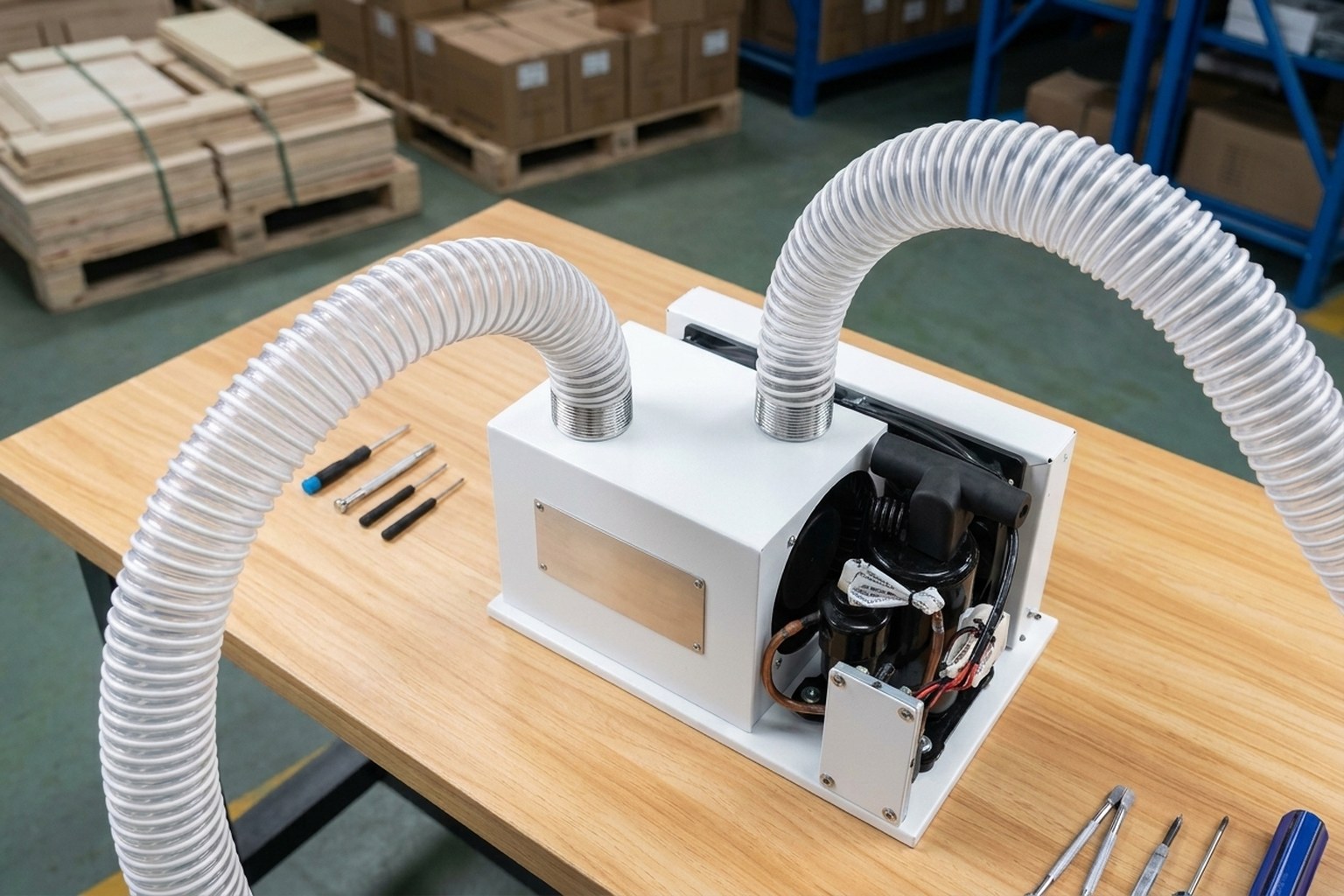 For specifications on micro DC air conditioning units suitable for pet crate cooling, including 12V and 24V models with 450-550W cooling capacity, see the RIGID Micro DC Aircon product page.
Temperature Targets for Different Animals and Breeds
Not all animals have the same thermal tolerance. Setting the right temperature target prevents both overheating and over-cooling:
Brachycephalic breeds (Bulldogs, Pugs, French Bulldogs, Boxers): These breeds have compromised respiratory cooling due to shortened airways. They overheat faster and recover slower. Target crate temperature: 20-23°C. Begin cooling intervention when ambient exceeds 25°C. These breeds are the primary use case for pet crate air conditioning — they face genuine life-threatening risk in hot vehicles.
Standard breeds (Labradors, Shepherds, Pointers, Setters): Better heat tolerance through normal respiratory anatomy but still vulnerable in enclosed crates. Target: 22-26°C. Intervention when ambient exceeds 28°C for extended periods.
Working dogs in active service: Police K9, search-and-rescue, military working dogs generate high metabolic heat from exertion. Recovery cooling between deployments is critical for performance and safety. Target: 18-22°C for rapid recovery. These applications benefit from higher cooling capacity (550W+) for quick pull-down.
Cats and small animals: Lower metabolic heat generation but confined in smaller spaces. A small crate heats up faster due to lower thermal mass. Target: 22-25°C. Lower cooling capacity needed (250-350W) due to smaller enclosed volume and lower animal heat output.
Real-World Installation Examples
Practical installations that demonstrate the system in operation:
Show dog transport van: A professional handler travels to shows with 4 dogs in individual crates in a van. Each crate has a DV1910E-AC unit (12V, 450W) powered from the van’s secondary battery bank (2× 100Ah lithium, isolated from starting battery). A solar panel on the roof provides partial charge during shows. The handler monitors crate temperatures remotely via wireless sensors. Total installation cost per crate: approximately $650 including the AC unit, mounting hardware, ducting, and temperature monitor.
Police K9 vehicle: A patrol vehicle with a rear-compartment K9 kennel. The micro DC aircon runs from the vehicle’s electrical system whenever the engine is running, and from an auxiliary battery (200Ah) when parked. A temperature-activated alarm alerts the officer if kennel temperature exceeds 27°C, triggered if the AC fails or battery depletes. Critical safety requirement: backup ventilation (fan + open vents) activates automatically if AC power is lost.
Breeding kennel (multiple runs): A small breeder with 6 kennel runs uses one DV3220E-AC (24V, 550W) per pair of adjacent runs, with cooled air ducted to both spaces. Powered from mains through 24V supplies. Thermostat control maintains 23°C during summer heat waves. Total cooling for 6 runs: 3 units, operating cost approximately $2-4/day in electricity during peak summer.
Legal and Ethical Considerations
Several jurisdictions have laws regarding animals in vehicles and enclosed spaces:
- Hot car laws: Many US states have laws prohibiting leaving animals in vehicles under conditions that could cause harm. A functioning crate AC system demonstrates reasonable precaution — but verify local laws regarding whether this provides legal protection or merely reduces risk.
- Transport regulations: Commercial animal transport (airlines, professional handlers) has specific temperature requirements. IATA Live Animals Regulations specify 15-25°C for most species. A controllable AC system helps meet these requirements during ground transport segments.
- Show venue requirements: Some show organizations require shade and cooling provisions for crated animals. A documented cooling system may satisfy these requirements where passive shade alone does not.
Installing a pet crate cooling system is a responsible decision that addresses real animal welfare concerns. However, technology is not a substitute for attention — always monitor your animal’s condition regardless of what the thermostat reads.
Maintenance and Seasonal Considerations
A pet crate AC system operates intermittently (typically spring through fall in temperate climates). Seasonal maintenance ensures reliability when you need it:
- Spring startup: Run the system for 30 minutes before the first hot-weather use. Verify cooling output, check for unusual noises, confirm condensate drains freely. Check battery condition if using dedicated battery power.
- Monthly during use: Clean the condenser fins (pet hair accumulates quickly). Check air filter if installed. Verify temperature monitor/alarm batteries.
- Fall shutdown: Run system briefly to confirm everything works for storage reference. Clean all components. Store in dry conditions.
- Battery maintenance: If using lithium batteries for portable operation, store at 50-60% charge during off-season. Do not leave fully charged or fully depleted for months.
For specifications on micro DC air conditioning units suitable for pet crate cooling, including 12V and 24V models with 450-550W cooling capacity, see the RIGID Micro DC Aircon product page.