
Why a Dog Crate Air Conditioner Is a Safety Necessity, Not a Luxury
Dogs die in hot cars. This is not an exaggeration — it is a documented, preventable tragedy that happens thousands of times every year. A parked vehicle in 30°C (86°F) weather reaches 50°C (122°F) inside within 30 minutes with windows closed. Even with windows cracked, temperatures reach dangerous levels within 15-20 minutes. Dogs cannot sweat — they regulate temperature through panting, which becomes ineffective above 40°C. Heatstroke begins at a body temperature of 40.5°C (105°F) and can be fatal within minutes.
A dog crate air conditioner solves this problem by maintaining a safe temperature inside the crate or vehicle regardless of outside conditions. Not a fan — fans just move hot air around. Not a wet towel — that stops working when the towel warms up. An actual air conditioner that removes heat from the enclosure and maintains a controlled temperature.
If you travel with your dog, work with K-9 units, transport animals professionally, or simply need to leave your pet in a vehicle or crate for any period during warm weather, this is the equipment that keeps them alive.
How a Micro DC Air Conditioner Cools a Dog Crate
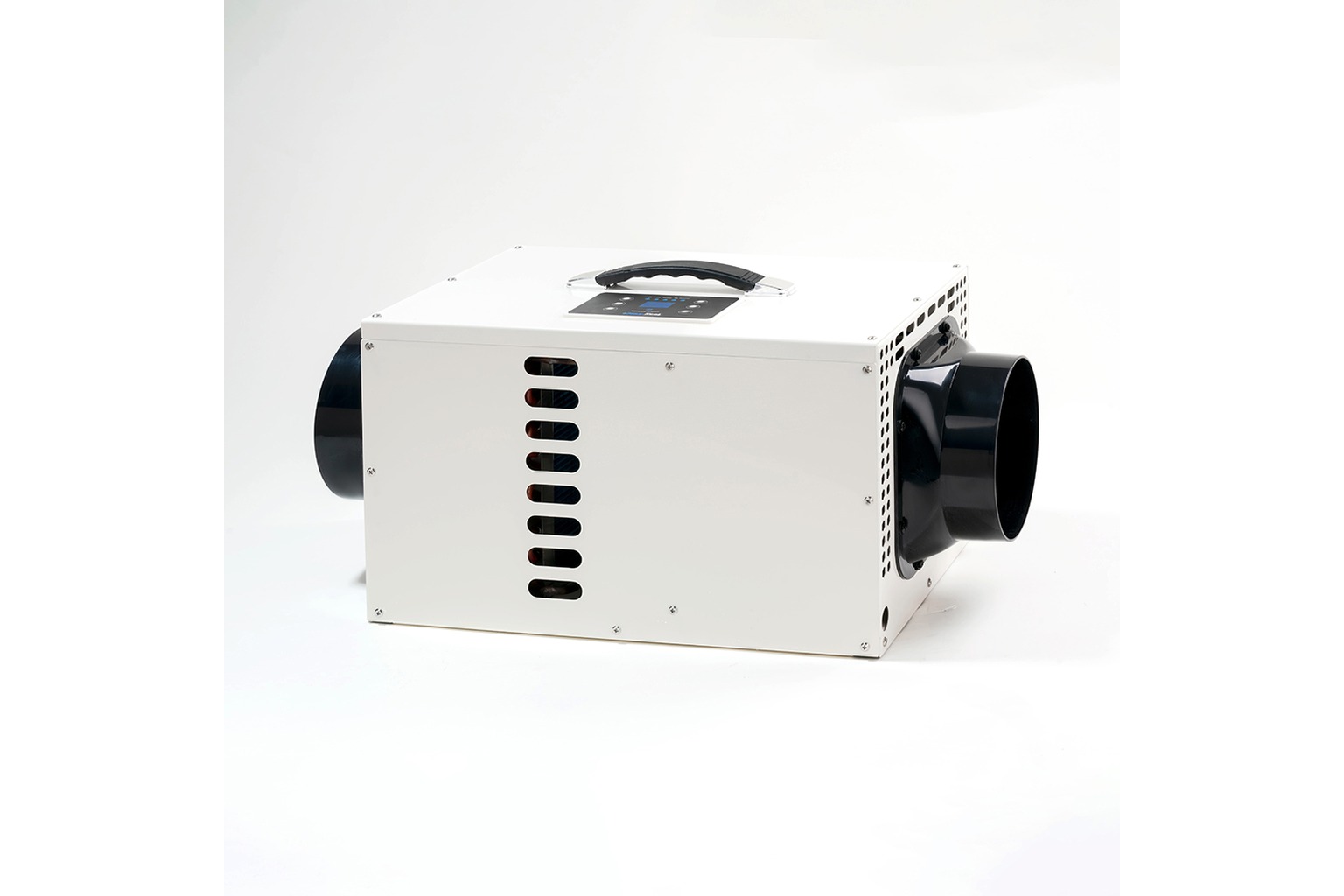
A micro DC air conditioner uses the same vapor-compression refrigeration technology as your home AC, miniaturized to run on 12V or 24V battery power. It circulates refrigerant through a compressor, condenser, expansion device, and evaporator — creating genuinely cold air, not just moving existing air around.
The system has two parts:
- Evaporator unit (inside the crate/vehicle): Blows cold air into the enclosed space. This is where heat is absorbed from the air.
- Condenser unit (outside or in a ventilated area): Rejects heat to the outside. This must have access to fresh air to work properly.
Connected by small refrigerant lines (pre-charged, no special tools needed), the system cools the crate interior to a set temperature and maintains it automatically. The variable-speed BLDC compressor adjusts its output based on how much cooling is needed — running fast during initial cooldown and slowing to a quiet hum once the target temperature is reached.
What Size Unit Do You Need?
The cooling requirement depends on the enclosure size, insulation quality, and ambient conditions:
Single Dog Crate (Large — 42″ to 48″)
Interior volume: approximately 0.3-0.5 cubic meters. With a vehicle providing some insulation, a 450W (1,535 BTU) unit like the RIGID DV1910E-AC provides substantial overcapacity. This is ideal — the unit runs at low speed most of the time, consuming minimal power and producing minimal noise. Even in extreme heat (40°C+), the unit maintains comfortable temperatures easily.
Vehicle Cargo Area with Multiple Crates
An SUV cargo area or van section with 2-4 dog crates represents 1-3 cubic meters of space. A 700W (2,387 BTU) DV2820E-AC handles this comfortably. For large K-9 transport vehicles with poor insulation or extreme climate conditions, the 900W DV3820E-AC provides maximum capacity.
Outdoor Kennel or Run
An enclosed outdoor kennel (covered, with walls) of 2-4 square meters floor area needs 700-900W depending on insulation and sun exposure. Open-air kennels cannot be effectively air conditioned — the cooling escapes immediately. The space must be reasonably enclosed for AC to work.
Quick Sizing Guide
| Application | Recommended Unit | Runtime on 100Ah 12V LiFePO4 |
|---|---|---|
| Single large crate in vehicle | DV1910E-AC (450W, 12V) | 8-14 hours |
| 2-3 crates in SUV cargo | DV2820E-AC (700W, 24V) | 6-10 hours (24V 100Ah) |
| K-9 transport van | DV3820E-AC (900W, 24V) | 5-8 hours (24V 100Ah) |
| Enclosed outdoor kennel | DV2820E-AC or DV3820E-AC | Varies with insulation |

Power Options: How to Keep It Running
Vehicle Electrical System (Engine Running)
The simplest setup. Connect the unit to the vehicle’s 12V or 24V system. While the engine runs, the alternator provides continuous power. Unlimited runtime. This works for driving and for situations where you can leave the engine idling — though idling has its own fuel cost and is prohibited in many areas.
Auxiliary Battery (Engine Off)
For situations where the vehicle is parked and the engine is off, a dedicated auxiliary battery powers the AC independently. A battery isolator prevents the AC from draining the vehicle’s starting battery. This is the most common professional setup for K-9 units and animal transport.
LiFePO4 batteries are the preferred choice: lighter than lead-acid, tolerant of deep discharge, and provide stable voltage throughout their discharge cycle. A 12V 100Ah LiFePO4 battery weighs about 12 kg and provides 8-14 hours of runtime for a 450W unit cooling a single crate.
Solar Panel Supplement
A 200W solar panel on the vehicle roof extends battery life significantly during daylight hours. In sunny conditions, 200W of solar can provide 30-50% of the AC’s average power consumption, effectively doubling battery runtime during the day. For all-day outdoor events (dog shows, field trials, training days), solar supplementation makes the system practical without a generator.
Safety Features to Look For
Temperature Monitoring and Alarm
The most critical safety feature. A temperature sensor inside the crate should trigger an alarm (audible, visual, or transmitted to your phone) if the temperature rises above a safe threshold — typically 27°C (80°F) for dogs. This alerts you to system failures, power loss, or conditions exceeding the AC’s capacity before your dog is in danger.
Low Battery Protection
The system should shut down gracefully (not abruptly) when battery voltage drops to a minimum safe level, and trigger an alert. Abrupt shutdown followed by rapid temperature rise is more dangerous than a gradual alert that gives you time to respond.
Redundant Airflow
Even if the compressor fails, a fan-only mode continues circulating air through the crate. This does not provide cooling, but maintains airflow that helps dogs self-regulate through panting. Some systems have a backup fan that activates automatically on compressor failure.
Automatic Restart After Power Interruption
If power is briefly interrupted (loose connection, vehicle starting), the system should automatically restart and resume cooling without manual intervention. You may not be present to notice and manually restart the system.
Installation Guide
In-Vehicle Setup
- Mount the evaporator unit where cold air can reach the crate. This can be inside the crate (if space allows) or aimed at the crate opening. Ensure the dog cannot contact the evaporator directly — it gets cold enough to cause discomfort on direct contact.
- Mount the condenser unit outside the vehicle or in a ventilated area. The condenser rejects heat and needs fresh airflow to function. Mounting under the vehicle, on a roof rack, or through a partially open window/hatch are common approaches. Never seal the condenser inside the vehicle — it will recirculate heat and the system will fail.
- Connect refrigerant lines between evaporator and condenser. Pre-charged quick-connect fittings make this tool-free on most RIGID units.
- Wire to power source. Use appropriately sized wire (check the unit’s current draw specifications) with an inline fuse at the battery terminal. For 12V systems drawing 20-40A, use 6-8 AWG wire for runs under 3 meters.
- Test before trusting. Run the system for 30 minutes in the hottest conditions you expect and verify that the crate interior reaches and maintains a safe temperature. Do not trust the system with your dog until you have verified performance.
Temperature Danger Zones: Why Cooling Matters for Dogs
Understanding canine heat physiology helps you appreciate why active cooling — not just ventilation — is essential:
How Dogs Regulate Temperature
Dogs do not have sweat glands across their body like humans. Their primary cooling mechanisms are panting (evaporating moisture from the tongue and respiratory tract) and limited sweating through paw pads. Panting works when the ambient air is cooler than the dog’s body temperature and has low enough humidity for moisture to evaporate. In a sealed vehicle at 50°C with rising humidity from the dog’s own panting, both mechanisms fail completely. The dog’s core temperature rises with no way to stop it.
Breed Vulnerability
Brachycephalic breeds (flat-faced dogs: bulldogs, pugs, Boston terriers, boxers, shih tzus) are at dramatically higher risk because their shortened airways make panting less efficient. These breeds can overheat even at temperatures that other dogs tolerate. Double-coated breeds (huskies, malamutes, samoyeds) are also at elevated risk because their insulating coat retains heat. Large, heavy dogs generate more metabolic heat and take longer to cool down. For these breeds, active cooling is not just advisable — it can be the difference between a routine car ride and a veterinary emergency.
Signs of Overheating
Excessive panting, drooling, bright red tongue and gums, restlessness followed by lethargy, vomiting, and staggering are progressive signs of heat distress. By the time a dog shows lethargy or staggering, organ damage may already be occurring. Prevention — maintaining safe ambient temperature with active cooling — is far more effective and humane than treating heatstroke after it starts.
Common Mistakes to Avoid
- Sealing the condenser inside the vehicle. The condenser must reject heat to the outside. If it is sealed inside, it heats the vehicle interior, which heats the crate, which makes the AC work harder, creating a spiral that ends in system failure and a dangerously hot crate.
- Undersizing the battery. A battery that lasts “4 hours” in ideal conditions may last only 2 hours on a hot day with the AC running at full capacity. Size for worst-case conditions, not average.
- No backup monitoring. Technology fails. A temperature monitor with remote alerting (Bluetooth or cellular to your phone) provides a safety net. Some K-9 units use dedicated vehicle monitoring systems that call dispatch if crate temperature exceeds thresholds.
- Using fans instead of AC. Fans do not cool air — they move it. In a sealed vehicle at 50°C, a fan blows 50°C air. Your dog is still in danger. Only a vapor-compression air conditioner actually removes heat from the space.
- Relying on cracked windows. Cracked windows reduce peak temperature by only 2-5°C. A vehicle at 30°C ambient still reaches 45°C+ with windows cracked. This is not safe for dogs.
Who Uses Dog Crate Air Conditioners?
Law Enforcement K-9 Units
Police dogs spend hours in vehicles during shifts. Many departments now mandate vehicle cooling systems for K-9 units after high-profile deaths. The micro DC AC provides reliable cooling without idling the patrol vehicle — saving fuel and reducing emissions while protecting the animal.
Search and Rescue Teams
SAR dogs travel to deployment locations in vehicles, often in remote areas without shade or facilities. A battery-powered crate AC keeps the dog in peak condition during transport and standby.
Professional Dog Transport
Pet transport services move animals across cities and states. Temperature-controlled transport is increasingly required by regulations and customer expectations. A micro DC AC in each crate compartment provides individual temperature control.
Dog Show and Competition Participants
Dogs at outdoor shows and competitions spend hours in crates between events. Summer shows in particular can be dangerous without cooling. A battery-powered crate AC with solar supplement runs all day at an outdoor venue.
Everyday Pet Owners
Anyone who travels with their dog and may need to leave them in the vehicle briefly — veterinary appointments, errands, road trips — benefits from knowing their pet has active cooling, not just cracked windows and hope.
Frequently Asked Questions
Is a dog crate air conditioner safe to leave running unattended?
With proper installation and monitoring, yes. The system runs automatically and maintains temperature without intervention. However, always use a temperature monitoring system with remote alerts so you are notified immediately if something goes wrong. No mechanical system is 100% reliable — monitoring provides the safety net.
How loud is it? Will it stress my dog?
BLDC variable-speed units at low speed (maintenance mode) produce a gentle hum — comparable to a quiet fan. Most dogs acclimate within minutes. The noise is far less stressful than the panting and anxiety that come from overheating. During initial cooldown at full speed, the unit is louder but still quieter than vehicle engine noise.
Can I use it for cats or other pets?
Absolutely. The cooling system does not care what species is inside the enclosure. Cats, rabbits, birds, and reptiles all benefit from temperature-controlled transport. Adjust the target temperature to your pet’s species-appropriate comfort range.
Bottom Line
A dog crate air conditioner is the only reliable way to keep a pet safe in a vehicle or enclosed crate during hot weather. Fans do not cool air. Cracked windows are not enough. Ice melts. A micro DC air conditioner — powered by the vehicle’s electrical system or an auxiliary battery — maintains a safe, controlled temperature for hours. For professional animal handlers, it is standard equipment. For any pet owner who travels with their dog in warm climates, it is the difference between safety and risk.