
Electric Tractor Cooling Starts with a Simple Question: Where Does the Power Come From?
Every tractor operator who has run a belt-driven air conditioner through a full day of field work knows the feeling. The engine bogs slightly when the compressor clutch engages. The PTO slows for a moment during heavy drafting. On a 60-horsepower compact tractor pulling a rotary cutter through thick growth, the 3–5 HP consumed by a belt-driven AC compressor is not a rounding error — it is a measurable reduction in implement performance that shows up as slower ground speed, more frequent downshifting, and increased fuel consumption.
For decades, this was the only option. If you wanted cab cooling on a tractor, the compressor bolted to the engine block, drove off a belt, and taxed the same power plant that was supposed to be turning the wheels and the PTO. On large row-crop tractors with 200+ HP, the penalty was negligible. On compact and utility tractors in the 25–80 HP range — the machines that dominate small farms, orchards, vineyards, municipal grounds crews, and livestock operations — the AC compressor load is a real engineering constraint, not an inconvenience.
The emergence of battery-powered DC air conditioning changes this equation entirely. A DC system draws power from the tractor’s electrical system — the battery — rather than from the engine’s mechanical output. The engine delivers every available horsepower to the drivetrain and PTO, while the cab stays cool on electrical power that the alternator replenishes in the background. This is what electric tractor cooling actually means in practice: decoupling thermal comfort from mechanical performance.
The Real Cost of Belt-Driven AC on Agricultural Tractors
The horsepower penalty is the headline, but the full cost of a traditional belt-driven AC system on a tractor extends further than most operators realize.
Mechanical Complexity
A belt-driven system requires a compressor mounted to the engine block, a tensioner pulley, a magnetic clutch, belt routing that avoids interference with other accessories, and refrigerant hoses that must accommodate engine movement on its mounts. Every component in this chain is a maintenance item. Belts wear and need replacement. Clutch bearings fail. Tensioner springs fatigue. The compressor itself — spinning at engine RPM whether the cab needs cooling or not (when the clutch is engaged) — accumulates wear hours tied to engine hours, not cooling demand.
On older tractors where the AC was a factory option that has aged, these components often reach end-of-life simultaneously. The repair quote for a full belt-driven AC overhaul — compressor, clutch, condenser, receiver-drier, expansion valve, and labor — can approach or exceed the cost of a complete DC replacement system.
Installation Constraints on Retrofit
Many compact and utility tractors were not equipped with factory AC. Adding a belt-driven system after the fact means finding physical space on the engine for a compressor bracket, routing a belt through an engine bay that was not designed for it, and locating a condenser where airflow is adequate but interference with the radiator and oil cooler is avoided. On tractors below 50 HP, there is often no practical way to add a belt-driven compressor without custom fabrication that compromises access to other engine components.
Fuel Consumption
The AC compressor load translates directly to additional fuel consumption. A belt-driven compressor drawing 3–4 HP continuously during a 10-hour field day at partial throttle adds measurable fuel cost over a season. For operations running multiple tractors with AC, the aggregate fuel penalty is a real line item — one that disappears entirely when the cooling system runs on electrical power from the battery rather than mechanical power from the crankshaft.
How DC Air Conditioning Decouples Cooling from the Engine
A DC air conditioning system uses an electrically driven compressor that connects to the tractor’s battery circuit — typically 12V or 24V on conventional tractors, or 48V and higher on newer electric and hybrid platforms. The compressor motor is controlled by an electronic inverter that adjusts speed based on cooling demand, rather than spinning at a fixed ratio to engine RPM.
This architecture produces several practical advantages for agricultural applications:
- Zero mechanical parasitic load on the engine. Every horsepower stays available for the drivetrain, PTO, and hydraulics. The operator does not choose between comfort and implement performance.
- The compressor runs only when cooling is needed and at the speed required to maintain setpoint — not at engine RPM. This variable-speed operation is inherently more efficient and quieter than a fixed-displacement belt-driven compressor.
- The system can cool the cab before the operator arrives (pre-cooling on battery power) and continue cooling during engine-off lunch breaks or fueling stops — functions that are impossible with a belt-driven system.
- Installation does not require any modification to the engine block, belt routing, or mechanical accessories. The compressor mounts remotely — on the cab structure, frame, or fender area — and connects to the battery with electrical wire, not a belt.
Electrical Budget: Can the Tractor Battery Handle It?
This is the most common objection to DC air conditioning on tractors, and it deserves a direct answer. The concern is valid — a DC AC system draws significant current, and tractor electrical systems were not originally designed with cab cooling in mind.
Understanding the Power Draw
A DC air conditioning system rated at 2,300 W (7,843 BTU) — a capacity that covers most enclosed tractor cabs in ambient temperatures up to 40–45 °C — draws approximately 96 amps at 24V or 48 amps at 48V during full-load operation. In practice, the compressor does not run at full load continuously. Once the cab reaches setpoint, the variable-speed compressor throttles back, and the average power draw drops substantially — often to 40–60% of rated capacity during steady-state operation in moderate conditions.
Alternator Capacity
Most modern tractors in the 40+ HP range are equipped with alternators rated at 60–120 amps (at 12V) or 40–70 amps (at 24V). At engine operating RPM, the alternator can typically sustain the AC system’s average draw while maintaining battery charge for lights, ignition, instrumentation, and control electronics. The key is to verify the alternator’s output at the RPM range where the tractor spends most of its operating time — not just the peak rating at maximum RPM.
Voltage Flexibility Matters
Tractors operate across a range of electrical system voltages depending on make, model, and era. Conventional diesel tractors typically run 12V or 24V. Newer electric and hybrid tractors may operate at 48V, 60V, or higher. A DC air conditioning system that accepts multiple input voltages — 24V, 48V, 60V, 72V — can be deployed across a mixed fleet without requiring different units or voltage converters for each machine. This is particularly relevant for farm operations and municipal fleets that run equipment from multiple manufacturers and generations.
Split-Type vs. Monoblock: Which Architecture Fits the Tractor?
Aftermarket tractor AC solutions fall into two main form factors, each with trade-offs that matter in agricultural use.
Rooftop Monoblock Units
These place the compressor, condenser, and evaporator in a single housing on the cab roof. Installation is relatively simple — cut a roof opening, mount the unit, wire it up. The appeal for tractors is clear: no condenser to mount separately, no refrigerant lines to route, and a single-point installation. However, the monoblock approach adds all weight to the cab roof (raising the center of gravity on a machine that often works on slopes), restricts headroom inside the cab, and places the condenser in a location where grain chaff, dust, pollen, and crop debris accumulate rapidly — requiring very frequent cleaning to maintain cooling performance.
Split-Type Systems
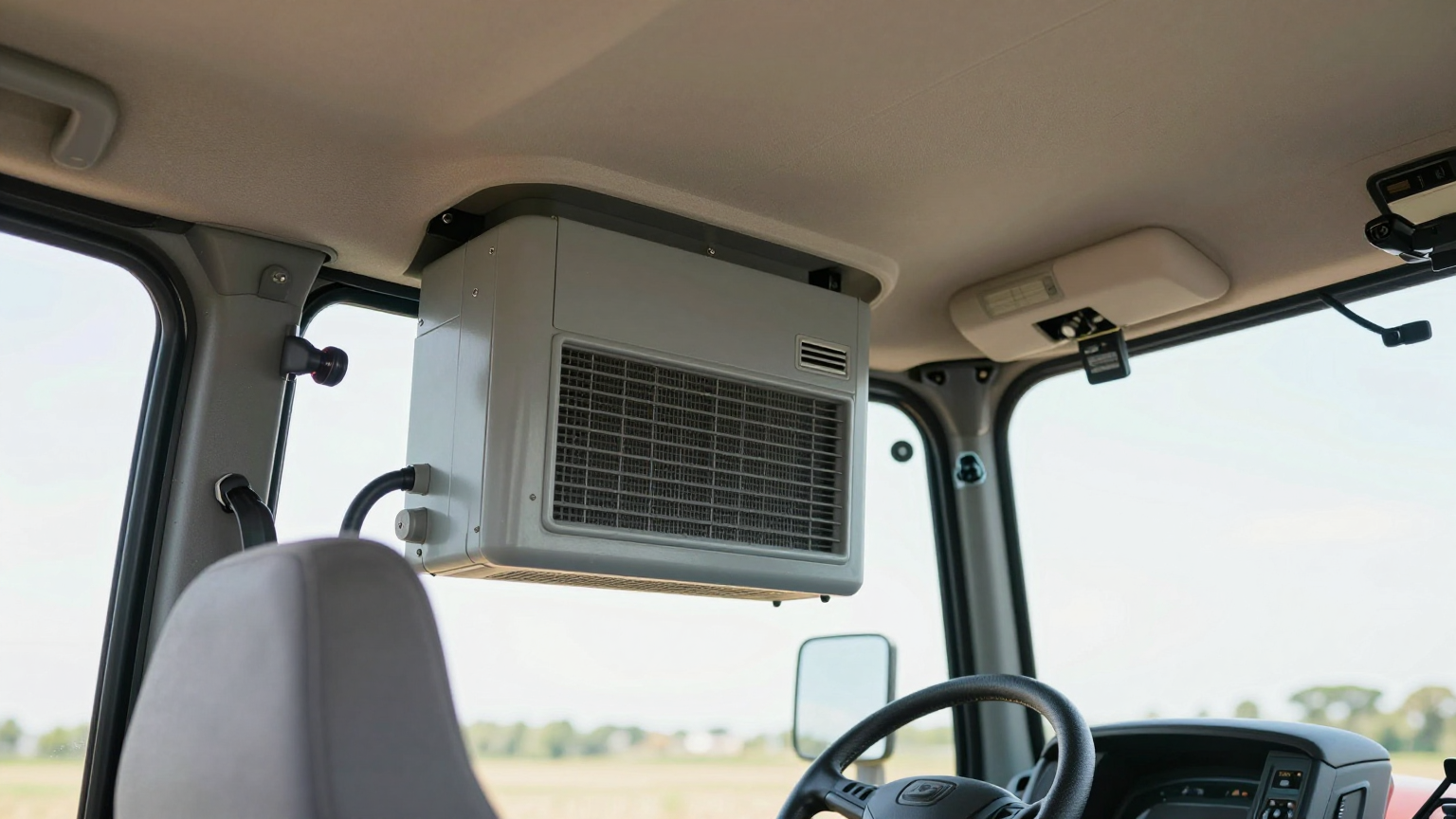
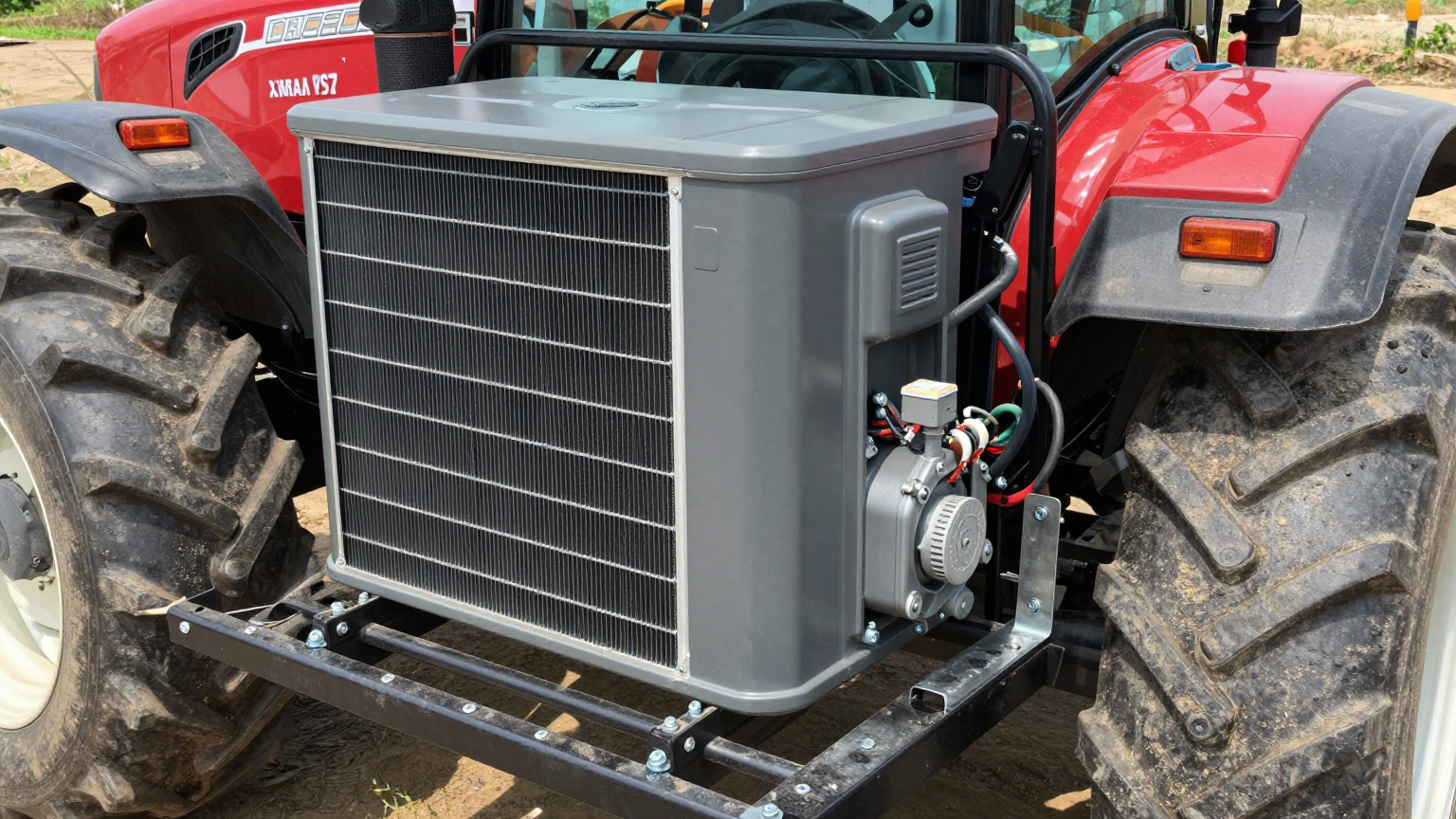
A split-type system separates the evaporator (mounted inside the cab at the headliner or a side panel) from the condenser and compressor (mounted externally on the machine frame, fender, or rear structure). The indoor unit is compact — dimensions in the range of 440 × 140 × 320 mm allow it to fit within the cab ceiling zone without reducing headroom. The condenser (typically 600 × 250 × 430 mm) mounts where airflow is accessible and cleaning is easy, and the total system weight of approximately 48 kg is distributed between two mounting points rather than concentrated on the cab roof.
For tractors that work on hillsides, in orchards with low-clearance canopy, or in applications where cab height is constrained, the split-type architecture avoids the center-of-gravity and clearance penalties of a rooftop unit. The trade-off is a more involved installation that requires routing refrigerant lines between the indoor and outdoor units. Pre-charged systems with R134a refrigerant and factory-sealed connections minimize this complexity — no field evacuation or charging equipment needed.

Agricultural-Specific Installation Considerations
Tractor installations share some challenges with other heavy equipment (vibration, dust) but also present unique constraints that other mobile AC applications do not face.
Crop Debris and Organic Particulates
Agricultural dust is not the same as construction dust. It includes grain chaff, pollen, cotton lint, hay fibers, and organic matter that is sticky, hygroscopic, and biologically active. This material adheres to condenser fins more tenaciously than mineral dust and supports mold growth when combined with moisture. Condenser fin spacing, material, and coating all affect how quickly the coil fouls and how effectively it can be cleaned. A blowdown with compressed air — effective for mineral dust — may not fully clear organic accumulation; periodic washing with water may be necessary.
Chemical Exposure
Tractors used for spraying operations expose the AC system’s external components to agricultural chemicals — herbicides, pesticides, fertilizers, and adjuvants. Some of these chemicals are corrosive to aluminum condenser fins and copper refrigerant tubing. The condenser location should be chosen to minimize direct chemical exposure, and post-spray washdown of the external unit should be part of the operating procedure.
Cab Sealing in Spray Operations
Many modern enclosed tractor cabs are designed as pressurized enclosures to protect the operator from chemical exposure during spray operations. The AC system must integrate with the cab’s pressurization system, drawing air through the cab’s charcoal filter rather than introducing unfiltered outside air. Any AC installation that compromises cab seal integrity — roof penetrations, poorly sealed refrigerant line pass-throughs — can defeat the cab’s chemical protection function, creating a safety hazard far more serious than operator discomfort.
Seasonal Use Pattern
Unlike over-the-road trucks that run year-round, many agricultural tractors have heavy seasonal use patterns — running daily during planting, spraying, and harvest seasons, then sitting idle for weeks or months. AC systems that sit dormant for extended periods can develop compressor seal hardening, refrigerant migration, and condenser corrosion. Running the system briefly during off-season storage periods helps maintain seal lubrication and identify issues before the next season’s demand.
Decision Framework: When Does DC Cooling Make Sense?
| Scenario | Belt-Driven AC | DC Battery-Powered AC |
|---|---|---|
| Large tractor (150+ HP) with factory AC | Maintain existing system; HP penalty negligible | Consider only if factory system is end-of-life |
| Compact tractor (25–60 HP) without factory AC | Difficult retrofit; HP penalty significant | Strong candidate — no engine modification needed |
| Electric or hybrid tractor | Not applicable — no engine belt to drive | Only viable option; matches DC architecture |
| Older tractor with failed factory AC | Full rebuild may cost as much as DC replacement | Clean-sheet installation avoids aging components |
| Mixed fleet with multiple voltages | Each machine needs model-specific parts | Multi-voltage DC unit deploys across fleet |
The strongest case for DC air conditioning is on compact and utility tractors where engine horsepower is a limited resource, and on electric tractors where belt-driven AC is simply not an option. For large conventional tractors with working factory AC, the conversion may not be justified unless the existing system has failed and the rebuild cost approaches replacement cost.
Common Field Questions
Will the AC drain my tractor battery during long field days?
When the engine is running, the alternator continuously replenishes the battery. The AC system draws current from the battery, and the alternator replaces it — similar to how headlights, radios, and GPS systems operate. The key is ensuring the alternator’s sustained output at operating RPM exceeds the AC system’s average draw. For a 2,300 W system on a 24V tractor, average draw during steady-state cooling is typically 40–60 amps — within the capacity of most modern tractor alternators.
Can I use the AC with the engine off?
Yes — this is one of the primary advantages of a DC system. During lunch breaks, fueling, or while waiting for a truck at the grain cart, the system continues cooling directly from battery power. Runtime on battery alone depends on the battery’s amp-hour capacity and state of charge. On a typical 24V tractor battery bank, 30–60 minutes of engine-off cooling is generally feasible before the battery needs recharging.
Does it really save horsepower compared to belt-driven AC?
A belt-driven AC compressor typically consumes 3–5 HP when the clutch is engaged. A DC system draws that energy from the electrical system instead, and the alternator load required to replenish it is typically less than 1 HP equivalent — because the DC compressor runs at variable speed matched to actual cooling demand, rather than at full displacement tied to engine RPM. The net HP recovery is meaningful on compact tractors where total available power is limited.
What about tractors with 12V electrical systems?
A 2,300 W system at 12V would draw approximately 192 amps at full load — a substantial current that exceeds many 12V tractor alternators and requires heavy-gauge wiring. For 12V tractors, options include using a smaller-capacity DC unit with lower current draw, installing an upgraded alternator, or adding an auxiliary 24V battery bank with a voltage step-up arrangement. The 24V and higher voltage options are generally more practical for full-capacity cab cooling.
How does the system handle the heavy vibration of field work?
DC compressors designed for mobile applications — such as the SANYO DC rotary compressor — are built for vibration environments more demanding than agricultural use. The rotary design has fewer reciprocating parts than piston compressors, reducing sensitivity to multi-axis vibration. When the condenser and compressor are mounted with proper vibration isolation hardware, the system tolerates the vibration profile of tractor field operations, including rough-ground travel and PTO-driven implement loads.
Is the installation reversible if I sell the tractor?
A split-type DC system mounts with brackets and electrical connections — no engine modification, no belt routing, no holes in the engine block. The evaporator mounts inside the cab, and the condenser mounts externally. Removal involves unbolting the components and disconnecting the wiring. The system can be transferred to a different tractor, though mounting brackets may need to be refabricated for the new machine’s geometry.
Integration Support
Agricultural fleets are diverse — from 25 HP compact tractors to 400 HP articulated machines, from conventional diesel to full-electric platforms. If your tractor fleet presents voltage, space, or operational constraints that differ from the scenarios covered here, the Rigid engineering team can evaluate the specifics and work toward a cooling configuration that fits. The HS23P split-type DC air conditioner provides the multi-voltage input, compact split-type form factor, and pre-charged refrigerant circuit that address the core challenges of agricultural cab cooling without taxing the engine.
The tractor cab does not have to be an oven during planting season. The question is no longer whether cab cooling is possible on compact equipment — it is whether the cooling system takes its power from the engine or the battery. For most agricultural operations running equipment under 80 HP, the answer is increasingly clear: let the engine do its job, and let the battery handle the comfort.