
EV Battery Cooling DC Air Conditioner: Solving the Battery Box Heat Challenge
Battery enclosures — the physical boxes that house lithium cells in electric vehicles, energy storage systems, and telecom backup installations — face a persistent engineering problem. The cells inside generate heat during charge and discharge cycles, and that heat accumulates within a sealed or semi-sealed metal or composite enclosure. Without adequate thermal management at the enclosure level, cell temperatures climb beyond safe operating windows, accelerating degradation and reducing usable capacity over time.
This article focuses specifically on cooling the battery box itself — the physical enclosure where cells reside — rather than the broader topic of EV thermal management systems. For system integrators, battery pack designers, and fleet electrification managers working with small-to-medium battery packs, understanding how to maintain thermal control within the enclosure is critical to delivering reliable, long-lasting products.
Why Battery Boxes Trap Heat
A battery box is designed primarily for mechanical protection, ingress prevention (IP65/IP67 ratings are common), and electrical isolation. These design priorities create an inherent conflict with thermal management. Sealed enclosures restrict natural convection. Metal housings conduct ambient heat inward during hot weather. Internal cell arrangements create localized hot spots where airflow cannot reach.
The thermal challenge intensifies with energy density. As pack designers fit more cells into smaller enclosures to meet space constraints in EV auxiliary systems or compact ESS modules, the watts of heat generated per cubic meter of enclosure volume increases. A 5 kWh battery module in a 40-liter enclosure might generate 50-150W of waste heat during sustained discharge — enough to raise internal temperatures by several degrees per hour in a sealed box with no active cooling.
Most lithium cells begin degrading faster above 45°C (general industry knowledge), and optimal operating range for longevity is typically 20-35°C. In environments where ambient temperatures already reach 35-45°C — common in desert climates, rooftop installations, or engine compartments — the battery box needs to reject heat actively, not just passively.
Why Passive Cooling Fails at Scale
Passive cooling strategies include heat sinks, thermal interface materials, phase-change materials (PCMs), and natural convection through vented enclosures. These approaches work within limits but break down as thermal loads increase or ambient temperatures rise.
Heat sinks and thermal pads can conduct heat from cells to the enclosure walls, but they rely on a temperature differential between the wall and ambient air. When ambient temperatures approach or exceed the target cell temperature, conduction-based approaches cannot maintain the required gradient. The heat has nowhere to go.
Phase-change materials absorb heat during melting transitions, providing temporary buffering. However, they have finite capacity — once fully melted, they stop absorbing heat until they resolidify. For continuous-duty applications like fleet vehicles running multiple charge-discharge cycles daily, PCMs alone cannot sustain thermal control.
Vented enclosures sacrifice IP ratings and expose cells to dust, moisture, and contaminants. For applications requiring IP65 or higher protection — which includes most outdoor ESS installations and vehicle-mounted battery boxes — venting is not an acceptable trade-off.
The fundamental limitation of passive cooling is that it cannot pump heat against a temperature gradient. When you need the battery box interior cooler than the surrounding environment, only active cooling can deliver.
DC Aircon Advantages for Battery Enclosures
Vapor-compression air conditioning — the same thermodynamic cycle used in building HVAC — can actively pump heat from inside the battery box to the outside environment, maintaining interior temperatures below ambient. When implemented as a DC-powered micro air conditioner, this technology becomes practical for battery enclosure applications.
A micro DC air conditioner designed for enclosure cooling offers several specific advantages for battery box applications:
Direct DC operation eliminates inverter losses. Battery systems already operate on DC — 12V, 24V, or 48V depending on the architecture. A DC-native air conditioner connects directly to the battery bus or a dedicated auxiliary supply without requiring an inverter. This eliminates 10-15% conversion losses and removes a potential failure point.
Vapor compression efficiency outperforms thermoelectric cooling. Peltier/TEC modules are sometimes used for small enclosure cooling, but they deliver a coefficient of performance (COP) well below vapor compression systems. In practical terms, a micro DC aircon provides an estimated 3-5x more cooling per watt of input power compared to thermoelectric alternatives. For battery-powered systems where every watt counts, this efficiency gap is significant.
Compact form factor suits enclosure mounting. At approximately 11 lbs (5 kg), micro DC aircon units are sized to mount directly on or within battery enclosures. The evaporator section fits inside the enclosure to cool internal air, while the condenser section mounts externally to reject heat. This split arrangement maintains enclosure sealing while providing active cooling.
Variable-speed BLDC compressor matches load. A brushless DC compressor with variable speed control adjusts cooling output to match actual thermal load. During light-load periods, the compressor slows down, reducing power consumption. During peak discharge when cells generate maximum heat, it ramps up. This modulation prevents overcooling and minimizes energy consumption.
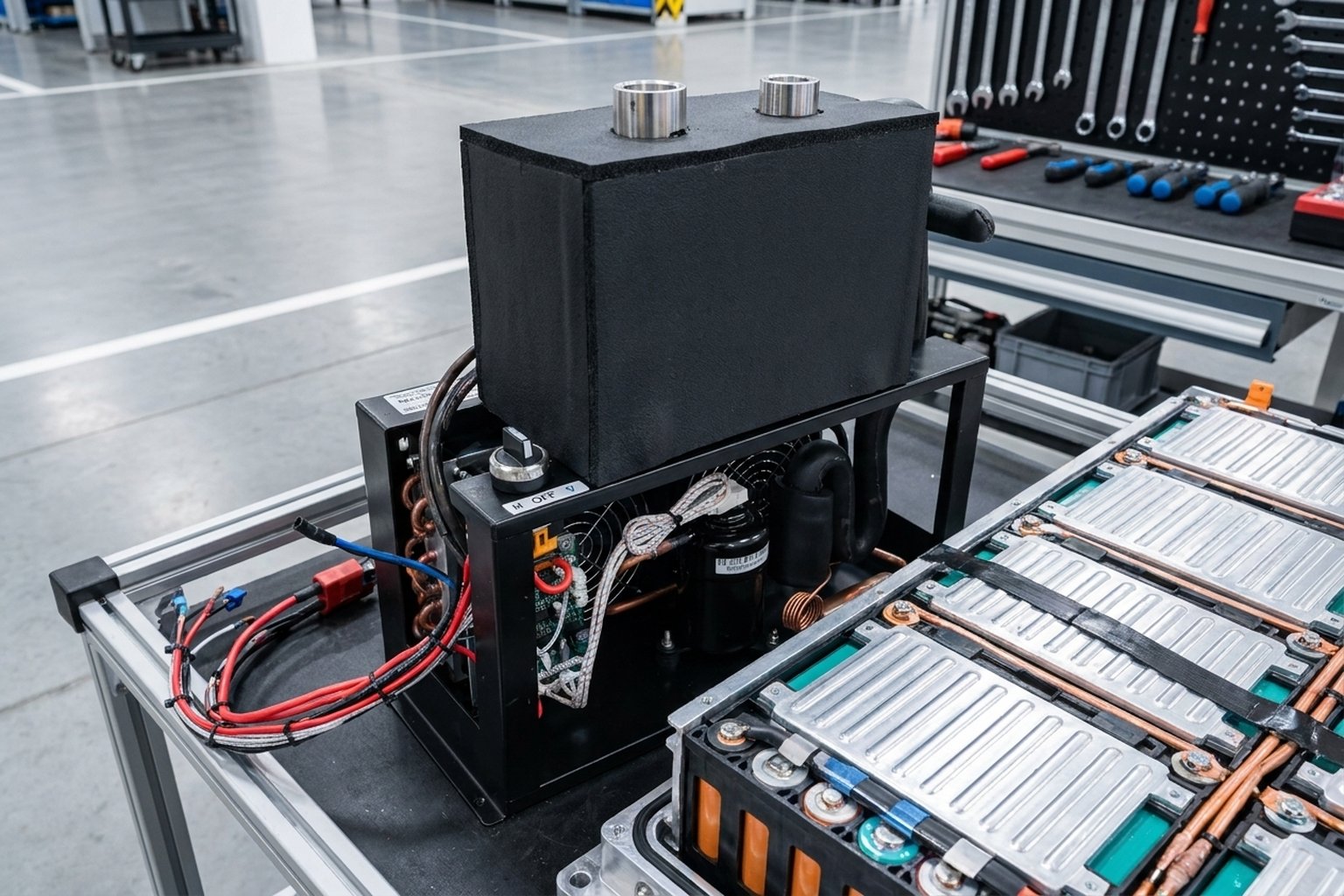
Sizing for Common Battery Box Volumes
Selecting the right cooling capacity for a battery enclosure depends on several factors: enclosure volume, cell heat generation rate, ambient temperature range, target internal temperature, and insulation quality. While precise sizing requires thermal modeling for each specific application, general guidelines help narrow the selection.
The micro DC aircon range offers cooling capacities from 450W up to 900W (approximately 1535-3069 BTU/h):
- 450W cooling capacity (models DV1910E-AC at 12V, DV1920E-AC at 24V, DV1930E-AC at 48V) — suitable for smaller enclosures with moderate heat loads, such as EV auxiliary battery boxes in the 2-5 kWh range or telecom backup modules with intermittent discharge patterns.
- 550W cooling capacity (model DV3220E-AC at 24V) — a mid-range option for enclosures with slightly higher thermal loads or larger volumes requiring more airflow coverage.
- 700W cooling capacity (models DV2820E-AC at 24V, DV2820E-AC-T at 24V with R290 refrigerant) — appropriate for medium battery boxes in the 5-10 kWh range with sustained discharge cycles, or smaller enclosures in high-ambient environments.
- 900W cooling capacity (models DV3820E-AC at 24V, DV3830E-AC at 48V) — the highest capacity option for larger enclosures, high-ambient installations, or applications with continuous high-rate discharge.
As a rough estimate (not a precise formula), a useful starting point is to calculate the total heat generation of the cells at maximum sustained discharge rate, add estimated heat ingress from the environment through the enclosure walls, and select a cooling capacity that exceeds this total by a reasonable margin. Environmental heat ingress depends heavily on insulation, enclosure material, surface area, and solar exposure — factors that vary widely between applications.
The adjustable temperature setpoint range of 5°C to 30°C allows the system to target the optimal operating window for the specific cell chemistry used. Most integrators set targets between 20-30°C for standard lithium-ion chemistries.
Mounting and Airflow Considerations
Effective battery box cooling requires attention to how the cooling unit integrates with the enclosure physically and how air circulates within the sealed space.
Mounting orientation: The micro DC aircon can mount in several orientations depending on enclosure geometry. Top-mounting places the evaporator above the cells, allowing cooled air to descend naturally. Side-mounting works when vertical space is limited. The key requirement is ensuring the condenser section has adequate external airflow for heat rejection — mounting against a wall or in a confined space reduces condenser performance.
Internal air circulation: With 27.8 CFM of airflow from the evaporator, the cooled air needs a path to reach all cells within the enclosure. For simple rectangular enclosures with uniform cell arrangements, direct discharge from the evaporator may suffice. For L-shaped enclosures, multi-tier cell stacks, or enclosures with internal partitions, additional internal ducting or small circulation fans may be needed to eliminate hot spots.
Condensate management: When cooling air below its dew point, condensation forms on the evaporator. The system must drain condensate out of the enclosure without compromising IP ratings. A simple gravity drain with a check valve or P-trap maintains sealing while removing moisture — which also helps control humidity inside the enclosure, an additional benefit for cell longevity.
Vibration considerations: For vehicle-mounted battery boxes, the cooling unit must withstand road vibration and shock loads. The BLDC compressor design inherently produces less vibration than fixed-speed alternatives, but mounting hardware should include vibration isolation appropriate for the vehicle class.
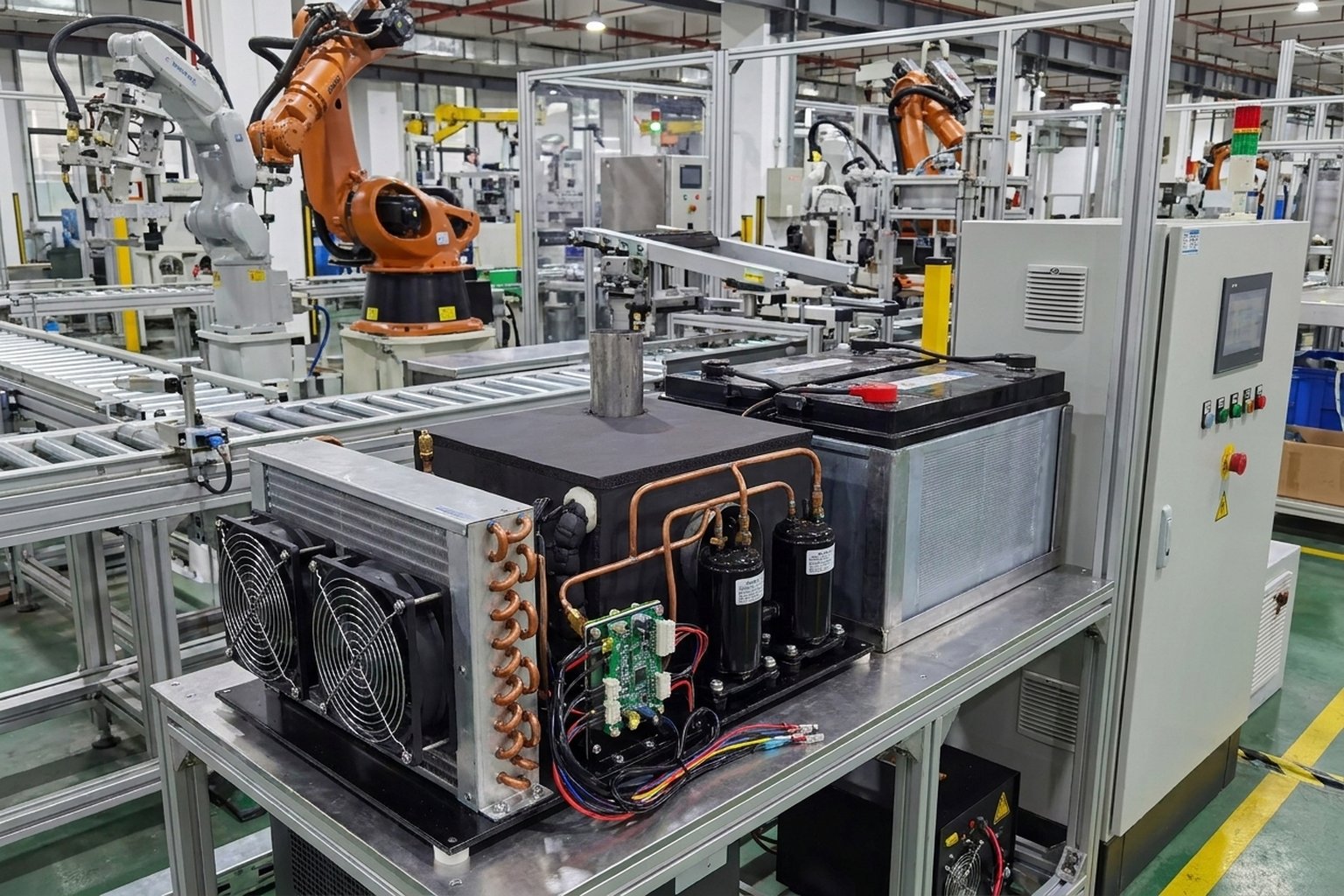
Real-World Application Scenarios
Telecom Backup Battery Enclosures
Telecom tower sites increasingly use lithium battery packs for backup power, replacing lead-acid systems. These battery enclosures sit in outdoor cabinets exposed to full sun and ambient temperatures that can exceed 45°C in tropical and desert regions. The cells must remain operational for years with minimal maintenance.
A 48V telecom battery system pairs naturally with the DV1930E-AC (48V, 450W cooling) or DV3830E-AC (48V, 900W cooling) depending on enclosure size and ambient conditions. The DC aircon draws power directly from the battery bus or solar charge system, maintaining cell temperatures within the 20-30°C window regardless of external conditions. The variable-speed compressor reduces power draw during cooler nighttime hours, conserving stored energy.
EV Auxiliary Battery Systems
Electric vehicles use auxiliary battery packs for non-traction loads: HVAC, lighting, control systems, and accessories. These auxiliary packs are often mounted in locations with limited airflow — under seats, in trunk compartments, or near heat-generating drivetrain components. Unlike the main traction battery (which typically uses liquid cooling loops), auxiliary packs are smaller and often rely on air cooling.
A 12V or 24V micro DC aircon (DV1910E-AC or DV2820E-AC) provides dedicated cooling for these auxiliary enclosures. The compact size and light weight (approximately 5 kg) allow integration without significant impact on vehicle packaging. For fleet vehicles operating in hot climates with continuous duty cycles, active cooling of auxiliary battery boxes extends pack life and maintains consistent performance.
It is important to note that micro DC aircon units are suitable for these small-to-medium auxiliary applications. Large-format automotive traction battery packs — the main drive batteries in passenger EVs and commercial vehicles — require liquid cooling loops with significantly higher cooling capacity and are outside the scope of this solution.
Solar ESS Modules
Residential and commercial solar energy storage systems use battery modules in outdoor or garage-mounted enclosures. These installations face seasonal temperature extremes and daily cycling patterns that stress cells thermally. A 24V system with the DV2820E-AC (700W cooling) or DV3820E-AC (900W cooling) maintains optimal cell temperatures through summer peaks and high-rate discharge periods.
The R290 (low-GWP) refrigerant option available in the DV2820E-AC-T model addresses environmental regulations increasingly relevant to ESS installations, particularly in European and Australian markets where F-gas regulations restrict high-GWP refrigerants. For residential installations where the battery enclosure sits in a garage or utility room, the cooling system also reduces the risk of elevated temperatures triggering safety disconnects during peak afternoon solar export periods — precisely when the system should be charging at maximum rate.
Compliance and Standards Considerations
Battery enclosure thermal management intersects with several regulatory frameworks. Standards such as UN38.3 (transport safety), IEC 62619 (secondary lithium cells for industrial applications), and UL 9540A (energy storage system safety) include requirements or recommendations related to thermal management and temperature control. Requirements vary by jurisdiction and application — integrators should verify which standards apply to their specific use case and market.
Active cooling systems that maintain cells within specified temperature ranges support compliance with these standards by preventing thermal excursions that could trigger safety mechanisms or accelerate degradation beyond acceptable limits. Documentation of thermal management capability — including cooling capacity specifications, temperature control range, and response time — is often required as part of the safety case submitted for certification. Having a defined, measurable cooling system simplifies this documentation compared to passive approaches where thermal performance depends heavily on installation conditions.
Integration and Support
For system integrators evaluating micro DC aircon for battery box applications, RIGID provides technical support for thermal sizing, mounting configuration, and control integration. The engineering team can assist with matching cooling capacity to specific enclosure geometries and thermal loads, as well as integrating temperature control with existing battery management systems (BMS).
Selecting the right thermal management approach for your battery enclosure depends on the specific combination of cell chemistry, enclosure design, duty cycle, and environmental conditions. The micro DC aircon platform offers a proven vapor-compression solution that scales from 450W to 900W cooling capacity across 12V, 24V, and 48V DC systems — covering the range of small-to-medium battery box applications where active cooling delivers measurable improvements in cell longevity and system reliability.